Tuesday, September 4, 2018

Screwed workers pushing Americans left. Kavanaugh + other Banana Republicans want to make it worse

With the absurdity of today’s Supreme Court hearing, due to GOPs try to ram through Brett Kavanaugh’s nomination without letting people know about Kav's legal career and judicial leanings, the great Charlie Pierce reminds us that there is plenty we already know about Kavanaugh. And a lot of it isn’t good.

Over the weekend, Pierce focused in on Kavanaugh’s thoughts relating to labor rights, and in typical 21st Century GOP fashion, they seemed to be based out of the thinking of the 19th Century.
Much of the attention— rightly—will be drawn to Kavanaugh's dreadful history on reproductive rights, as well as to whatever is stashed away in the 100,000 documents that the administration* is keeping buried regarding what Kavanaugh did during the torture years under President George W. Bush. But it shouldn't be overlooked that his record on labor issues is every bit as retrograde as any other part of his Federalist Society bona fides. From Mother Jones:
Kavanaugh joined two other Republican-appointed judges in a unanimous 2012 ruling in favor of the Trump Organization, after company executives asked the NLRB to throw out the results of a union election at Trump Plaza, arguing that support from politicians had introduced bias. As a July Bloomberg article points out, in 2015 Kavanaugh sided with the management of Sheldon Adelson’s Venetian Casino Resort in a similar case, authoring a majority opinion upholding the casino’s First Amendment right to summon police to issue citations to union protesters trespassing on company property

One of Kavanaugh’s most high-profile dissents of NLRB authority was in a 2014 case against SeaWorld’s Florida theme park involving events depicted in the documentary Blackfish. When a killer-whale trainer died during a live show in 2010—the second death at the location—the Occupational Safety and Health Administration (OSHA) launched an investigation that found the theme park had willfully endangered its employees. The DC Circuit upheld the decision of a Department of Labor administrative judge, who ruled the theme park had violated OSHA guidelines and imposed a $7,000 fine. In his dissent, Kavanaugh said OSHA was uncharacteristically trying to “stretch its general authority.” He said the SeaWorld employees’ position was no different than any other occupation where workers consent to put themselves in danger, comparing their work to tiger taming and football.

“When should we as a society paternalistically decide that the participants in these sports and entertainment activities must be protected from themselves—that the risk of significant physical injury is simply too great even for eager and willing participants?” he asked, calling the “physical risk…among the greatest forms of personal achievement for many who take part in these activities.” …
From 1897 until approximately 1937—the end date is a matter of some dispute—the court's relation to labor was defined by the horrendous decision in Lochner v. New York. Citing "freedom of contract" as a constitutional right, the decision was used through the decade to strike down all manner of regulations touching on business large and small. (Lochner itself was about working conditions in bakeries.) Unions, of course, came along with the deal. In Adair v. United States, the Court struck down a law that would have made it illegal for a company to fire employees for trying to organize.
If we go back to that mentality at SCOTUS, it's going in the opposite direction that the country is going, as Americans increasingly reawaken to the fact that corporations aren’t going to give the 99% of us anything unless it is demanded and taken from them, a GOP government that received well less than half of the votes of its citizens is installing laws all around America that are designed to make that inequality even worse.


Just look at these Koched-up jagbags.

With that in mind, let me point you to Harold Meyerson’s Labor Day column in the LA Times. In this column, Meyerson notes that Americans understand that the product of their labor is increasingly only helping the fat cats in the board rooms, and that people in real jobs are not getting the rewards of their work.
…In 2011, the chief investment officer of JP Morgan Chase calculated that three-quarters of the long-term increase in U.S. companies’ profit margins was due to the declining share going to wages and benefits. A study last year by Simcha Barkai, an economist at the University of Chicago’s Stigler Center, found that labor’s share of the national income has dropped by 6.7% since the mid-1980s, while the share of the nation’s income going to business investment in equipment, research, new hires and the like has dropped by 7.2%. Correspondingly, the share of the nation’s income going to shareholders (the lion’s share to the very wealthy, among them the CEOs who are compensated with shares) rose by 13.5%. That shift has put American workers at a double disadvantage, as their wages and the private-sector investment that creates jobs and boosts productivity have both hit the skids.

Like slowly simmering frogs, Americans have required some time to grasp just how dire their situation has become. On Labor Day 2018, however, it’s clear that most of them now realize the need to reshuffle the power structure. A Gallup Poll released on Friday showed support for unions at 62%, the highest level in 15 years, with majority backing from every demographic group except Republicans, and even they are evenly split, 45% to 47%.

The overwhelming public support for striking teachers this spring in such red states as West Virginia, Oklahoma and Arizona was no fluke; another recent poll, this from the venerable education pollster PDK, found 73% support for teachers’ strikes, and a remarkable 78% support from parents of school-age children. The two-to-one rejection of a right-to-work law this summer by Missouri voters is further evidence of a pro-labor shift in public opinion, as are the successful unionization campaigns over the past year of such not-easily-fired workers as university teaching assistants and journalists (including those at such venerable anti-union bastions as the Chicago Tribune and the Los Angeles Times).

As was the case during the years when the Labor Question was first before the nation, the chief instrument the right relies on to diminish worker power is the courts. The Supreme Court’s decision in June in the Janus case, which was meant to reduce the membership and resources of public-sector unions, was just the latest in a string of rulings to advantage corporate and Republican interests. During the past year, however, progressives have put forth some of the most far-reaching proposals in many decades to rebalance economic clout, including bills from two Democratic senators – Massachusetts’ Elizabeth Warren and Wisconsin’s Tammy Baldwin – that would require corporations to divide their boards between representatives of workers and representatives of shareholders.
When you’re mentioned with Elizabeth Warren on the economy, you’re doing it right.

But instead of listening to the people’s increasing demands for corporate accountability and to stop having the playing the field be so slanted in favor of the money power, this minority Trump Administration and gerrymandered GOP Congress is going the other way. And they want to install paid-off, unqualified tools like Brett Kavanaugh onto judges’ benches to protect corporations from consequences when they do wrong, and to keep anti-worker laws in effect long after the GOP puppets in DC and the states are booted out of power.

If Kavanaugh’s appointment is jammed through the Senate and joins SCOTUS, there are currently only two ways an illegitimate “Justice” like him gets removed. Neither option is nice or lends itself to stable government, but they would likely have to be explored in the future, given that he and the equally illegitimate Neil Gorsuch likely lack the class to step down themselves.

Our current situation regarding economic inequality and our judicial system has become a characteristic of a Banana Republic(an). History shows that if these inequities aren’t allowed to be reversed at the ballot box, it often ends up with the people in power leaving in…less dignified ways.

So your choice, GOPs. Listen to the people, let the silenced majority win a few things, and you might be able to walk away with yourself and your (ill-gotten) fortunes largely intact. You don't, and you'll likely end up losing a lot more.

On the first day of classes, the "education governor" visits...a taxpayer-backed charter school

Our Fair Governor made an interesting choice for his “First Day of School” photo op today.


La Casa de Esperanza isn’t a technically a “voucher” school, as there’s really no student tuition to be paid for, but is instead a “2r” independent charter school, which is defined by the Department of Public Instruction as follows.
The terms "2r" or "2x" refer to the section of the charter school law within s. 118.40 that grants these entities authority to authorize charter schools. All independent charter schools are considered non-instrumentality schools since since the employees of the school are not employed by any school district but are instead employed by the operating organization of the charter school.
Which of course means that those teachers lack union protections and any kind of publically elected oversight other than the leaders at UW-Milwaukee, (who is the authorizing agency that lets the La Casa operators run the school), and UWM officials have about 1,000 bigger things to worry about than the operations of some charter school in Waukesha.

Odd enough to have that photo op at a charter school and not a typical public school, but look at what happened inside of the school doors.
During the visit, Brad Piazza of La Casa de Esperanza's Board of Directors presented Governor Walker with the Legacy Award for his leadership on parental choice in education."Providing a quality K-12 education that prepares students for college, career, and life is my top priority," said Governor Walker in a statement. "We've made historic investments in our K-12 public schools and charter and choice schools because we want to ensure every student in Wisconsin receives access to a quality education regardless of their ZIP Code."
Which likely means Mr. Piazza’s has or will give a nice check to the Betsy DeVos/Scott Jensen conduits, which will be spit out over the next 9 weeks in ads that will never say the word “vouchers" or "charters", and are 50-50 at best to even mention education.

Since Walker and WisGOP took office in 2011, funding "2r" independent charters like La Casa have risen by more than 20% from $57.425 million to $68.976 million, and the per-student payment to these schools has risen from $7,775 in 2011 to $8,612 for this school year (10.8%). And in 2015, just like vouchers, these 2r schools were allowed to open outside of Milwaukee and Racine, and La Casa de Esperanza was the first school outside of those 2 cities to take advantage.

In addition, the nearly $69 million that the 2r schools are getting comes from funneling away $69 million of general formula aids from Wisconsin school districts …even if the student never attended a regular public school.


Meanwhile, Democrats on the state’s Joint Finance Committee used the first day of school to remind us of the larger Walker/DeVos/Jensen education scam paid by taxpayers – vouchers for students to attend private, religious schools. The numbers come from a memo sent by the Joint Finance Committee to the JFC Dems on the subject.
In the 2017-19 biennium so far, voucher schools have received $269.6 million in state funding, while public schools have seen a $90.6 million reduction in state aid. (And this is only for the voucher program. Aid reductions to independent charters and other privatization programs are on top of this).

· Approximately $475 million of taxpayer dollars were paid to voucher schools over the 2015-17 biennium, during which time public schools in those districts faced a $150 million aid reduction

· Private school voucher programs in Wisconsin have already received over $2.5 billion [$2,576,900,000 approx.] in total state funding, and that number is only growing.

“As our children go back to school, we want the best for them and their bright futures. But Republicans have funneled millions of tax dollars to unaccountable voucher schools while our K-12 public schools continue to go to referendum just to keep the lights on," said Rep. Katrina Shankland (D-Stevens Point).

“Instead of funneling tax dollars to private schools, the legislature should fairly fund our public schools so that everyone in Wisconsin has the same opportunity to learn and succeed.” “Taxpayers have the right to know how much of their hard earned dollars are going toward voucher schools, especially since voucher schools are not required to meet the same accountability standards as public schools and have shown no significant improvements over public school performance,” said Sen. Jon Erpenbach (D-Middleton).
And no matter how much our “education governor” (hold on, I’m doubled over in laughter…OK, better) tries to claim that his one-time bump in per-pupil and sparsity aids somehow makes up for 7 prior years of underfunding and denigration, the money-funnel from public schools to campaign contributors in the voucher/charter lobby doesn’t lie.

So it seems fitting that on the first day of school, Walker showed up at the independent charter school that has taken advantage of his laws expanding of where state school aids can flow to. It reveals Gov Dropout’s true objectives on K-12 education- removing local control from voters and their school districts, busting teachers’ unions through these “independent” schools, and giving state money to private operators who will reward his campaign handsomely.

Monday, September 3, 2018

Walker's ain't rooting for Wisconsin's team this week

Let me remind you of who our Fair Governor is really rooting for in this week's big Cubs-Brewers series. This is from the in-depth 2015 article in Politico discussing Walker's meltdown on the presidential campaign trail, culminating in Walker quitting after 10 weeks of laughable screwups.
Walker’s biggest political patrons, the Ricketts family, which has contributed $5 million to his super PAC, felt similarly blindsided, according to an adviser to the Walker campaign. Todd Ricketts, who has been among Walker’s most aggressive fundraisers, did not get a call [that Walker was quitting] until later Monday afternoon.

Ricketts, whose family owns the Chicago Cubs, was set to host a Manhattan fundraiser later this week and had been busily organizing a never-before-reported event for Walker bundlers at Wrigley Field on Oct. 2. Even amid sinking poll numbers, turnout was expected to be high. “The Wrigley Field thing was going to be awesome,” said the adviser. “This guy busted his ass for Scott Walker.”
Which is probably why Cubs fans are happy that Theo Epstein is given free reign to do the baseball operations, because if the fittingly-named Ricketts family thought that Scott Walker was talent worth investing in, they're a special type of self-centered idiot.

And it proves yet again that money doesn't buy class or decency. And it would make any Brewer win over those right-wing Cubbies all the better.

3rd straight year of fewer corporate taxes in Fitzwalkerstan do nothing for Wis wages

On this Labor Day, we see more evidence about how corporate power is being favored over labor power, and that it's not making things better for most of us.

Let's start with Preliminary final revenue estimates for the State of Wisconsin have been released for Fiscal Year 2018. Generally the numbers were in line with the (amazingly accurate) projections that the Legislative Fiscal Bureau came out with back in January.

Prelim total Wisconsin tax revenues, FY 2018
Income tax +5.47%
Sales tax +4.29%
Corporate tax -2.94%
Excise tax -1.55%
Public Utility +1.35%
Other taxes -1.24%

See that corporate tax number? That's not the first year that corporate taxes declined in Wisconsin. It’s become a common theme over the last 3 years, even as income taxes and sales taxes have both grown by solid levels as the country's economic expansion continues.


I also wanted you to look at another chart, which will give you an idea about how much various types of taxes consist of Wisconsin’s General Fund budget.


You can see that the proportions of income taxes rebounded with the Obama recovery from 2011-2013, while sales and corporate taxes were basically the same from 2011-2013. Then Walker and WisGOP used a one-time surplus in 2013 to cut income taxes before the 2014 elections, which promptly led to a revenue shortfall and large 2015 budget deficit, and also shifted more of the General Fund burden onto the sales tax. You can also see where corporate taxes started being a smaller piece beginning in 2015, with it shrinking from 6.9% to 5.5% in 3 years. Other taxes also took up less of piece, while the individual income tax’s share has risen by more than 2% in the same time.

Remarkably, Wisconsin corporations paid almost as much in taxes right 11 years ago, right before the Great Recession hit ($890.1 million) than they did in 2018 ($893.9 million). But because General Fund revenues were $3.5 billion less in 2007 than they are today (it’s not really a sign of growth, 3/4 of that is inflation), it means corporate income taxes take up a notably smaller share than it did in 2007 (7.1% then, 5.5% now).

Sure seems like there needs to be a reordering of tax burdens, especially given that corporations also are getting a massive tax cut on the federal side through the GOP Tax Scam (corporate tax revenues are down by more than 1/3 since it’s been in place). And it’s not like we’ve seen any kind of uptick in job growth since corporations started paying a smaller share of state taxes. In fact, 2016 and 2017 were the two worst years for job growth since Scott Walker and WisGOP came to power in 2011.

And yet we keep doubling down on these pro-corporate giveaways under the ALEC crew, such as this recent photo op in Green Bay, which came with $60 million in WEDC tax credits.


I’m sure it’s just coincidence that GB Packaging executives have given tens of thousands of dollars to the GOP and Walker. But I digress- we won't be paying for that additional tax writeoff till future years.

Meanwhile, people who work for a living aren't much better off. The Center on Wisconsin Strategy (COWS) just released their annual State of Working Wisconsin report, and it shows that while more people are working in the state in the 2010s (like more are working in the rest of the country), those that are working are not becoming better off.

This is especially true for workers that don't have 4-year college degrees, whose wages have gone down over the last 4 decades. And the people hurting the most are the GOP's strongest voting bloc - white guys that didn't get a bachelor's degree.
Figure 3.7 makes the educational stratification of wages in Wisconsin obvious. Among Wisconsin men, those with four-year college degrees or more saw their wages increase nearly $5.00 per hour from 1979 to 2017, ending the period with a median of $29.94 per hour. That’s good news for one in three of the state’s workers who have these degrees. But for the two in three Wisconsin men without four-year degrees or more, the picture is one of nearly [40 years?] of wage decline followed by stagnation: since 1979, wages have fallen by about 38 percent for high school dropouts (from $ 19.29 to $11.93), by 22 percent for high school graduates (from $22.13 to $17.35) and 10 percent for those with one to three years of college (from $21.47 to $19.36).  In 1979, a four-year college degree secured about 15 percent higher wages ($25.52) than a high school degree ($22.13). In 2017, men’s pay-off to the four-year is nearly four times as large, providing a wage advantage of more than $12.50 per hour over the median high school graduates ($17.35).

In the new millennium, wages have been stagnant even for the group with the highest levels of education. While the returns to education are still substantial, they are no longer increasing as they did in the 1990s.

And while the graphics are a bit difficult to make out, you can see that wages for Wisconsinites with "some college" and HS diplomas have grown a bit since 2010, it doesn't come close to the increases that people with college degrees have seen. And it doesn't come close to making up for the losses non-college workers took throughout the 2000s in Wisconsin.

Along with education, COWS notes that another major separator in wages has to do with whether or not someone joins a union. This is especially true in the private sector, even more than the public sector.


And you wonder why a corporate-bought Wisconsin GOP has gone out of their way to bust unions and suppress wages every way they can for the last 7 1/2 years (with a lot of success, by the way)? Seems like it's well past time to reverse a lot of these giveaways to corporate Wisconsin, which have generally come at the expense of the rest of us in the state, union or non-union.

Those small-town and lower-educated Wisconsinites that wanted to "roll the dice" with someone like Trump in an attempt to return the state and the country to the glory years where their parents made decent wages need to know that the current corporatist GOP is a big reason why things have gotten worse. Try voting for a party and politicians this November that are going to stop the playing field from being so slanted, or else this crippling inequality will keep growing wider.

Sunday, September 2, 2018

ALICE report shows more people living on the edge in Fitzwalkerstan

The United Way released its annual ALICE report this week. This report not only looks at how many people in a given area are in poverty, but also breaks down costs for specific counties and regions to show which people are struggling, even though they may be above the poverty line. And as you'll see, there are a lot of people in Wisconsin that are stuck in that situation.

To back up, let’s look at what the United Way defines as someone falling under the “ALICE” level.
ALICE is a United Way acronym that stands for Asset Limited, Income Constrained, Employed.

ALICE is your child care worker, your parent on Social Security, the cashier at your supermarket, the gas attendant, the salesperson at your big box store, your waitress, a home health aide, an office clerk. ALICE cannot always pay the bills, has little or nothing in savings, and is forced to make tough choices such as deciding between quality child care or paying the rent. One unexpected car repair or medical bill can push these financially strapped families over the edge….

ALICE earns above the federal poverty level, but does not earn enough to afford a bare-bones household budget of housing, child care, food, transportation, and health care. The United Way ALICE Reports use new measures to provide a more accurate picture of financial insecurity at the state, county, and municipal level.
is one of several states that the United Way looks at in-depth with its ALICE report, and the report shows how much it costs for the typical Wisconsin family to be financially comfortable enough to be out of the ALICE zone.


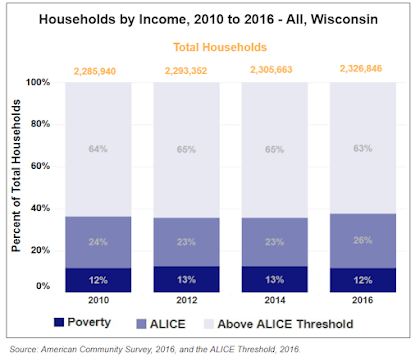
These numbers change depending on where in the state you live (more on that in a second), but overall, more Wisconsinites lived on the edge in 2016 than they did in 2010. The dark color in this picture represents those under the poverty line, and the middle color represents those at the ALICE level.


Breaking it down to the county level, you can see a higher level of individuals in peril in northern and western Wisconsin, generally in more rural and remote areas. . In many of these cases, the main increase isn’t due to people falling into poverty, but instead involves people just hanging on in the “ALICE” range.


A good example of this was in Douglas County in the northwest corner of the state. Poverty stayed around the same levels there for all years measured in the 2010s, but the percentage of people “on the edge” in the ALICE area went up by 7% as the number of households dwindled.


Adams County shows this pattern to an even higher extreme, with a 12% increase in the ALICE range.


A similar pattern appears in Rusk County, with slightly higher poverty levels.


Even Waukesha County, which tries to think of itself as immune to the difficulties of the poor, is seeing an increase in people that are threatened. Another 6% of country residents have fallen into the ALICE range since 2012.


A big culprit of increasing financial peril in the burbs and bigger cities seems to be the rising price of child care and housing for parents with 2 small children. Note the differences between the 5 most-heavily populated counties in Wisconsin, and the two most rural counties I have brought up as examples.

Child care survival costs per month, 2016 ALICE survey
Dane County $1,895
Milwaukee Co. $1,774
Waukesha Co. $1,709
Racine County $1,471
Brown County $1,330

Rusk County $1,231
Adams County $1,159

Housing survival costs per month, 2016 ALICE survey
Dane County $936
Milwaukee Co. $907
Waukesha Co. $907
Racine County $888
Brown County $756

Rusk County $674
Adams County $658

This shows how dealing with the high cost of housing and child care is an especially relevant concern in those larger metro areas, and how the higher wages that those communities pull aren’t necessarily leading to a much higher quality of life. And if the wages aren’t higher in those communities, then the stresses become very high.

On the flip side, the ALICE report assumes the costs of food and health care needs will be the same regardless of where you live, so the rural areas are in extra need of assistance here, as wages tend to be lower. Given the increase of people into the ALICE zone in small-town Wisconsin, it sure seems like taking the expanded Medicaid that allows people with incomes up to 138% of poverty to have near-$0 health care premiums would have been a great solution.

But instead, Scott Walker and the GOP Legislature decided to sabotage the ACA to turn the people against the program. Instead of being suckered into resentment due to this cynical sabotage and voting for the GOP, maybe rural Wisconsin shouldn’t vote for politicians like Sean Duffy, Glenn Grothman, Leah Vukmir and Scott Walker who will eradicate the ACA and Food Stamps, and turn their current ALICE-zone existence into flat-out poverty (just a thought).

The ALICE survey likely goes a long way toward explaining why so many people don’t feel much better off than they were 8 years ago, despite stats showing many more people employed than we saw in 2010. And lower taxes and corporate deregulation aren't going to do anything to get people out of the ALICE zone. The cost of staying afloat continues to rise, often well above any small increase in wages that people have seen in the same time period.

If there’s any kind of economic downturn in the near future, it seems likely that a lot of people that are just getting by today will go over the edge very quickly. Are we going to be ready for that, and be able to handle those social costs? Sure doesn’t seem like it, especially with safety nets at high risk of being shredded in deficit-ridden, GOP-run America (hell, VP Mike Pence even admitted last week in Milwaukee that electing Leah Vukmir to the US Senate will allow the GOP another chance to repeal Obamacare and leave people at the mercy of soulless insurance companies).

So we need to elect Dem politicians in November that will actually try to improve the security and financial futures for these people in the ALICE zone, or else much of Wisconsin is in real danger of having a large number of their people in desperate straits, with little hope of getting out of it if they stay in the places that they currently live in.

As rain keeps falling and waters keep rising, WisGOP failures require new leaders, policies

As there are 5 more days of rain forecast this week on top of the catastrophic flooding we've already seen in this state, we need to realize that these situations are becoming more common, and that many of the people running Wisconsin government have not done anything to deal with it.

There have been a number of articles that have come out in the last 2 weeks describing the floods, cleanup efforts, and policy choices that have been made. Let's start with an excellent article from Dylan Brogan in Isthmus on Madison's flooding situation. Brogan talks with State Rep. Chris Taylor and a UW-Madison professor, who both express surprise and disappointment that more isn't being done to combat the worsening situation.
“The storms are worse. I don’t even care why [GOP lawmakers] think they are worse. But let’s address what’s confronting us. The weather doesn’t care if you’re a Republican or a Democrat. The damage is the same,” says Taylor. “For us not to address this is irresponsible and it puts people’s lives in danger.”

Taylor cites changes to wetland permitting and the state curbing local regulatory authority as actions that have made it more difficult for communities to prevent damage from severe weather.

[UW Professor Emily] Stanley says the potential for flooding in Madison and other communities should not surprise anyone.

“We don’t know when big storms will come but we do know they seem to be coming more frequently. We are aware that there is a link between these events and the changing climate,” says Stanley. “From a personal point of view, it is frustrating. We had the opportunity to address this on a global scale. This isn’t just a Wisconsin issue.”


As an example of this increasing frequency of big storms, the Baraboo River between Baraboo and Portage has kept river stage records for over 100 years. Now maybe they only tracked the “big ones” in decades long ago, but it’s still worth noting that if you include this latest flood, 1/4 of the 16 crests have been in the last 3 years, 9 of the 20 highest have occured since 2000, and 4 of the top 6 have been in the last 25 years. Today, that River sits near 24.5 feet, more than 50% above flood stage, and the 3rd highest level ever.

This is where you see climate change cause real problems – severe weather events have always happened, but they’re happening a lot more often in recent years. Former Baraboo State Rep. Fred Clark had an article in Friday's Capitol Times noting this trend of increasingly severe weather events. Clark also calls out the Walker Administration for refusing to admit that these floods and other weather events are an increasing problem in Wisconsin, let alone take legislative action to deal with this changing situation.
While the costs and impacts from climate-related events to our economy, public health and safety mount, agencies such as the Department of Natural Resources; Department of Agriculture, Trade and Consumer Protection; and Public Service Commission have stopped acknowledging climate change as a threat. In the case of the DNR, the employees who created one of the most comprehensive websites in the country dedicated to climate change were the same employees ordered to remove its content after Scott Walker’s DNR Secretary Cathy Stepp took control of the agency.

Public servants at all levels are responding heroically to climate-related crises when they occur. However, as the frequency and intensity of floods, storms and other climate-related impacts grow, the Walker administration’s policy of feeding its base by refusing to say the words “climate change” or act strategically about it is becoming increasingly absurd….

Preparing for and adapting to the climate-related impacts we are already experiencing and those we are likely to experience is one of our most important obligations. In addition to adapting, mitigating climate change by reducing greenhouse gas emissions is a global challenge that requires coordinated action by governments, businesses and mission-driven organizations at every level. Wisconsin can join other states like California in driving greenhouse gas reductions that are good for business and our quality of life.

But without policies and resources to address these issues at a strategic and sustained level, even our most well-intentioned responses will be inadequate. We need to reinvest in science so we have the best understanding possible of the most profound threat our planet has ever faced. We need to develop coordinated policies and actions within and among state agencies, and stronger partnerships with local governments and stakeholders. And we need to budget the resources to prepare and to respond effectively to events and address impacts as they occur.
Another rural Democrat sounded similar notes as to how we need to better stewards of the land in this state. Kriss Marion is running for the State Senate seat that covers much of Southwestern Wisconsin, including the waterlogged areas of Reedsburg and Rock Springs, and says we must take smarter actions to deals with this changing reality.
How do we do this? First, we look upstream of our communities and consider how land use changes, including wetlands loss, contribute to flood risks and damage. We identify, protect and restore wetlands, so they can function as sponges and holding areas for floods. We protect and enhance shoreline habitat to withstand dramatic rises in water levels. We reduce the use of impervious surfaces in urban areas. We design, plan and zone for more resilient infrastructure.

We are going backward instead of forward on these practices in Wisconsin. My opponent, Sen. Howard Marklein, has voted along party lines over and over to allow accelerated development on wetlands and to prohibit counties from enacting their own water protection ordinances. He voted to weaken the DNR’s protection of wetlands, cut DNR scientists and roll back groundwater management. Water policy is one of my top legislative priorities, and recent events illustrate just one reason why.

We’ll do well to reflect on our experience — just as I’ve taught my children to do when they suffer hard times. While we can’t do anything to avoid 11-, 9- or 6-inch violent precipitation events, we can acknowledge the data that show we’re likely to see more of them. We can accept University of Wisconsin recommendations on how to mitigate the impacts of such events on agriculture, development and infrastructure. Perhaps we can agree that Mother Nature is quite tough, and we’re going to need to work with her to do better by our communities in the future.
Even as Governor Walker has made himself more visible in observing the numerous emergency operations that have been required around the state over the last week, it’s obvious that photo ops and politics are still his first priority.

This was shown again in an exchange that Brogan captured in his article, where Walker tried to use his appearance of sandbagging at a Madison flood site to bait a local person into an incident that would have played into Scotty’s “divide and conquer” method of “governance.”
Another man biked up to Walker to confront him: “Gov. Walker, I want to say that your time and energy would be much better spent enacting policies to counteract climate change rather than shoveling sand into bags. Would you agree?”

“Glad you’re here. Thanks for watching,” replied Walker. “You can say what you want. You can call me a F-word if you want.”
“I’m not doing that,” the man countered. “I’m just saying climate change policy would be more effective than shoveling sand. Otherwise, you’ll be out here next year, too.”

Actions speak louder than photo ops

Walker had better not be out there next year, because that means the voters of this state were stupid enough to re-elect Governor Dropout, which means that nothing will be done to lessen the damage and runoff caused by these weather events.

Let me close with another Isthmus article, this time from writer/cartoonist Alan Talaga, who notes that while Dane County should consider lowering its chain of lakes to lessen the possibility of flooding, the real change (or change back) has to come from the state level.
Lowering Lake Mendota is a crucial policy goal but it is not the only one. For the last eight years, state government, under Gov. Scott Walker, has stripped environmental protections at every level. The Department of Natural Resources has become a rubber stamp for business interests, utterly abandoning the agency’s historic role as a caretaker for the environmental resources we all depend on.

One particularly egregious way state policy is making this worse involves regulations around runoff. Property developers are replacing rain-soaking green space with asphalt, which means that more water becomes runoff and flows into our lakes. But the county is now powerless to stop it. This year, Walker signed a bill forbidding local governments from adopting stronger runoff standards than the state. Over the weekend, Walker stopped for a photo-op at Tenney Park to fill some sandbags. I’m glad he picked up a shovel, but it doesn’t come anywhere near undoing the damage he did with a signature.

We need to restore the balance between environmental protection and the short-term gains of private industry. Luckily, Wisconsinites have a chance to restore some balance on Election Day in November.
Yes we do. And we'd better not mess it up.

Saturday, September 1, 2018

Corporate profit bubble keeps blowing higher while their taxes go down. Happy Labor Day weekend!

Just in time for this Labor Day weekend, we have new information in the updated GDP report which shows corporate profits keeps rising in the US.
Pretax profits at U.S. companies climbed 7.7 percent from a year earlier, the most since 2014 and the seventh consecutive gain, according to Commerce Department data released Wednesday. Throw in the boost from lower taxes that went into effect this year under the Trump administration, and firms have plenty of wherewithal for more investment and hiring….

After-tax corporate profits grew 2.4 percent last quarter from the prior period, down from an 8.2 percent jump at the start of 2018, according to the Commerce Department’s first estimate of second-quarter profits.
The article is underselling it, because it only looks at pre-tax profits. If you go into Table 9 of the updated GDP report, you’ll see that post-tax profits for corporations were up 16.1% compared to a year ago, and 58.0% after net dividends are figured in.

So what’s happening to that 16.1% in post-tax profits? It’s making the stock market bubblicious again, and leading to more automation. As Yahoo Finance notes
The expanding coffers are reflected in a stock market hitting record highs. Businesses are also putting the cash to use: nonresidential fixed investment, which includes spending on equipment, structures and intellectual property, increased last quarter by [an annual rate of] 8.5 percent, revised from a previously estimated 7.3 percent, the data showed. Spending on business equipment rose an upwardly revised 4.4 percent.

Firms are also on a stock-buyback spree following the tax windfall, with Goldman Sachs Group Inc. estimating that companies in the S&P 500 index will authorize $1 trillion in stock buybacks in 2018, a record and a 46 percent jump from last year.

The big question is whether companies continue to be as enthusiastic about investing and employment, given the headwinds from a trade war and a fading benefit from the tax stimulus. The latest figures indicate that the boost from tax cuts “has already hit the corporate bottom line,” according to Chris Rupkey, chief financial economist at MUFG Union Bank in New York.
So what about the employment side of the equation? That’s not going up nearly as much. Total compensation paid to all employees went up only 4.7% compared to the same quarter a year ago, and when you figure that total jobs rose by 1.7% over that same time period, that means compensation per worker only rose by 2.9% - no better than the rate of inflation.

Even though pre-tax profits keep going up with corporations, they're paying less and less to Uncle Sam. This is a trend that was already happening as income inequality exploded in the US over last 15-20 years, but the GOP's Tax Scam has put that on steroids, and has caused corporate taxes to plummet while profits stay high.

And the same trend showed up in Wisconsin's newly-released year-end revenue figures for the 2018 Fiscal Year. While the overall numbers were good (in fact, they were a $18 mil above the LFB's estimates from January), corporate taxes in Wisconsin fell short by more than $56 million. In addition, it was the 3rd straight year that corporate tax revenues in the state.

Corporate tax revenues, Wisconsin
FY 2015 $1,004.9 mil
FY 2016 $963.0 mil
FY 2017 $920.9 mil
FY 2018 $893.9 mil

And with the need for this “profit and earnings bubble” to keep going higher, do you think corporations are going to pay employees more, and risk having the numbers go down, or will they put that money into machines and stock buybacks to keep the benefits for themselves and other shareholders? If you’re even bothering to contemplate this question, you haven’t paid much attention to how capitalism really has worked over the last 40 years.

So when does the bubble pop, and/or the layoffs begin? Is it after the “disappointing” 3rd quarter 2018 earnings results, as the one-time boost from tax cuts and stock buybacks stalls out? Is it when many multi-nationals get low prices and/or reduced markets from Trump’s trade wars? Is it when people file their taxes in Winter 2019, realize that the GOP’s Tax Scam has made their planned deductions for home ownership worthless, and have to pay Uncle Sam instead of getting a refund?

It sure seems like something’s going to come up to end the profit and earnings bubble that’s making an already absurdly unequal country even more separated, and it seems likely to be sooner than later.