Monday, September 21, 2020

In a time of record wealth, many are left behind. And no stimulus means even more will be hurt.

Not that this should surprise you, but how the economy is doing may seem very different depending on your specific circumstance. For example, if you had a white-collar job, and owned a house and/or stocks, you probably haven't suffered much beyond the social inconveniences of the COVID World. That was reiterated today, as we found out that despite a record drop in GDP, household wealth hit record levels in Q2 of 2020.
Americans' household wealth rebounded last quarter to a record high as the stock market quickly recovered from a pandemic-induced plunge in March. Yet the gains flowed mainly to the most affluent households even as tens of millions of people endured job losses and shrunken incomes.

The Federal Reserve said Monday that American households' net worth jumped nearly 7% in the April-June quarter to $119 trillion. That figure had sunk to $111.3 trillion in the first quarter, when the coronavirus battered the economy and sent stock prices tumbling.
On the other end of the spectrum, we are still tens of millions of jobs in the hole, and it has disproportionately hit people who were already close to the edge without much opportunity to build wealth.
The full recovery of wealth even while the economy has recovered only about half the jobs lost to the pandemic recession underscores what many economists see as America's widening economic inequality. Data compiled by Opportunity Insights, a research group, show that the highest-paying one-third of jobs have almost fully recovered from the recession, while the lowest-paying one-third of jobs remain 16% below pre-pandemic levels.

The wealth data “highlights the inequalities in the recovery in the sense that high-income workers not only have jobs that for the most part have come back; they also have savings that have continued to grow,” said John Friedman, an economist at Brown University who is co-director of Opportunity Insights.

The recovery in household wealth has benefited mostly a narrow slice of affluent Americans. The richest one-tenth of Americans owned more than two-thirds of the nation's wealth, according to Fed data through the end of March, the latest available. The top 1% owned 31%.
The growth of wealth and lack of lost jobs in certain sectors has insulated a lot of people from realizing just how bad things still are, which raises the chances that we will get another, longer-lasting economic downturn.
“There has always been a reckoning that needs to occur which has not yet taken place,” said Steve Blitz, chief US economist for TS Lombard. “And that is the possibility of an extended recessionary environment. Because most people believe this is a COVID cycle as opposed to a true economic cycle, the forward sentiment never dropped like it would in a regular recession.”

By “COVID cycle,” Blitz means changes in economic activity dictated by the need to control the spread of the virus: short-term business closures, temporary layoffs, and so on. The sense that this is not a “real” recession comes from the fact that the economy is so bifurcated, keeping the Americans who need assistance “off the radar,” he said in an interview.

“The burden is more on the people making $14 an hour than those making $40 an hour,” Blitz said. That also masks the blow to the economy: “The $14-an-hour people are only responsible for 9% of consumer spending. And the top 40% have had a lifestyle change but their lives haven’t changed and their balance sheets are bigger than they were at the beginning of the crisis.”
One way to help those individuals who have lost their lower-wage jobs would be a new round of targeted stimulus, to give a push to the already-flagging growth in consumer spending. And if no new bill is passed, both the stock market and the real economy are likely to fall apart.
Strategists at BCA Research earlier in September quantified exactly how much fiscal support they believe is needed: at least $500 billion, to ensure consumer spending grows about 2% over the next 12 months. In the aftermath of the 2008 financial crisis, spending growth averaged between 2% and 6%, BCA notes.

BCA’s calculations show that if Congress were to extend another $1.1 trillion worth of stimulus, that would boost spending to 6% over the next 12 months. But the team estimates that even just holding spending growth flat requires more spending – roughly $249 billion, they reckon – “and that outcome would almost certainly disappoint markets,” they said.
This is especially true as unemployment claims are still at unprecedented levels in a time when expanded benefits are expiring in much of the country.
Yes, the Supreme Court fight will be a big deal. But I'd argue that it's even more important in the short term for House Dems need to put Senate GOPs and the GOP in the White House on the defensive by passing another stimulus bill this week, even if it's a pared-back $1.5 trillion package. Dare Moscow Mitch and the several endangered Senate GOPs to say no, and show Americans that they care more about rigging justice than in the economic suffering of tens of millions of Americans. That'll turn a 4-5 seat Dem pickup into 9 or 10 seats.

And the last thing Nancy Pelosi and other House Dems should do is pass a Continuing Resolution that offers no stimulus, which allows Senate GOPs to punt on stimulus until after the election. Not only will this cause major hardship for a lot of workers and business owners that are barely hanging on today, but you can bet that if Biden wins and gets a Dem Senate (a likely combination of outcomes), you know that Senate GOPs will gladly allow the economy to die so Biden can inherit a mess that handcuffs him and the Dem majorities in Congress (just like in Obama's first term).

Besides, if House Dems really want to fight for RBG, they should put Moscow Mitch, Russian Ronnie and the rest of the GOP in the position of SHUTTING DOWN THE GOVERNMENT by choosing judges over stimulus. That'll make the markets tank really fast ahead of the election, and when the 1%ers start losing their wealth and privilege, Senate GOPs tend to start caring more about what their (in)action is causing.

Now's not the time for order and "proper governance." Now is the time to take things to the wall. Both with SCOTUS, and with the stimulus that so many Americans still need.

Sunday, September 20, 2020

Wiconsin COVID breaks out to new levels, and gets worse in new places

Needless to say, it was a bad week for Wisconsin with the COVID pandemic. To the point that we will likely exceed 100,000 total infections today, and we are now in the US's top 5 in a very bad way. The common thread of these 10 states? All voted for Donald Trump and have GOP-run Legislatures. I'm sure it's just a coincidence.

I said a couple of weeks ago that we3'd find out if the higher numbers that came with a new school year would be a blip or the start of a new level of infections for the state. In mid-September, the trends are not promising, as new cases have more than doubled in the last 2 weeks, and the rate of positive tests keeps going up.
If there's any positive news from this, it's that the number of individual Wisconsinites being tested rose for the first time in several weeks, and deaths are at at their lowest in nearly 2 months.
But there are a couple of trends that are worrying on the severity front. Yes, most of the jump in new cases in Wisconsin are from people aged 18-24. But we're also starting to see older age ranges have a bump up in infections over the last couple of weeks, and those people are more likely to suffer more severe health issues from COVID.
And we are starting to see that translate into big jumps in hospitalizations in the 920 and 715 area codes.
On a related note, did we mention that President Trump had a rally in an airport hangar in North Central Wisconsin last week? I'm sure all these people will be around in 6 weeks with no difficulties so they can get out and vote in person like a "real 'Merican." SUCKERS!

But hey, we got football coming back at the pro and college levels. So, according to Assembly Speaker Robbin' Vos, things are getting back to normal with nothing to worry about! Enjoy your tailgating at the bars around Lambeau today, and don't worry about what might happen in the county with the highest rate of COVID infections in the state!

Saturday, September 19, 2020

RBG's dead, and the GOP will grab more power. So what are we going to do about it?

I could give this whole rigamarole about how Republican Senators should be consistent and not fill the vacancy on SCOTUS that has been caused by RBG's death until a new Senate and presidential term is in place, like they did with another SCOTUS vacancy in 2016. But why waste my time on things that won't happen?

Look, Republicans don't care about consistency, fairness or decency, and they don't get shamed when they're called out for not being consistent, fair or decent. They only care about two things - POWER AND MONEY for themselves and their supporters. All of that high-minded shit that you were taught in school about "public good" and "consent of the governed"? They couldn't care less about that.

Shoving another SCOTUS justice on the court allows for this country to become even more distanced from the will of the people, and slanted in favor of the rich, connected and (mostly) white. And makes the rest of us have to work even harder just to draw even with those favored groups.

Ari Berman of Mother Jones has covered the GOP's many attempts to limit voting and grab power in recent years, and summed up just how out-of-whack things are when it comes to who is in power in DC. The same mentality pervades in Wisconsin, where GOP Assembly Speaker Robbin' Vos did his typical pipsqueak bravado act this week, and in the process, he admitted he doesn't care about the large number of people who might not vote for a certain candidate.
Assembly Speaker Robin Vos, [R]-Rochester, conceded that some suburban seats were competitive, but he said Republicans knew how to win there.

"I think these are all pipe dreams on the part of the Democrats," Vos said. "If somebody wins with 60 percent or 57 percent, it might make you feel a little bit better. But just like in football, all that matters is who wins the game."

Or if they win with 55% or less of the vote, like 13 GOP Assembly members did in 2018, which enabled this notorious picture to emerge after those elections.
Because GOPs can't win with the general public on their ideas, tactics are what they have left. So they rig voting to make it easier for GOP-leaning groups and harder for Dem-leaning ones, and used one good election in 2010 to rig electoral districts to give control to the party that gets fewer votes from the state's voters. In DC, it involves abusing the powers of a US Senate that gives preference to state borders that were drawn 150-300 years ago instead of the number of people who live in those states, and then filling courts with judges who make up decisions to fit the GOP/corporatist agenda, no matter how ridiculous or repressive they may be.

So what do we do from here? Former Hillary Clinton press secretary Brian Fallon summed up the steps perfectly. When the GOP grabs their power, we pack the court. And we outlaw gerrymandering, and we blow up the filibuster in the Senate. Sure, that's not how they drew things up in 1787, but when you have a GOP that is acting more like a Fascist dictatorship than a constitutional republic, it's what you need to do to keep the republic.

You've taken the fun out of everything..."

Friday, September 18, 2020

Retail sales shows a leveling off, with danger of a double-dip

I think we are starting to see more examples of the economy leveling out to its new baseline with August's figures. This includes the US's retail sales numbers, which showed decent growth, but also growth that was declining from previous months.
Advance estimates of U.S. retail and food services sales for August 2020, adjusted for seasonal variation and holiday and trading-day differences, but not for price changes, were $537.5 billion, an increase of 0.6percent (± 0.5 percent) from the previous month, and 2.6 percent (± 0.7 percent) above August 2019. Total sales for the June 2020 through August 2020 period were up 2.4 percent (± 0.5 percent) from the same period a year ago. The June 2020 to July 2020 percent change was revised from up 1.2 percent (± 0.5percent) to up 0.9 percent (± 0.2 percent).
On the positive side, retail sales in the US are actually higher than they were before COVID-19 broke out. But you can see the flattening over the last 2 months.
But even though the total sales are what you might have expected 6 months ago, the COVID era has caused a major change in where people are spending their money. Some retailers have benefitted from having more people staying at home, including non-store retailers like Amazon.com, along with grocery stores and home/garden stores. Those places had big gains starting in March, and have held most of those gains in the months after that.
Conversely, money spent on going out continues to be depressed, and brick-and-mortar retail that relies on in-store purchases is floundering. These sectors have not seen many of their jobs come back, and I can't see it getting much better as the weather turns colder while COVID continues to fester.
Instead of a short-term adjustment to a lockdown, these changes are now becoming structural. And unless there is a significant bailout for these sectors coming, many of these businesses are going to go under in the coming weeks and months, with little to replace them.

And once those businesses and jobs go away this Winter due to the lack of demand, that likely will make retail sales decline again, unless there is some kind of assistance coming from DC to allow the typical American to keep spending somewhere. We would then go from the K-shaped "recovery" that we've been seeing back to a full-fledged double-dip recession that starts from an already-weakened economy, and whoever is president and in Congress in 2021 will be walking into a mess.

Thursday, September 17, 2020

Like America, Wisconsin kept gaining jobs in August, and is still in a major hole

Much like the rest of the US, Wisconsin continued to regain some of the jobs in August that it had lost in March and April, and the unemployment rate continued to fall. But also like the rest of America, Wisconsin is still far behind where we were in February. First, the numbers.
Place of Residence Data: Wisconsin's unemployment rate in August was 6.2 percent, 0.9 percent lower than July's revised rate of 7.1 percent. The U.S. unemployment rate in August was 8.4 percent.

Place of Work Data: Wisconsin added 34,700 total non-farm jobs and 16,700 private-sector jobs in August.
The drop in unemployment was for the “good reason” – the labor force increased by 21,900 in Wisconsin, and the number of people employed went up by 47,700. But it’s worth mentioning that the labor force number still is significantly down from where we were at the start of the year, which keeps the rate lower than it would have been with the same proportion of people working in prior years.
As you can see, the number of Wisconsinites identified as "employed" in the household survey is down more than 142,000 since the start of 2020. If the same number of people had been in the labor force since January, our unemployment rate would be 8.1% instead of the 6.2% reported for August.

On the payrolls side, you may have noticed more than half of the jobs added in Wisconsin was in government. Almost 30% of that came from the Feds (5,300), likely through the Census, which added 247,000 jobs last month nationwide. There also was a sizable increase in Local government jobs (+10,600), but I wonder if that’s simply an odd timing thing related to when people started working for K-12 public schools this year. I’ll have to wait until September’s report to see if this is a long-term recovery or just a trick of the calendar.

Looking at the private sector, Wisconsin continued to slog back from the large jobs deficit it was put into in March and April. Construction and manufacturing accounted for 4,700 of those regained jobs, and a few beaten-up service sectors had a bounce-back in August.

Job change, Wisconsin, August 2020

Retail trade +6,300

Arts, Entertainment + Rec +2,600

Accomodation/Food Services +2,500

That being said, those last two sectors reflect lower-than-normal seasonal layoffs in August, and that likely reflects the fact that tens of thousands of Wisconsinites in those sectors were laid off well before August.
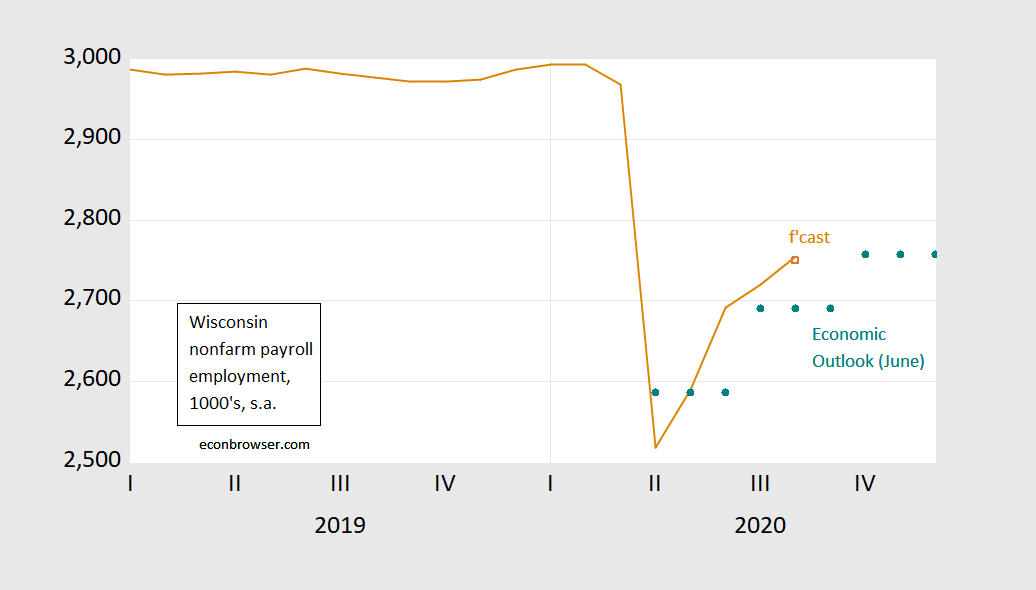
When looking at total jobs, like the rest of the country, Wisconsin still has yet to gain back half the jobs they lost in March and April, as illustrated by UW-Madison professor Menzie Chinn in Econbrowser today.
And like a lot of things in our economy, I think August is going to mark the end of the "rapid restoration" part of the recovery, and I think it’ll be worthwhile to think of August’s numbers as part of a new baseline to figure out if things are going in the right direction.

As it stands today, we still have more than 200,000 jobs that need to be brought back in the state (and more than 11.5 million in the country), and there's no underlying economic drive to do so. So the challenge is now going to involve figuring out how we accomplish the hard work of getting those last jobs back and continuing to reduce the still-huge unemployment rolls and output gaps, and given what we're (not) seeing in DC, I'm not seeing what does that.

Robbin' Vos on socialism

Assembly Speaker Robin Vos retweeted this yesterday. This is the same Robbin' Vos who got Wisconsin taxpayers to send hundreds of millions of dollars of infrastructure to his district as part of the Foxconn boondoggle.

This is the same Robbin' Vos who took between $150,000 and $350,000 from Uncle Sam under the PPP program, which was set up to defray the results of a recession.

This is the same Robbin' Vos who has headed up schemes to give hundreds of millions a year to private schools, as a taxpayer-funded kickback for Betsy DeVos's campaign contributions.

I suppose Robbin' Vos can speak a lot about socialism, because he sure believes in using government resources and olicy to improve outcomes for himself and his donors. But unlike real socialism, the everyday person doesn't get helped one bit from Vos-style redistribution, and I suppose that's the difference, isn't it?

Tuesday, September 15, 2020

Wis college towns are the worst for COVID breakouts, but not the only ones

I ran the numbers for counties through Monday in Wisconsin on COVID-19 cases, and to no surprise, counties with UW campuses have had significant increases in the last few weeks as college students come back to school. The biggest jump has been around the Madison campus, which reversed weeks of lower cases in Dane County.
And other UW campuses also have seen a big jump. All five of the counties listed in these charts are place with sizable UW campuses, and you can see when the students got back.
As I mentioned a few days ago, when you create a situation where UW campuses are increasingly reliant on tuition and dorm revenues to survive, it puts the schools in a situation where they feel they have to put students on campuses if it is at all possible. And the record high levels of new COVID cases are the unsurprising result. But it's not just college towns that are seeing cases hit record levels. The I-41 corridor continues to get record cases, and not just in the Oshkosh area. Appleton and the rest of Outagamie County is doing especially bad.
This culminates with Brown County having more than 600 new cases reported last week, surpassing the previous highs that were reached in later April and early May, when meat packing plants around Titletown were having huge breakouts.
While most of the college towns have yet to see a significant increase in hospitalizations (partly due to the younger population, but also because it seems to take 2-4 weeks for the full cycle of COVID to run its way through people), that's not the case in the Fox Valley. The Wisconsin Department of Health Services says the number of people hospitalized in that part of Wisconsin has more than quadrupled over the last 2 weeks.
There is one area in Wisconsin where COVID is on the wane - most of Southeastern Wisconsin, and especially Milwaukee County. The county with the most people in Wisconsin is having its lowest numbers of new cases in 3 months, and accounted for less than 1 in 10 new cases in the state last week.
But the Milwaukee County numbers are small solace for much of the rest of the state, who is seeing COVID come back at levels that is giving the state national notice. And we still got 2 weeks where students have to stay in school so the UW can get its tuition, room and board. Oh, and then it'll get colder with more people going inside after that. Hoo boy. And that's before we go inside for good in about a month. Hoo boy.