Friday, February 18, 2022

WisGOPs fail miserably in trying to "solve" the non-problem of Wisconsinites staying on unemployment.

With the state’s unemployment rate at a record low and wages going up in order to fill positions, Wisconsin Republicans reacted to this situation by…. trying to punish the few people left on unemployment?
Republicans argued AB 938 would work to improve what they called mismanagement of unemployment benefits.

Rep. Warren Petryk, R-Town of Washington, said the bill would increase the ability of DWD to audit unemployment claims to levels seen before Gov. Tony Evers took office.

“This bill will help a legislator get to the bottom of the scope of how much exactly unemployment fraud has occurred under this governor’s watch and what he did or what he did not do to address this important issue,” he said….

The Assembly voted 58-34 along party lines to approve AB 935, which would reinstate time limits and implement work requirements for the FoodShare program.

Under the bill, DHS would be required to enforce and implement the program’s employment and training program requirement and drug screening, testing and treatment requirements.
In addition to the general cruelty and the fact that WisGOP is giving state government ZERO dollars to take these extra steps against alleged fraud, the Wisconsin Budget Project says that these bills would reverse the progress that has been made in helping low-income families survive in recent years.

The Budget Project also says that these bills wouldn’t solve the alleged problem of Wisconsinites not wanting to take jobs, because it doesn’t deal with the real barriers that exist.
It’s very difficult to believe that these proposals constitute a good faith effort to address the worker shortage because the authors of these bills have shown little interest in policy measures that would significantly boost the number of workers. If they truly want to accomplish that goal, they should listen to workers and potential workers about the barriers to work, and they should develop a nonpartisan agenda.

Based on conversations with nonprofits that work with Wisconsinites who are facing barriers to health and economic security, here is our list of recommendations for how Wisconsin can expand the workforce in ways that will help workers, their families, and the state’s economy:

Because a sharp drop in child care slots has forced many parents to drop out of the workforce, policymakers need to increase access to child care by substantially boosting funding for the child care subsidy program and creating more flexibility in the program, so it serves parents with erratic work schedules.

Make adults without dependent children eligible for the state Earned Income Tax Credit (EITC), so low-wage jobs aren’t a poverty trap. Research shows that these credits do a great job of promoting work, but among the 30 states that have EITCs, only Wisconsin excludes workers who aren’t custodial parents.

Stop suspending driver’s licenses for low-income people who are unable to pay fines, if those fines are unrelated to driving.

Increase the minimum wage, which has been frozen at $7.25 per hour since 2009.

Provide paid sick leave and family leave. This would not only help families, but would also benefit our economy by increasing worker retention and creating a more stable workforce.
Assembly Dems echoed the Budget Project’s themes, saying that yesterday’s GOP bills are pointless and cruel.

Rep. Katrina Shelton, D-Green Bay, said in a media briefing the bills “highlight a doubling down on an extreme right-wing commitment to a legislative agenda that is anti-worker, anti-Wisconsin and anti-family.

“They do nothing to promote rejoining the workforce and they literally rip the rug out from underneath those who are trying to make ends meet while they look for work,” Shelton said.
But that’s the whole point of these GOP "anti-welfare" bills, isn’t it? They are intended to make Wisconsinites as desperate as possible, and keep them from being able to turn down crappy jobs with crappy pay.

Workers are not desperate today, as Madison writer Tom Saler pointed out in a recent Journal-Sentinel article that discussed the country’s inflation situation.
Surely, pandemic-related concerns are playing a role in the so-called Great Resignation, in which 4.3 million workers quite their jobs in December alone, leaving the labor market 2.4 million workers smaller than in February 2020. A red-hot economy in which jobs appeared abundant contributed as well, as did money saved from two massive government stimulus programs.

But the pandemic also gave Americans a rare chance to step away, to slow down, to reimagine working lives to include meaning, recognition and astonishment. Or, especially among those approaching retirement, to imagine lives without work at all. And when a shrinking workforce meets an overheating economy, wage inflation inevitably shows up in consumer prices.
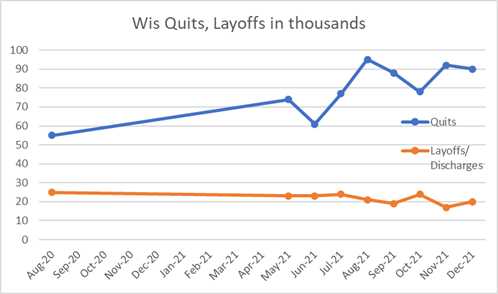
The Great Resignation was reiterated again in this week’s state-level JOLTS report, which showed Wisconsinites continuing to quit work at high levels at the end of 2021, while layoffs continue to be almost nonexistent.
So good luck to WisGOP if they want to sell a strategy of “lazy, unemployed Wisconsinites need to be shoved back into work” in the post-pandemic era. A lot of people have seen what happens when they are given choices and supports and power over their wages, and they’re not going to accept being forced back into a spot where they are begging employers for a few crumbs in order to survive.

Wednesday, February 16, 2022

COVID receding fast in Wisconsin. Good trend, but we've seen that before

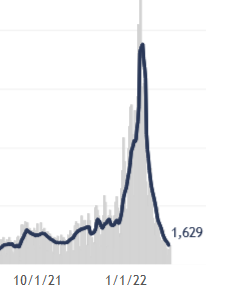
This is a nice illustration of where things are going on the COVID situation in Wisconsin.

We're now down to the lowest level of cases since early September, just above 1,600 cases a day on a 7-day average, with 27 straight days of declines.

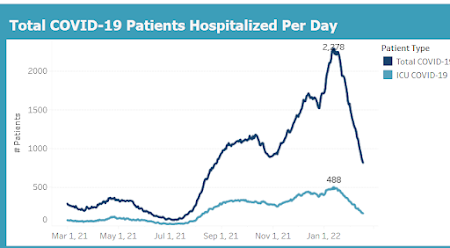
The amount of severe COVID illnesses are also falling fast, and should continue to decline as that follows the trend of new cases. COVID-related hospitalizations and ICU admissions are at their lowest levels in 6 months.

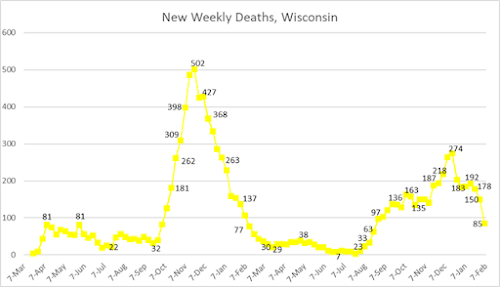
COVID deaths are also plummeting in Wisconsin, down by 2/3 after peaking in mid-December.

All of this is great, and is likely a big reason behind Dane County getting rid of its mask mandate in 2 weeks, and many UW System schools are also planning to end their mask mandates next month. My boosted self definitely feels a lot more comfortable doing events inside and in large crowds than I would have a month ago.

But we also saw cases and deaths decline this time last year, when we thought the pandemic was ending as people were first getting vaccinated. And just because masks aren't going to be mandated, it doesn't mean that masking should necessarily go away - risk factors should be accounted for by all of us. So while the clouds of COVID are lifting, and will likely clear up more as the weather warms and people do more things outside, it would be a big error to pretend that we're going back to the pre-2020 World where there was no COVID to be aware of.

Tuesday, February 15, 2022

Here it comes - how to pay for the the next 20 years of Miller Park

After the 0.1% Miller Park/AmFam Field tax was finally retired in early 2020, you kind of knew it was a matter of time before the Brewers might be hinting at a need for more public help.

AND NOW IT BEGINS, with Tom Daykin of the Milwaukee Journal-Sentinel giving a good, in-depth rundown earlier this week. While the Southeast Wisconsin Baseball Park District has enough funding to pay for upgraded seats, better elevators/escalators and ongoing fixes to AmFam Field’s roof over the next 3 years, there’s more that is going to be needed after that, and the District claims it won't have enough funding to pay for those future needs.
Rick Schlesinger, Brewers president of business operations, told the board at its Jan. 31 meeting of his concerns of a possible funding shortfall if estimated long-term improvement costs exceed the stadium district's $87 million reserve fund.

A shortfall would create a problem for the district.

Its lease to the Brewers, which runs through at least 2030 and could be extended by the club to 2040, requires the agency to pay for improvements — including those needed to keep American Family Field up to the evolving standards of other Major League Baseball stadiums.

No matter what you call it, more might be coming.

Daykin also noted that the Stadium District pays for almost all of those upgrades, and according to the way the agreement is set up, the ballpark has to fixed up to a high level.
"[I]mprovements must be made in a manner consistent with MLB stadiums which "can reasonably be said to fall within the 'top' twenty-five percent (25%) of all such facilities, when such facilities are ranked or rated according to the quality with which they are repaired and improved," according to the lease.

Call it the "keeping up with the Joneses" clause.

The district in the 2005-'06 off-season added a ribbon scoreboard and an out-of-town scoreboard at the cost of $3.1 million. Those boards were updated in the 2019-'20 off-season — costing $2.1 million, according to the district.

Also, LED stadium lights were installed in the 2020-'21 off-season for $2 million. That was another improvement triggered by the "keeping up with the Joneses" clause.
The district (and not the Brewers) are the ones paying for most of those upgrades, and now that the Miller Park sales tax is gone, a lot of their funding doesn't exist. So is it time for the team to step up and pay more of their share? In the 2020s, the Crew has sure been doing a lot better than in 2001, when the ballpark opened.

. It's worth noting that last year, Forbes estimated the value of the Brewers' franchise at $1.22 billion, nearly $1 billion more than the $223 million that Mark Attanasio's group bought it for in 2005. And concessions certainly aren't at 2005 prices ($10.50 for a can of Spotted Cow??), neither are ticket prices nor parking, nor TV/radio revenues. All of that money goes into the Brewers' pockets, and the team only is slated to contribute $1.5 million to the Stadium District in 2022, while the District pays out for many of the improvements.

In addition, Bruce Murphy at Urban Milwaukee has mentioned several times that as part of their lease agreement, the Brewers don't pay property taxes for the hundreds of billions of dollars of land and ballpark that they get to use (this article is an especially good breakdown). And beyond payments to Milwaukee Police to have their cops help out Brewers' employees for gameday security and traffic control, I'm not sure what else the team pays to the City that they play in. Speaking of Bruce Murphy, he responded to Daykin's story in Urban Milwaukee yesterday. Murphy questions why there would be any kind of urgency for the team and/or Stadium District to need more money for investment into the ballpark.
Meanwhile the Brewers were still sitting on a huge pile of money from the taxpayers, because that $605 million in [Miller Park] sales taxes included a buildup of enough reserve funds to continue subsidizing the stadium until 2040, as Urban Milwaukee reported, far beyond the 30-year period repeatedly noted in a 1999 report by the nonpartisan Legislative Audit Bureau. The reserve funds included $42 million to help pay for the stadium’s annual maintenance costs and $52 million for any expenses that may arise for capital costs. Press reports indicate that $94 million fund is now down to $87 million.

Tyler Barnes, the team’s senior vice president of communications and affiliate operations, said that since the stadium opened in 2001, the Brewers have paid $20.9 million in rent to the district, $112.7 million in capital improvements at the ballpark and $95 million in maintenance and cleaning. Which confirms that most of the costs have been borne by the taxpayers. Though it might help to have an independent analysis of this by the [Legislative] [A]udit [B]ureau.
Barnes’ comment of “the Brewers have paid ____ in rent and capital improvements” is especially unimpressive when you realize he’s referring to the total cost over 21 years. $1 mil a year in rent and under $6 mil in capital improvements is a whole lot less than fair market value for both rent and capital/upkeep costs on an annual basis, while the Brewers keep the overwhelming amount of revenues that come from using the land and the ballpark.

Not that I'm in favor of any subsidy given how things lay out right now, but if they want to do it, then maybe it should be a way to allow Milwaukee to get some long-deserved fiscal help. For example, why not have a 1% tax that is levied on all revenues generated from events at AmFam Field? This could then be split in some way (call it 50-50?) between the team (who uses the money for capital needs) and the City (who provides services that benefit both the Brewers and their fans).

In all seriousness, how can it be justified for the state and county get a cut of the Brewers' revenue (via sales tax), but the City basically gets no boost in tax revenue outside of the contract with Milwaukee Poloice and possibly a few more room taxes from tourists. Aside from a sales tax, another option could be to follow the example of the Bucks arena, which has a $2 ticket tax, of which $1.50 goes to downtown Milwaukee's Wisconsin Center District for future development.

Also, what happens if the City and the State tells the Brewers to pound sand and pay for their own upgrades if/when the Stadium District runs out of money? I suppose the team could go as far as claiming that the terms of their lease is being broken in not allowing the ballpark to be "kept up with the Joneses", and could use that as an excuse to try to leave town in 10 years or so. But do we really see that happening?

That type of brinksmanship is well down the road. But watch out for the talk to begin about how to "keep the Brewers competitive" by finding some kind of new subsidy or some other kind of assistance to keep the Crew from having to pay more into the ballpark that they and so many Brewer fans benefit from. You know it's coming.

Monday, February 14, 2022

Even WMC's own survey says we need more pay and more workers. Think they'll listen?

Usually anything that involves "research" from the oligarchs from Wisconsin Manufacturers and Commerce is automatically ignored by me. But it seems telling that even WMC is admitting that wages are going to have to go up in our state.
A survey of 265 Wisconsin businesses found 88% of them are struggling to hire workers and more than 80% plan to raise their wages 3% or more this year, according to Wisconsin Manufacturers & Commerce.

When listing the reasons why businesses are having trouble hiring people, 44% said there is a lack of qualified applicants, 36% cited the labor shortage and 9% cited generous unemployment benefits, according to the Wisconsin Employer Survey.

“Wages are rising much faster than they have in recent memory,” said WMC President and CEO Kurt Bauer.

“Wisconsin does not have enough people to fill the jobs we have available, and that creates an aggressive competition for talent. We are seeing wages rise at a faster rate, sign-on bonuses, work flexibility and many other strategies from companies to attract and retain talent.”
Hey Kurt - you think that maybe having government offer options for child care and raising the minimum wage might help businesses "attract and retain talent"? And maybe you "business leaders" should have recognized that Wisconsin has been paying some of the lowest wages in the Midwest for years, including the lowest manufacturing wage in the Midwest in the last quarter that the Bureau of Labor Statistics tracked it.

Average weekly manufacturing wage, Midwest Q2 2021 Ill. $1,392
Minn $1,386
Mich $1,322
Ind. $1,242
Ohio $1,222
Iowa $1,183
Wis. $1,178

You can dig into WMC's presentation at this link. And I noticed a couple of other interesting responses from WMC's selected group of employers.

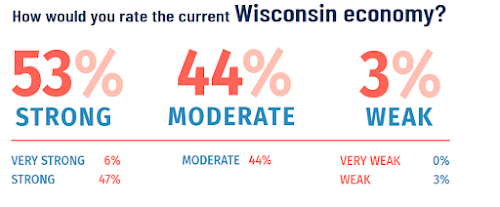
But while more than 1/2 of these employers claim the state's economy is "strong", WMC will tell you that Tony Evers is somehow holding the state back. Surrrrre.

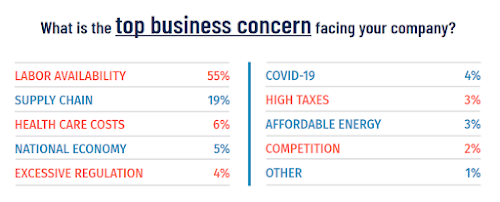
Here's the other question that stood out to me, that also isn't what WMC wants you to believe.

WMC tells us that cutting "regulations" and "taxes" are what will cause a boom in Wisconsin. But a total of 7% of the employers they talk to say that's their top concern, while more than half say it's the availability of labor.

Since it's clear that we need to make moves that assist in attracting talent and convincing people to come to Wisconsin to work and raise their families, why does WMC continue to blindly give millions of dollars supporting Republicans who pass regressive garbage such as:

1. Promoting the Big Lie, trying to overturn the 2020 election, and its related voter suppression.
2. Defunding and denigration of public education, community schools, and educated people. This includes trying to prevent students from learning any sort of real history or inconvenient fact that could improve their cultural understanding and intelligence.
3. Proliferation of guns, including allowing guns on school grounds.
4. Cruel, micromanaging abortion laws that make women second-class citizens.
5. An electoral strategy of using barely-concealed racism to try to win the votes of dead-end trash while telling non-white people "you are not welcome here."

Hey WMC, if you want people to come to work here, you might want to get rid of the stupid cultural crap that repels a whole lot of people. Y'know if you actually cared about something beyond rent-seeking greed and grabbing even more power.

Sunday, February 13, 2022

Big budget surplus allows Wisconsin to fix broken system of funding locals, schools. If we choose

In the last month, Wisconsin has received projections of $3.8 billion additional dollars to be available between now and June 2023. Governor Evers used the chance to ask for a $150 tax rebate for all Wisconsinites, more funding for public schools and a few tax breaks, while GOPs in the Legislature are likely to hold back the funds for later tax cuts (because they don't want Evers to get credit for anything before the November elections).

But the Wisconsin Policy Forum came up with another way to use that money - to change direction as to how Wisconsin's schools and local governments are funded.

In the report, the Policy Forum notes that the original connection between state revenues and the amount of money the state shares to local governments has been broken, Using some of the surplus to restore a large amount of shared revenues would reverse this trend.
According to an article on the Wisconsin Historical Society website, municipalities initially received 70% of the state income tax collections, counties 20%, and the state 10%. Over time, not only have the percentages paid to local governments dramatically declined, but the concept of “sharing” state tax revenues as they continue to grow has been abandoned. In the meantime, with the exception of a half-cent local sales tax option granted to counties in the early 1990s and a similar option later granted to a handful of municipal “premier resort areas,” Wisconsin’s local governments have not received permission from the state to levy income or sales taxes.

In our 2019 report, Dollars and Sense, we estimated that in 2015, total state aid to municipalities accounted for less than one-sixth of the value of state income taxes. That calculation includes federal aid received by the state and passed along to municipal governments.

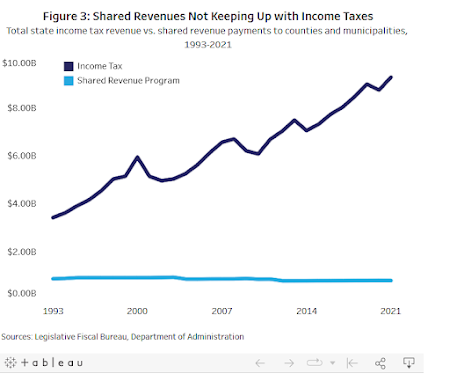
Moreover, while state income tax collections have more than tripled since the early 1990s, appropriations for the shared revenue program – which is the primary mechanism for upholding the state’s original commitment to redistribute some portion of state income and sales tax collections to local governments – have declined somewhat (see Figure 3). If inflation is taken into account, the disparity becomes more striking. In fact, if the 1990 shared revenue expenditure of $835.6 million had grown at the pace of the Consumer Price Index (CPI), then it would have totaled $1.73 billion in 2021, or more than double the estimated expenditure of $829.6 million.

For perspective, giving another $400 million a year in the next 2 years (restoring 1/2 of the inflation-adjusted cuts to shared revenue) wouldn't even cost 1/4 of the projected surplus that we are projected to carry over into 2023.

WPF President Rob Henken explained those thoughts some more on the most recent episode of Capital City Sunday with Channel 27's AJ Bayatpour.

HENKEN: ....Wisconsin is somewhat unique in terms of, Number 1, the exclusivity, the fact that we say to our local governments your only game in town when it comes to the major source of taxation is the property tax. Now, of course there is an exception for counties, there is an option for a half-cent county sales tax, but even that was put in place in the early '90s and hasn't moved upward since that time.

But what's happening here [is with] this concept of revenue sharing. So when this system was created back in 1911, when the state created a state income tax, the bargain at that time was is that we are going to reserve the right to use that taxation for ourselves, state government, and local governments, you're not going to be able to tap into that form of taxation, but we the state government are going to make a commitment to share...some portion of the revenues that we earn via our state incokme tax, we're going to redistribute that back to local governments.
Henken says that the COVID relief funds that went to local governments should be able to stave some of the strain for the next couple of years, but those are one-time funds to fill in revenue losses and often are targeted for specific needs, and those funds are merely a band-aid that doesn't address the ongoing problem.
When those [COVID relief] dollars are spent, after 2024 and heading into 2025 budget season, that a lot of these local governments are going to face challenges that exceed the challenges they facing pre-pandemic, before any of this even happened. And where that impact may be most pronounced may be in public safety...We are already seeing some significant stress in the ability of local governments to hire paramedics, to hire part-time rosters of employees in these smaller fire departments to respond to fire and emergency medical service calls.
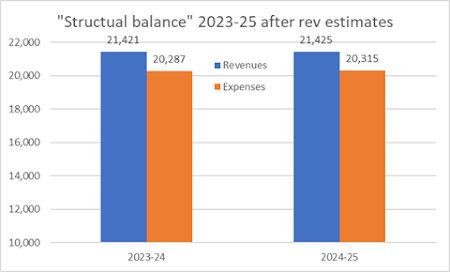
As Henken alludes to, Wisconsin has the fiscal breathing room to be able to put up the funds needed to reform this broken system of funding local governments. Not just with the current $3.8 billion in projected surplus over the next 16 months, but also because of a $1.7 billion "rainy day" fund that literally can't have any more money added to it. And based on the Fiscal Bureau's recent revenue estimates, we have a "structural" surplus of over $1 billion to start the next budget with.

In an odd way, the jobs and inflation situation of 2022 works in the favor of the state's budget, because while higher wages and prices translate into more income and sales tax revenue, then budgeted numnbers of many programs are already set, and can't increase without a request from those agencies. And that's if those agencies and programs even need to raise their budgets at all, given the lower poverty rates and need for services.

But again, this is all temporary and it means that there will be a need to set aside more funds for these services starting next year. If that doesn't happen, this will result in communities having to decide where those needed services will either have to be (further) cut, or the voters will have to approve more referendums to raise their already-high property taxes.

Why should that happen in Wisconsin when we have billions in the bank and an already-high amount of property taxes due to the flawed system that we have? As I've mentioned before, why can't we put together a plan where there's a sizable increase in state aid for schools, where 1/2 of the money goes to replacing and limting property taxes that go into schools, and 1/2 goes into classrooms, teacher salaries, and other K-12 resources.

And if you're concerned about local governments being able to maintain police, fire and EMS services, why not allow them to put in a sales tax of 0.5% or 1.0% that is earmarked for those services (we already do a version of this in the 8 small Wisconsin restort towns that have the Premier Resort Tax). We could also change out local wheel taxes for local road aids from the state - or get help via the extra funds that are now available with the sales tax.

Now's the time to make these tax changes to adjust to the realities of the 21st Century, and if Tony Evers and Wisconsin Dems want to win in 2022, combining lower property taxes + more funding for schools and cops sure seems like a winning strategy.

Saturday, February 12, 2022

Lewis Black, Charlie Pierce, and how Wisconsin and the US are "Off the Rails"

A friend scored free tickets to see a comic master last night, and my wife and I were glad to use them.

I'd seen Mr. Black a few times before, and much of his show dealt with how he dealt with COVID pandemic in 2020 while he was living alone in New York, and how it made him and many others crazy. In the act (fitting titled "Off the Rails"), Black remarked on how much of the country operates in two separate worlds with few shared experiences, and idiocy is allowed to run rampant without regard for masks or common respect.
As he says in his special: "We've done something with these two political parties that really is unbelievable. No other country has done it. No other country. We used to have parties that argued ideas. Not anymore. Now we have two separate political parties that actually exist in two totally different realities."

"It's like you go from one reality to another," Black said. "I left New York, and the 'OhMyGod virus,' as I call it, was hitting there. And people were masking up again, and they never had stopped masking. They were masking on the streets in New York City. They were not fooling around. Then I got to Florida. It was like, 'Woohoo, it's over!' You know, it was done there. And there is a real fight in this country. It's those two realities."
And the stupid and crazy seems to continue in RW Bubble World without any brakes or consequence. Today's "big political announcement" in Wisconsin is a great example.

These dopes wouldn't believe the sky is blue if AM 1130 and Faux News told them it wasn't. The level of weakness and self-absorption of these types is something I don't understand, likely because I evolved after age 15.

Along those lines, I wanted to excerpt the weekly column that Esquire's Charlie Pierce wrote this week (members only, so no real link to give). Pierce also sees the large number of self-appointed experts, conspiracy theorists and other morons running for public office as a sign of a country that has gone off the rails in many areas, because we allowed Trump trash and other hucksters to be put in positions of importance.
Remember Joe The Plumber, the guy who became widely (and briefly) famous for mouthing off against candidate Barack Obama? He was a bright little bauble to brighten up the dog days of a presidential campaign. He even got a book deal out of it. The problem is that, through the efforts of El Caudillo del Mar-a-Lago and his supporters, we’re hip-deep in Joe The Plumbers these days, and worse, their fame is not fleeting. Many of them have deep pockets, like Lindell, which, in our cash-soaked political age, makes them players, no matter how bizarre their particular contributions to the political scene may be. Many of them are elected to political office, like Tina Peters, and there are more of them on the way. My favorite—which is to say, the one I’m dreading the most—is Mark Finchem, who’s running for secretary of state in Arizona. Finchem was in Washington on January 6 and brags about his friendship with the Oath Keepers. Then there’s Kristina Karamo in Michigan. From CNN:

"Based on the series of evidence and knowing how these situations work, how these anarchists operate, I believe this is completely Antifa posing as Trump supporters," Karamo said on an episode of her podcast the day after the January 6 insurrection. "I mean, anybody can buy a MAGA hat and put on T-shirt and buy a Trump flag.”

I wouldn’t buy an apple from this person, never mind let her run my state’s elections. Can we all just agree that, ideology aside, we should not let soapbox screamers and the like take on the job of governing the rest of us? Can we not at least agree on that?
And make no mistake, the Republicans WANT dimwits like this running our elections. Including here in Wisconsin. They want hacks and fascist looneys running the show, because they care more about being in charge and getting all the gains from that power than they do in having a functional, improving country/state that deals with and solves real problems. And never think otherwise. Pierce ends his column by noting that America in 2022 is so self-absorbed and without a sense of community that they've largely given up on
.....What I’ve been calling the prion disease for the past decade has now spread far beyond even the Republican Party. The entire nation is blindly staggering under its effects now. We have so thoroughly abandoned self-government in favor of self-indulgence that we are like the plague-stricken Athenians, of whom Thucydides wrote:

So they resolved to spend quickly and enjoy themselves, regarding their lives and riches as alike things of a day. Perseverance in what men called honor was popular with none, it was so uncertain whether they would be spared to attain the object; but it was settled that present enjoyment, and all that contributed to it, was both honorable and useful. Fear of gods or law of man there was none to restrain them.

As for the first, they judged it to be just the same whether they worshipped them or not, as they saw all alike perishing; and for the last, no one expected to live to be brought to trial for his offenses, but each felt that a far severer sentence had been already passed upon them all and hung ever over their heads, and before this fell it was only reasonable to enjoy life a little.
As both Lewis Black and Charlie Pierce recognize, post-COVID America is a traumatized nation that has become numbed to awfulness and idiocy, in no small part because there is no accountability for such awfulness and idiocy.

That lack of accountability from the cowardice of Merrick Garland and Robert Mueller for not dropping the hammer on crooked, powerful people when they flout the law, all the way down to state legislators and Faux News/AM radio outlets, who have gerrymandered themselves into a place where there is no statement too absurd or no law too hateful/regressive that it isn't immediately followed by people losing their jobs and lots of money. In fact, our political and media system is incentivized today to reward this garbage, which leads other opportunists and low-info bystanders to join in on the destructive idiocy.

This is only resolved through either:

1. Crushing the scumbags and the jagoffs, where they lose their jobs, livelihoods and/or freedom for what they've said and done, and making them non-factors in everyday and political life for several years. This goes for both the politicians and MAGAts in general, since they lack all empathy and only respond to direct punishments. Or:

2. Secession - Let the regressive, scared minority can continue to live out their 20th Century mentality in backwards places that don't attract talent. The rest of us will live in a 21st Century, multi-cultural society that values science and decency over gut and fee-fees, rewards work over wealth, and teaches real history instead of what we wished were true.

In our country just saying or feeling something doesn't make it true, and we will have the cultural senstivity and emotional intelligence to come up with better solutions in both business and politics. We also won't be scared of what the future will hold because we're not being held back by minority rule from the 20th Century dimwits who refuse to grow up or catch up.

I don't want secession, but I do know that we can't keep being dragged down by the freak shows. MAGA types may shoot their mouths off and get the media attention, but a whole of us in the Silent Majority are seething these days over the illness that keeps festering without it being mitigated and stopped by the people who could do so. And that virus isn't COVID.

EDIT- Here's a late addition, where the Chair of the Republican Party of Wisconsin says their fake elector scheme was totally cool. And the reason why he can say that, is because no one is getting sued/locked up for it.

Thursday, February 10, 2022

Inflation still rising, but so are wages and profits. What should we cut back on? The profits

Oh noes! Inflation keeps rising!
U.S. consumer prices rose solidly in January, leading to the biggest annual increase in inflation in 40 years, fueling financial markets speculation for a hefty 50 basis points interest rate hike from the Federal Reserve next month.

The broad increase in prices reported by the Labor Department on Thursday was led by soaring costs for rents, electricity and food, and could heap more political pressure on President Joe Biden, whose popularity has been declining amid anxiety over the rising cost of living.

The consumer price index gained 0.6% last month after a similar increase in December. Food prices rose 0.9%, with the cost of food consumed at home increasing 1.0%. There were strong increases in the prices of cereals and bakery products, dairy, fruits and vegetables. Meat prices rose moderately. Electricity prices jumped 4.2%, offsetting cheaper gasoline and natural gas.

In the 12 months through January, the CPI jumped 7.5%, the biggest year-on-year increase since February 1982.
1982? Great year!

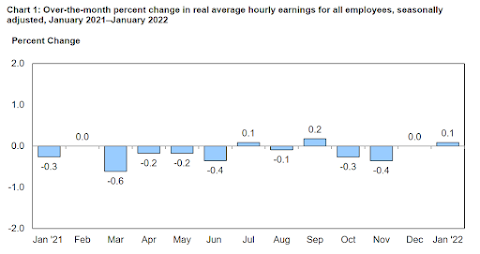
Well, 1982 isn't so great when you’re talking about the economy. But unemployment today is nearly 5% below the 8.9% that it was at back then. In addition to there being more people working, workers today have had their wages largely keep up with the rising prices in the last 7 months, after losing ground in the first half of 2021. We even eked out a small gain for January in this stat.

Real average hourly earnings for all employees increased 0.1 percent from December to January, seasonally adjusted, the U.S. Bureau of Labor Statistics reported today. This result stems from an increase of 0.7 percent in average hourly earnings combined with an increase of 0.6 percent in the Consumer Price Index for All Urban Consumers (CPI-U)….
Still it’s not great when you widen the picture out to the last 12 months.
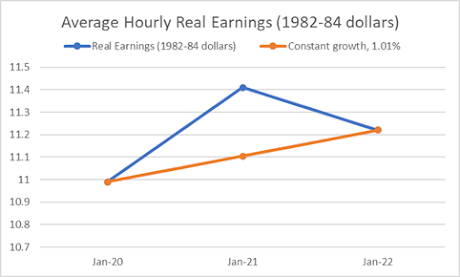
Real average hourly earnings decreased 1.7 percent, seasonally adjusted, from January 2021 to January 2022. The change in real average hourly earnings combined with a decrease of 1.4 percent in the average workweek resulted in a 3.1-percent decrease in real average weekly earnings over this period.
I know doing a lot of “on one hand…but on the other hand” with this report, and here’s another when it comes to looking at that 12-month drop in real wages. Don’t forget that there were large increases in average wages in the first year of the pandemic, while prices didn’t go up much at all. Even with the decline in real wages that has happened since the start of 2021, we are still well above the real wages that we had 2 years ago.

Now I don’t want to minimize that some people are likely worried as they see prices continue to rise, but when you combine that reality with child tax credits, stimulus checks and other COVID relief, I would bet that most Americans haven’t seen their real INCOMES fall over the last year. That’s a good thing.

When I dig into the data, I keep coming back to finding corporate greed to be one of the main sources of this inflation. And the recent Bureau of Labor Statistics report on productivity at the end of 2021 adds to that theory. The BLS says that businesses didn’t have to lay out that much more to make more products, because workers were working more efficiently by the end of the year.
Unit labor costs in the nonfarm business sector increased 0.3 percent in the fourth quarter of 2021, reflecting a 6.9-percent increase in hourly compensation and a 6.6-percent increase in productivity. Unit labor costs increased 3.1 percent over the last four quarters. (See chart 2 and table A1.) BLS calculates unit labor costs as the ratio of hourly compensation to labor productivity. Increases in hourly compensation tend to increase unit labor costs and increases in productivity tend to reduce them.

Labor productivity, or output per hour, is calculated by dividing an index of real output by an index of hours worked by all persons, including employees, proprietors, and unpaid family workers. In the fourth quarter of 2021, both output and hours worked increased for the sixth consecutive quarter following historic declines in those measures in the second quarter of 2020. The fourth-quarter 2021 output index is 4.1 percent above the level seen in the fourth quarter of 2019, the last quarter not affected by the COVID-19 pandemic, while the hours worked index remains 0.4 percent below its fourth quarter 2019 level….
Combine the big jump in prices, along with increases in productivity and relatively muted labor costs per unit, and you get big-time profit for business owners. And they know it.

In manufacturing, those unit costs went up by a little more than other jobs in 2021, but nowhere near the 7.5% increase in prices.
Unit labor costs in the total manufacturing sector increased 4.2 percent in the fourth quarter of 2021, reflecting a 3.4-percent increase in hourly compensation and a 0.8-percent decrease in productivity. Manufacturing unit labor costs increased 3.2 percent from the same quarter a year ago.
With manufacturing productivity rising by 1% vs Q4 2020, that would translate into decent wage growth in a time of higher prices in a normal economy.

But that’s not happening as much as it should. Manufacturing is one area that has lagged in wage growth over the last year, making inflation bite a bit harder on workers, while giving extra profit to employers to sell products at those higher prices.

Change in wages, manufacturing vs other private jobs
Increase in CPI, Jan 2021-Jan 2022 – 7.5%
Avg hourly wage, Manufacturing +5.2%
Avg hourly wage, Other private jobs +6.9%

Avg Weekly wage, Manufacturing +4.2%
Avg Weekly wage, Other private jobs +5.4%

You know, if people want to have a strike/convoy, maybe it should be because their company is getting rich off inflation while you can barely keep up. Just a thought.

The danger now is in reacting the wrong way to and these prices increases while we have a hot economy. As alluded to in that news report, Wall Street now fears that interest rates won’t just go up in March, but it’ll rise by half a point instead of ¼, which will bring their cocaine party to a quicker and harsher end.

To me, jacking the daylights out of interest rates like its 1979 and inducing 1982-style unemployment is the absolute wrong way to deal with our current economic situation. Instead, 2022 seems like the perfect time to rejigger our economy with a better safety net, strong regulation against profiteering, and encouragement of public competition for drug prices, child care and medical needs.

It also seems like a good time to return taxes on corporations and rich people to at least they levels they were at 5 years ago (i.e., before the GOP Tax Scam), to discourage the hoarding of gains and possibly heading off the damage caused by the bursting of asset Bubbles caused by speculation. Funny, all these ideas sound a lot like Build Back Better, don't they?

As 2021 ended and 2022 began, you could sense that working people recognized they don’t have to settle for the crumbs they got for much of the last 30-40 years. And they aren’t going to accept going back to hearing that businesses and governments can’t afford to help them achieve a high standard of living. Our current demand-and-profit-induced inflation should not be used as an excuse to screw them over.