Friday, June 24, 2022

Wisconsin's incomes rising fast, and above the rest of US

Earlier this week, we got a look at income growth by state for Q1 2022. And look who did really well!

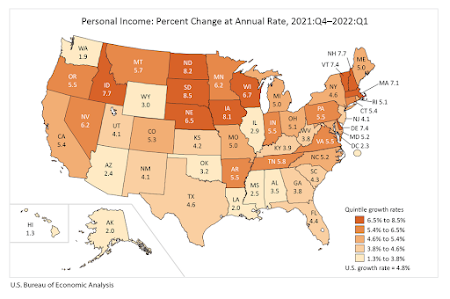
See Wisconsin in the dark orange? That means we were in the top 10 out of all the states for income growth in Q1 2022, at 6.7% income growth (annual rate).

Given that Iowa, the Dakotas, Nebraska and Minnesota also scored high, I had suspicions over why the increase was so much. And indeed, farm earnings took a big jump in the Heartland for the first 3 months of this year.

Change in farm earnings (annual rate), Q1 2022
Iowa +$1.56 billion
Minn +$1.34 billion
Wis. +$1.28 billion
Neb. +$1.08 billion
S. D. +$0.73 billion
N.D. +$0.59 billion

But while that amount of earnings is large among all of these states, Wisconsin also got a lot of increased income from other areas, and had non-farm earnings give a bigger contribution to the gains than any of these other 5 states.

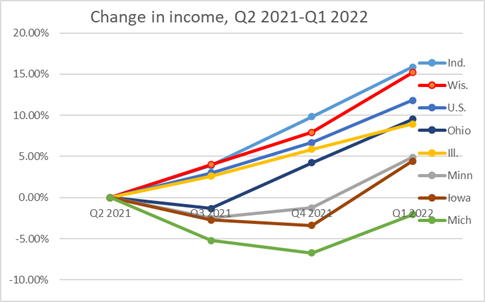
This report also had revised figures for all 4 quarters of 2021. Every state had a big jump in income in Q1 2021 and then dropped off severely in Q2 of last year because of stimulus checks that were sent out in March, so I think it’s fair to start from Q3 and look at how Wisconsin’s income growth has fared vs other states in the 9 moths measured since then.

When you do that, you’ll see that Wisconsin did quite well for income growth, beating the US average in all 3 quarters, and up more than 15% (annual rate) in that time.

Yes, inflation eats away some of those gains. But still about half of those gains are real, which may help explain why state tax revenues continue to fly by estimates and adding to our already-massive budget surplus.

Economic issues seem pretty trite to discuss after what's been going on in this country the last 2 days. But these numbers for Wisconsin might give a good indication why I'm not seeing any evidence of the "recession" theme that so many in GOP/media want to spin. Because things looked pretty darn good on the income side here, at least through March.

Tuesday, June 21, 2022

Ron Johnson - buffoon and accomplice to 1/6's plot

I was expecting that there would be some Wisconsin connections mentioned in today's hearing of the January 6th Committee. Especially since this meeting was focusing on the scheme to use state officials to overturn the election, and we know that Wisconsin Republicans sent a fake slate of electors to DC as part of the plot to overturn the election.

But I wasn't expecting this.

WHAT THE WHAT?

And this wasn't some random coffee boy trying to talk big game. This guy is Ron Johnson's Chief of Staff, and had worked 5 other years for RoJo before spending a year in Trump World.

Nice ALEC gig right out of college, by the way. It's a Big Club, and we ain't in it.

As part of today's hearing, WisGOP state officials were playing dumb about what was going on between November 2020 and January 2021, and claimed it was a White House production. Including this hilarious moment.

Sen. Johnson's staff quickly went into deflection mode.

Does that make a lick of sense to you? Me neither.

And then RoJo himself ran into CNN reporter (and UW grad) Manu Raju and other Capitol reporters, and after being called out for faking a phone call (!), tried the same "I know nothing" BS.

Because who among us hasn't passed along an unvetted package to the VICE PRESIDENT OF THE UNITED STATES on a day the potential for violence and tension was already high?

Oh, and let me remind you that on January 6, 2021, the Chair of the Senate's Homeland Security Committee was....Ron Johnson. And he's randomly just sending documents over to the VP's office without knowing what it is? Give me a f_ing break.

I had always figured Ron Johnson was fine with the plot to overturn the election, given that he was hanging with the My Pillow guy and threatening to vote against certifying the results of the election before 1/6.

What's amazing is that I wasn't expecting RoJo to be the WisGOP member of Congress that got named as being in on the plot today. The Chair of the Wisconsin Dems for the 5th Congressional District reminds us of another evil prick that helped this scheme along.

And also don't forget this part in the lower chamber of the Legislature, and how it comes back around to our senior US Senator.

I want subpeonas and perp walks for these scumbags. By the 4th of July. There's more than enough here.

Monday, June 20, 2022

Gas tax holiday? It's a gimmick, and Biden and Evers should both do it

As the 4th of July looms in 2 weeks and gas prices remaining high, the Prez is thinking of making a move to bring those prices down ….a bit.
President Joe Biden said Monday that he's considering a federal holiday on the gasoline tax, possibly saving U.S. consumers as much as 18.4 cents a gallon.

“Yes, I’m considering it,” Biden told reporters after taking a walk along the beach near his vacation home in Delaware. “I hope to have a decision based on the data — I’m looking for by the end of the week.”…

The Biden administration has already released oil from the U.S. strategic reserve and increased ethanol blending for the summer, in additional to sending a letter last week to oil refiners urging them to increase their refining capacity. Yet those efforts have yet to reduce price pressures meaningfully, such that the administration is now considering a gas tax holiday. Taxes on gasoline and diesel fuel help to pay for highways.

The Penn Wharton Budget Model released estimates Wednesday showing that consumers saved at the pump because of gas tax holidays in Connecticut, Georgia and Maryland. The majority of the savings went to consumers, instead of service stations and others in the energy sector.
I’m generally not a fan of such gimmicks, because you’re taking quite a bit of money out of highway funds, and you gotta make that up somehow. But I’d argue that June 2022 is a good time to do it for 2 reasons.

1. As part of last year’s Infrastructure Bill, the Highway Trust Fund got a one-time shot of $118 billion in General Fund revenues (aka – not gas taxes or registration fees). That’s nearly triple the revenues it gets in a typical year, and so that Trust Fund can handle not getting a few billion of gas taxes for a month.

Of course, that would accelerate the dwindling of the Highway Trust Fund over the next 5 years. But those funds can always be found from numerous sources, and kicking the can down the road shouldn’t be front of mind when you have to deal with gas prices NOW.

2. The infrastructure bill means we are setting aside more money to fix highways and fund transit as it is, and there won’t be a need to cut those projects in 2022 even if there aren’t a few weeks of gas tax revenue.

Again, not having that money in the bank now means you may not be funding everything you planned in 3-4 years. But honestly, so what? A main point of the infrastructure bill is to accelerate things that were supposed to happen later anyway.

So I think a federal gas tax holiday, combined with oversight that makes sure the savings are passed onto consumers, would be something that could be decent policy for the next few weeks. I also think this could be done at the state level in Wisconsin, in a couple of different ways.

The first reason a state gas tax holiday (of some amount) can work is due to the infrastructure bill. Remember that Wisconsin is getting $283 million in additional highway funds for this fiscal year, which is around what the state is slated to collect in gas taxes for 3 Summer months.

Now, you wouldn’t want to avoid adding to the number of road projects, but perhaps cutting the state’s 32.9 cent gas tax in half for the Summer or dumping it entirely for 1 month could work out. There would still be enough funds available to fix more roads and give relief at the pump for drivers in Wisconsin.

That could be done through Governor Evers ordering the Wisconsin Department of Revenue not to collect gas taxes for a certain time period (what, is someone going to sue to make them add price to the pump?) The other way a Wisconsin gas tax holiday could be done in Wisconsin would be for Evers to do something that makes the GOP Legislature put up or shut up.

Evers could call a special session that has one simple purpose – to send a small portion of the state’s $3.8 billion budget surplus to the state’s Transportation Fund, replacing the loss of funds that would result from a gas tax holiday.

This would make the Legislature have to choose between giving Governor Evers what he wants (but also looking decent to voters themselves), or having another issue where they do nothing, giving Evers and Dems an attack angle of “those gerrymandered GOPs won’t do JACK about gas prices. They don’t give a damn about how Wisconsinites are hurting.”

Again, I admit that it’s a gimmick to have a gas tax holiday. I’ll add that I think it is bad policy when we already have longer-term challenges in funding our roads and other transportation needs at both the state and federal levels. And that work needs to resume in a couple of years as those funding challenges will come back to a head.

But in this time of what seems to be a temporary and bullshit spike in gas prices, and with DC’s infrastructure bill giving a fiscal cushion while allowing for more road investments to continue, it can work. I’d say both Biden and Evers should do it, and announce it this week before 4th of July travel ramps up.

Evers can get an extra benefit of bringing more anger against the gerrymandered GOP Legislature. It would go along with a campaign theme that Evers and WisDems really do care about the issues facing Wisconsinites, while GOPs are Big Liars who’d rather play games than solve problems.

So DO IT, Tony!

Sunday, June 19, 2022

COVID cases, community levels dropping in Wisconsin. But some severity still happening

Hadn't mentioned the trends in COVID cases in Wisconsin in a while, so wanted to briefly touch on that.

The good news is that the number of new reported COVID cases in Wisconsin continues to fall, although the 7-day average is still elevated, at nearly 1,400 cases.

It also looks like the number of Wisconsinites hospitalized has plateaued after rising through much of May. Combined with the decline in reported cases, this has led to the number of counties with “high” community levels falling from 18 at the end of May to 4 today, with a majority of counties now listed as having “low” levels.

But the higher hospitalizations of May are now translating into more COVID deaths than had in April. It’s still nothing near what we had at the start of 2022, and similar to what we were at this time last year. But it's also not single digits, and we're still seeing 4-5 Wisconsinites die every day from this virus.

Perhaps the lower number of (reported) cases and good weather of recent days are going to lessen the chances of more COVID cases and deaths, at least through the next few weeks. But as we've seen far too often, just when we think we've seen the final downturn, some goofy variant comes along to annoy us further. So it's at least worth staying aware of the numbers, even if they're not the headline-grabbers that we saw in other times.

Housing starts crash! But more houses are now available, and might become more affordable

For the "recession is coming" crowd, Thursday's report on new housing starts in the US was a big piece of evidence for their case.
Privately‐owned housing starts in May were at a seasonally adjusted annual rate of 1,549,000. This is 14.4 percent (±8.9 percent) below the revised April estimate of 1,810,000 and is 3.5 percent (±10.7 percent)* below the May 2021 rate of 1,605,000. Single‐family housing starts in May were at a rate of 1,051,000; this is 9.2 percent (±11.0 percent)* below the revised April figure of 1,157,000. The May rate for units in buildings with five units or more was 469,000.
UGH!

Yes, April was revised higher to the most (seasonally adjusted) housing starts in 16 years, but 1,549,000 is still the lowest amount of starts in 13 months, and it may make some people wonder if an already-frothy housing market might be boiling over into a 2006-style decline.

On the flip side, the higher amount of housing starts from prior months are becoming homes that are ready to be moved into.
Privately‐owned housing completions in May were at a seasonally adjusted annual rate of 1,465,000. This is 9.1percent (±22.6 percent)* above the revised April estimate of 1,343,000 and is 9.3 percent (±19.0 percent)* above the May 2021 rate of 1,340,000. Single‐family housing completions in May were at a rate of 1,043,000; this is 2.8 percent (±13.6 percent)* above the revised April rate of 1,015,000. The May rate for units in buildings with five units or more was 417,000.
That's a good sign to me, as more inventory is something that many have been calling for as home prices in America increased by more than 20% year-over-year. And it also shows that home construction workers have been plenty busy, so the lack of starts shouldn't lead to layoffs in the near future and may actually result in a bit of relief to get things back towards balance.

The decline in housing starts came in a month when the Federal Reserve gave its first increase in interest rates off of the rock-bottom levels we had seen for the last 2 years. Now that the Fed has raised rates by another 75 points this month, with more likely to follow. So if you're pessimistic, you will likely have concerns about whether higher costs of borrowing are going to combine with already-inflated housing prices to slam the market like we're back in 2006 or 2007. And you know what followed 2006 and 2007....

With that situation in mind, let's look at the stats from the Wisconsin Realtors Association on our state's housing market. Wisconsin has also seen a significant runup in housing prices in recent years, with the median sale price reaching $275,000 in May 2022, which is more than $125,000 above where it was 8 years ago, and over $100,000 more than it was 5 years ago.

This graph from the WRA shows how year-over-year sales prices have risen by sizable amounts since 2017, with noticeable gaps for each of those years.

Conversely, even though there are more home sales in Wisconsin as the weather warms and the school year ends, you can see how Wisconsin's stronger sales in January and February over the last 2 years have flattened out in the months after that (2022 is the thicker black line, and 2021 is the thicker red line). That's a noticeable contrast to the 2010s, where sales took off with the weather.

Here's another way to look at how things have flattened out in March, April and May in the 2020s, by comparing how many more sales happened in those months vs the low-sale month of January. Look at how the gap between years blows up.

My question is "is this a bad thing"? Wages in Wisconsin certainly have not gone up 59% in the last 5 years like median home prices have, and now the higher rates makes those higher prices even less affordable. Some reversion should be expected as a result, and perhaps the higher inventories will also help home prices to come closer to something that more Wisconsinites can safely accept.

The question to me is how far this housing market falls, and how fast. If there's a slight, gradual decline over 12 months, that might be something that not only doesn't affect the wider economy, but actually is welcomed and turns us back toward a more affordable, balanced market. But if people aren't able to pay their mortgages or the construction industry stops quickly and sharply, then we would see a crash in prices and/or demand that becomes a much worse situation, and could shove the economy over into recession.

I think more Americans are locked into lower rates and/or cash vs the 2000s, so that makes me think any damage would be limited compared to the Great Recession. But the coming months will tell us a lot, and I have definite fears that the Fed's is going to raise too much, too fast"" in a time when our overheated housing market is already set to slow down.
Saturday, June 18, 2022

Same old jobs story in Wisconsin - some gains, but maxed out at sub-3% unemployment

Following the trend in the country as a whole, Wisconsin’s job market followed the US jobs trend higher in May.
The Department of Workforce Development (DWD) today released the U.S. Bureau of Labor Statistics (BLS) preliminary employment estimates for the month of May 2022, which show the number of Wisconsinites employed at a historic high of 3,059,300. The data also show an increase in Wisconsin's total labor force for the sixth consecutive month.

• Place of Residence Data: Wisconsin's labor force participation rate was 66.5 percent in May, unchanged from April, and 4.2 percentage points higher than the national rate of 62.3 percent. Wisconsin's unemployment rate in May was 2.9 percent, up slightly from April's historic low due to an increase in active participants in the labor force.

• Place of Work Data: Wisconsin total nonfarm jobs increased from April 2022 to May 2022 by 2,200 while private-sector jobs increased by 1,800 over the same period.
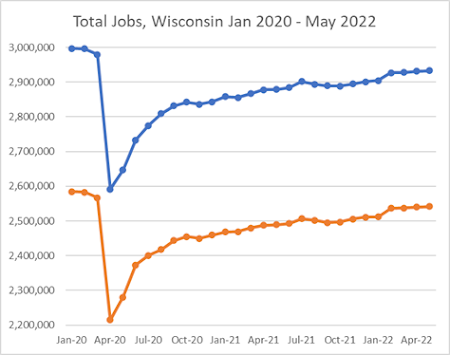
Both “employment” and jobs have grown by decent amounts in the year since most Wisconsinites were able to be fully vaccinated, although the number of jobs has yet to reach the pre-COVID peaks like the number of workers has.

The difference between "employment" growth and job growth may not necessarily be a bad thing either, since wages and supports may be strong enough these days so that some people don’t have to have multiple jobs.

There is a bit of concern in that construction and manufacturing had a seasonally-adjusted decline in jobs for May. But that also seems to be a reflection of lower-than-normal seasonal hiring.

Job change, Wisconsin May 2022
Construction
Raw increase +4,900
Seasonally adjusted -1,700

Manufacturing
Raw increase +400
Seasonally adjusted -1,200

We saw a similar story in Leisure and Hospitality for May (+16,600 raw increase, +200 seasonally adjusted), and the low unemployment rate will make Summer hiring even more difficult to fill. And if we truly are maxed out on the number of people available to work, we may see job growth may “decline” or "stagnate" in months where employers can’t hire as many people as normal.

But even with another 54,500 jobs added in the state since May 2021, Wisconsin's 1.9% rate of job growth is less than half the 4.5% rate of growth the nation has seen in that time period. And with 2.9% unemployment in a state that has labor participation more than 4% above the national average, it makes me wonder just how many more jobs can be added in the state today.

June’s report should be intriguing to see if the gap for Summer employment is able to be closed, and why they might or might not be closed (needs lessen? More hiring? Or can’t find people to work at a certain wage rate?). We know for sure that Wisconsin still had a tight labor market in May, and those imbalances aren’t likely to all go away in one month.

It also tells us that the longer-range challenge for the state is to get people to locate to a cold-weather place that traditionally hasn't paid as much as nearby big markets like Chicago or the Twin Cities. And a regressive Legislature that seeks to outlaw abortion and is outright hostile to public education isn't going to get anyone with talent to want to move here, so getting rid of those bums (and certainly not having them in the Governor's Office signing more bad laws) is necessary in order to increase this state's economic potential.

Friday, June 17, 2022

Gas is tight in US today, but it's been tighter before. With Friday's oil crash, we better see relief soon

Wanted to do a quick check back on gasoline usage and supply in America, now that we have a full week of data in after Memorial Day. Sure enough, after a rise over the Holiday weekend due to pre-planned trips, US gas consumption went back down to the lowest non-pandemic level in 8 years.

What also is at its lowest level in several years is the availability of gasoline, which would justify some runup in price. But you'll also notice that supplies were tighter this time of the year in both 2014 and 2015.

But the price at the pump in 2014 and 2015 was under $4 a gallon instead of heading toward $5.

In fact, June 2014 is when that last peak happens, with prices plummeting below $3 gallon by the end of that year and not coming back above it again until 2021. But to fair, things are different today...as we're also pumping out nearly 100 million more barrels a month than we were in June 2014, and US gas usage is lower now than it was in 2015 or 2016, when prices were in the low $2s.

Doesn't really add up, does it? Tells me that a lot of this oil/gas runup is out of whack with reality, and today's action in the oil markets underscored my instinct that this is BS.
Oil prices tumbled about 6% to a four-week low on Friday on worries that interest rate hikes by major central banks could slow the global economy and cut demand for energy.

Also pressuring prices, the U.S. dollar this week rose to its highest level since December 2002 against a basket of currencies, making oil more expensive for buyers using other currencies.

Brent futures fell $6.69, or 5.6%, to settle at $113.12 a barrel, while U.S. West Texas Intermediate (WTI) crude fell $8.03, or 6.8%, to settle at $109.56.
Those "worries" is how Wall Street media describes "speculation", and I strongly suspect that's a lot of what has been driving the oil and gas markets, to the delight of oil/gas companies who get to pull in big profits on the higher prices without having to invest much more (if anything).

Given today's crash in oil prices, I would hope that means we see gas prices level off and possibly start falling by the 4th of July. It certainly warrants a closer eye on what these companies and their distributors are trying to get away with, and will likely try to continue to get away with in the coming months.

Gven how those companies would love to have Koched-up GOP Congress members be able to cut off Biden Admin attempts to reduce our usage of fossil fuel, I also wouldn't doubt some of the recent action is the oil markets has political motivations. And if I was a Dem running for office in 2022, I'd be loudly reminding people that the rise in gas prices has been due to corporate and Wall Street greed, and that pump prices should go down based on this week's crash in oil and the drop in demand.