Monday, August 22, 2022

Wisconsin nurses can't get licensed because of WisGOP sabotage

There’s been an issue looming in recent months, and I wanted to dig into it at various points. But because I have a real job and a real life, I didn’t put it all together into a post.

And then Corinne Hess of the Milwaukee Journal-Sentinel ran an in-depth article this morning describing how Wisconsin nurses are losing opportunities because they can’t get their licenses from the state.

Wisconsin nurses have been making calls, sending emails and faxes and hearing nothing back for months as they wait for the state to issue them licenses.

They're frustrated and eager to work in a high-demand industry, but stymied by slow approvals at the state Department of Safety and Professional Services.

The delays have resulted in political finger-pointing between GOP legislators and the administration of Gov. Tony Evers, a Democrat. And it's been seized upon as a potential issue by Evers challenger, Republican Tim Michels.

Since the Milwaukee Journal Sentinel reported on the delays Aug. 18, several nurses and other health care professionals have come forward to discuss the impact on their lives. They waited months, been suspended from work after training or unable to advance their careers because the hold up at the agency.
And that’s not an acceptable situation, especially in nursing where there is an alarming shortage of available help for people who can’t wait on services.

But I got furious when I saw Republicans trying to use this as some kind of cudgel against Governor Evers. Because it’s Republicans in the Legislature that have gotten in the way of any attempts to solve this problem.

The nursing shortage was discussed at a committee meeting at the Capitol 3 weeks ago, and featured these bits of information, which showed less staffing at DSPS, and a ton of money locked away that could be used to staff up.

In addition to the $36 million that is sitting around in that DSPS account, do you also see the $1.5 million that is being sent to the state’s General Fund? The same General Fund that is projected to have nearly $5 BILLION in the bank when we get the year-end revenue figures in the next couple of weeks?

That $1.5 million that gets funneled to the General Fund could be kept with DSPS, and pay for temporary help to clear the backlog, getting these qualified workers licensed and able to help the best they can.

But approving that funding change and those new jobs would require the full GOP Legislature to end the paid vacation they’ve been on since March, so that’s not happened. But the GOP’s BS double-talk on this issue goes well past doing nothing today. Governor Evers wanted to speed up licensing at DSPS 18 months ago, and the GOPs blocked him.

Take a look at this Legislative Fiscal Bureau budget paper from Winter 2021, which described what Evers wanted to do in the last state budget to improve DSPS’s license staffing.
1. [Evers’ proposed State Budget] would provide $907,900 PR in 2021-22 and $1,178,100 PR in 2022-23, and 14.0 PR permanent positions, beginning in 2021-22, and 2.0 PR two-year project positions beginning October 1, 2021, to increase staffing for DSPS. The attachment shows the division, position title, and associated funding for each. The 2.0 project positions and 8.0 of the permanent positions would be provided to support [the Division of Professional Credential Processing], with corresponding funding of $537,100 PR in 2021-22 and $689,200 PR in 2022-23.

2. Four of these positions -- the 2.0 license and permit program associates (LPPAs) provided on a project basis and 2.0 of the paralegals -- would work to process health credentials, such as physicians and registered nurses. The Department indicates that it receives an annual surge in applications for these credentials in May through August, corresponding with college graduations. During this time, DSPS estimates that workload exceeds the health team's normal staff capacity by 45%, or approximately the equivalent of 5.5 full-time positions. DSPS indicates that the additional paralegals would improve capacity to handle the more complex credential types, such as physicians. The LPPAs would increase the agency's capacity to receive and process applications and other required documents, process national and state examination scores, review applications, and respond to questions and concerns from applicants. DSPS also indicates that improving processing time would increase efficiency for the team as a whole by reducing the number of calls from applicants inquiring as to the status of their application.
Evers also wanted to add 4 more positions to DSPS’s customer service call center in the budget, to allow for easier access to those with questions. All of these positions would have been paid for with license fees and other Program Revenue – ZERO tax dollars.

The GOPs on Joint Finance didn’t want that to happen, and drastically cut back on Evers’ request. They only allowed half of the 4 health-related licensing positions to be added, and only approved 1 of the 4 new call center jobs.

And now these GOP jackwagons are complaining about delays in those licenses being filled? Spare me the crocodile tears, and let’s call it what it is.

Which is how GOPs roll. They try to tie the hands of any Dems in charge, and then when problems inevitably don’t get solved, they squawk to the media that “Dems can’t govern. We shouldn’t license nurses/other jobs anyway,” and other BS.

I got hot when I saw where this was going, because if there’s something I can’t stand in politics, it’s cynical, dishonest stuff like this. It assumes voters are stupid, and it’s adolescent garbage from people who know better.

So I said a few things this morning on the Twitter machine that I’ve mostly repeated in this post. And it got the notice of the Big Guy at the DPW.

Thanks Ben. GOPs are counting on voters not understanding why nurses can't get licensed, but they're not counting on those voters to understadn why, We can’t these GOP lowlifes off the hook for the problems that they have ACTIVELY CHOSEN NOT TO DEAL WITH.

Sunday, August 21, 2022

July jobs mixed in Wisconsin. Still feels maxed out, and different from pre-COVID

Late last week, the Wisconsin jobs report for July came out, and it presented a mixed bag.

Wisconsin Jobs Report July 2022
Payrolls Survey
All jobs +9,900
Private Sector Jobs +10,000

Household Survey
Labor Force -9,000
Employed -10,700
Unemployed +1,700
Unemployment rate +0.1% to 3.0%

3.0% unemployment is still a pretty good place to be, but it does seem like the state might be maxed out on the number of people who are available to get jobs. Both labor force and the number of Wisconsinites identifying as "employed" peaked in May and have fallen back to where they were at the end of 2021.

On the payrolls side, perhaps the data is catching up to the gains we saw in the household survey earlier in the year, as DWD reported that (seasonally adjusted) payrolls had been flat for the 4 months before July, while the household survey was saying more Sconnies had jobs.

Payrolls Survey
Feb-June 2022 +1,100
July 2022 +9,900
TOTAL CHANGE +11,000

Employed, Household Survey
Feb-May 2022 +10,400
June 2022 -6,600
July 2022 -10,700

TOTAL CHANGE -6,900

So which one is correct? Hard to tell, and complicating the matter is that July is a time of peak Summer tourism and other seasonal employment, so it throws off the "seasonally-adjusted" totals, since it is assumed that there will be more people working in Wisconsin in many industries in Summer than in Winter.

No better example of this than in the two main areas of the "Leisure and Hospitality" industries. Both industries have hired up thousands in the state in the last 4 months, but you can see where the seasonal adjustment deflates those numbers in the official jobs reports.

I view this as a good sign, as perhaps shortages are still getting filled, even though total employment in the Leisure and Hospitality sector is still not back to what it was here (down 16,700 from January 2020). But that doesn't mean things are completely back to pre-COVID normal...or might ever be. These three stories in the past week were a bit alarming, with popular, well-known restaurants announcing that they would not carry on.

After nearly a quarter-century, one of the Food Fight Restaurant Group’s first entries into the Madison dining scene is shutting down. On Wednesday, the company announced Eldorado Grill would be closing at the end of the month.

Food Fight CEO Caitlin Suemnicht attributed the company’s decision to shut down the Southwestern restaurant, which is located on the isthmus, to staffing shortages and customers not returning after the pandemic in the numbers they needed.

Jim McCabe opened the brewpub in 1997. Known for its craft beer and elevated pub fare, Milwaukee Ale house is located along the Milwaukee River, at 233 N. Water St.

“Unfortunately, we lease this famous space, and the building owners have decided to go in a different direction. Our lease is expiring and our last day at this location will be September 11, 2022,” said a Facebook post uploaded Monday night.
News of the Milwaukee Ale House closing comes as a sale is pending for its parent company, Milwaukee Brewing Company. The asset disposition firm New Mill Capital is handling the sale of the production brewery at 1128 N. 9th St. inside The Forty Two complex, Urban Milwaukee previously reported. The Ale House and El Dorado closings are especially bad to me, as I have had plenty of good times in both places. But you'll note that "lack of demand" is often not listed as a main reason in these stories, but is instead some combination of landlord/rent concerns, lack of staffing, or a "changed environment" in the industry (more takeout, less in-house drinking, for example).

Those stories also indicate to me that that we're not done with post-COVID adjustments, especially in the service industries. Combine that with a state that seems to be at maximum employment given its current demographics, and it feels like we might be more in "maintain" rather than growth mode for a while.

That beats recession with large-scale job loss, and it's much better than we were at the start of 2021, but it also should make us recognize that attracting talent and younger workers through quality of life needs to be the next step in Wisconsin's economic strategy.

Saturday, August 20, 2022

Retail sales a mixed bag in July, but lower prices should be on the way

With the drop in gas prices in July, it was going to be interesting to see how consumers reacted to that, and what happened to their spending. And a report from (Wednesday) seems to be evidence that Americans picked up their shopping in other areas.
U.S. retail sales were unexpectedly unchanged in July as falling gasoline prices weighed on receipts at service stations, but consumer spending appeared to pick up at the start of the third quarter, further assuaging fears the economy was in a recession.

Declining gasoline prices, however, freed up money for spending on other goods, including furniture, electronics and appliances, as well as building materials and garden equipment….

Last month's flat reading in retail sales followed a downwardly revised 0.8% increase in June. Retail sales in June were previously reported to have advanced 1.0%. Economists polled by Reuters had forecast that sales would gain 0.1%, with estimates ranging from as low as a 0.3% decline to as high as a 0.9% increase. Sales rose 10.3% on a year-on-year basis in July.

Retail sales are mostly goods and are not adjusted for inflation. The retreat in gasoline prices from record highs in July resulted in goods prices falling 0.5%. That means inflation-adjusted retail sales increased 0.6% last month.
The June downward revision is a bit of concern, but “core” retail sales in July (which excludes care-related sales and purchases at gas stations) jumped by a healthy 0.7%.

Much of that was driven by a big increase in Non-Store (Amazon and other online-only) retailers, and an increase in building supply/garden store sales (although it’s actually lower-than-normal Summer declines).

Biggest gainers, Retail sales report July 2022
Non-Store Retailers +2.7%
Building materials/garden stores +1.5%
Misc. Retailers +1.5%

That’s a similar trend to what we saw as the COVID World first set in, as people spent more time at home and bought items to fix up their homes. But furniture (+0.4%) and electronics/appliance stores (+0.2%) didn’t see the large jumps that those places had in 2020, so I don’t think there's been that much of a reversion to spending habits of 2020 and early 2021.

What also didn’t rise much is spending at grocery stores, despite “food [to be used] at home” prices going up another 1.0% in July. The sales increase for July at food and beverage stores was only 0.2%, and their 8.4% increase in sales over the last 12 months is well below the 13.1% increase in prices for “food at home” in that time. This indicates to me that there is some kind of “downshifting” in what Americans are buying (or how much they are buying) that the CPI report doesn’t account much for.

In previous months, this trend had been offset by noticeably higher sales at bars and restaurants. But that's been leveling off a bit in recent months.

To be fair, this could be a seasonal blip, as the Census Bureau’s models count on a sizable increase in bar/restaurant spending in July (July 2022 had a 3% increase in raw sales vs June).

I also want to note the sales at big box stores, which are telling a story that is similar to what grocery stores are seeing. People are limiting their spending there, while non-store retailers are continuing its impressive COVID-era rise in sales.

It means that people aren’t spending as much at your Sam’s Clubs and Costcos, and it seemed to be resulting in a large increase in the inventory-to-sales ratios at several types of stores as we hit the halfway point of 2022.

In theory, this higher inventory should lead to some lower prices for consumers to take advantage of, and will lessen inflation. And we should ask some serious questions if that doesn’t prove to be the case in the next couple of months.

I think this retail sales report is fine, although a bit uneven. With gas prices going even lower in August, let’s look and see if more of an adjustment was made by Americans into other types of spending, and if back-to-school sales come in strong as a result.

If so, I think that can put any type of “recession” concern to bed, and that our bigger worry should be in figuring out how we can continue to staff all these stores to keep up with the demand in a time of multi-decade lows in unemployment.

Friday, August 19, 2022

Petty WisGOPs have a problem with a Guv who wants to help opiod addicts and clean the water

The Legislature’s Joint Finance Committee met earlier this week and approved several items that reallocated funds for items that had come up over in recent times. At the end of that meeting, State Sen. LaTonya Johnson asked about whether the Committee was going to do anything about $31 million that the state is receiving as part of a settlement with opiod manufacturers.

Here’s a look at the Evers’ Administration plan what those funds would go to, with treatment and prevention part of the work.

Sen. Johnson mentioned that the JFC had to decide whether to accept that plan this week, or to block it and/or come up with one of their own to vote on. Guess what the GOP-controlled committee chose to (not) do.
Committee co-chairs state Rep. Mark Born, R-Beaver Dam, and state Sen. Howard Marklein, R-Spring Green, released a statement after the committee objected to the plan. “Fighting the opioid epidemic has been a priority for Wisconsin Republicans for over a decade. We remain committed to ensuring our communities have the resources they need to help those with opioid use disorders and their families," they wrote.

“We have been working with stakeholders to ensure that we are investing in impactful programs without duplicating our efforts. We will swiftly improve the plan to promptly distribute these funds to help combat the opioid crisis that continues to ravage our state.”
Let’s not forget that the only reason Wisconsin is getting any funds from the opiod manufacturers at all is because Josh Kaul got elected Attorney General in 2018, and joined multi-state lawsuits that former GOP AG Brad Schimel refused to be part of.

So these aids only are available to Wisconsinites because a Democratic AG got involved, and the Dem Governor wants to get that assistance out to Wisconsinites, but are being blocked by Republicans on Joint Finance because….?? Well, we know why.

In addition to the fact that Republicans are corrupt are want to shield their Pharma donors from paying anything for the damage they caused, approving these funds would allow Governor Evers to be shown helping people. So GOPs want to keep that from happening in the hopes that voters can be upset enough to want to throw out the Governor in November.

Don’t believe me? Look at how pissy GOP JFC member Duey Stroebel got when the Governor announced that he was using $10 million in stimulus funds to clean up drinking water in Wisconsin.

So in WisGOP World, Gov Evers shouldn’t use funds that have already been sent to this office to stabilize and improve things to clean up drinking water? Cleaning up water is as basic a governmental function as it gets, because it keeps individuals from paying big money to remedy contamination that many of them didn’t have anything to do with.

This garbage only continues until Republicans pay a price for playing these games over doing anything for everyday Wisconsinites. These lowlifes are still power-drunk, and feel their gerrymander insulates them from being accountable to the voters that pay their salaries (salaries that continue despite the Legislature’s 10-month vacation for actual legislating).

And the WisGOP legislators that aren’t on Joint Finance are as guilty as the ones that “serve” on it, because they aren’t doing anything to tell their colleagues to break the logjam, step up, and help the Wisconsinites who are in need. Don’t let them slink away, and ALL should be considered bad, no matter how “independent” they claim to be.

Wednesday, August 17, 2022

Good MU Poll results for Dems...and better when you dig into it

To me, the significance of the Marquette Law School polls in this state is because news organizations run with the results and use it to shape their coverage. It's why I'm often touchy about a lot of it (especially given the connections between the Bradley Foundation and Marquette Law), because poll results are such a big part of how we cover elections, and how far too many voters decide what they should do.

But I respect the depth of information that accompanies the numbers. And now MU Law's first post-primary poll of Wisconsin is out, with it containing this pleasant surprise.

I was expecting Barnes to be ahead in this poll, but not by that much. And the reasons why are good signs if you want Ron Johnson to get the boot.

And people like Mandela (with more people gaining a positive opinion of him over the last two months), and a whole lot of people don't like Johnson.

That'll make it harder for Johnson/WisGOPs/oligarchs to knock down Mandela with ads, and Johnson's hateability makes it harder to keep him around for a third term.

On the flip side, the MU Poll on the Governor's election was closer than I thought it would be.

I'm very skeptical of that 7% for Joan Beglinger - a person I had never heard of until today, yet somehow is leading among the 9% of "true independents" that MU Law polled? I'm gonna bet most of those people fall towards Evers, they just don't want to admit that they have to choose among a 2-party system for them to get what they want.

And that Beglinger BS helps to explain how Michels "closed the gap" on Evers - it wasn't because a lot of indys (including those who lean toward one party or the other) chose to switch to Michels.

Voters aren't disliking Evers - he's more liked now than he was two months ago, and people still think he is doing a good job.

When you realize that more than 1/5 of independents haven't chosen between Michels and Evers, it sure seems that Evers would have the edge when you look at what independents think about issues.

And Michels' stated desire to keep abortion outlawed in Wisconsin isn't going to help him win independents. They support abortion rights 3-to-1, with 95% of them disagreeing with Michels position of "no abortions at all."

I also can't think that independents would be in favor of Michels' support of the Big Lie. Or the fact that Michels rode Trump's endorsement to a primary win.

This also was an interesting breakdown.

That 4-point lead among those "certain to vote" tells me Evers does better among those who are paying attention, while less involved Wisconsinites are more likely to think Michels is some kind of "generic Republican" that wouldn't change a lot if he was elected. They are wrong on that, DEAD WRONG, and I'm betting that won't help Michels once voters find out.

I also think there's a post-election bump that helps both Barnes and Michels. People like seeing a winner, no matter the level of election, and they're both non-incumbent faces that haven't had a lot of investigation from some casual voters.

My guess is that you can take about 4 points off of both candidates, which makes it Evers by 6 and Barnes by 3, and that's pretty close to the baseline case right now. Lot of way to go in the next 83 days, and you can bet there will be a lot more twists and turns and flat-out BS, but I'd rather be the Dems than the GOPs today, and not just because I want this state and this country to remain something that I recognize and care for.

Tuesday, August 16, 2022

WisGOPs thinks competing on drug prices is bad because...of BS and corruption

I was trying to figure out how WisGOPs were going to try to say how Americans paying lower drug prices would be a bad thing. And so Paul Ryan's Coffee Boy obliged over the weekend....after pathetically dodging a question about the disgraced former president.

And sure enough, our Dumb Senator followed with the same theory.

During an interview on Monday, Fox radio host Brian Kilmeade told Johnson that allowing Medicare to bid on drug prices would be "bad" even if it lowers costs.

"The industry is going to pay a huge price and we're going to pay the price on innovation," Kilmeade declared.

"Correct," Johnson agreed. "You're absolutely right. When you start punishing the pharmaceutical industry, you're going to have less innovation; you are going to have fewer life-saving drugs. That's not a good thing."
"Less innovation" is the first crock of crap - a whole lot of the initial R&D in treating the maladies come from government funded university research, such as the Drug Development Core at UW's Carbone Cancer Research Center. Only after those types of drugs and treatments are figured out do drug companies typically jump in with their development to perfect the drug, and how to market it.

And drug companies make plenty of money off of people's suffering with their "innovations". EVERY ONE of the top 20 drug companies in America had higher revenues in 2021 compared to 2020, and 5 of the 20 had revenue growth of more than 40%.

In addition, a whole lot of those dollars aren't plowed back into R&D, but instead are used to get more market share via mergers and jack up stock prices. Take a look at this story from last December.
Some of the biggest pharmaceutical companies, sitting on large and growing sums of cash, are funneling those funds into major share buyback programs and acquisitions of smaller biotech companies.

On Thursday, Swiss drugmaking giant Novartis announced plans to buy back up to $15 billion worth of its shares by end of 2023, a program it will fund with proceeds from the recent sale of its long-held stake in crosstown rival Roche for nearly $21 billion. Three days earlier, Bristol Myers Squibb announced a similarly sized share buyback plan for the next few years.

And after a relatively quiet year for dealmaking in the industry, there are signs the largest drugmakers are moving more aggressively toward acquisitions, particularly as a pullback in biotech company valuations makes potential deals less expensive. Pfizer recently agreed to buy Arena Pharmaceuticals for $6.7 billion, while Merck & Co. in late September announced an $11.5 billion deal for Acceleron Pharma.

By the end of next year, more than a dozen of the largest pharmaceutical companies will have more than $20 billion in cash, and six will hold between $30 billion and $70 billion, according to estimates from SVB Leerink, an investment bank.
I think those companies can afford to take a bit of a haircut while taking off pressure on Americans' checkbooks, don't you? And it saves Medicare money over the long run, so win-win, right?

So why would RoJo have such a problem with something that seems to be a good thing on many fronts?

Republican U.S. Sen. Ron Johnson, while serving as chairman of the Homeland Security and Governmental Affairs Committee in 2018, declined to subpoena Teva Pharmaceuticals as part of a Democrat-led investigation of the drugmaker’s role in the opioid epidemic. In the months to follow, Teva would donate to both Johnson’s campaign and an affiliated PAC.

The subpoena would have been on behalf of former U.S. Sen. Claire McCaskill, a Missouri Democrat and ranking member of the committee who was leading a probe into several drug manufacturers and distributors exploring the companies’ role in the epidemic.....

McCaskill’s investigation seemed to stall after Johnson declined to subpoena Teva — though litigation against the company from numerous states, including Wisconsin, continued.

In the year and a half after the public disagreement between Johnson and McCaskill, Teva’s political action committee made two donations, totaling $3,500, to Johnson’s campaign and an affiliated PAC.

On Dec. 5, 2018, Teva donated $2,500 to Johnson’s leadership PAC, Strategy PAC.
Ahhh yes, the other place big drug company profits go from "innovation" - right into the pockets of crooked politicians like Ron Johnson. Who then (ab)use their power to cover up their drug company donors from accountability.

Monday, August 15, 2022

Prices still elevated, but perhaps leveling? Already for gas, and food to follow?

After last week's report, is INFLATION WATCH on hold for a while?
U.S. consumer prices were unchanged in July due to a sharp drop in the cost of gasoline, delivering the first notable sign of relief for weary Americans who have watched inflation climb over the past two years.

The Consumer Price Index (CPI) was flat last month after advancing 1.3% in June, the Labor Department said on Wednesday in a closely watched report that nevertheless showed underlying inflation pressures remain elevated as the Federal Reserve mulls whether to embrace another super-sized interest rate hike in September.
"No increase in overall price levels" is great to hear, but it was heavily driven by gas prices going down by 7.6% in July. The big concern I have with the consumer inflation numbers is that while gasoline declined, food prices continued to rise.

And in reading the full CPI report, the Bureau of Labor Statistics says that's especially true for groceries, which are seeing double-digit price increases vs last year.
The food index increased 1.1 percent in July; this was the seventh consecutive monthly increase of 0.9 percent or more. The food at home index rose 1.3 percent in July as all six major grocery store food group indexes increased. The index for nonalcoholic beverages rose the most, increasing 2.3 percent as the index for coffee rose 3.5 percent. The index for other food at home rose 1.8 percent, as did the index for cereals and bakery products. The index for dairy and related products increased 1.7 percent over the month. The index for meats, poultry, fish, and eggs rose 0.5 percent in July after declining in June. The index for fruits and vegetables also increased 0.5 percent over the month.

The food away from home index rose 0.7 percent in July after rising 0.9 percent in June. The index for limited service meals increased 0.8 percent and the index for full service meals increased 0.6 percent over the month.

The food at home index rose 13.1 percent over the last 12 months, the largest 12-month increase since the period ending March 1979. The index for other food at home rose 15.8 percent and the index for cereals and bakery products increased 15.0 percent over the year. The remaining major grocery store food groups posted increases ranging from 9.3 percent (fruits and vegetables) to 14.9 percent (dairy and related products).
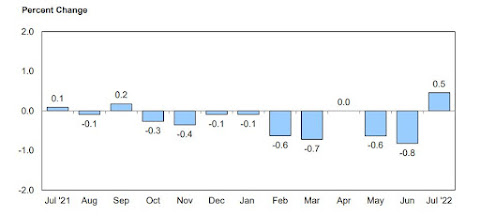
Which is why the topline foods stats in the Producer Price Index report was concerning, in that July’s numbers at the final demand stage rose.
The index for final demand goods fell 1.8 percent in July, the largest decline since moving down 2.7 percent in April 2020. The July decrease can be traced to a 9.0-percent drop in prices for final demand energy. Conversely, the indexes for final demand foods and for final demand goods less foods and energy rose 1.0 percent and 0.2 percent, respectively
But that same report also indicated that foods and other products had prices decrease further "up the line."
The index for processed goods for intermediate demand fell 2.3 percent in July, the largest decline since moving down 3.4 percent in April 2020. Most of the broad-based decrease in July can be traced to a 9.0-percent drop in prices for processed energy goods. The indexes for processed materials less foods and energy and for processed foods and feeds also moved lower, 0.2 percent and 0.1 percent, respectively….

Prices for unprocessed goods for intermediate demand fell 12.4 percent, the largest decline since moving down 14.4 percent in April 2020. Most of the broad-based decrease in July is attributable to a 21.2-percent drop in the index for unprocessed energy goods. Prices for unprocessed nonfood materials less energy and for unprocessed foodstuffs and feedstuffs also declined, 6.9 percent and 0.8 percent, respectively. For the 12 months ended in July, the index for unprocessed goods for intermediate demand increased 27.5 percent.

With that in mind, you would hope that top-line PPI and CPI for foods would also start tracking lower soon. It also appears that the futures markets are planning on food prices to level off and/or decline. Not only has there been selling in the current month contracts, but traders are also expecting prices to come down in future months.

I also want to add that while overall prices went flat in July, average hourly wages continued to rise. Which resulted in the first real increase in average hourly wages since last September.

We’ve seen nominal wage growth be consistently strong over the last 2 years, and it outpaced the increase in prices for the last half of 2020 and the start of 2021. The inflation got moving, and price growth has jumped well past the average wage increase, so that there was a big gap to start making up for this Summer (on a macro level, at least).

But US job growth continued in July, so labor demand is keeping up and likely will contunue wage growth going for the near future. If that can be passed ahead as part of prices, then that might keep inflationary pressures on (although I’d argue that wage/job based inflation is the “good type” vs an increased cost of supplies). If not, then this gap could start to narrow quickly.

Republicans may be rooting for recession, but I would think most reasonable Americans would rather have our current, brightening economic situation over that. And I dare other GOPs to take Ron Johnson’s cue and put Medicare and Social Security benefits on the chopping block, as a way to solve the “problem” of everyday Americans having more jobs, more money and raising their overall demand for products.

Yes, the high inflation of later 2021 and the first half of 2022 still lingers, and it is something that still is giving strain to quite a bit of Americans. We can’t ignore that reality, but let’s also admit that strong job and nominal wage growth is much better than a recession where jobs are being lost and people can’t afford their bills because of a lack of income vs higher prices (which are easier to adjust spending habits to).