Saturday, December 16, 2023

My school taxes are up, and yours probably are too. Let's see why

As mentioned earlier, we recently received notice of a sizable 6.7% property tax increase on our home. And the Wisconsin Policy Forum says while that's higher than the rest of the state, there are many other Sconnies getting a property tax increase.
On bills mailed out this month, Wisconsin’s 421 K-12 school districts will levy $297.8 million more in property taxes than they did last year, preliminary figures from the state Department of Revenue (DOR) show. The 5.4% increase is the largest since 2009, and will bring gross statewide K-12 property taxes to $5.77 billion (see Figure 1)....

The state’s 72 counties will increase property tax bills by 2.6% – third-most since 2009 – while technical college levies will rise by 4.9%, the most since 2008. Data for other local governments are not yet available, but the state Legislative Fiscal Bureau projects municipal levies will rise by 3.4% and tax increment districts by 13.6%. If those projections hold true, then gross local property taxes would increase by 4.7%, or the most since 2007.

To be fair, the Policy Forum notes that most Wisconsinites won't be paying a 5.4% increase in property taxes for their schools, because of state payments that knock down what property owners end up paying. In fact, those state aids give more help to owners of higher-value properties and higher property value parts of the state, even if they don't give extra resources to the schools in the process.
The DOR data represent gross property tax levies, meaning they do not account for a sizable increase in state credits that reduce net tax bills for Wisconsin residents. The 2023-25 state budget increases the school levy tax credit by $255 million, or 27%, on this December’s levies. The funds from these credits do not increase school spending. Instead, the additional state money is used to lower the net tax bills paid by property owners. The budget will also increase the state lottery credit by $15.9 million over what it otherwise would have been, producing a similar effect.

These provisions will help hold the statewide property tax increase much closer to those seen in the years preceding the pandemic – likely about 2% to 3% – while allowing a healthy increase in local revenues. The school levy credit is distributed based on how much in K-12 property taxes is paid in each community. As a result, the increase in the credit will deliver the most benefit to communities such as Brookfield or Madison with high property values, since they tend to pay more in property taxes for K-12 schools.
The higher property taxes led Assembly Speaker Robbin' Vos to try to take political advantage with partisan hackery.

Except the property tax increases of 2023 have nothing to do with what Governor Evers vetoed last summer. Let's go back to that veto, and note when it takes effect.
A surprise partial-veto from Wisconsin Gov. Tony Evers gives school districts the ability to collect an additional $325 per student annually for the next 402 years.

Evers expanded the additional revenue limit authority from 2024-25 in the budget passed last week by the Republican-led Legislature to 2425.

Doing so would "provide school districts with predictable long-term increases for the foreseeable future," Evers said at a press conference Wednesday morning.

Budget plans forwarded by Wisconsin's Republican legislators would have provided the state's public schools and additional $325 in revenue per pupil in this budget cycle. Using his broad veto powers as a scalpel, Evers sliced out bits of the budget document to extend that increase for four centuries.
In other words, a $325-a-year increase in revenue limits was already in place for this year and next, based on the budget that Robbin' Vos and the GOP-run Legislature sent to Governor Evers. All Evers did is put allow those increases to continue in 2025-26, on bills that first show up in December 2025. His veto has zero to do with K-12 revenue limits or property taxes this year.

So that makes Robbin' Vos this week's contestant in our favorite game show: "REPUBLICANS - LYING OR STUPID?" Given that Vos has been in the Assembly for nearly 20 years and has made screwing over public schools education funding a specialty of his, I think I know this answer.

Want to know what else is raising K-12 property taxes this December? Something near and dear to Robbin' (de)Vos's heart - funneling more money to voucher schools at the expense of public schools. As the Policy Forum tells us
Another contributor to the rise in school levies is recent changes to the state’s charter and voucher programs providing additional public funding for qualifying students outside of traditional public schools. Under the state’s complex funding mechanism for these programs, these increases could add $42.9 million to the statewide school property tax levy, according to an estimate by the state Department of Public Instruction.
There's one other odd item with this Winter's property taxes that makes for an odd irony. Many Wisconsin homeowners may be paying more property taxes toward their schools, but they're paying less of their home's value at the same time.
As the Forum has pointed out, however, skyrocketing property values mean that K-12 tax rates will generally fall. Just 18.1% of districts will increase rates.

But I don’t think that those of us that are paying higher property taxes with lower rates consider it a “tax cut”, like we would if that happened with income tax. Guessing Wisconsin Republicans aren't going to say that, either.

While the shared revenue increases to local governments will help on that side for 2024, and the higher revenue limits for public schools give a little more breathing room, the reality is that local governments and schools are "catching up" to years of defunding and inflationary increases in costs. And combined with big jumps in home values, it means that property tax bills are still going up for most people in Wisconsin this month.

Which tells me that more likely needs to be done going ahead, including reforms to how we pay for voucher schools (and stop having them steal funds from public schools and forcing property tax increases in the process), and perhaps letting more local communities beyond Milwaukee and small tourist towns pay for their expenses with a sales tax instead of loading it all on the property tax and user fees.

That's a deeper conversation for another post, but I think it's worthy to be recognizing what's going on now, and to separate the Vossian BS from the reality that we're in when it comes to this year's tax bills.

Thursday, December 14, 2023

Fed and Wall Street catch up to reality that rates should be lower

I've been calling for it for a while now, but now it seems to be finally happening. The US's monetary tightening phase seems to be done, and future loosening seems to be in the cards.

With the inflation rate easing and the economy holding in, policymakers on the Federal Open Market Committee voted unanimously to keep the benchmark overnight borrowing rate in a targeted range between 5.25%-5.5%.

Along with the decision to stay on hold, committee members penciled in at least three rate cuts in 2024, assuming quarter percentage point increments. That’s less than what the market had been pricing, but more aggressive than what officials had previously indicated….

The committee’s “dot plot” of individual members’ expectations indicates another four cuts in 2025, or a full percentage point. Three more reductions in 2026 would take the fed funds rate down to between 2%-2.25%, close to the long-run outlook, though there was considerable dispersion in the estimates for the final two years.
Part of the runup in stocks in November and the first part of December was because Wall Street traders have started to anticipate rate cuts happening sooner than later in 2024. The written words in the Fed’s statement backed up those theories, causing stocks to jump after that document was released yesterday afternoon.

Then Fed Chair Jerome Powell appeared for his typical post-meeting press conference, and did a rate thing. He admitted reality and didn’t throw cold water on our positive economic situation.
“Inflation has eased from its highs, and this has come without a significant increase in unemployment. That’s very good news,” Chair Jerome Powell said during a news conference.

That echoed new language in the post-meeting statement. The committee added the qualifier that inflation has “eased over the past year” while maintaining its description of prices as “elevated.” Fed officials see core inflation falling to 3.2% in 2023 and 2.4% in 2024, then to 2.2% in 2025. Finally, it gets back to the 2% target in 2026.
And that led to even more buying, resulting in a new benchmark for the DOW Jones.

It’s nice to see the banksters and other Wall Streeters come around to what a lot of us have recognized for the last 6 months – that any kind of legitimate inflation in 2021 and 2022 really was a result of post-COVID supply and displaced labor situations. Well that, along with Wall Street speculation that spiked oil prices after Russia invaded Ukraine, and quite a bit of profiteering from corporations that were glad to take advantage of the higher prices.

The profiteering still is there (profits are back to their mid-2022 peaks), but because Producer Prices aren’t much different than they were a year before, and worker productivity keeps rising in 2023, the higher profits aren’t the result of much higher expenses for consumers.

Which means that the US has been put in a very good economic position as 2023 ends. Unemployment is still below 4%, 6-figure job growth is still happening every month, average US gas prices have dropped by a quarter a gallon in the last month (and even more in Wisconsin), and wages are outpacing inflation by more than 1% for line workers.

And now that the Wall Streeters are trying to front-run a lower-interest rate cocaine party, we have new highs in the stock market, and portfolios that got damaged in 2022 are now back on track. I have no illusions that everything will stay this positive, especially with bad actors more than willing to try to sidetrack Bidenomics over the next year to keep their tax cuts and other advantages they'd get under a Republican president. But it does look like we’re going to head back toward a more balanced interest rate situation, and as long as Americans continue to stay on the job, that should help a lot of people feel better about how the economy feels in this election year.

Well, they'll be positive about the economy if they're honest about the situations and not falling for what they want to believe. Some won't have the guts to do that, but if Federal Reserve oligarchs can finally deal with reality and figure out that 2023 is not a reurn of 1970s stagflation, I have hope for more than enough Americans to do the same.

Wednesday, December 13, 2023

And now another 180 at the UW

4 days ago, there was train wreck of a rushed meeting led to a the UW Board of Regents turning down a deal (on a 9-8 vote) with Assembly Speaker Robbin' Vos that would have recateogrized some Diversity, Equity and Inclusion (DEI) jobs and install an affirmative action position for right-wingers at UW-Madison.

Today, that same deal is moving ahead.

And in looking at what was agreed to, it seems to be the same deal as what was on the table on Saturday. I get why you would shrug and take the deal, but I also think that this is allowing Vos and other WisGOP dweebs to save face in something where they were losing in the court of public opinion, and on a gut level, I would have told those clowns to shove their ALEC BS right up their backsides.

The way this was handled was an absolute disaster, both in making the deal behind closed doors and possibly violating open meetings laws, and then in trying to rush the deal through on a weekend. In fact, State Superintendent Jill Underly (who serves on the Board of Regents) is out of the country on a prior arrangement, and asked the Board to delay the meeting, but they chose not to.

This is not a way to do business, either on the Regents' side, or in Robbin' Vos using his gerrymandered position to hold hostage the pay raises he and the Legislature already approved 6 months ago in the State Budget.

The last week up on Bascom Hill adds to a far-too long list of absurdities and power-grabbing crookedness that has made us just another state in flyover country that makes others ask "What is going on over there in Wisconsin?" This state is so badly in need of new maps and new leaders that'll get this state back to the progressive, pro-education place that made it such a special place to be from through 2010. Tony can't fix all of this damage on his own, folks.

Tuesday, December 12, 2023

There isn't much to look at with INFLATION WATCH these days

Just as the Federal Reserve's Open Markets Committee starts its meeting, we got even more evidence that inflation is staying under control as we wrap up 2023.

Overall prices only rose 0.1% for the month of November, and have only gone up 2.1% since February. Even grocery prices have calmed down in the last year, with food at home only up 1.7% in the last year. With gas prices staying low in December and oil futures at their lowest point in nearly 6 months, there doesn't seem to be much that would cause inflation to fire back up in early 2024.

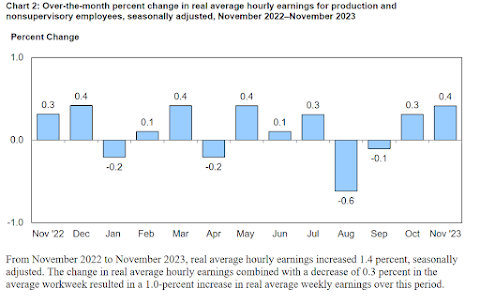
With prices taming down, we continue to see inflation-adjusted wages recover the losses they took on in 2022.

That's after another positive month for overall inflation-adjusted average hourly wages, (this time up 0.2%), making it 7 out 9 months for real gains since February, and up 0.8% for the last year. The news is even better for everyday workers, as non-supervisory employees are seeing even larger gains in the last 2 months.

In fact, real average hourly wages for non-supervisory workers are higher now than they were in November 2021, even with all the price hikes in 2022. Another year of wage gains like that wouldn't hurt when it comes to making sure democracy still exists in this country.

Know what else wouldn't hurt? Having the Fed realize that inflation really was a post-COVID transitory thing for the last half of 2021 and first half of 2022, and having them reduce rates from the punitive 5.4% that they have imposed on us. There's no logical reason to have real interest rates of more than 1%, let alone 2%, and I would hope we see some indications this week that this lower-inflation reality has sunk in to the Central Bankers, so they loosen up in 2024.

Sunday, December 10, 2023

New rail stops for Sconnies? Possible, and long overdue

Last week, we found out that we were getting one step closer to having more places for Wisconsinites to travel in-state by rail.

State and local officials received five $500,000 federal grants to study expanding Amtrak passenger rail service from Milwaukee to Chicago, Green Bay, Madison, Eau Claire and the Twin Cities....

The five routes picked for further study would extend service out of Milwaukee to the 500,000-plus residents in the Madison metro area, the more than 820,000 residents along the I-41 corridor between Fond du Lac and Green Bay, and the 160,000-plus residents in Eau Claire.

Rail expansion to Waukesha County, Madison, Green Bay and other communities could attract 250,000 new riders within a decade and 1.6 million by 2050, according to Wisconsin Department of Transportation data published in May.

And that's on top of the recent announcement that there will be a second round trip between Chicago and the Twin Cities (bypassing Madison with the route shown in blue, then heading to the Twin Cities in the route in green), possibly by the end of next year. And given the fact that the second round trip will be within those regions and not part of a longer-distance train, it may have a better chance of serving places at better times with better reliability, due to fewer variables that can complicate things with longer distances.

I would think the route to Madison has better chances of starting sooner than the other new routes, because all it would require is updating information and studies that were done before Scott Walker idiotically got politicians to turn down more than $800 million in stimulus in 2010. Those funds were intended for upgraded rail lines that would have led to passenger rail service between Milwaukee, Madison and the Twin Cities six years ago.

However, we do have some idea on the costs to upgrade the tracks on service to Madison, based on what was estimated back in 2010. The one line item in particular we should look at is the "Watertown to Madison" costs, because service between Milwaukee and Watertown is already being upgraded with the second round trip between Chicago and the Twin Cities.

Given that it'll be at least 15-20 years between 2010 and whenever Amtrak service to Madison might start, you can probably double those costs (all the more reason that Walker was a moron for turning this down, it costs a lot more after you delay the work on it), so $660 million plus passenger stations and some additional environment remediation along the way.

That seems like a lot to ask for, but we definitely have the funding and Administration in DC to get it from.

So after being set back for more than a decade, it looks like things are finally (incoming pun warning!) back on track for having more Wisconsinites be able to get on a train and travel from town to town. And given how much Madison and Dane County have grown since 2010, it feels like it's more needed and ready to succeed as ever.

So LET'S GET TO WORK ON IT.

Saturday, December 9, 2023

2 big turns of events at the UW

Well, it's been an interesting 24 hours on Bascom Hill. Starting with what broke yesterday afternoon.

In a deal months in the making, the University of Wisconsin System has agreed to "reimagine" its diversity efforts, restructuring dozens of staff into positions serving all students and freezing the total number of diversity positions for the next three years.

In exchange, universities would receive $800 million for employee pay raises and some building projects, including a new engineering building for UW-Madison.

"This is an evolution, and this is a change moving forward," UW System President Jay Rothman told the Milwaukee Journal Sentinel. "But it does not in any way deviate from our core values of diversity (and) inclusion."

The compromise brokered with Republican legislative leaders caps a contentious six months of negotiations for the state university system over diversity, equity and inclusion programming. Campuses view DEI programs and staff as critical in supporting a broad range of students while conservatives cast the effort as wasteful and racially divisive.
It's ridiculous that Assembly Speaker Robbin' Vos made DEI into such a big deal, because pretty much any business worth a damn has some kind of DEI training and outreach in 2023, and it seems important to show underrepresented groups that they are welcome and valued on campus.

But because Vos cares more about following the culture-war agenda handed down from ALEC and in having his 5'7" self show others that he has power, he held those 4% pay raises from UW employees hostage as the co-chair on the state's Joint Committee on Employee Relations.

System President Jay Rothman thought he had a deal in place that could be accepted by the UW's Board of Regents. And it turned out he was wrong.

Well that wasn't expected. And so we're back to where we were.

Here's the funny part about this whole DEI agreement to me - I don't think much was going to change, and it was a fig leaf for Vos and WisGOP to claim they got something out of a losing issue. Take a look at the language used in the resolution, and it seems like all they were doing were changing job titles.
Through December 31, 2026, the System will not increase from the level currently in effect the aggregate number of positions that serve the System’s core DEI functions: (i) the DEI subfamily that provides DEI services, (ii) the job subgroup “academic services and student experience” with job titles that include DEI, and (iii) senior leadership positions in the dean and/or vice chancellor series focused on DEI. In addition, to continue the enhanced focus on student success, the System will, through a mixture of normal attrition and active restructuring and reimagining of the DEI function, realign over two academic years at least 33% of the above-referenced roles that are currently filled (or at least 43 positions) to areas with a primary focus on academic and student success.
The "position cap" proposal also had a ton of loopholes in it.
The position cap will not apply to faculty. It also will not apply to instructional and other staff who spend at least 75% of their time working directly with students and/or patients, or whose research positions are funded at 75% or more by gifts or grants. In addition, the position cap will not apply to other positions funded by gifts, grants or contracts, positions related to outreach such as Extension provided that such positions are funded 75% or more by gifts, grants, or intergovernmental contracts, or to new positions necessary to address subsequently enacted or expanded state and/or federal compliance mandates. Part-time student employees, who gain both useful employment experience and whose employment helps fund their educational pursuits, would likewise be excluded.
And yet it got rejected anyway. I don't know if that's necessarily the smartest move, because I thought UW was going to make out fine in this deal, but it also could pay off.

Here's how I'm guessing this will play out in the coming weeks. Vos and a few other racist/dweeby GOPs will stamp their feet and claim that UW will now get nothing, at least for a few days. But the spotlight, pressure and anger will now also get turned back onto Vos, and everyday Wisconsinites hate that guy. Attention also needs to get put onto every other Legislative Republican that is allowing that dweeb to hold up these pay raises and hold up the Engineering Building and other facilities that the business people say they need to help the state compete for jobs and talent.

I've heard some dumb right-wingers in social media try to claim this deal "saves money". How so? It gave hundreds of millions for building projects (good investments, but not it's note a savings in the short term), and allowed for the pay raises to go through. Oh, do they think that UW employees will go through the year with no pay raise and that'll be a major taxpayer savings? Well, I got a little secret for those guys - the money is already allocated!

The UW's salary additions are lumped together with other statewide employees in an allocation known as the Compensation Reserves. And that was already fully-funded and signed into law in the state budget.

So what's stopping UW from using the money that it already has and giving the 4% pay raises on their own? As we've seen many a time in the last 20 years, rules and customs have little enforcement power. Sure, it's not great PR with the Legislature, but maybe it's time to say "Screw those clowns. What are they going to do to us anyway?" Evers isn't going to let the Legislature screw over the UW in funding, and the GOPs don't have the numbers (or public support) to override any of his vetoes.

It's high-level poker to be sure, and if I was a Regent, I might have taken Vos's deal while crossing my fingers behind my back on the DEI and positions. But I also think there are enough Regents and others that have simply had enough of Little Napoleon and the rest of the anti-UW WisGOPs, and figure they may as well be seen as fighting for their students and their campus culture.

And that may well be a gamble that pays off. You thought Republicans were toxic in college towns and among the college-educated before this idiocy? Apparently there are new depths for them to comb! And the new maps are coming, kids....

Friday, December 8, 2023

Good US jobs report keeps things moving ahead. We gotta keep telling this truth, and keep it going

It’s another Jobs Friday here in America, so what do we have?

Seems pretty good to me, especially when I see that the unemployment rate dropped for the “good reason” – more people entered the labor force in November (+532,000), and even more found jobs (+747,000). This means that the overall % of Americans working (under the Employment-Population Ratio metric) is at a new post-COVID high.

That’s pretty good considering there are a lot of Boomers that have hit retirement age between 2019 and 2023, which would “naturally” reduce this number. And indeed, a higher percentage of people between the ages of 25-54 are working now (80.7%) than were at the start of 2020 (80.6%).

Later in the morning, there was another positive sign, as it seems that the persistent negativity that many Americans have had over the economy may be finally starting to fade.

Consumer fears over inflation tumbled in December amid declining energy prices and as the impact of interest rate hikes take hold.

In the latest University of Michigan consumer sentiment survey released Friday, the one-year outlook for the inflation rate slid to 3.1%, down sharply from 4.5% in November and the lowest since March 2021. The five-year outlook also moved lower, down to 2.8% from 3.2% the previous month….

Consumer optimism also jumped higher in December. The University of Michigan index of consumer sentiment index rose more than 8 points to 69.4, tied for the best level since July. The current conditions index registered a reading of 74, up nearly 6 points, while the expectations index surged almost 10 points to 66.4.
It’s still not at the levels we had pre-COVID, but that’s mostly because MAGAs refuse to accept the real world and just assume things are worse because their guy isn’t in power.

After those reports, some of the spin from the Wall Street media is that this news wasn’t so great if you wanted to see the Fed start cutting interest rates sooner than later. And indeed, after 6 weeks of declining longer-term yields, they had a bit of a reversal today.
Treasury yields jumped Friday after the November jobs report showed the unemployment rate unexpectedly fall, suggesting continued tightness in the labor market despite the Federal Reserve’s efforts to cool the economy.

The yield on the 10-year Treasury note was up by 9 basis points at 4.22% as it recovered some losses made earlier in the week when it dipped as low as 4.14%. Similar levels were last seen in early September.

The 2-year Treasury was last more than 11 basis points higher at 4.692%.
But those figures are still 50-75 basis points below where they peaked in mid-October, and I think they should stay down, because I don't think the outlook is much different than it was before Friday’s jobs report.

So if things didn’t really change much, why did sentiment go up by so much in November? I hope it’s because the reality that the economy is really good is finally starting to get through the Bubble of BS that is regularly pumped out by Faux News and other GOPper-ganda on a daily basis.

Chris Hayes had an excellent segment (last night) which illustrated how the Biden Administration has handled a series of economic challenges, and we've come out the other side in good shape. But the RW messaging machine tried to convince everyday Americans that the country was either headed to or in a recession (which hasn't happened), and by hammering on rises in prices of products like eggs and gasoline, to try to anger people and convince them that inflation was still an economic headwind (it really hasn’t been for 18 months).

People may be annoyed that interest rates are higher than they have been in 20 years, given how it adds expenses to borrowing and is an impediment if they haven’t been lucky enough to have bought a home or car before 2022. And I agree that they shouldn't be as high as they are (due to Republican Jerome Powell and other central bankers who are still stuck in the 1970s). But there also are a lot more people working than they were 4 years ago, they’re making more money in doing so, and there isn’t that much out there to slow that down as we head into 2024.

We just gotta keep telling the truth about where things are today, and learn the lessons of the last 4 years of economic policy – direct government investment and supports works when it comes to getting people back to work and in making them feel more secure about their futures. And when we back off on that investment and support, then the problems and concerns kick in (like when Joe Manchin and all Senate Republicans tanked the Child Tax Credit in late 2021).

So don’t take the foot off the gas and stop more of the progress that has been made in the 2020s. As part of their 2024 strategy, Dems should call out the oligarchs who are clearly unhappy that the typical American worker now has options in a full-employment economy, and that the "special few" can’t extract even more than the already-excessive profits and productivity gains that they are getting. What we have now is a better situation than we had from 2001-2019, and we can’t afford to go back to that losing way.