Sunday, September 13, 2020

COVID flares higher in Wisconsin as September wears on

Not much good to say about the state's numbers for the last week regarding COVID-19 are good. The headlines are from UW campuses in Madison and La Crosse going into lockdown with online classes for the next 2 weeks. But if you look at the last 7 days through Saturday, it was bad all around for Wisconsin, with record highs for both cases, and in percentage of tests turning up positive.
The only "good" news is that deaths have not risen with the number of cases, staying at the rate of 40-50 a week that we have seen for the past several weeks.
But we also know that deaths are usually in line with case trends that happened a month prior, so we will see what that looks like in October. So we will see where that goes in the coming weeks, and to see what happens in light of last week's record cold and constant rain, which kept a lot of Wisconsinites inside and possibly more susceptible to picking up the virus.

The news from today wasn't a good sign. Stay safe and stay smart out there, folks.

DOT revenues low in 2020, but it might be worse in 2021


After finding out that Wisconsin’s General Fund tax revenues held up surprisingly well for the 2019-20 Fiscal Year, this week we got a look at the Transportation Fund, which is the main source of funds for road projects and other WisDOT programs. And the events of the last year led to an odd mix of news on that front.

Preliminary information regarding transportation fund revenue collections for 2019-20 is now available. According to the Department of Transportation (DOT), net transportation fund revenue collections after transportation revenue bond debt service is paid, totaled $1,893.3 million in 2019- 20, which was 6.2% higher than net transportation fund collections in 2018-19. The revenue increases over the prior year are the result of the transportation tax and fee increases included under 2019 Act 9.

The final estimate of net transportation fund collections estimated under 2019 Act 9 was $1,990.6 million. Preliminary actual transportation fund collections were $97.3 million, or 4.9%, below the estimate.

The Legislative Fiscal Bureau says that all of the shortfall (and then some) came as a result of people driving less as COVID-19 kept people home, and that the increases in license and title fees didn’t translate into the $158 million in additional revenue that LFB predicted…at least through June 2020.


What's especially concerning is that this decline only reflects about 3 1/2 months of the COVID World. 12 months of depressed travel and reduced title transfers would likely cause a bigger hole for year 2 of the WisDOT budget, and unless there is a significant infrastructure package coming from DC, it'll put a crimp in the plans to spend more on making up for the Scott-hole backlog that developed on the state's roads from 2011-2019.

We would have been in an even deeper hole from FY 2020, except that the state's Petroleum Inspection Fund gave $67.6 million to the Transportation Fund, $16 million more than expected. The Petroleum Inspection Fund is collected with a 2-cent-per-gallon tax on gasoline and other related products, and part of it is used to clean up abandoned gas stations and other places that have gas tanks in the ground. But some of that money also goes to WisDOT, and here's the LFB's description of how that works in 2 different ways.
As provided under current law, revenue from the petroleum inspection fund (PIF) would be used to support transportation programs. This includes a provision of 2017 Act 59, under which the DOA Secretary, beginning on June 30, 2020, and on June 30 of each subsequent fiscal year, is required to transfer the unencumbered balance of PIF to the transportation fund, except for an amount equal to not less than 5% of the gross revenues received by PIF during the fiscal year in which the transfer is made. However, under Act 9 [the 2019-21 Wisconsin State Budget], revenue from one cent of the two-cent petroleum inspection fee on gasoline, diesel, and other petroleum products will be deposited directly to the transportation fund, effective July 1, 2020. As shown in a separate item, the net effect of this action and the current law transfer willbe an increase of $2,290,100 SEG-REV to the transportation fund in the biennium. In total, this provision will result in an estimated $38,900,000 associated with one cent of the fee being deposited directly to the transportation fund. As provided under current law, estimate PIF transfers of $45,292,600 in 2019-20 and $16,703,100 in 2020-21. In addition, the ongoing statutory transfer from the PIF to the transportation fund of $6,258,500 annually will continue.
So because there was apparently a lot of money left over in the PIF on June 30, that gave the $16 million boost to the Transportation Fund. But now that left-over money is gone, and because 1/2 of the PIF Tax is now going directly into WisDOT's pockets, there won't be much to be sent over in June 2021. That wouldn't be a problem, except that if travel and gas usage stays low in FY 2021 (and there's no reason to think it won't), then there's less money going in to the Transportation Fund from the PIF, which creates another loss of revenue for the 2nd year of the 2019-21 budget.

If that's the case, then there's going to be the need for those funds to be made up in some other fashion in early 2021, and for the 2021-23 budget. Otherwise, road projects won't get fixed, and we will be having this scene for longer than we should, because the State of Wisconsin won't have enough money to get everything done at once.

Saturday, September 12, 2020

COVID mess on UW campuses a predictable result of WisGOP defunding

To little surprise, COVID-19 has broken out in a big way at many UW campuses since students came back a couple of weeks ago. This includes record-high numbers of new cases in La Crosse and Eau Claire Counties, and there are strong indications that UW-Platteville is starting to see serious community spread.
On Wednesday, UW-Platteville conducted 98 tests with 24 coming back positive, a 24.5% positive test rate, according to a UW System report. That was the highest positive rate of all UW schools.
In total, the school has only 56 positive cases, but it has also only conducted 284 tests, according to a university dashboard. That means the school has tested 3% of its more than 8,000 students.
But the largest breakout is at the largest UW campus, where students in 2 dorms and numerous Greek houses are being asked to quarantine, all classes have been moved online for the next 2 weeks, and more than 1,700 cases have already been reported among UW-Madison's students, faculty and staff. Madison's Daily Cardinal sent this editorial over the weekend, which reflects the rightful anger many students are feeling in light of the chaotic situation on campus. This is largely true, and it has led to a predictable mess. So why did UW administration allow it to happen? The answer is sad, and simple - they need the money, as years of underfunding leave the UW with little choice but to try to get as many students as they can on campus. Let me remind you that the UW System now has more money coming in from tuition than it does in taxpayer funding, a trend that is projected to continue is the next state budget.
In addition, the UW System counts on those dorms being filled. If you look at this year's UW budget, it assumes $770 million in "Auxiliary Operations", which are self-supporting entities like dorms, student unions and athletics. Those numbers are down $75 million from last year's projection of $845 million, but if students are sent home en amsse , or there is no football in Madison, that number could end up being much less than that.

Friday was already one big deadline for this, as students needed to withdraw from school to get all of their tuition revenue back. It also was a deadline to have students pull out of their dorm contract for the Fall semester. We should find out soon just how many students have canceled out, and how much of a budget hole that might cause for the System.

You know what might come in handy right now? A one-tme shot of state and/or federal funding to fill in the budget holes that inevitably will occur as some students and their parents make the understandable decision not to want to make themselves more susceptible to COVID-19 by stuffing themselves into high-density living away from home.

But whie the feds allowed universities some money for the Spring semester to take care of those deficits and to make some on-campus adjustments to the COVID World, there isn't much more coming in the Fall of 2020, especially after stimulus talks fell apart this week in Mitch McConnell's graveyard of a Senate.

And we know the ALEC Crew in the State Legislature sure won't do it. Heck, those guys would have likely induced the same kind of COVID mess had the UW even tried to shut down, as explained by a UW-Madison PoliSci professor. And this downward spiral of no-win situations for the UW System won't end until the ALEC Crew is blasted out of power. There is no other option that will see the UW return to the well-funded and respected position at the Capitol that it had throughout the 20th Century. Vote accordingly.

Don't let the $3 trillion deficit be an excuse stop helping the many in need


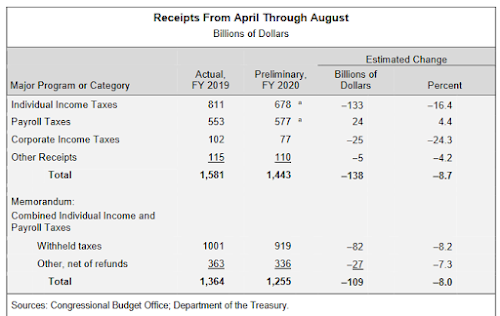
Wanted to give an update on where the federal budget stands, as there were headlines this week that took the August budget update from the Congressional Budget Office, and noted that our budget deficit went past $3 trillion with a month left to go in Fiscal Year 2020.

The cumulative federal budget deficit for the first 11 months of fiscal year 2020 was $3.0 trillion, CBO estimates, $1.9 trillion more than the deficit recorded for the same period last year (see Figure 1).
Revenues were 1 percent lower and outlays were 46 percent higher through August 2020 than in the same 11-month period in fiscal year 2019. CBO projects that the 2020 deficit will total $3.3 trillion. At 16.0 percent of gross domestic product, that would be the largest shortfall relative to the size of the economy since 1945. </blockquote> Of course, 1945 was the final year of World War II, which led to a massive increase in expenses for the military and in services needed back at the homefront.

2020 is also having a large increase in spending and needs, although I’d argue it’s largely because we <em> didn’t </em> go on a wartime footing on COVID-19 until it was far too late, leading to large levels of shutdowns in March and April and a major hole in the economy that still is far from being filled. This chart gives you a good indication of when COVID-19 started hitting the budgets in DC.


The exploding deficit is largely driven by spending generated through the CARES Act and other legislation passed in the fallout of COVID-19 and the resulting recession, which makes for a major change in outlays for the 2nd half of this Federal Fiscal Year vs 2019.


But note the one area of expenditures that’s gone down – interest on the debt. That’s pretty amazing given the large increases in the deficit/debt in the last year, but it shows just how much interest rates have been lowered through Federal Reserve action. And given that inflation still remains muted (although it’s creeping up, as shown by the 0.4% increase in the Consumer Price Index for August), the deficit itself isn’t a major economic threat, for now.

 What may be concerning for the future is that revenues are also showing signs of significant slowing, mostly due to the lack of jobs. They were holding up for a while, partly due to the fact that the $600-per-week add-on for unemployment benefits gets taxed. But that went away in August, and corporate taxes were already slipping before then.  

Now add in the temporary decline in payroll taxes that will come from employers that choose to be part of President Trump’s 3 month scam deferral, and revenues will likely be even less for the near future (well, until those same people getting a “tax cut” now have to double-pay those taxes in early 2021).

But as mentioned before, the size of the deficit isn’t that big of a deal if we aren’t seeing other economic effects. And other than the increased inequality that has resulted from asset Bubbles (a monetary policy effect more than fiscal, although there is a lot of money floating around), there hasn’t been a lot to indicate that our fiscal deficit is causing ripple effects in our economy for now.

What there has been is a noticeable increase in inequality that has hit due to those asset Bubbles (helping the rich, who own most assets). Combine that with the fact that job losses have been especially large for service occupations like food service, travel, entertainment and lodging, and there is definitely a need for more fiscal moves that reverse this damaging, unsustainable trend.

But given the meltdown of stimulus talks in DC this week, it looks like there isn’t going to be much done to redirect funds toward those in need, and that could well cause economic problems that ends the mini-recovery we’ve had in the last 4 months, and begins a “new normal” of lower activity compared to what we had at the start of 2020.

While the deficit might not be a reason for that stagnation and the related economic problems, you can bet some cynical corporatists will use it as a reason not to try to solve those problems. There are only 2 proper responses to that.

1.      No the deficit is not causing our problems, and in fact, deficit spending kept them from becoming worse.

2.      If you’re so concerned about the deficit, then tax the rich to have them pay for the programs that people need to stay afloat. After all, they’ve made a lot of money due to the Fed’s help, so they can afford to give some of that back to keep us from having a deeper and longer recession. It’s the least they can do.

Friday, September 11, 2020

You know who needs a bail out? Live music venues!

I know COVID World has existed for nearly 6 months in this part of the country, but I think we still haven’t come to grips with how far down in a hole we were, and in some places still are. This report that came out today from the Commerce Department gives an illustration about how much business certain sectors lost in the first half of 2020, and take a look at what’s happened to a couple of parts of the entertainment industry.
Channel 58 in Milwaukee recently gave a local flavor to this issue, illustrating how much has been taken away from live music venues in the 6 months of COVID-related shutdowns. The story starts off by talking to Gary Witt, the CEO of Milwaukee’s Pabst Theatre Group, which includes the Pabst, Riverside and Turner Hall venues downtown.
Between their five venues, the Pabst Theater Group does 700 shows every year in the city of Milwaukee.
Thirty-percent of the people attending the events come from below the state line.
"We also contribute about a quarter of a billion dollars to the city's economy, so people who come to town and stay in a hotel or rent a car or go out to a restaurant or go to a bar," he added….
Meanwhile, smaller venues in Milwaukee are worried they may be on the verge of shutting down.
"Trying to keep paying foundational bills and hope to make it through this very difficult time, there's venues across the country that are comparably sized that are closing," said Kelsey Kaufmann, owner of Cactus Club.
The Pabst group says there is a relatively easy way to keep Wisconsin’s live music places afloat during the pandemic - give state subsidies to keep them afloat, since they can't put on shows due to COVID-19 crowd limitations.
Witt is just one venue group out of more than 70 in the state who is part of Wisconsin's National Independent Venue Association.
The NIVA is petitioning Gov. Tony Evers to set aside less than $10 million of CARES Act funding for the Live Entertainment Grant Program, which would help venues get by until they can open again.

Remember that CARES allows Evers to hand out the money without having to wait on the Legislature, so some of the $200 million+ of Wisconsin’s CARES funds that hasn’t been designated could go to independent operators of live music places and other forms of live arts. The program can also be tailored to exclude publicly-funded and/or 5,000+-seat venues, since those places are often “paid-for” and/or can make up the money in a much easier fashion. 

 Compare this to the airline industry, which had their revenues go down by 78.5% in the first half of 2020, got $32 billion in bailouts from Congress, and is now asking for $25 billion more. We could bail out live music and arts venues that have lost even more of their business, at a fraction of the price, whether that's via individual states or some kind of Act of Congress. 

In the process, we would help a lot of entrepreneurs, save a lot of jobs, and help the survival of an industry that adds more to our society than a lot of other economic areas that have already gotten plenty of COVID-related assistance. Seems like a pretty good idea to me.

Thursday, September 10, 2020

While tens of millions are still unemployed, their help from DC is going away


Remember when President Trump reacted to the end of the $600 add-on for unemployment benefits by giving an "executive order" allowing for a $400$300 add-on? Well, that's already coming to an end, even before a majority of states have made one payment.
More than a month after Mr. Trump signed the order, only 17 states are currently paying out the benefits, according to UnemploymentPUA.com, which tracks jobless benefits. FEMA said that 48 states, Guam and the District of Columbia have been approved for the payments. South Dakota declined to accept the funds, with its governor saying that most jobs lost during the pandemic have been recovered. Nevada is the sole state awaiting FEMA approval.
But it's clear that even six weeks of $300 payments will go quickly. Two states, Montana and Texas, have already exhausted their six weeks of funding.... 
Mr. Trump is funding the supplementary unemployment benefits through FEMA's Disaster Relief Fund, which had $44 billion in available funds. The agency on Thursday said that to date it has distributed $30 billion through the LWA program. September 10 is the final day for states and territories to apply for assistance, according to FEMA.
Wisconsin is among the states that applied for the $300 add-on, but no unemployed Wisconsinites have gotten it yet. While the Wisconsin Department of Workforce Development says that benefits will be applied retroactively all the way back to August 1 (when the $600 add-on went away), DWD says that it'll likely be late October until its system is able to be completely programmed for Lost Wages Assistance and that extra $300/week gets sent out. And it looks like there won't be any additional unemployment benefits to be given out after the $44 billion taken from FEMA runs out. That's because stimulus negotiations have collapsed in DC, after the GOP-run Senate refused to go along with the $3 trillion that the House agreed to in May, and couldn't even get a fraction of that through the upper chamber today.
The measure fell short of the 60 votes needed on a procedural step to move toward passage. All Democrats present, and one Republican — Rand Paul of Kentucky — opposed it in a 52-47 vote. The nearly unanimous vote for the GOP followed weeks of disagreements within the Republican caucus about whether to pass any more aid at all. 
The legislation would have reinstated enhanced federal unemployment insurance at a rate of $300 per week, half of the $600 weekly payment that expired at the end of July. It also would have authorized new small business loans and put money toward schools and into Covid-19 testing, treatment and vaccines. 
The measure did not include a second $1,200 direct payment to individuals. It also lacked new relief for cash-strapped state and local governments or money for rental and mortgage assistance and food aid — all priorities for Democrats.

                          Sometimes you don't need a gun to hurt people. 

  The lack of help for the unemployed is going to be a big hit to a lot of Americans, as evidenced by today's weekly report on unemployment claims, which shows that we are still seeing people getting laid off at unprecedented levels.

In the week ending September 5, the advance figure for seasonally adjusted initial claims was 884,000, unchanged from the previous week's revised level. The previous week's level was revised up by 3,000 from 881,000 to 884,000. The 4-week moving average was 970,750, a decrease of 21,750 from the previous week's revised average. The previous week's average was revised up by 750 from 991,750 to 992,500. 
The advance seasonally adjusted insured unemployment ratewas 9.2 percent for the week ending August 29, an increase of 0.1 percentage point from the previous week's unrevised rate. The advance number for seasonally adjusted insured unemployment during the week ending August 29 was 13,385,000, an increase of 93,000 from the previous week's revised level. The previous week's level was revised up 38,000 from 13,254,000 to 13,292,000. The 4-week moving average was 13,982,000, a decrease of 523,750 from the previous week's revised average. The previous week's average was revised up by 9,500 from 14,496,250 to 14,505,750.
In addition, the PUA program for "gig workers" and others who don't get traditional unemployment is being increasingly utilized, to the point that more people were getting PUA than regular unemployment by late August. This means that five-and-half months after COVID-19 first started having a serious affect on the labor market, we still were seeing nearly 30 million Americans getting some kind of unemployment benefit.
Many of those people have already been dropped off of the $600-a-week add-on for their benefits, and even though they might be getting their $300-a-week payments from FEMA soon (if they haven't already), they shouldn't expect that the Feds are going to help them stay afloat as the weather gets colder. And that is a scary situation not just for tens of millions of people out of work, but for the entire economy as a whole.

It doesn't have to be this way. We choose it to be this way in America.

Wednesday, September 9, 2020

Our dumb Senator keeps deflecting for his buddy Vlad

With all that's going on, this absurdity may have slipped by your notice.

Johnson in the interview contended the people who have participated in violence and destruction in the wake of police shootings of Black men have continued such actions in an effort to exploit difficult situations.

"You can’t continue to riot for 100 days without having some sort of financial support," he said. "Possibly, some of our unemployment insurance in the CARES Act might be funding some of these people...

"I don't know what extent individuals are being funded but we also found out some of these protesters were staying in pretty swanky hotels in Washington, D.C.," Johnson also said.
Um, is Ron Johnson saying that forcing people into low-income work is a way to keep them occupied and in line? That's an interesting reason to cut benefits.

Also, if Ron Johnson is worried about jobless losers renting hotel rooms to cause trouble and racial violence, he should take a look at what these guys did back home.

These guys were allegedly members of the "417 Second Amendment Militia", and this ties back to Johnson in a couple of ways.

The first is obvious - as chair of the Senate Homeland Security Committee, you'd think Johnson might care about people traveling across state lines to cause violence and mayhem.

The second is because of who Johnson was talking to when he gave his theory about CARES money allowing for protests.
Johnson made his comments in a Thursday appearance on a conservative talk radio show hosted by Vicki McKenna.
That's THIS Icki McKenna.

Sounds like the 417 Militia took Icki up on her offer. And a sitting US Senator was still buddying up to her on the air 10 days later.

But Ron Johnson has interests beyond giving winks and nods to gun nuts. He's got other important business to attend to in DC.
Johnson previously subpoenaed the FBI for documents, and has been holding closed-door depositions with former Obama administration and current Trump officials.

He previously told The Hill that he wanted to release an interim report on the Biden-Ukraine investigation by mid-September. But he indicated this week that the timeline had slipped slightly, and that the interim report would now likely be released in late September.
Because wasting taxpayer dollars to launder Russian propaganda about a nothingburger is absolutely more important than getting to the bottom of why the President lied to Americans about how severe COVID 19 was going to be, which has led to tens of thousands of unnecessary deaths, with many more to come.

Well, spewing misdirections are the priority of the people who Russian Ronnie Johnson really works for, anyway. And that's all you need to when you're trying to figure out why Our Dumb Senator is being even more ridiculous than normal these days.