Wednesday, February 9, 2022

COVID cases diving in February. But that's won't stop WisGOPs from complaining

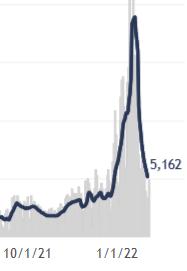
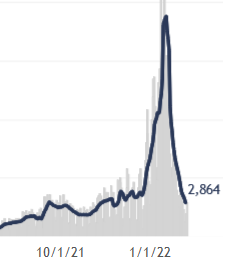
Throughout this first part of February, it is unmistakable that things have gotten better with COVID in Wisconsin. The Wisconsin Department of Health Services says that the 7-day average of new cases is now below 3,000 new cases a day, the lowest levels we've seen in 3 months.

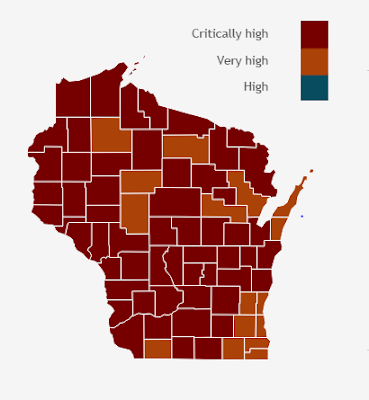
DHS says 70 of the state's 72 counties have had significant declines in new cases in the last 2 weeks, and several counties have fallen out of the "red zone", reserved for counties where at least 1 in 100 residents have tested positive over the previous 14 days.

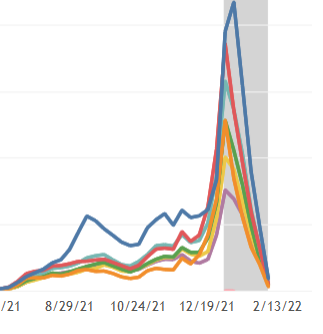
As more data comes in, it's evident that a big reason behind the January spike in cases was kids going back to school, as children under 18 (shown in blue in this graph) were the only age group seeing a rise in cases in the week after New Year's (when classes resumed).

But that's not stopping Republicans from wanting to take away the ability of Wisconsin school districts to take certain COVID mitigation measures, even if local conditions warrant.

This joins past WisGOP "small government" legislation that current pre-empt Wisconsin cities from allowing higher minimum wages, having more stringent work rules, or protections such as paid sick leave.

But it's not like Wisconsin Republicans care to actually take steps that would remove the COVID cloud and keep it away for the rest of 2022. They want the upheaval and distress that's caused by COVID continuing to hang around, and so they can make up a (non-)issue to distract rubes with. If they keep bringing up stupid distractions, then WisGOPs hope they don't have to answer why they don't want to make things better for the COVID situation....or most anything else.

Monday, February 7, 2022

Rolling Stone tells the nation about Wisconsin's Big Lie, and the danger for America

Hey, I hear Wisconsin is being given a huge spread in Rolling Stone! What’s it about?

Awww, crap. I don’t need to be reminded about how freaky things are here, and how important these November’s elections are in these parts. Especially as WisGOPs hold a public hearing today on a number of proposed changes to elections (which fortunately will be vetoed by Governor Evers).

But Kroll has written an excellent, in-depth article that brings the national spotlight back onto the nefarious plans that are afoot by WisGOPs, and how we got to this messed-up spot in our history.
For the first 150 years or so of its existence, Wisconsin earned a reputation as a laboratory of sorts, a testing ground for policies cooked up by liberals and conservatives. Think unemployment insurance and Social Security, school choice and voter-ID laws. Love them, hate them: Thank (or blame) Wisconsin. Deep political divides have always cleaved the state’s politics — this was, after all, the home of progressive icon Fighting Bob La Follette and notorious red-baiter Joe McCarthy, the land of Republican hero Tommy Thompson and LGBTQ pioneer Tammy Baldwin. And for the past two decades, Wisconsinites have grown used to statewide elections decided by razor-thin margins and a perennial battleground-state status. But if not for Florida’s hanging chads in 2000, the entire world might have converged on Wisconsin instead, where Al Gore won by 5,700 votes. Through it all, Wisconsinites saw themselves as a model for clean, open government, a kinder counterpoint to the brutal machine politics of Richard Daley’s Chicago, 90 miles to the south.

For the past decade, however, Wisconsin politics have polarized in much the same way the nation has. Scott Walker’s gubernatorial election in 2010 and his subsequent “divide-and-conquer” assault on labor unions, a surgical gerrymander that has locked in GOP majorities with no end in sight, Wisconsin Republicans, including former Speaker Paul Ryan and former White House Chief of Staff Reince Priebus, steering the party through the Trump presidency — all of it has cemented Wisconsin’s place as a bastion for the Republican Party. If you want to understand where the GOP might be headed, watch Wisconsin.
Tell me about it, dude. We have been the testing ground of pretty much everything bad about politics since 2010, from disgusting levels of dark money and growing inequality, to relentless attempts to slant the playing field for the GOP through “divide and conquer” measures that try to trick everyday people into voting Republican out of resentment/fear of “others” over any legitimate policy reason.

But the “divide and conquer” strategy included building a Bubble of BS through Hate Radio 1130/1310 and social media/Internet GOPperganda. And now that Bubble has turned WisGOPs into conspiracy-addled fools that refuse to deal with the reality that more Wisconsin voters chose Joe Biden over Donald Trump in November 2020.

Much of the Rolling Stone article centers on State Rep. Tim Ramthum (R-Kewaskum), who has tried to decertify Wisconsin’s 2020 electoral votes (something he or no one else can do legally), claiming some kind of fraud happened in the presidential election. Rolling Stone author Kroll met with Ramthun last month, and the Washington County Rep gave his sources and “proof” of sketchiness.
Ramthun came late to the cause. He traces his journey toward the truth to a March 10, 2021, hearing of the state Assembly’s campaigns and elections committee. He listened as the witnesses, all of them selected by the Republicans who ran the committee, made accusations of illegality and fraud about the way the city of Green Bay ran its 2020 election. His mind reeled as a lawyer named Erick Kaardal, who had previously represented Kanye West’s campaign in the state, told the committee that “a private corporation” funded by Facebook chief executive Mark Zuckerberg had funneled millions of dollars into the state’s five biggest cities, which Kaardal referred to as the “Wisconsin Five.” The money had acted as bribes to those cities to get out the vote for Joe Biden, and no one had noticed it at the time.

A few months later, Ramthun attended a gathering in Sioux City, Iowa, of all the major election-fraud activists, hosted by MyPillow’s Mike Lindell, and returned full of conviction that his state needed to do more to ensure integrity in the 2020 election.
Of course, Ramthun doesn’t mention that Zuckerberg’s organization gave grants to 214 communities all around Wisconsin, with the counties that had the most communities getting grants being pro-Trump Marathon and Marinette Counties.

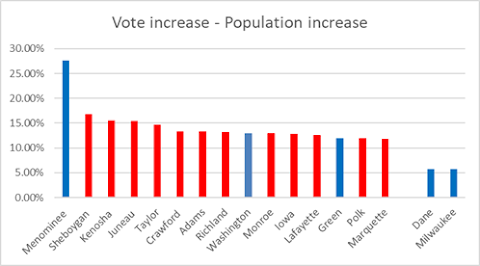
The bigger cities got more money BECAUSE THERE ARE MORE PEOPLE IN THOSE CITIES with nowhere near the same number of people per voting place as you have in the sticks. Also not mentioned by Ramthun is that the biggest increase in turnout during the 2020 election generally came from rural Trump-voting counties, despite their stagnant populations and higher COVID rates in November 2020. This translated into wider margins for Trump in most of those places vs 2016 (represented in red here).

But in Ramthun world, the votes from (Dem-supporting) cities (with more People of Color) are somehow…different.

It's also worth noting that Erick Kardaal, the lawyer who inspired Ramthun to "search for the truth", was referred for sanctions by a federal judge for his Big Lies, and is employed by the “non-profit” fundies at the Thomas More Society.

That same Thomas More Society is currently having some of its “workers” share office space in Brookfield with fellow Big Liar Michael Gableman, and both Gableman and the Thomas More folks are collecting nice paychecks at Wisconsin taxpayer expense as they continue their interminable “work” for the same Assembly Elections Committee that Ramthun got his initial “proof” from.

The Human Centipede of WisGOP BS continues with the Chair of that Assembly Elections Committee, who also is interviewed in the Rolling Stone article.
Wisconsin Republicans say they’ve heard from voters who are disgusted by the 2020 election, and plan to hold Democrats accountable. “There will be retribution down the road,” state Rep. [Janel] Brandtjen tells me in her office. There’s an icy certainty in the way she says this, and her use of the word “retribution” catches me off guard. What does she mean by that, I ask.

Brandtjen stares straight at me. “There’ll be retribution for people because they don’t think there’s fair elections.” She goes on, “You see what happens to countries when they don’t think they have fair elections. Look at Venezuela. It falters the republic.”
Who is “they”, Janel? Dumb trailer trash who buy into the Big Lies that Faux News, AM Radio and your fellow GOPpergandists throw out? Or are you talking about yourself, a mediocre marketing rep from Menomonee Falls that’s drunk on power in a gerrymandered Legislature?

PS- Nice “Venezuela” reference, Janel. Good to know you buy into one of the absolute stupidest conspiracy theories out there. (Hugo Chavez is long dead, Jan).

The only fun part here is that Robbin' Vos thought he could use the Big Lie to stir up MAGAt rubes in the 2022 elections, but now it has gotten out of control and his own party members have turned on the Speaker.

For those of us outside of Bubble World, the end of Kroll’s piece spells out the stakes. I think most of us in Wisconsin are sick of being reminded of this, but it is something worthy of the national attention he is giving it. Because like so many other things in the last 12 years, we are the test run for nationwide GOP evil.
The threat to democracy in Wisconsin isn’t coming from a lawless election commission, hacked voting machines, or illegal ballots coming out of nursing homes. It comes from a political party that united around suspicions and lies, and sought to bend reality to its will. Wisconsin is more than a laboratory for new policies and bold ideas; it’s a trial for whether democracy can survive at all.
Again, here’s the link. Read the whole thing, if you can stomach it.
Saturday, February 5, 2022

Even though people had jobs in January, omicron's shadow still affected things

While people didn't lose jobs and the overall economy didn't suffer many business shutdowns in January, the unprecedented number of COVID infections did have an effect on the jobs report for that month.

If you go to the BLS’s “Absences from Work” page, you can see the Omicron effect. Millions of Americans missed at least some work in the middle of January, when the jobs report’s survey was happening.

Absences from work, January 2022
Missed full week
Illness/Medical Reasons 3.62 million (+2.55 million vs Jan 2020)
Childcare Problems 72,000 (+42,000 vs Jan 2020)

So how did that show up in the jobs report?
Depending on the reason they missed work, some people who report that they are temporarily absent from work are not classified as employed. For example, people who missed work due to vacation, parental leave, or bad weather are classified as employed (with a job, but not at work). However, people who were temporarily laid off and expecting recall (and available to return to their job if recalled) are classified among the unemployed on temporary layoff. People who do not have a job, including those who permanently lost their job, are classified as unemployed if they are both available for work and actively looking for employment. (People on temporary layoff do not need to look for work to be considered unemployed.) People who are not employed and do not meet the criteria to be unemployed (for example, they aren’t looking for work or they are not available to work for reasons other than their own temporary illness or they do not expect to be recalled from their layoff) are classified as not in the labor force.
So these people may not have worked, but it’s not because they were laid off or their business was closed, so they are technically considered “employed” and having a job.

And those who had more than 5 hours of their full-time job reduced due to illness or child care reasons are counted in the “part-time for non-economic reasons” stat. This rose by quite a bit in January, but didn’t seem to show up in a large seasonally-adjusted loss (which seems odd).

Missed at least 5 hours of full-time job
Illness/Medical Reasons 4.23 million (+1.86 million vs Jan 2020)
Childcare Problems 196,000 (+111,000 vs Jan 2020)

The only place you’d really see this hit the topline employment numbers is in the “hours worked” stat, and indeed that fell some in January.
The average workweek for all employees on private nonfarm payrolls fell by 0.2 hour to 34.5 hours in January. In manufacturing, the average workweek edged down by 0.1 hour to 40.2 hours, and overtime edged up by 0.1 hour to 3.3 hours. The average workweek for production and nonsupervisory employees on private nonfarm payrolls decreased by 0.2 hour to 33.9 hours.
Seems small, but that decline in the work week turned a strong 0.7% gain in average hourly wages into a relatively tepid 0.15%, and that could well mesn that real hourly wages going up and real weekly wages going down for January.

If you’re looking at those figures and not thinking “we need more robust child care and sick leave for workers to remove these barriers from economic growth”, then you should be disqualified from being taken seriously on the economy.

So while the predictions from the “experts” about possible job losses in January weren’t close to correct, you can see where that theory may have come from. Where they went wrong (beyond wanting to buy into a Faux News narrative), is that the big jump in absences didn’t get measured as being “out of work”, because those people still had their jobs and their businesses stayed open.

It does mean that we should expect the average work week to be larger in February’s report, assuming omicron infections and hospitalizations continue to fall next week. And if not, then we should be concerned over how total incomes are getting hit by the virus, even if it’s not entirely putting people out of work.

January jobs report shows Biden Boom still rolling and consistent.

There were a lot of Wall Street "experts" claiming that the Omicron breakouts in January were going to result in the first job losses in more than a hyear in America. And boy, were they wrong.

In addition to the big (seasonally-adjusted) increase in January, the other big news to me was the annual benchmark revisions for the monthly jobs reports for all of 2021. And they had some big changes.

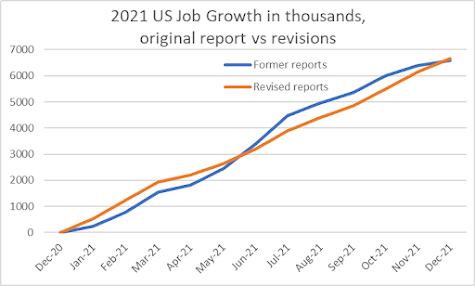
Here's another way to look at the effect of these revisions. What it shows is that job growth was more consistent in 2021 than previously reported. This made the growth larger in the Winter, lower in the Spring and Summer, and larger again as 2021 ended.

How did we get such big changes? Let's allow the Bureau of Labor Statistics to explain that much of the changes are adjustments to the reality of COVID and post-COVID America.
In accordance with annual practice, the establishment survey data released today have been benchmarked to reflect comprehensive counts of payroll jobs for March 2021. These counts are derived principally from the Quarterly Census of Employment and Wages (QCEW), which counts jobs covered by the Unemployment Insurance (UI) tax system. The benchmark process results in revisions to not seasonally adjusted data from April 2020 forward. Seasonally adjusted data from January 2017 forward are subject to revision. In addition, data for some series prior to 2017, both seasonally adjusted and unadjusted, incorporate other revisions....

As part of the benchmark process, the seasonal adjustment models are also updated. These models remove normal seasonal fluctuations—such as regular employment changes due to major holidays — from the data series, making it easier to observe cyclical and other economic trends. Now that there are more monthly observations related to the historically large job losses and gains seen in the pandemic-driven recession and recovery, the models can better distinguish normal seasonal movements from underlying trends. As a result, some large revisions to seasonally adjusted data occurred with the updated models; however, these monthly changes mostly offset each other. For example, the over-the-month employment change for November and December 2021 combined is 709,000 higher than previously reported, while the over-the-month employment change for June and July 2021 combined is 807,000 lower. Overall, the 2021 over-the-year change is 217,000 higher than previously reported. Going forward, the updated models should produce more reliable estimates of seasonal movements. Table A presents revised total nonfarm employment data on a seasonally adjusted basis from January to December 2021.
The household survey that determines the unemployment rate also was affected by COVID as well as information from the recently completed US Census. And it ended up in mostly positive changes.
Effective with data for January 2022, updated population estimates were incorporated into the household survey. Population estimates for the household survey are developed by the U.S. Census Bureau. Each year, the Census Bureau updates the estimates to reflect new information and assumptions about the growth of the population since the previous decennial census. The change in population reflected in the new estimates results from the introduction of a blended 2020 population base, which combines population totals from the 2020 Census and demographic characteristics from other sources. It also reflects adjustments for net international migration, updated vital statistics, and estimation methodology improvements. The vast majority of the population change, however, is due to the change in the base population from Census 2010 to the blended Census 2020 base....

The adjustments increased the estimated size of the civilian noninstitutional population in December by 973,000, the civilian labor force by 1,530,000, employment by 1,471,000, and unemployment by 59,000. The number of persons not in the labor force decreased by 557,000. Although the total unemployment rate was unaffected, the employment-population ratio and labor force participation rate were each increased by 0.3 percentage point. This was mostly due to an increase in the size of the population in age groups that participate in the labor force at high rates (those ages 35 to 64) and a large decrease in the size of the population age 65 and older, which participates at a low rate.
The key takeaway for me is that we are even closer to full capacity on employment than we knew, and there are now fewer people of retirement age for a sad reason - COVID-19 deaths. That should change a few evaluations about where our economy is, and what we should do going forward. It SHOULD, anyway....

There was on Omicron effect in the jobs report, mostly in a lower work week, which blunted a 23 cent/0.7% increase in average hourly wages (I'll touch on this in a later post). But the increase of wages is pretty widespread, especially at the lower end of the wage scale, which is beating the rate of inflation.

I'll also note that these 12-month wage numbers don't include the added INCOME that has resulted from child tax credit payments and stimulus checks, along with growth in asset prices among more secure Americans. Which partially explains our increased inflation but also contributed to the record job growth due to the increased demand.

What these revisions tells me in 2022 is that the Biden stimulus measures of 2021 worked well, got us back to full employment. Now our challenge is to keep these jobs and make sure they pay better, maintain the higher incomes and lower poverty rates that happened in 2021, and increase workers' options and protections to lock in the gains that have resulted from this Biden Boom.

Thursday, February 3, 2022

Multi-decade lows in unemployment claims leading to a loss of January jobs? Doesn't add up

With tomorrow's jobs report looming and some on Wall Street expecting the first loss of jobs in the last 12 months, I think we need to take a look at what jobless claims have been doing. And if they're any indication, I think the numbers will be just fine.

Take a look at this note in the jobless claims report from today.
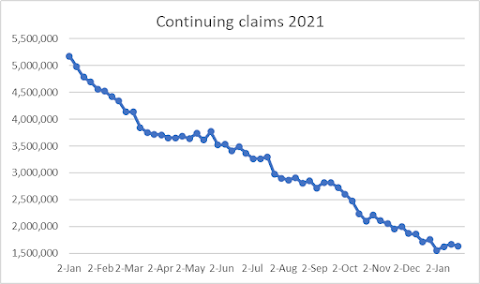
The advance seasonally adjusted insured unemployment rate was 1.2 percent for the week ending January 22, unchanged from the previous week's unrevised rate. The advance number for seasonally adjusted insured unemployment during the week ending January 22 was 1,628,000, a decrease of 44,000 from the previous week's revised level. The previous week's level was revised down by 3,000 from 1,675,000 to 1,672,000. The 4-week moving average was 1,619,750, a decrease of 31,250 from the previous week's revised average. This is the lowest level for this average since August 4, 1973 when it was 1,608,750. The previous week's average was revised down by 750 from 1,651,750 to 1,651,000.

So how are we losing jobs when we have the lowest number of people filing unemployment claims in 48 1/2 years? Did hiring completely slam shut last month? I'm doubtful.

Also remember that there are usually 3 million fewer people working in January than December because of seasonality, and that the jobs report takes that into account when figuring out how many jobs were "gained" or "lost" for the month.

Even the ADP report of 301,000 jobs lost for January needs to be taken with a serious grain of salt. That's because ADP said there was a huge gain of jobs in December that didn't bear out in the "regular" monthly jobs report from the Bureau of Labor Statistics.

Change in jobs, ADP Report
December 2021 +776,000
January 2022 -301,000
TOTAL +475,000

The ADP and BLS jobs report generally converge to similar totals over time. So if you take December's "disappointing" BLS report of 199,000 jobs, that would mean a gain of 276,000 jobs in January to equal the 2-month total in the ADP report.

I'm just throwing a dart here, but the numbers we've seen wouldn't indicate that tomorrow's big jobs report won't be the brutal number that some are expecting. But it also was surveyed at the height of omicron infections 3 weeks ago, so who really knows what this number will mean as a future or even current indicator.

Wednesday, February 2, 2022

Omicron burning out in Wisconsin? It might be, it could be...

As February dawns, some of the gloom from COVID may be fading in Wisconsin. After a sharp spike between Christmas and the middle of January, we are back down at the case levels that we were at when 2022 began, and falling fast.

While these are still disturbingly large numbers, it's worthy to note that the trends are going the right way. And while deaths have risen this winter, it is nowhere near the peaks that we saw at the end of 2020 and early 2021. Deaths exceeded 30 a day for a couple of weeks in December, but have declined slightly from there since then.

And if hospitalizations are a future indicator of death rates, these numbers should fall further, as the Wisconsin Hospital Association says the number of COVID patients are at their lowest levels in 2 months.

This is a clear endorsement of how vaccination reduces the amount of serious illness resulting from COVID. And the gap between more-vaxxed and less-vaxxed areas of the state continues to be apparent. Here's the NY Times records of average daily totals in Wisconsin over the last 14 days, sorted by the top 9 counties for death rates in the last 2 weeks.

And there is a definite red-blue and educational attainment correlation in how many deaths have happened since the start of the pandemic.

We are also seeing strong evidence that being boosted makes omicron a mere annoyance over something serious (especially for the non-elderly/vulnerable). So do your part, play it smart, and we might be back to relative calm by the middle of this month.

Tuesday, February 1, 2022

The Great Resignation was still JOLTing the job market at the end of 2021

One bit of economic data that has gotten increasing attention over the last year is the monthly Job Openings and Labor Turnover Survey (JOLTS) report. And (Tuesday’s) release indicated that we continue to see a tight labor market with lots of demand for workers.

That elevated number of openings continue to stay at this record level even as the US added more than 3 million jobs in the last 6 months of the year. And a big reason why was the Great Resignation, where Americans were quitting their jobs at record rates because they could find better work, or they were leaving the work force entirely. That trend remained high for December, although there was a bit of leveling off.
The number of quits edged down in December to 4.3 million (-161,000) following a series high in November. The quits rate was little changed at 2.9 percent. Quits decreased in health care and social assistance (-89,000), accommodation and food services (-64,000), and construction (-44,000). Quits increased in nondurable goods manufacturing (+19,000). The number of quits decreased in the South region.

Since much of America was able to be vaccinated in March, the increase in quits outpaced the increase in hires for each of the last 5 months of 2021, and December had the largest gap of them all.

While omicron had emerged in most parts of the country by the end of December, it wasn’t leading to large-scale layoffs. We’re seeing that reiterated in weekly jobless claim numberss (which are still well below 300,000 a week), or in the JOLTS report, which hit another record low as the year ended.
In December, the number and rate of layoffs and discharges were little changed at 1.2 million and 0.8 percent, respectively; both series lows. Layoffs and discharges decreased in retail trade (-67,000) but increased in federal government (+14,000). The number of layoffs and discharges decreased in the Northeast region.
I’m now seeing “experts” say that they think omicron could lead to job losses in January’s jobs report. But I notice that BLS counts on about 3 million jobs to go away each January on a raw numbers basis, and expects the accommodation and food services sector to have a January loss of around 300,000 jobs.

So if jobless claims are staying low and job openings are staying high, I’d be surprised if the headline number is a loss for January, even with omicron-related absences. In the COVID World, these seasonal swings in employment aren’t nearly as much as they used to be, and so let’s see if that means we see a seasonally-adjusted surprise to the upside on Friday.

And even if there is a slight slowing in the first couple of months of 2022, the large number of job openings shows that there is a lot of demand still around and a lot of needs for businesses to fill. So if COVID fades as an overhang for employees and availability, it should continue to be a good environment for finding jobs and getting paid more at them.