Monday, June 6, 2022

More indications of employers continuing to need workers in early 2022

In the first third of 2022, the US labor market continued to be historically strong. More proof of that came with last week's Job Openings and Labor Turnover Survey (JOLTS), which showed that employers continued to have millions more job openings than available workers.
The openings total declined by 455,000 from the upwardly revised March number to 11.4 million in April, about in line with the FactSet estimate, according to the bureau’s Job Openings and Labor Turnover Survey.

That left a gap of 5.46 million between openings and the available workers, still high by historical standards and reflective of a very tight labor market, but below the nearly 5.6 million difference from March. As a share of the labor force, the job openings rate fell 0.3 percentage point to 7%.
What also continued in April was the Great Resignation, with workers still leaving their jobs at record levels.
In April, the number of quits was little changed at 4.4 million. The rate was unchanged at 2.9 percent. Quits increased in real estate and rental and leasing (+37,000) but decreased in state and local government education (-19,000).
I would assume the quits in state + local public schools will tick up quite a bit in the coming months, perhaps exceeding the usual amount of teachers saying they've had enough.

It's been a remarkable jump in the private sector in the amount of hiring and quits since most Americans were able to get COVID vaccinations starting in March 2021.

And despite the small decline in total openings in the last 2 months, two main blue-collar industries saw a big jump in employers wanting to fill positions. Openings in manufacuturing has especially shot up, even as hiring remains strong in the sector, and layoffs are lower than they were in early 2021.

Construction also saw a large number of seasonally-adjusted openings, meaning that there were more needs beyond the typical warm-weather season.

You see those charts, and it makes a lot of sense that construction saw job gains of 36,000 in May, and manufacturing had a combined gain of 79,000 for April and May. And with demand that high, it seems like a pretty good time to be a worker in those industries (oh, but Biden and Dems have abandoned blue-collar America. Riiiight)

April also did have one harbinger of possible concern, and that was in the decline in needs and quits in a couple of sizable service sectors.

Retail ended up having a sizable seasonally-adjusted decline of 60,700. It's a bit misleading, as May is usually a month with a large amount of hiring, but it's still a red flag, especially as rents come due and people have now adjusted their spending habits to an post-COVID world.

Accomodation and food services did grow in May (+67,500 total), but it's been cresting after having gains of more than 100,000 a month through the end of 2021. And the JOLTS data may be indicating that these industries might be starting to "catch up" some to the huge job shortages that we've seen in those industries.

The May JOLTS data won't come out until another 3 weeks from now, so we'll see if inflation is starting to have any kind of effect on employers' hiring plans (it certainly didn't prevent big net gains in May). But it certain hadn't been happening through April, and with layoffs continuing to be low, it looks like the jobs market can continue to expand through the first half of 2022.

Sunday, June 5, 2022

American consumers are driving less and gas is still plentiful. So why are prices still rising?

I don't think anyone can ignore what's been going on with the price of gas, with pump prices exceeding up 50-60 cents in the last week in Wisconsin, and exceeding $5 a gallon in some areas of the state. So I wanted to see if the long-rumored concerns about a shortage of gasoline were actually happening, especially after a high-travel Holiday weekend.

The answer is not just no, but that Americans are already adjusting to the higher prices of gasoline and not using as much of it.
Current U.S. gasoline consumption levels are running 3% lower than a year ago and have been declining at a 3-5% clip the past seven weeks, according to researchers at DataTrek (chart below). DataTrek noted that these declines were not the case prior to April 2022, suggesting that pain at the pump is affecting consumer behavior.

"Given that commuting is the single most common reason Americans drive, we would have thought gas consumption would still be showing positive comps to last year," DataTrek writes. "Office occupancy was barely 20% at this point last year and is double that now (43%). Lower gasoline consumption is therefore a troubling sign about overall consumer spending patterns."
I take issue with that last assertion, as overall consumer spending patterns have largely remained strong, as evidenced by the 1.3% increase in non-gasoline retail sales in April.

But I do note this graphic that accompanies the article, which shows that gasoline consumption now trails the amount that we had this time last year, after the majority of Americans were able to be vaccinated and many COVID restrictions were being removed.

The US Energy Information Administration also released their information on gasoline usage and availability for the Memorial Day weekend (at least through that Saturday), and it shows that not only is US gasoline usage below last year's levels, outside of 2020's COVID-related shutdowns, last weekend used the least gasoline than any Memorial Day weekend had since 2014.

In addition, we're not really seeing that much of a supply constraint in this country yet, as the amount of available gasoline is no different than we saw in 2016 and 2017, and is more plentiful than we had in most of recent years prior to the COVID era.

And yet the price of oil and gasoline continues to rise in this country. "World price, Jake. It's tighter elsewhere so it's not just what's going on here."' I get that. But I also get that US oil productionwas less than 2% below 2019's record levels as of March, and is projected to exceed 2019's records next year. There is no reason those oil supplies couldn't be diverted to American use, and combined with the lower demand, gasoline prices should decline in this country.

While I get the concept of "world prices and world markets", maybe it's well past time for "America first" mentality to take over on this issues. This can include export quotas, an end to oil subsidies in a time of elevated prices, and a windfall profits tax for excessive margins and prices that are out of whack with the level of this country's supply and demand. I wouldn't even expect some of these proposals to actually have to be enforced, because I strongly suspect this rise in oil and gas prices is a gouge job where traders and oil companies are taking advantage of the "uncertainties" over supplies in other parts of the world to jack up prices (and profits) of the widely-available product in the states.

But the Biden Administration and other DC Dems need to be pushing on this. The White House can announce enforcement actions without allowing a crooked Congress to bury measures, which would prevent Americans from continuing to pay more than they should at the pump.

Friday, June 3, 2022

May sees yet another strong month of US job growth. Sure beats recession.

Yet another strong US jobs report in May whether you want to see it or not.
Total nonfarm payroll employment rose by 390,000 in May, and the unemployment rate remained at 3.6 percent, the U.S. Bureau of Labor Statistics reported today. Notable job gains occurred in leisure and hospitality, in professional and business services, and in transportation and warehousing. Employment in retail trade declined….

In May, the unemployment rate was 3.6 percent for the third month in a row, and the number of unemployed persons was essentially unchanged at 6.0 million. These measures are little different from their values in February 2020 (3.5 percent and 5.7 million, respectively), prior to the coronavirus (COVID-19) pandemic.
On the goods-producing side, construction an especially strong May, and manufacturing had a solid gain last month to go along with strong upward revisions for gains in March and April. Both sectors are near or exceeding their pre-COVID levels of employment.
Employment in construction increased by 36,000 in May, following no change in April. In May, job gains occurred in specialty trade contractors (+17,000) and heavy and civil engineering construction (+11,000). Construction employment is 40,000 higher than in February 2020….

Manufacturing employment continued to trend up in May (+18,000). Job gains occurred in fabricated metal products (+7,000), wood products (+4,000), and electronic instruments (+3,000). Employment in manufacturing overall is slightly below (-17,000 or -0.1 percent) its February 2020 level.

Given that the boost in infrastructure spending is just starting, and that new orders and shipments for manufacturers continue to rise, there’s no reason to think hiring in these industries will slow down any time soon (well, unless there are no potential workers left that want to take these jobs).

Bars and restaurants (+46,100) and accommodations (+21,400) continued to recover from the pandemic (even as reported cases rose in May). May’s increase is even more impressive when you consider that those sectors count on Summer hiring to start in May, which means the increases went above and beyond that expected growth.

Job change, May 2022
Bars/restaurants
Seasonally-adjusted +46,100
Raw increase +251,800

Accomodation services
Seasonally-adjusted +21,400
Raw increase +66,100

That being said, the job levels in these sectors are still well below where they were in the pre-COVID era.

Despite the lower employment numbers, accomodation and food services are one of the few sectors where hourly wages are increasing faster than the 8% inflation rate (up 11.8% for non-supervisors and 10.3% for all jobs in these industries). And while overall hourly wages weren’t up all that much in May, I note that everyday workers are actually outpacing their bosses for raises these days.
Average hourly earnings for all employees on private nonfarm payrolls rose by 10 cents, or 0.3 percent, to $31.95 in May. Over the past 12 months, average hourly earnings have increased by 5.2 percent. In May, average hourly earnings of private-sector production and nonsupervisory employees rose by 15 cents, or 0.6 percent, to $27.33.
And those non-supervisory workers have seen robust wage gains of 6.5% over the last 12 months, which might help explain how consumer spending has continued to rise beyond the rate of inflaton in the first half of 2022.

I get that inflation is a stressor for a lot of Americans, especially in a country where so many live close to the edge, and the visible rises in food and gas prices are especially infuriating. But those price increases are not slowing down growth in the US jobs market, and last week’s “record low layoff, high openings” JOLTS report and jobless claims staying at or below 200,000 a week as May ended shows that this economy keeps growing.

And this is why my bigger concern isn’t whether prices keep going up (within reason, of course). It’s that the Federal Reserve will raise interest rates too high and too fast, which will cause panics in the asset markets and lead to drastic cutbacks in other places. By comparison, I think if the economy can be managed where the torrid pace simply slows down vs slamming shut, we might well see the “soft landing” that would continue full employment while tampering down inflation.

Even a small drop in spending in certain industries wouldn’t be a bad thing, as it would give many industries a better chance to “catch up” to a situation where demand is outpacing the supply of labor and materials/supplies. I keep waiting for that slowdown in both spending and (indirectly) the jobs market, but it’s not happening yet, and we need to be telling this truth, and acting accordingly.

Thursday, June 2, 2022

Due to Obamacare and Biden stimulus, Wisconsinites saving on health care and tax dollars

One of the items approved by the Joint Finance Committee this week was an item that allowed the state to pay more claims under the state's reinsurance program. This program is related to .health coverage and claims that Wisconsinites get on the individual health care marketplace (aka the "Obamacare exchanges"). At the time, I derided this as a cynical "scheme" cooked up by Scott Walker and the Wisconsin GOP in 2018 to avoid expanding Medicaid, but it does seem to have worked out surprisingly well.

(This is all the more ironic that Walker/WisGOP set it up, since they and DC Republicans were trying to sabotage the ACA at the same time when they were working to have the Feds pay for more coverage through Obamacare with this reinsurance program. But I digress.)

To back up, let’s explain how the reinsurance program works from the fiscal and operational side. We have quite a bit of data about it, because the Department of Health Services is asking to get the program renewed, and sent a report on it to the Joint Finance Committee last week.

This chart is part of the renewal report, and indicates how expensive a claim has to be for the reinsurance plan to kick in (the attachment point) , how much of the claim that state will subsidize after it hits the attachment point (coinsurance rate), and the cost of a claim where the state stops paying more to subsidize the claim (WIHSP reinsurance cap).

Given that the state is picking up quite a bit of the expense of high-cost claims, the idea is that insurance companies will lower their premiums on the Obamacare exchanges (which the Insurance Commissioner’s office (OCI) oversees) and be more likely to offer insurance in general.

You’ll also notice the WIHSP maximum, which is the total amount that is paid out to insurers as part of this formula. As the Legislative Fiscal Bureau points out, much of that total comes from the feds, as a reward for saving money due to the lack of a need to give as much of a tax break to people that but a policy on the ACA exchanges.
Reinsurance payments are made from two appropriations. First, a federal funds appropriation enables OCI to expend all moneys that the agency receives that are generated by federal savings resulting from reduced costs of federal premium tax credits. The federal Department of Health and Human Services (DHHS) notifies the state of this amount, referred to as the "pass-through funding," at the beginning of each plan year. Second, a sum-sufficient GPR appropriation funds the difference between available federal pass-through funding and the total reinsurance payments. Reinsurance payments are made in August of the year following the end of the plan year for which the claims were paid. Consequently, the 2021 plan year payments will be made in state fiscal year 2022-23.

The 2021-23 budget act included $34,233,200 GPR in 2022-23 for 2021 plan year reinsurance payments. This estimate was based on the difference between estimated total payments of $200,000,000, and federal pass-through funding of $165,766,800, the amount that DHHS had indicated would be available to the state.
Then you add in provisions from the Biden/Dem stimulus that became law in March 2021 which gave more availability and assistance for people buying insurance on the Obamacare exchanges, and instead of $34.2 million, the state is set to pay ZERO for this program in the next fiscal year. And even more savings being carried over into 2024.
Subsequent to the passage of the budget, DHHS notified OCI that the state's pass-through funding for 2021 would be increased to $229,175,400. This increase is attributable to provisions of the federal American Rescue Plan Act of 2021, which increased the value of premium tax credits and, in turn, the per enrollee federal savings associated with reinsurance. In addition, a special enrollment period running from February 15 through August 15, 2021 resulted in an increase in enrollment in exchange plans, which further increased the total federal savings attributable to reinsurance. Since the revised pass-through funding exceeds the total amount of expected reinsurance payments, the state will incur no GPR cost for reinsurance payments in 2022-23. Any 2021 federal pass-through funding not used 2021 reinsurance payments will be available to reduce the state's GPR cost for 2022 plan year reinsurance payments, paid in state fiscal year 2023-24.
The flip side of this is that because more Wisconsinites were getting their insurance from the Obamacare exchanges, it also means that more high-cost claims came in for 2021, and that the total payments are above the $200 million limit for reinsurance payments for last year.
….Due in part to higher exchange enrollment and a higher volume of high-cost individual claims, the total amount of claims for reinsurance payments submitted by insurers for 2021 was $202,587,711.24. Under provisions of the program, reinsurance payments are prorated if total claims exceeds the statutory cap; for 2021 the proration percentage would be 98.7%. However, OCI is authorized to submit a request to the Joint Committee on Finance to exceed the cap and the Committee approves the Commissioner's request. OCI has requested that the cap be increased by $5,000,000 to $205,000,000 to pay the full amount of the reported claims, plus any subsequent adjustments reported before the end of the year.
Joint Finance agreed to add this $5 million to the cap for 2021’s payments on May 31, and with the cap for 2022 payments going up to $230 million (per the waiver’s plans, as the chart shows), there shouldn’t be proration needed for that year either.

Conversely, the federal Centers for Medicare and Medicaid Services (CMS) is indicating that they will only pay $181.9 million of those 2022 reinsurance payments next August as ARPA and other stimulus assistance wanes, so the state would have to pick up some costs in the 2023-24 fiscal year. However, it would be barely half the amount of state tax dollars that went into this program 3 years prior to that.

A looming question on the reinsurance program is whether Congress and/or President Biden act to extend the ARPA-era subsidies before open enrollment starts this October. Failing to do so would raise Obamacare exchange premiums for Wisconsinites by an estimated 56% this Fall, and likely cause some to choose to go without coverage.

That uncertainty explains the two possibilities in OCI's report on how reinsurance coverage might work next year in Wisconsin.

That’s a topic to go into more at another time. But I’ll close by noting how it’s funny to me how Republicans on Finance have zero problem with using more federal funds to save state tax dollars when it pays for a complicated scheme to lower insurance premiums. But if they have the chance to do the same thing for a lot more savings if they merely expand Badger Care to people with incomes just over the poverty line? NO WAY!

Ridiculous stuff when you look at the refusal to expand Medicaid. But at least Wisconsinites that get insured through the Obamacare exchanges should continue to benefit, and at little to no cost to state taxpayers overall for the next 2 years.

Wednesday, June 1, 2022

A winner from inflation - Wisconsin farmers

Few areas in our economy showcase the level of inflation that we’re dealing with than food prices. And Tuesday’s release from the US Department of Agriculture gave a great illustration as to how Wisconsin farmers are getting a lot more money for their products these days.
The average price received by farmers for corn during April 2022 in Wisconsin was $6.89 per bushel according to the latest USDA, National Agricultural Statistics Service - Agricultural Prices report. This was 55 cents above the March price and $1.74 above April 2021.

The April 2022 average price received by farmers for soybeans, at $15.50 per bushel, was 30 cents above the March price and $1.60 above the April 2021 price.

The April average oat price per bushel, at $5.70, was 31 cents above March and $2.39 above April 2021.

All hay prices in Wisconsin averaged $152.00 per ton in April. This was $1.00 above the March price and $3.00 above the April 2021 price. The April 2022 alfalfa hay price, at $161.00, was unchanged from the previous month but $4.00 above April 2021. The average price received for other hay during April was $125.00 per ton. This was $5.00 above the March price and $4.00 above April last year.
Given the hard times that Wisconsin farmers faced for the last half of the 2010s, this is a welcome turnaround from a producer standpoint, even if it runs up your bill at the grocery store.

It's especially a big reversal for Wisconsin dairy farmers, who got wiped out in historic levels in 2018 and 2019. Those that were able to make it through those tough times are now getting a much larger payoff for their milk.
The Wisconsin all milk price for April 2022 was $27.10 per hundredweight (cwt) according to the latest USDA, National Agricultural Statistics Service - Agricultural Prices report. This was $1.80 above last month's price and $8.20 above last April's price.

The U.S. all milk price for April was $27.10 per cwt, the same as Wisconsin's price but $1.20 higher than last month's U.S. price. All of the 24 major milk producing states had a higher price when compared with March. South Dakota and Wisconsin had the largest price increases, both up $1.80 per cwt.

That $27.10 per hundredweight is an increase of nearly 44 percent compared to a year ago, and is nearly double what milk was going for in May 2020, at the height of COVID-related lockdowns. Milk prices have also gone on an 8 month uninterrupted streak of higher prices, blasting past prior peaks.

It is also nearly $12 a hundredweight above the lows of Summer 2018, a time that was followed by a loss of more than 800 dairy farms in the state for 2019. That rate of farm closings has slowed significantly in the last couple of years as dairy farmers have gotten more money for their milk, and due to bailouts that were given as part of COVID relief packages.

And dairy farms are taking advantage of the higher prices to pump out more milk, with levels staying at the record amounts produced in 2021, which is about 100 million pounds a month above what was being produced before the COVID pandemic.

Given the increasing cost to consumers for dairy products, is there going to be an inflection point where people stop paying so much for these items, and the higher production and lower demand combines to level off and/or lower these prices? Like a lot of things in America in 2022, those changes haven’t happened yet, so no need to adjust at this time.

We often don’t mention that there are winners in times of inflation, but they do exist, especially in the industries that make products whose prices become inflated. And after years of pain, it looks like one of those groups of winners are Wisconsin farmers….if they were able to stay in the business.

Tuesday, May 31, 2022

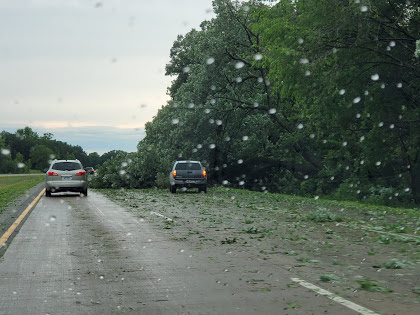
Another cost going up - the cost of severe weather in Wisconsin

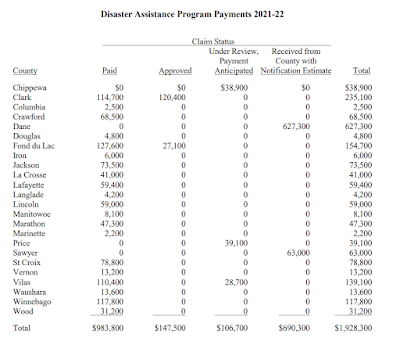
As part of a series of requests from Governor Evers that the Joint Finance Committee approved of today, more funds got sent to the Department of Military Affairs to deal with disasters. The Legislative Fiscal Bureau broke down the request, why more is needed, and it gets paid for. The Wisconsin Department of Military Affairs (DMA) heads up the state's disaster assistance efforts, and the program is intended to help pay the bills for communities that have been hit with some kind of weather event that causes severe damage to infrastructure and related needs.
State Disaster Assistance Program. The state disaster assistance program, created in 2005 Act 269, makes payments to local units of government and retail electric cooperatives for governmental costs, such as debris clearance, protective measures, and damage to roads and bridges, incurred as the result of a "major catastrophe." A major catastrophe is defined as a disaster, including a drought, flood, high wind, hurricane, landslide, mudslide, snowstorm, or tornado, that resulted in the Governor requesting a presidential declaration of a major disaster under federal law. In 2021-22, for example, DMA provided assistance for flooding and severe thunderstorms events in Clark, Manitowoc, and Wood Counties, and for flooding, tornado, wind damage, and severe thunderstorm events in east central Wisconsin, southeastern Wisconsin, southwestern Wisconsin, and west central Wisconsin.

Under administrative rule, local governmental units may be reimbursed if the following eligibility criteria are satisfied: (a) the local governmental unit has suffered a "major catastrophe"; (b) a disaster or emergency declaration was issued by the local governmental unit or the state during the event; (c) the damages suffered and eligible costs incurred are the direct result of the event; (d) federal disaster assistance is not available because the Governor's request that the President declare the catastrophe a major disaster has been denied or no federal assistance is requested because the event does not meet the per capita impact indicator issued by the Federal Emergency Management Agency (FEMA); (e) at least one local governmental unit or a tribal governmental unit within the county has incurred public assistance costs that exceed the per capita impact indicator under the public assistance program guidelines issued by FEMA; and (f) the local governmental unit will contribute at least 30% of the total amount of eligible costs incurred from other funding sources.
And the amount set aside to pay disasters in the 2021-22 fiscal year hasn't been enough to cover the amount of claims that local governments have had.
The Department's request for 2021-22 is identified in Table 4. Through April 11, 2022, the disaster assistance program had expenditures of $983,800, pending claims of $147,500, claims under review with payment anticipated of $106,700, and an available balance of $2,500. Based on initial damage estimates from counties that have not yet submitted applications, the Department estimates that it will receive $690,300 in additional claims this fiscal year. In addition, DMA has received a preliminary estimate resulting from March, 2022, ice damage in Marinette County ($94,000) and projects that $500,000 a year in new claims may occur in 2021-22 and 2022-23 based on prior claims activities.

The disaster aids program is paid for through as a portion of the 2-cent Petroleum Inspection Fee (PIF) that goes on every gallon of gas in Wisconsin. But there is only $986,300 available for this year and $711,200 for the next one. That's a lot less than what DMA is already set to pay to Wisconsin communities, so JFC allowed for another $1.536 million for this fiscal year and nearly $750,000 in 2022-23.

In theory, this will lower the amount of money that can be used by the Wisconsin Department of Transportation for roads and other needs, but it's a tiny fraction of the large amount of funds that WisDOT uses for highways, transit, and other transportation needs. The LFB also mentions that WisDOT has its own disaster assistance program, generally for specific earmarks to repair storm damage, and GPR tax dollars can be added to pay for these earmarks if more than $1 million is needed.
The DOT disaster damage aid program, which aids local governments for road-related disaster costs, receives funding through two sum-sufficient appropriations: a transportation fund-supported (SEG) appropriation and a general fund-supported (GPR) appropriation. The SEG-supported appropriation is estimated at $1.0 million each year. Expenditures from the SEG-supported appropriation may not exceed $1.0 million for a single disaster without the Governor's approval. Each year, individual disasters with road damages below this $1.0 million threshold are also paid with SEG. If the expenditures for smaller disasters collectively exceed the estimated amount, the program's sum-sufficient appropriation draws on the transportation fund to cover costs. For individual disasters exceeding $1.0 million, the Governor may approve the transfer of GPR to the transportation fund for the costs exceeding the $1.0 million threshold. These GPR transfers may only be made in the second fiscal year of each biennium. In 2020-21, no funds were transferred from the disaster damage-related, GPR appropriation to the transportation fund.
There also can be funding for disasters through the federal FEMA program, which can take the strain off of the state for picking up the costs associated with disasters.
Additionally, funding from FEMA may reduce the amount of repairs funded by DMA. FEMA's public assistance program provides reimbursement for projects submitted by counties, cities, townships, and not-for-profit organizations for events that receive a federal disaster declaration. Eligible projects include repairs to roads and bridges and costs for debris removal. Under the program, FEMA provides 75% reimbursement of eligible costs, while the state and local agencies share the remaining 25% equally.
There have been no presidential disaster declarations for Wisconsin since snowstorms hit the state in early 2020, but FEMA is still paying claims related to historic rainstorms in the northern and western parts of the state in 2018 and 2019.

One last thing that this need for supplemental funding underscores is that future disasters will cost more in Wisconsin. Not even because historic storms seem to happen more often, but because inflation and inflated property values are going to raise the price tag for all repairs and mitigation. Which makes it all the more vital to care about climate change and the need to take steps to both prevent future disasters, and to deal with the ones that'll happen.

Monday, May 30, 2022

Budget deficit outlook - better now, worse later

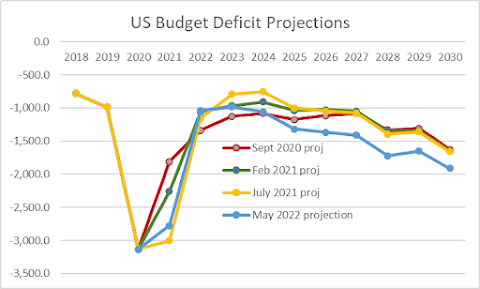
Wanted to give a brief overview of last week's release of The Budget and Economic Outlook from the Congressional Budget Office. The good news is that the budget deficit is going to drop this year to its lowest level since the COVID pandemic started more thn 2 years ago. And the reason why is because jobs and (nominal) incomes have continued to roar back, raising tax revenues.
According to CBO’s projections, under current law, the budget deficit in 2022 will be $1.0 trillion, $1.7 trillion less than the shortfall recorded last year, as spending in response to the pandemic wanes and revenues increase. That decrease would be larger if not for a shift in the timing of certain payments. Because October 1, 2022 (the first day of fiscal year 2023), falls on a weekend, certain payments that would ordinarily be made on that day will instead be made in fiscal year 2022. If not for that shift, this year’s projected shortfall would have been $68 billion smaller (see Table 1-2).

CBO projects that, under current law, revenues will increase by 19 percent in 2022, a slightly faster rate of growth than the 18 percent increase that occurred in 2021. That growth in 2022 results in part from the current economic expansion and the end of temporary provisions enacted in response to the pandemic that reduced revenues. However, even after accounting for those factors, tax collections so far in 2022 have been larger than currently available data on economic activity would suggest. CBO will evaluate the reasons for the discrepancy as more detailed information from tax returns becomes available. In total, revenues are projected to rise by $789 billion in 2022, to $4.8 trillion. Revenues will reach 19.6 percent of GDP this year—the largest that receipts have been as a share of the economy in more than two decades.
That's a smaller deficit for this year than CBO was projecting before the stimulus bills of December 2020 and March 2021 became law, and about $800 billion less than what CBO was thinking would happen last September.

The CBO adds that all of these stimulus measures will raise the deficit in isolation, but also is less than what was shelled out in 2020 and 2021. And the higher revenues due to strong economic growth over the last 2 years will more than counteract that increase in spending for this year.
Since CBO prepared its March 2020 budget projections (the final set of projections before most laws enacted in response to the pandemic took effect), legislation has increased the agency’s estimates of the federal budget deficit, excluding the costs of servicing the debt, by $0.5 trillion in 2022 and by $0.2 trillion in 2023, mostly by increasing federal spending. The effects of legislative changes on the deficit will be considerably smaller in 2022 and 2023 than in 2020 ($2.3 trillion) and 2021 ($2.6 trillion) because several provisions of pandemic-related legislation will expire or wind down (see Figure 2-2 on page 30). In CBO’s assessment, diminishing fiscal support in 2022 and 2023 will provide a smaller boost to the overall demand for goods and services than the significant boost provided by fiscal policy in 2020 and 2021.....

CBO revised its estimate of revenues in 2022 upward by $251 billion (or 6 percent) and its projection for the 2022–2031 period upward by $1.3 trillion (or 2 percent) for technical reasons. New tax data and stronger-than anticipated tax collections over the past year account for the most significant increases. CBO observes payments to the Treasury as they occur but does not receive detailed information on tax liabilities until as many as two years after payments have been made.....

Individual Income Taxes. Technical changes raised CBO’s estimate of individual income tax receipts in 2022 by $173 billion (or 7 percent) and its projections for the 2022–2031 period by $790 billion (or 3 percent). CBO boosted projected receipts at the beginning of the period because recent tax collections have continued to be stronger than expected given current economic data and the agency’s estimates of the budgetary effects of recently enacted legislation. Additionally, CBO revised upward its estimates of the amount of corporate business income taxed at the individual level throughout the projection period. That change reflects modeling refinements based on recent historical tax and economic data. Partially offsetting the upward adjustments to 2022 revenues was a reduction in the anticipated amount of payroll taxes that would be reallocated to individual income taxes in that year.
So that helps the budget in the short term, but the CBO also says that budgets are now slated to become notably larger in the coming years.

And a big reason why is an expense that had been falling over the last 2 years - interest on US debt. CBO says rates will rise ifor the rest of the year and continue to rise over the next couple of years, which means it will cost more to pay off the debt from future-year deficits.

In CBO’s projections, interest rates on short-term Treasury securities rise in concert with the increases in the target range for the federal funds rate carried out by the Federal Reserve. In 2022 and 2023, the Federal Reserve rapidly increases the target range for the federal funds rate to reduce inflationary pressures in the economy. In CBO’s projections, the interest rate on 3-month Treasury bills follows a similar path, rising to 1.4 percent by the fourth quarter of 2022, 2.3 percent by the fourth quarter of 2023, and 2.6 percent by the fourth quarter of 2024 (see Figure 2-4, bottom panel). The Federal Reserve reduces the target range for the federal funds rate in 2025 to counteract the drag on economic growth stemming from the higher individual income tax rates that take effect at the beginning of 2026 under current law. Accordingly, in CBO’s projections, the 3-month Treasury bill rate falls to 2.4 percent by the fourth quarter of 2026.

Interest rates on long-term Treasury securities are expected to increase through 2026, partly because short-term rates are expected to rise. Long-term interest rates are partially determined by investors’ expectations about the future path of short-term interest rates. Potential purchasers of long-term bonds weigh those bonds’ yields against the yields from purchasing a series of shorter-term bonds (for example, purchasing a 1-year bond each year for 10 years). When the expected future path of short-term interest rates rises, the yield on long-term bonds rises to ensure that there are enough buyers for all the long-term bonds currently for sale. In CBO’s projections (which reflect economic developments as of March 2, 2022), the interest rate on 10-year Treasury notes rises from 1.5 percent in the fourth quarter of 2021 to 2.7 percent in the fourth quarter of 2022 as the Federal Reserve tightens monetary policy, signaling a higher future path for short-term interest rates. After 2022, the interest rate on 10-year Treasury notes rises more gradually, increasing to 2.9 percent in the fourth quarter of 2023 and 3.1 percent in the fourth quarter of 2024.

What's funny to me about this is that a typical Koched-up complaint about deficits is that they cause inflation by "overspending", which devalues the dollar. In fact, the dollar is at a 20-year high vs other currencies, and inflation stayed high (and went higher) after government stimulus went away and overall government spending started going down several months ago.

Instead what we have is the Federal Reserve raising interest rates to head off inflation that has partly due to very strong economic growth, and partly due to supply constraints and profiteering that has little to do with the spending of tax dollars. And the higher rates will result in higher costs to pay off the debt, which translates into much of the increase in spending over the next 10 years.

Overall federal spending has dropped in 2022 as fewer funds are needed for COVID treatment and relief, but other areas are going to rise - from infrastructure to defense to debt service to Social Security and Medicare.
In CBO’s projections, total federal outlays decrease by $1.0 trillion in 2022. (That amount excludes shifts in the timing of some outlays; the discussion of CBO’s projections that follows reflects adjustments to remove the effects of timing shifts.) The decline in 2022 is dominated by a $1.1 trillion drop in estimated mandatory spending—the result of sharply lower pandemic-related spending—to $3.7 trillion this year. That large decrease is partially offset by much smaller increases in discretionary outlays and net interest costs. Assuming no changes to current law, discretionary outlays are projected to increase by $81 billion (or 5 percent) and reach $1.7 trillion this year; the government’s net interest costs are projected to increase by $47 billion (or 13 percent), to $0.4 trillion.

What I also want to note is that the CBO says the economy should remain strong in the coming years, with full employment and/or employment shortages. It also means higher levels of nominal GDP and wages and salaries than what was anticipated last year, although some of this gets eaten up by inflation (especially in the next 2 years).

Sure, you can say that the higher deficits and interest costs for that debt could become a headwind, but that can be solved by simple fiscal means such as taxing the rich and/or raising the cap on earnings for Social Security and/or Medicare, or increase user fees for highways via gas tax and/or registrations. We also could certainly cut into our $750 billion military budget if we wish, and there are trillions in surpluses in other trust funds that are growing and will never be used (like disability and retirement funds of military and other federal employees) that can replace the deficits in other trust funds.

And I would much rather the Fed undershoot with lower interest rates and risk inflation than overshoot us into recession with higher rates and higher debt costs. I don't see other countries cutting us off or destroying our dollar any time soon, and I still hold a bias that we need to keep growing the economy as much as possible and/or keep the safety net robust when economic downturns happen.

I think it's better if people don't fall on hard times due to fiscal austerity, and while I get that rising deficits in future years are going to be something to stay aware of, the deficit shouldn't be the dominant reasoning behind why we make decisions on economic policy.