But I thought Robbin' was going to wait till he met with his caucus next week! What's the rush, bud? And I noticed that when asked about this, Little Napoleon blamed everyone but himself for this fiasco, even though VOS chose to hire Gableman, VOS chose to approve all of the taxpayer-funded checks to Gableman, and VOS put wackadoodle Janel Brantdjen in charge of the Assembly's Elections Committee. Typical mediocre Republican, they want all the power, and the appearance of being in charge. But when things go bad... It's Great Taste weekend int he Mad City, I got a group of friends coming in from multiple states, and it's time to get this great annual celebration underway. More to follow in days to come.BREAKING on @AP
— Scott Bauer (@sbauerAP) August 12, 2022
Wisconsin Assembly @SpeakerVos has fired Michael Gableman, the former state Supreme Court justice he hired 14 months ago to investigate the 2020 election
Vos fired him three days after Vos beat a GOP challenger Gableman and Donald Trump endorsed
Friday, August 12, 2022
Quick note before taking a Taste
Been busy in real life here, so I haven't had that much time to discuss our softening inflation or other oddities that have been going on for the last couple of days. But I did just see this.

Wednesday, August 10, 2022
Wis primary shows Trump effect, GOP split, and Dems' opportunities
A couple of quick reflections from last night's primary.
First of all, we had quite high turnout, especially since the Dem Senate race had all the drama taken out of it 10 days before the election. Unofficial results for Tuesday's primary show that nearly 693,000 Republicans voted in the governor's race and more than 501,000 Democrats voted in the Senate primary. Interest fell in that race won by Lt. Gov. Mandela Barnes after his three top challengers dropped out two weeks ago.
Still, the 25.5% turnout was the best since 26.9% in 1982. Turnout in the 2018 primary, which featured a large field of Democratic gubernatorial candidates, was 23%. I don't view the difference in turnout by party to mean much, because I would imagine more than a few people chose to vote in the GOP race for Governor because that was where the contested action was, and voters who are "independent" (or claim they are to seem "above politics") tend to follow the heat.
And the result in the GOP primary for Governor is an amazing Rohrschacht test about the party, and whether they went along with the Scott Walker-endorsed Rebecca Kleefisch, or the Trump-endorsed Tim Michaels.
 Lots of socioeconomic and educational...errr..differences between the pink counties and the dark red counties. And it continues a trend that we saw in 2018, where the Walker-establishment Republicans won with Leah Vukmir, but "outsider" Kevin Nicholson won most of the counties.
And the GOP split broke wide open after the polls closed when arguably the most powerful Republican in state politics pulled off this blast after surviving his primary by less than 300 votes.Crystal Ball: @JMilesColeman and me on the rural forces winning out in the WI-GOV R primary, the closer-than-expected MN-1 special, and Rs picking the more conservative option in blue state Senate primaries https://t.co/W2eoGlJTVY pic.twitter.com/G6N1KIDAmF
— Kyle Kondik (@kkondik) August 10, 2022
Boy, if only Robbin' could do something about that, and about Janel Brandtjen chairing the Assembly's Elections Committee... And it got more ridiculous today, as Robbin' went back to weaseling about the Big Lie investigation that HE ordered and HE controls.Said that the caucus will be meeting soon to take up whether Gableman will continue with his investigation into 2020
— Laura Schulte (@SchulteLaura) August 10, 2022
GIVE ME A F***ING BREAK! This was Vos trying to two-step by keeping the MAGA rubes stirred up about something that he knew was BS from day 1. And of all the people that could have been chosen to head up this sham, he chose a crooked dope like Gableman because....?? Now the GOPs have 3 old white male 3 pro-MAGA candidates at the top of their tickets for the most important races in the state (US Senator, Guv, and Derrick "Small-D" Van Orden in the 3rd Congressional District). And that candidate for Governor did worst in areas where Trump bled away the most voters in 2020.Speaker Robin Vos details the process of the Gableman investigation & when things changed from an investigation to a "crusade to please certain people in our party..."
— 620wtmj (@620wtmj) August 10, 2022
Listen to the full interview with Speaker Vos on Wisconsin's Morning News: https://t.co/AYh3z7iG5s pic.twitter.com/hemjK7Q82K
Between that and the overturning of Roe v. Wade, sure seems like Dems should be rocking the suburbs and appealing to decency and steadiness for the next 3 months, doesn't it? It also means that the barely-GOP State Senate districts in Appleton/Neenah/Menasha and Tosa/Brookfield/New Berlin/Stallis are definitely in play for Fall, GOP-held districts that include high-educated suburbs and college towns are in peril. Lots more can be broken down in the future (there are some real treats that won GOP primaries last night), but the results seem to tell us a lot about how broken the state GOP is, and how different things are in TrumpWorld vs the other 2/3 of Wisconsinites. And while Tim Michels may have gotten the most votes to win the GOP nomination, he only got around 27% of the total votes in an election that only had 26% of voters turn out. So good luck to Michels and other Trumpers in having that translate to a midterm win when turnout that is likely to be at least twice as much as we had yesterday. And a majority of them hate Trump.Wisconsin UNOFFFICIAL votes.
— Charles Franklin (@PollsAndVotes) November 9, 2020
The map of the vote margin by county, and of the shift in margin from 2016 to 2020.
A familiar map of red and blue counties. Only Sauk and Door flipped, R->D
Margin change notable that WOW and BOW (Fox Valley) both getting smaller Rep margins
1/n pic.twitter.com/osu47aczO1
Monday, August 8, 2022
Inflation Reduction Act gets through, with good things for real people...and the US budget!
After an absurd all-night and morning session over the weekend, the Senate finally finished their dumb procedure that allows for 51 votes to actually win the day over 50 votes.
So let’s review some of the items in the Inflation Reduction Act.PASSED! The Senate Democratic majority advanced the Inflation Reduction Act: making billionaire corporations pay a minimum tax to fund historic investments in clean energy and lower costs.
— Elizabeth Warren (@SenWarren) August 7, 2022
Every Senate Republican sided with corporate special interests and against this bill.
The bill would allow Medicare to negotiate prescription drug prices – long opposed by the pharmaceutical industry – and extend Affordable Care Act subsidies three more years through 2025. To address climate change, the bill includes $10 billion in tax credits to build electric vehicles, solar panels and wind turbines; $7,500 tax credit rebates for consumers to buy electric vehicles; and $9 billion for energy-efficient home retrofits for low-income Americans. There's up to $20 billion for loans to support electric vehicle plants, $20 billion to assist farmers and ranchers with climate change and $30 billion for cities and states to transition utilities to clean electricity.Oh, but SPENDING, Jake! SPENDING! For those of you who are so economically illiterate that you think our inflation is caused by debt, good news! These measures are paid for, and then some.
To pay for these and other measures, the bill would establish a 15% corporate minimum tax and beef up enforcement of the Internal Revenue Service. The bill would raise about $739 billion in tax revenue, more than offsetting the $433 billion in proposed spending. The legislation would decrease the federal deficit by $102 billion over the next decade, according to the Congressional Budget Office.If you’re thinking the math of $739 billion in taxes - $433 billion in spending doesn’t add up, you’re not alone. Let me remind you that the CBO admitted it left some of the budget effects out of its analysis.
CBO expects that the provisions in title I that would increase funding for tax enforcement activities also would increase revenues. However, under guidelines agreed to by the legislative and executive branches, that change is not included in this cost estimate, although it would be reflected in CBO’s baseline budget projections after the legislation was enacted….CBO estimates that as a result of those increases in outlays, revenues would increase by $204 billion over the 2022-2031 period.It’ll be hilarious to see WisGOP Congressmen like Tom Tiffany, Glenn Grothman and Scott Fitzgerald all whine about extra tax enforcers when the House takes up this bill. That’s because they all voted for Scott Walker’s 2013-15 budget that raised tens of millions by…hiring extra agents at the Wisconsin Department of Revenue to go after tax cheats. Interestingly, the CBO also responded to some (leading) questions from Sen. Lindsey Graham by saying that overall inflation wouldn’t be affected much by the Inflation Reduction Act. But I’ll explain in a second why this type of analysis is largely BS.
In calendar year 2022, enacting the bill would have a negligible effect on inflation, in CBO’s assessment. In calendar year 2023, inflation would probably be between 0.1 percentage point lower and 0.1 percentage point higher under the bill than it would be under current law, CBO estimates. That range of likely outcomes reflects uncertainty about how various provisions of the bill would affect overall demand and output, the supply of labor, the persistence of disruptions in the supply of goods and services, and how the Federal Reserve would respond to offset any increase in inflationary pressure. Responsiveness to the enhancement of health insurance subsidies established by the Affordable Care Act is the most important factor boosting inflationary pressure, and responsiveness to the new alternative minimum tax on corporations is the most important factor reducing inflationary pressure. The range applies to multiple measures of inflation: the GDP price index, the personal consumption expenditures price index, and the consumer price index for all urban consumers…. CBO expects different provisions of the legislation to affect overall demand and output differently. For example, provisions that directly increase government purchases of goods and services would add to overall demand on a dollar-for-dollar basis. Increases in financial support to people, such as through enhanced health insurance subsidies, would boost spending more among lower-income people than among higher-income people, partly because lower-income households typically consume a higher fraction of their additional disposable income than higher-income households do. Thus, financial assistance to lower-income households would boost the overall demand for goods and services more than financial assistance to higher-income households would. Changes to business taxes that affect after-tax profits on past investments—as opposed to the return on new investments—would have relatively small effects on overall demand, in CBO’s assessment.This is a typical GOP trick that they’ve pulled for years with Obamacare. The claim is that increases in subsidies raise costs and inflation, because the total amount paid for the service may be more. But consumers aren’t the ones paying that, and in fact are paying less. And shouldn’t that be what we care about, if the deficit is being reduced at the same time? How much they personally end up paying is what typical Americans care more about. And many Americans would pay less for drugs (especially if they are on Medicare), less for health insurance, and get help in making energy-efficiency moves that save money down the road. Then the “cost” is in making corporations that have $1 billion in profits pay a minimum tax rate? Like real people have to? Seems like a win-win to me. It also puts a 1% excise tax on the economically wasteful and regressive tactic of stock buybacks.
As I’ve mentioned before, we shouldn't expect or demand this bill to be the magic pill that solves the climate crisis or immediately turn around the crippling inequalities that have resulted from 40 years of giveaways to the rich and corporate. It won’t be. But it’ll make us a lot better than we were, and if Dems build upon this success with more wins in 3 months, it allows for us to go further. So let’s have the House pound this thing through at the end of this week, don’t mess around and try to get everything at once with amendments. Take the surprising win with the Inflation Reduction Act, and move on from there.Corporations have increasingly used stock buybacks to benefit their shareholders while avoiding taxes. In the first year after the Republican’s 2017 tax reform bill, corporations repurchased a record $1 trillion in their own stocks. https://t.co/IkcX42lMCc
— ITEP (@iteptweets) August 5, 2022
Saturday, August 6, 2022
Jobs report makes "recession" talk seem ridiculous
With the leveling out of inflation and consumers adjusting to the changing prices, GOPs and DC media were ready to pounce on Friday's jobs report and give more proof of a slowing/recessionary economy.
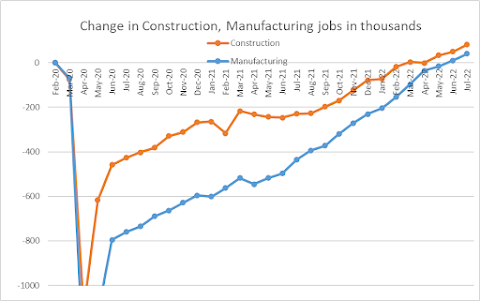 This is why the worries over "slowdown in housing" doesn't concern me much. There's still hiring going on, and a slowdown on the demand side is allowing the labor supply side to catch up, to the point that there shouldn't be much difference in overall activity....except perhaps with prices that aren't so ridiculous.
However, the inflation picture is part of the reason that this jobs report was initially seen as "good news being bad news" on Wall Street. Because the household survey indicated an economy that may still be pumping at or beyond potential.
This is why the worries over "slowdown in housing" doesn't concern me much. There's still hiring going on, and a slowdown on the demand side is allowing the labor supply side to catch up, to the point that there shouldn't be much difference in overall activity....except perhaps with prices that aren't so ridiculous.
However, the inflation picture is part of the reason that this jobs report was initially seen as "good news being bad news" on Wall Street. Because the household survey indicated an economy that may still be pumping at or beyond potential.
Sorry, guys.Here’s @ABC NEWS …accidentally releasing a pre written jobs report story with “XYZ” filling in for the coming numbers.. read the text… it is Amazingly wrong. pic.twitter.com/mROXiGB9if
— Hal Sparks (@HalSparks) August 5, 2022
BREAKING: Payrolls increased 528,000 in July, much better than expected in a sign of strength for jobs market https://t.co/MAhKmg6hrz
— CNBC Now (@CNBCnow) August 5, 2022
Oh no! Pivot, pivot!!We have now fully recovered *all* the jobs that were lost early in the pandemic pic.twitter.com/IPz9gyWZIZ
— Catherine Rampell (@crampell) August 5, 2022
Yeah, it amazes me too. Job growth is still picking up, even as unemployment falls to 50-year lows of 3.5%. So let's look at the full jobs report and see what is driving the growth.Holy shit. Fox News is now attacking President Biden for BEATING jobs expectations, saying that it “misses [their] forecast.” https://t.co/8ez1AuZVr3
— No Lie with Brian Tyler Cohen (@NoLieWithBTC) August 5, 2022
In July, leisure and hospitality added 96,000 jobs, as growth continued in food services and drinking places (+74,000). However, employment in leisure and hospitality is below its February 2020 level by 1.2 million, or 7.1 percent.But I'll add that this gap was 4.1 million when Joe Biden took office in January 2021, so that sector is still building back from the COVID-related bomb dropped on it in 2020. And perhaps given how some of us have changed our leisure spending (along with increased use of methods of service such as carry-out/order ahead), some jobs in the sector may not come back. Although I still see plenty of "help wanted" signs around in this sector, so there's still demand to be met. The jobs report also notes a positive and possibly permanent shift in employment in another sector.
Employment in professional and business services continued to grow, with an increase of 89,000 in July. Job growth was widespread within the industry, including gains in management of companies and enterprises (+13,000), architectural and engineering services (+13,000), management and technical consulting services (+12,000), and scientific research and development services (+10,000). Employment in professional and business services is 986,000 higher than in February 2020.Blue-collar industries have also come back strong in 2022. Mining added another 7,000 jobs, and has added 45,000 in the last 6 months. The construction (+32,000) and manufacturing (+30,000) sectors also continued to hire, and are now above their pre-COVID levels.
In July, the unemployment rate edged down to 3.5 percent, and the number of unemployed persons edged down to 5.7 million. These measures have returned to their levels in February 2020, prior to the coronavirus (COVID-19) pandemic..... The labor force participation rate, at 62.1 percent, and the employment-population ratio, at 60.0 percent, were little changed over the month. Both measures remain below their February 2020 values (63.4 percent and 61.2 percent, respectively).But shouldn't we expect a lower participation rate simply due to pandemic and demographic effects? Take a look at this.
Well, they're gone unless scum like Ron Johnson are successful in putting Social Security Medicare on the chopping block. Now add on a whole lot of COVID death and permanent disabilities among the living, and this isn't that surprising. A lot of people resigned their jobs, moved on to better ones, and now have to be replaced by a smaller cohort of people. I don't see a large group of working-age people laying around, choosing not to work, especially as prices have risen and COVID-era relief has diminished over the last year. The other reason "INFLATION" fears may come back up after the employment report is this part.Okay so 2/3 of lost labor is 55+. I don’t think there’s an environment where they come back to the workforce. https://t.co/ucj7skJ2XU
— Brian Truman (@trumanium) August 6, 2022
That's both increased demand and increased cost for employers. While I view that as the "good type" of inflation, I have fears the Fed will now raise rates more than necessary in September and beyond, because how DARE we have everyday workers in control of things and limit profits like that! Even if there's evidence that Americans are adjusting their spending habits to limit their own distress from higher prices. But there's a whole month of data and a another jobs report ahead of that next Fed meeting. And for the rest of Summer, things seem pretty bright to me on the jobs front, and the economy in general. If we get a month of strong back-to-school and related spending, Q3 growth could look pretty good. That fact makes Republicans VERY unhappy, since they really have nothing to offer voters beyond whining about things. If too many people recognize that GOPs are selling empty BS, then the GOPs are set up to get slapped down in 3 months.Average hourly earnings growth, three month change, annual rate:
— Jason Furman (@jasonfurman) August 5, 2022
Last month's data: 4.1% and stable/falling
This month's data: 5.2% and rising
This is due to a combo of an additional month of data and revisions to previous months. pic.twitter.com/YXIZZhOSVS
Wednesday, August 3, 2022
No surprise - Dem bill improves things, reduces deficit, and GOPs BS about it
The Congressional Budget Office has weighed in on the Dems' Senate bill that would go after tax dodging corporations and individuals, while lowering insurance and drug costs and expanding some green energy initiatives. And CBO says it would improve the country's fiscal situation.
greed tricks that have taken funds away from everyday American workers. Once those corporations have to pay taxes on their profits, they might be more likely to want to expand and invest in their business, instead of wasting time and energy on less productive measures and tax dodges.
And let me remind you that this package of deficit reduction and relief from higher costs for everyday Americans comes on top of the US budget deficit already being at its lowest point in 5 years.
 Let's not kid ourselves about who really is the fiscally responsible party in DC. And while the IRA is far from everything we need, it would still be an improvement over what we've got.
Democrats’ plan would decrease deficit by more than $100B: CBO https://t.co/gPVxswRxfH pic.twitter.com/NSKTIx6XAG
— The Hill (@thehill) August 3, 2022
The Congressional Budget Office (CBO) on Wednesday released estimates for Democrats’ sprawling reconciliation plan, forecasting the legislation would lead to a net deficit decrease of more than $100 billion over roughly the next decade. The estimates from the nonpartisan budget scorekeeper come as Democrats are moving quickly to pass the mammoth bill, dubbed the Inflation Reduction Act, later this week.But I thought Dems were saying this would cut the deficit by $300 billion? So what gives?
“CBO expects that the provisions in title I that would increase funding for tax enforcement activities also would increase revenues,” the CBO said. “However, under guidelines agreed to by the legislative and executive branches, that change is not included in this cost estimate, although it would be reflected in CBO’s baseline budget projections after the legislation was enacted.” However, the CBO noted in its report that, as “a result of those increases in outlays, revenues would increase by $204 billion over the 2022-2031 period,” eventually cutting the deficit by more than $300 billion in total.Ah, that makes more sense. Although why you wouldn't score something that would happen doesn't make a lot of sense. But WisGOP thinks it has a way to attack the Inflation Reduction Act, and is trying to tie it to someone who hopes to be Senator - Mandela Barnes.
The latest Barnes-backed spending boondoggle would increase the tax rate paid by nearly all taxpayers, including a $17 billion tax hike on taxpayers earning less than $200,000....I'll spare you the rest of WisGOP's word salad, but where is this "tax increase" argument coming from? William Gale at the Tax Policy Center (TPC) explains it for us, pointing out that the Joint Committee on Taxation (JCT) says 1/4 of the increased taxes and costs from the minimum corporate tax will be paid by workers over corporations.
The labor portion in JCT’s model is relatively small compared to the burden faced by shareholders. But it’s enough to make the JCT distributional tables reflect tax increases among nearly all income groups in a bill where a corporate tax increase is the primary revenue source.I'll also note that the TPC immediately follows that up by saying the JCT isn't dealing with the reality of how big, tax-dodging corporations do things.
However, a more careful look at how corporate taxes work today calls into question the estimated changes in federal taxes for middle- and lower-income households. In analyzing corporate taxes, JCT does not distinguish between “normal” and “super-normal” returns. Normal returns can be thought of as the minimum risk-adjusted return necessary for a firm to make an investment. Taxing normal returns can deter business investment and reduce hiring and wages. On the other hand, super-normal returns—often called rents, excess retu>rns, or excess profits—comprise any returns above the normal returns a business could expect. Firms may earn super-normal returns through patents, special expertise, outsized influence in product or labor markets, or just simple luck. A tax below 100% on excess returns should still leave the firm with some remaining super-normal profit and be less likely to affect investment or hiring than a tax on normal returns. In that case, standard analysis assumes that the tax on excess returns is borne by shareholders. In fact, some studies show that 60 percent or more of the corporate tax base is made up of super-normal profits. Distinguishing between normal and super-normal returns is especially important here since the corporate minimum tax under discussion would only apply to firms with $1 billion or more in profits. Given their financial status, it’s quite possible the businesses impacted are more likely to be earning excess or super-normal returns.And I'd take that one step further - the type of corporation susceptible to this minimum tax is the type of place that does large amounts of share buybacks, outsourcing, and other
Tuesday, August 2, 2022
The Big Lie bites taxpayers...and Robbin' Vos!
We know that the WisGOP Assembly's absurd "investigation" into the 2020 election was a Big Lie. But we found out this week that the clown leading the investigation knows that he's been telling another Big Lie to the public.
Memo shows Wis. GOP lawyer privately opposed decertifying Biden’s 2020 winhttps://t.co/1jNFTAJej9
— Patrick Marley (@patrickdmarley) August 2, 2022
It was an extraordinary public statement from a former state Supreme Court justice hired by Republican lawmakers to probe the 2020 election: Wisconsin should take a “hard look” at canceling Joe Biden’s victory and revoking the state’s 10 electoral college votes.... But a newly unearthed memo shows that the former justice, Michael Gableman, soon afterward offered a far different analysis in private. “While decertification of the 2020 presidential election is theoretically possible, it is unprecedented and raises numerous substantial constitutional issues that would be difficult to resolve. Thus, the legal obstacles to its accomplishment render such an outcome a practical impossibility,” Gableman wrote to Assembly Speaker Robin Vos.Oh, so Mikey didn't think wasting time on election reversal was such a great idea, did he? Funny, he doesn't say that in public, and keeps stringing the rubes along. And how did we find out Gableman was double-talking?
Gableman’s memo was released under the state’s open records law to the liberal watchdog group American Oversight, which shared it with The Washington Post. Heather Sawyer, the group’s executive director, in a statement called decertification “a fiction designed to advance conspiracy theories and undermine confidence in our democracy.”And we found out this week that Robbin' Vos is perfectly fine with continuing this charade to "advance conspiracy theories and undermine confidence in our democracy." No matter what it costs Wisconsin taxpayers - whether it's paying for Gableman's fat salary and high-paid "consultants", or to pay back organizations that have to sue to hold this Big Scam accountable.
Attorney James Bopp, who is representing Michael Gableman in a lawsuit over records requests related to Gableman's taxpayer-funded review of the 2020 election, says in court today he is charging taxpayers $450 per hour to represent Gableman.
— Molly Beck (@MollyBeck) August 1, 2022
Dane County Judge Frank Remington rules Gableman is responsible for paying American Oversight's legal fees in the lawsuit, which amount to about $163,000. The fees will be covered by taxpayers.
— Molly Beck (@MollyBeck) August 1, 2022
Fiscal conservatism at its finest! Oh, but Robbin' Vos at least keeps the rubes misdirected, so that's gotta help him, right?Assembly Speaker Robin Vos, R-Rochester, hired Gableman at a cost of $676,000. Legal fees and other court expenses have pushed the price tag to more than $1.1 million — costs https://t.co/KgjUz6AtAd
— madison.com (@madisondotcom) August 1, 2022
So Robbin' Vos' two-step routine on the big lie is wasteful, stupid, and harmful to GOPs in statewide races. And it's still not good enough for Trump and the MAGAts! Hope THAT was worth it, you pathetic dweeb!Just in: Former President Donald Trump has endorsed Adam Steen, who's challenging @SpeakerVos in the 63rd Assembly District.
— A.J. Bayatpour (@AJBayatpour) August 2, 2022
Trump says he's backing Steen, "running against the RINO Speaker of the Assembly, Robin Vos."
Monday, August 1, 2022
Higher incomes fell short of inflation in June. With gas prices lower, does that reverse in July?
A day after the 2nd quarter GDP report led to a lot of recession talk, June’s income and spending report had added intrigue, to see if data really was pointing toward an economic downturn.  But let’s also remember that June was also the height of jacked-up gas prices/inflation, and the inflation index in the income and spending report reflects that.
  With gas prices quite a bit lower than they were in June, and CPI/PCE inflation likely to decline for July, I want to see if the nominal increase in spending stays around June's level of 1%, or if it falls with the prices. Also, we’ve seen wage/salary income rise at quite a strong nominal level (3.86% for first 6 months of 2022) - it just didn’t keep up with the rise in gas/food. Will those raises continue even as prices level off and/or fall?
This June report seems to tell me that Americans were still getting more jobs and better pay as Q2 2022 ended, which certainly isn’t recessionary. They were also continuing to spend, but in a choppier fashion that was influenced by which products were seeing prices go up the most. With gas prices back below $3.50 a gallon in these parts, it now seems like we are rapidly shifting to a different phase where we could softly slow spending and job growth, resulting in a relatively normal 2nd half of this year.
But we also could continue to see hot demand (both for labor and consumption), which could continue and possibly worsen shortages, reigniting inflation in other sectors even as oil falls back toward $90 a barrel.
The jury is far from back on this one, and July’s jobs report is going to give our first indications whether the “healthy slower growth”, “reignite”, or “crash shut” scenarios start to emerge for Q3 and the rest of 2022.
With gas prices quite a bit lower than they were in June, and CPI/PCE inflation likely to decline for July, I want to see if the nominal increase in spending stays around June's level of 1%, or if it falls with the prices. Also, we’ve seen wage/salary income rise at quite a strong nominal level (3.86% for first 6 months of 2022) - it just didn’t keep up with the rise in gas/food. Will those raises continue even as prices level off and/or fall?
This June report seems to tell me that Americans were still getting more jobs and better pay as Q2 2022 ended, which certainly isn’t recessionary. They were also continuing to spend, but in a choppier fashion that was influenced by which products were seeing prices go up the most. With gas prices back below $3.50 a gallon in these parts, it now seems like we are rapidly shifting to a different phase where we could softly slow spending and job growth, resulting in a relatively normal 2nd half of this year.
But we also could continue to see hot demand (both for labor and consumption), which could continue and possibly worsen shortages, reigniting inflation in other sectors even as oil falls back toward $90 a barrel.
The jury is far from back on this one, and July’s jobs report is going to give our first indications whether the “healthy slower growth”, “reignite”, or “crash shut” scenarios start to emerge for Q3 and the rest of 2022.
Personal income increased $133.5 billion (0.6 percent) in June, according to estimates released [Friday] by the Bureau of Economic Analysis (tables 3 and 5). Disposable personal income (DPI) increased $120.4 billion (0.7 percent) and personal consumption expenditures (PCE) increased $181.1 billion (1.1 percent).Those look like pretty good numbers, and that gain in income was driven by another increase in wages and salaries. But owners' income (shown in gray) also continues to go up.
The PCE price index increased 1.0 percent. Excluding food and energy, the PCE price index increased 0.6 percent (table 9). Real DPI decreased 0.3 percent in June and real PCE increased 0.1 percent; goods increased 0.1 percent and services increased 0.1 percent (tables 5 and 7).The 0.6% core inflation number is a problem if it continues, and the increase in real spending mixed with the decline in real disposable income meant that the savings rate declined down to 5.1%. It's also intriguing to see how Americans continued to adjust their spending in June 2022, as prices differed between products. Real consumption of groceries has declined as the prices of those products jumped in the first half of 2022. But spending in food services and accommodations continues to come back, albeit not as strongly as in the earlier parts of 2022.
Subscribe to:
Posts (Atom)