Under the governor's plan, counties could increase the sales tax by 0.5% and municipalities with a population of more than 30,000 could do the same. Voters would have to approve any increase in a referendum. Currently, Wisconsin imposes a 5% sales tax and almost all counties impose a 0.5% sales tax. That means the sales tax is 5.5% in most parts of the state — low compared to many parts of the country. Evers would allow the rate to go up to 6.5% in places where voters approved the maximum increases at both the municipal and county levels. In a few spots, it could go even higher because existing law allows communities that are tourist attractions, such as Wisconsin Dells and Eagle River, to levy additional sales taxes.I am all for this. Local communities have been held back for years by a failing system that relies far too much on shared revenues coming down from Madison, and on property taxes as the main method of raising funds. Wisconsin traditionally has kept its sales taxes down, and relied on income taxes (at the state level) and property taxes (at the local level) to fund government. The idea was that the state would pass down shared revenues at a sufficient level that locals could fund their services at a sufficient level, but the state has consistently shared less of its revenue over the last 20+ years. At the same time, Republicans at the state level limited local governments in how much they could raise the property tax to keep their services functioning, and locals have been prevented from having any sales tax beyond one at the county level (other than the handful of small, touristy communities that can levy a premier resort tax). One of the few ways that the locals could get money in to fix their roads and release pressure off of the property tax was to institute local vehicle registration fees. As the Wisconsin Policy Forum noted in its state-local tax report, the previously rare “wheel tax” became widespread in the state during the Age of Fitzwalkerstan. That’s $39 million in registration fees that Wisconsinites weren’t paying a decade ago, and it’s only paid by people that live in that community. Likewise, property taxes are also paid by residents, but not tourists visiting these communities and using a town's amenities. Even worse, many Wisconsinites can’t even write off those property taxes due to the GOP’s 2017 Tax Scam, which put limits on how many state and local taxes (SALT) that could be deducted. A local sales tax is something that the City of Milwaukee has long asked for, given that it's Wisconsin's Number 1 destination of tourism dollars and has been especially short=handed by the state's shared revenue formula in recent years. There was even a hearing on a bill in the first week of March to allow a referendum to come before voters... and then COVID shutdowns started the next week (the Assembly had already adjourned anyway). If you look at the Wheeler Report, take a look at the wide range of organizations in Wisconsin's largest city and county that backed Evers' move, along with the statewide organizations that represent local government. Also note that the one opponent are the oligarchs at Wisconsin Manufacturers and Commerce, who would love nothing more than for local governments to break down and have to sell off their services to corporations. It also makes me wonder which direction GOPs decide to take on this local sales tax proposal, especially the several GOPs whose seats are gerrymandered into Milwaukee County. To me, this is a reform that is long overdue, and I am glad to see Evers bring it up. If he’s smart, he ties it to some kind of property tax reduction/restriction over the next couple of years (and maybe a moratorium on new wheel taxes), and dares the GOP to take it out. It’s well past time Wisconsin make real steps to end their 20th Century local funding system, and freeing up local communities to make tourists and others spending discretionary income to pay more for the services that they are already using. It also seems like a smart time to shift away from the property tax in a time when they are threatening to sizably jump in 2022, without the benefit of allowing many Wisconsinites to write them off on their federal income taxes. It also allows a better chance to keep everyday operations running smoothly in our communities, because there is no more of this Koched-up austerity imposed on them. Which is especially handy in a time when it seems that social needs continue to grow, due to the inequality of our current economy. The Feds and the state are only going to be able to do so much, and want to give out so much to local communities after the COVCID World ends. Better to unlock the handcuffs and give them more options now.
Ventings from a guy with an unhealthy interest in budgets, policy, the dismal science, life in the Upper Midwest, and brilliant beverages.
Friday, February 12, 2021
Evers wants to allow Sconnie communities to have local sales taxes. It is necessary and long overdue
Thursday, February 11, 2021
More Americans out of work makes the need for stimulus even more urgent
That's the first time we've been above 20 million continuing claims since November, and the recently-extended PUA and 26+ week unemployment programs are the reason why. Notice that decline at the start of January and compare it to the spike we saw 3 weeks later (the last week measured for continuing claims in these programs). That decline is the week after the original PUA and PEUC programs ended in CARES, and Donald Trump waited until the following day to sign the stimulus bill that revived both programs. This caused confusion from beneficiaries, which likely delayed them from filing claims. And it seems likely that we are seeing some of those claims "catch up", causing the big jump last week. But given what Federal Reserve Chair Jay Powell indicated this week, those 20 million on unemployment may indeed reflect something very bad. Powell said that the "official" unemployment rate isn't accounting for many Americans that are out of work.NEWS: The US has 20.4 million people receiving unemployment benefits -- a sign of ongoing hardship and lack of job opportunities.
— Heather Long (@byHeatherLong) February 11, 2021
1.1 million *new* unemployment applications were filed last week (UI + PUA) as job losses continue.
Nearly 5 million are on long-term unemployment pic.twitter.com/FR9IJ917vY
The real unemployment rate in the U.S. is closer to 10 percent, Federal Reserve Chairman Jerome Powell said Wednesday, after misclassification errors are factored in to the official government figure. The current unemployment rate, as reported by the Bureau of Labor Statistics last week, is 6.3 percent. "We are still very far from a strong labor market whose benefits are broadly shared," Powell said, in a virtual speech for the Economic Club of New York on the state of the labor market. "The pandemic has led to the largest 12-month decline in labor force participation since at least 1948," he said.... "The Bureau of Labor Statistics reports that many unemployed individuals have been misclassified as employed," Powell said. "Correcting this misclassification and counting those who have left the labor force since last February as unemployed would boost the unemployment rate to close to 10 percent in January."If so, then things are truly dire for a large number of Americans, and President Biden's economic rescue package needs to get through Congress and get signed sooner than later. Especially the parts that allow for expanded benefits and survival checks, as many Americans are still struggling to find work and keep jobs 11 months after COVID first started hitting the overall US economy. Those people need all the help they can get, so they can keep paying their bills, and keep the economic damage from spreading beyond the hard-hit service sectors that have been battered in the COVID World.
Wednesday, February 10, 2021
And there's the inevitable GOP bailout to businesses. And other tax cuts
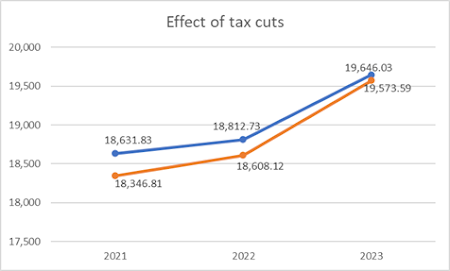
The bulk of the bill was an agreement lawmakers and the Evers administration struck last session to change the tax code to match federal provisions. A similar bill was in the works last session, but failed to pass amid the pandemic. The net impact of the more than two dozen proposed changes in the bill is a $540 million reduction in tax revenues through mid-2023. Because some of the cuts would take effect in the current fiscal year, the impact also would reduce the expected ending balance for the general fund. That in turn would reduce the expected transfer to the rainy day fund by $126.9 million. The amended bill would have to pass both houses and be signed by Evers to take effect.This was done by amending a small tax measure, and the largest move involves giving Wisconsin businesses that received PPP loans and related assistance to write off hundreds of millions of dollars of expenses - even if PPP paid for those expenses in the first place. The Legislative Fiscal Bureau says that most of these write-offs will hit in the next 2 fiscal years, then most of it fades out in 2023. If these tax cuts do become law, that'll limit the amount of money that will be available for Governor Evers to use in the upcoming 2021-23 budget. Also remember that Republicans have introduced an income tax cut that has a price tag of around $653 million between now and the end of that 2-year budget. So you start adding that up, and you can see where the available funds start to run low quickly, especially given that Evers is looking to have his own tax break for caregivers, along with initiatives in mental health, help to farmers and several other items that will be revealed in the coming weeks. My guess is that the full Assembly will quickly try to pass these tax cuts when they next meet on Tuesday, which happens to occur right before Evers will release his budget details. And then the debate goes on full-force. Let's just be aware of how much might be truly achievable (or not), based on the taxing and spending decisions that are already starting.
WisGOPs decide to take from their own school districts to force kids/teachers back into the buildings
The Committee has two options available to it in addressing the plan submitted by the Department [of Public Instruction]. First, it could approve the plan as submitted. Second, the Committee could adjust the amounts in the plan related to the state agency set-aside ($68.6 million) which, under the plan, would be allocated for: (a) a minimum grant of $100,000 for local education agencies ($2.4 million); (b) a minimum per pupil grant of $395 ($65.0 million); and (c) administrative costs ($1.2 million). Under the federal act, the state must allocate $617.5 million according to the formula used for the 2019-20 distribution of Title I Part A funds.So the Republican-dominated JFC could have signed off on DPI’s plan, and it would go in as written. But they decided they wanted to put their own stamp on how some of the Federal money went out. So here’s what the GOPs did.
Under the GOP motion that was approved 11-4, DPI’s administrative costs were cut to $700,000. The remaining $65.5 million will be divided up based on a formula that accounts for the hours of in-person instruction in the 2020-21 school year. The amount of the grants wouldn’t be known until the end of the school year, when in-person instructional hours are reported.In it's paper on the subject. the LFB listed every district in Wisconsin and what it would get out of the extra federal money, as well as whether their extra funds were entirely based on the district’s Federal Title I allocation, or if DPI had to move funds around in order to give them the $395 minimum. The districts that had DPI add money to get to $395 are the ones who stand to lose from this plan, since that money is now going to be spread out among many more districts. State Rep. Evan Goyke noted that many Wisconsin districts would lose out in this change, and here is a list of the districts that stand to lose the most as a result of this move. Districts that were to get most reobligated aid under DPI plan
Elmbrook $2,473,848 McFarland $2,225,943 Middleton-Cross Plains $2,196,035 Kimberly $1,696,418 Hudson $1,665,340 (Sussex) Hamilton $1,617,889 Mukwonago $1,580,075 Muskego-Norway $1,468,273 Waunakee $1,452,224 Wauwatosa $1,419,225 All suburbs/exurbs of bigger cities, with high property tax bases (and therefore heavily reliant on property taxes versus state aids). Most are represented by Republicans, and it was GOPs that voted to take away funds from those districts. Interesting choice, GOPs. Pushing kids and teachers back into the schools during a pandemic, and taking funds away from districts that you “represent.” Also worth mentioning, because this went through the Joint Finance Committee under a review process, any attempt by Governor Evers to redirect the money back to the districts under the original plan can be overridden by the 12-4 makeup of JFC in this gerrymandered Legislature. So we're basically stuck with this scheme to shove kids and teachers back into the classroom. Because....well, I don't know why. Because I don't live in a Bubble World of RW BS.
Tuesday, February 9, 2021
With more money around and budget release imminent, it's time to talk tax cuts!
Gov. Tony Evers wants to create a new $500 tax credit to help cover family caregiver expenses, a $200 million proposal announced Tuesday that will be a part of the governor's state budget plan submitted to the Legislature next week. "This pandemic has laid bare lack of access and affordability in the systems we use to support the people we care about," Evers said in a statement. "We have to do more to make sure families have quality, affordable childcare, that we're strengthening our caregiving workforce, and investing in long-term care. These areas will be critical to our state's economic comeback." The new tax credit would be part of more than $600 million Evers is proposing in new funding directed at long-term care and family caregivers. The Democratic governor also wants to raise nursing homes reimbursement rates by more than 11% each of the next two years, an increase of more than $240 million over the next two years.A caregiver tax credit has been proposed in the past by legislators, but never got through to the Governor's desk. We will see where it goes as the budget is debated. Speaking of the Legislature, there are a couple of minor tax items that the Joint Finance Committee is going to discuss on Wednesday. One deals with adopting a number of minor federal tax items and expanding how much can be written off with the state’s medical insurance deduction for self-employed individuals. The other would put in uniformity over how certain types of businesses can account for capital gains. On their own, the fiscal effect of these measures is small (total of around $25 million for the 2021-23 budget cycle), and it is dwarfed by a couple of other tax cuts that Republicans are pushing. One is an old GOP standby – CUT INCOME TAXES, whether that’s needed or not. The income tax proposal has alreadypassed one State Senate Committee, and here's how it would work.
This bill reduces the number of individual income tax brackets from four to three. Under current law, there are four income tax brackets for single individuals, certain fiduciaries, heads of households, and married persons. The brackets are indexed for inflation.The positive is that this income tax cut proposal is targeted towards lower incomes, with the overwhelming majority of taxpayers benefitting, and the tax cut is cut off past a relatively small amount of income. (Income levels are based on married couples filing jointly) That may seem like a small tax cut, but because millions of Wisconsin would get it, the price tag becomes quite large. Also interesting is that this bill would also require the Wisconsin Department of Revenue to adjust the withholding tables, which hasn’t been done for several years, and would take place within 90 days of the tax cut being signed into law. So Wisconsinites would see the tax cut in their paychecks, along with when they file their taxes next year. The other proposed tax cut that Republicans (and their donors) are supporting is one that would adopt a federal change which allows recipients of PPP and similar assistance from the Feds aid to write off expenses twice. This is not a small tax cut, as the Legislative Fiscal Bureau has estimated the business tax break to cost nearly $241 million in the current Fiscal Year, and more than $228 million in the next 2-year budget. I can't say I'm down with this, and I'd ask why the state would want to copy bad federal policy in the name of making it easier for businesses to file taxes. Remember that these businesses already got to pay off their expenses due to the PPP loans and similar assistance. Why should they be able to write them off again vs their “regular” income? Describing the lack of a second tax break as imposing "unexpected taxes” is nakedly cynical (but what would you expect from WMC?). And if that PPP tax break were combined with the proposed income tax cut, it would make it t harder for Gov Evers to invest in items over the next two years, because you’re now talking about $1.1 billion in reduced revenues. Then again, using tax cuts to avoid reinvestment is a nice side benefit to tax cuts in GOP Land, especially ahead of a re-election campaign for a Dem governor. Speaking of Dems, some of them have suggested a tax cut that got promoted by Tamarine Cornelius of the Wisconsin Budget Project in a recent column. It involves Wisconsin matching new Federal law, and allow more people to get the state’s Earned Income Tax Credit.
The federal COVID-19 package allows parents to choose between using their 2019 and their 2020 incomes when calculating their 2020 federal EITC amount. Parents can use whichever years’ income results in a larger tax credit. Without this change, low-income working parents who earned less in 2020 because of the pandemic might get smaller tax refunds than they otherwise would. (As a way of helping make work pay, the EITC amount increases as income increases, up to a point.) Wisconsin tax filers can claim a state version of the EITC. In other years, working parents in Wisconsin simply calculated their state EITC as a share of the federal credit. Unlike the federal approach, Wisconsin legislators have not changed the tax code to allow families the possibility of using either their 2019 income or their 2020 income to calculate the state credit amount. Instead, the state is requiring families to use their 2020 income when calculating their state EITC amount. Changing Wisconsin’s state EITC to be consistent with the federal approach of allowing either 2019 or 2020 income to be used requires the legislature to act. Governor Evers’ administration has advocated for bringing the state EITC in line with the federal credit, and helping low-income families make ends meet. But it is up to the Wisconsin legislature to amend the tax code in a way that would allow this to happen. If the Wisconsin legislature does not take action, working families will miss out on $31 million in tax refunds, according to the Wisconsin Department of Revenue.Lots of tax choices and options are out there, in addition to Governor Evers’ budget proposal to give a write-off to caregivers. With money to play with (for now), it’ll be intriguing to see what gets through in the next 4-6 months, and what does not.
Monday, February 8, 2021
Wisconsin making great progress on COVID in recent weeks. But can it continue?
Wisconsin is now leading the nation in the average number of COVID-19 vaccine shots being administered daily — a massive increase that comes as the Evers administration is expanding its rollout to include free vaccination clinics across the state. The state's vaccine rollout has improved among national rankings significantly in recent days, now 10th in administering a first dose to residents, and 16th in the total number of doses administered — up from nearly last fewer than two weeks ago. On a seven-day rolling average basis, Wisconsin is now administering roughly 6,170 shots per million residents per day. The next fastest state, Hawaii, is administering roughly 5,830 shots per million residents on average, according to data from the Centers for Disease Control and Prevention.You can see the leap in this chart from the Wisconsin Department of Health Services. However, that increasing number of vaccinations may be hitting a limit, as any backlog of vaccines that may have existed in Wisconsin is now gone, and some places aren't getting much (if anything) to replace the shots they have been giving. Here was a story on Channel 27 in Madison Monday, which discussed how a Baraboo pharmacy can't do many planned vaccinations for this week. No question that things look a lot better today than it did a month ago when it comes to Wisconsin's COVID situation. But it is tenuous and we cannot drop our guard now that cases are going down. Not only could COVID re-emerge if too many people ignore mitigation measures like mask-wearing and social distancing, but we also need to make sure that vaccines are able to continue to get into places where shots can be given to people. And that will be an ongoing battle that has to be fought for the next several months.
Sunday, February 7, 2021
Stimulus checks can get through. But who gets it, and what they get is the key
The Senate approved a budget resolution early Friday morning to speed passage of President Joe Biden’s pandemic aid plan without the need for Republican buy-in. After nearly 15 hours of amendments during the endurance run known as “vote-a-rama,” the Senate voted 51-50 to adopt the measure, unlocking reconciliation — the budget tool Democrats are readying to enact the president’s $1.9 trillion coronavirus relief proposal with just 51 votes in the Senate. Vice President Kamala Harris cast her first tie-breaking vote just after 5 a.m. on an amendment to the budget measure. Once the House approves the Senate’s tweaks, a total of 25 committees across both chambers will get to work writing the legislative flesh to enact Biden’s plan to send out a new round of $1,400 stimulus checks to Americans, boost the weekly federal unemployment benefit to $400 through September and more than double the federal minimum wage to $15 an hour, on top of hundreds of billions of dollars in aid to states, communities and schools.That at least gives a resolution that can now be reconciled to the details in the stimulus bill. But now the question becomes what will the details be? And among the biggest details to haggle over is in regards to who will get the checks, and how much will they be? Not as much about whether some checks will reach $1,400, and combine with checks in the December package to reach $2,000 (or even more, if some have their way), but who will get a check at all, and how do we determine who is eligible? Let me give an illustration of how it worked for the two checks that went out in 2020 bills ($1,200 single/$2,400 joint filers in Spring, $600 single/$1,200 joint in December), and how it would work for checks of both $1,400 and 2,000, using the same reductions of $5 per $100 of income that hit at $75,000 for single filers and $150,000 for joint filers (I will use the joint income figures for these charts). You can see how higher incomes become more likely to get checks the larger that the check is. Along those lines, what has been discussed by GOPs and some Dems who believe in (the outdated theory of) calculated centrism is an idea to cut off people at lower levels of income. So I wanted to illustrate how that might change things. I'll keep the recent $600/$1,200 checks on the chart, but also give items that start phasing out the $1,400 checks at $50K single/$100K joint (as has been discussed), and how the larger checks could be phased out at the same $174,000K level that joint filers got cut off at recently. In a way, this is more progressive, giving larger checks to lower-income people. But it also is a recipe for more resentment to be driven against lower-income people by the type of upper-middle class voter that switched toward Biden and Dems in US suburbs in the Trump era. Not that many of people in those income levels really need a check if they've been able to survive the COVID World with large incomes, but unless it is followed with tax relief given to those earners (SALT CAP REPEAL), you can see where GOPs will try to play both sides of things for 2022 in a cynical attempt to get those voters back. I'll add that the Chair of the Senate Budget Committee thinks that it's a bad idea to phase out checks at $50K single/$100K joint, as has been floated.
Budget Committee Chairman Sen. @BernieSanders tells CNN's @jaketapper that Democrats "have got to do the right thing" and reject calls to limit the next round of stimulus checks to people making $50,000 a year or less. https://t.co/lm6oiD3xH0
— State of the Union (@CNNSotu) February 7, 2021
"Well, I think what we have done in the past and what we have promised the American people, we have said two things in the last month," Sanders, chairman of the Senate Budget Committee, told CNN's "State of the Union." "We said we're going to get you $2,000. And that's $600 plus $1,400. And what we're going to do is say that everybody, a single person, individual $75,000 or lower, and a couple of $150,000 or lower, will be eligible for that full $2,000, $600 plus $1,400." "Now, when people said, 'we don't want rich people to get that benefit,' I understand that. I agree," Sanders continued. He added, "But to say to a worker in Vermont or California or anyplace else that, if you're making $52,000 a year, you are too rich to get this help, the full benefit, I think that that's absurd."And Biden's Treasury secretary also seems to support a higher phase-out level than $100K.
Yellen cited police officers and teachers who make $60,000, and said those individuals were worthy of a full check. But she also gave indications on the upper bounds of who should get a check.U.S. Treasury's Yellen: Americans earning $60,000 should get stimulus checks https://t.co/nwm78QFmpw pic.twitter.com/FVWBPFFrOq
— Reuters (@Reuters) February 7, 2021
The White House has said it is open to negotiation on who should be eligible to receive the proposed $1,400 checks, and has declined to specify where it thinks the income cutoff should be. “President (Joe) Biden is certainly willing to work with members of Congress to define what’s fair and he wouldn’t want to see a household making over $300,000 receive these payments,” Yellen said, without offering further detail.Based on the charts and phase-outs that I showed above, I don't see how a couple making $300K or even $250K would get a check, anyway (so STOP LYIJNG, Susan Collins and the rest of you GOPs). But it does illustrate that the Biden Administration is not planning to give everyone a check, which I suppose is noteworthy, as it indicates means-testing is still in place (for good and for bad). The other question is "what are the income levels based on"? Right now, the last records the IRS has for most people is based on their 2019 tax returns, which doesn't account for all the craziness of 2020, and the (ahem) changes in income that might have happened to millions of Americans.
So do we want to get the checks out fast, but possibly see them reduced to people that really need it (which is more likely to happen if we use 2019 incomes to base the size of the check)? Or are we OK with delaying those checks and/or having the Social Security Administration use wage data for 2020 to base the checks on? Or do try to have everyone rush their tax returns if their incomes dropped, so their 2020 tax return is the latest one on the record when the checks come out? One idea making the rounds is to assume everyone gets a check, and if they end up making too much, have them send it back when they file next year. This is a post from a random Twitter guy, but it sums up the idea well, and I've seen it tossed around elsewhere.The pandemic hit in 2020. We should not use 2019 income to determine relief eligibility.
— Alexandria Ocasio-Cortez (@AOC) February 7, 2021
This basically makes the stimulus check an advance tax credit on your 2021 taxes, and then if you got paid too much or too little, it adjusts when you file this time next year. Seems easy enough to me, but we'll see how they figure this out. As you can see, there's plenty of detail figure out, and not a lot of time to lose, if we want to avoid millions of unemployed and otherwise stressed Americans from falling into further financial distress in the coming weeks. And you can bet that Republicans in Congress will try to bog this popular package down as much as possible with stupid minutiae, so it's important to get this done fast. But getting the details right will likely be a major reason that decides whether our economy stabilizes and heads back toward full employment in 2021, or if it stagnates and causes more concern and anger to rise for the many Americans that are already on the edge.like, why not say "here's a relief payment, and we will make you pay it back in your 2021 taxes if you didn't actually qualify"
— Manish (@ManishEarth) February 7, 2021
worse than just not doing onerous means testing in the first place, but, failing that, far better than basing it off of two year old income!