Tuesday, April 12, 2022

Inflation goes even higher in March, and now has caught up to earlier wage gains

Given how gasoline prices and other costs jumped in March, you figured that today’s inflation report would show another sizable increase for this month’s report. And indeed it did.
The Bureau of Labor Statistics' (BLS) Consumer Price Index (CPI) rose 8.5% in March compared to the same month last year, according to the latest report released Tuesday. That marked the fastest rise since December 1981. This followed a 7.9% annual increase in February. Heading into the report, consensus economists were looking for an 8.4% jump for March, according to Bloomberg data.

On a month-over-month basis, prices rose 1.2% in March following a 0.8% monthly rise in February.

Some of the biggest contributors to the latest increase in inflation were food, shelter and gasoline, according to the BLS. In fact, the index tracking gas prices surged to rise 18.3% month-on-month in March, comprising more than half of the total monthly increase in CPI. In February, gasoline had posted a 6.6% monthly increase.

But even excluding more volatile food and energy prices, the CPI also posted a marked move higher in March. The core CPI jumped 6.5% in March over last year, accelerating from a 6.4% increase in February and representing the fastest increase since August 1982.
While gas prices have dropped since then, food prices have not, so it remains to be seen if that year-over-year total number is at a peak at 8.5%.

While the 12-month core CPI increase is also the highest since the Harvey’s Wallbangers era, President Obama's top economic advisor notes that the core increase in March was relatively tame, and the lowest in 6 months.

The drop in car prices may be a good sign that the alleged supply crunch for vehicles (as well as other goods) may be ebbing. That doesn’t do much for the everyday expenses for a lot of people, but we can hope it’s a sign that other supply-related expenses will be leveling off in the near future.

But the price hikes through March 2022 still happened, and they’ve been outpacing the increases in wages that have been going on over the last year. March was the worst gap so far, as shown by the real wages report that goes along with the CPI report.
Real average hourly earnings for all employees decreased 0.8 percent from February to March, seasonally adjusted, the U.S. Bureau of Labor Statistics reported today. This result stems from an increase of 0.4 percent in average hourly earnings combined with an increase of 1.2 percent in the Consumer Price Index for All Urban Consumers (CPI-U).

Real average weekly earnings decreased 1.1 percent over the month due to the change in real average hourly earnings combined with a decrease of 0.3 percent in the average workweek.

Real average hourly earnings for production and nonsupervisory employees decreased 0.9 percent from February to March, seasonally adjusted. This result stems from a 0.4-percent increase in average hourly earnings combined with an increase of 1.4 percent in the Consumer Price Index for Urban Wage Earners and Clerical Workers (CPI-W).

Real average weekly earnings decreased 1.2 percent over the month due to the change in real average hourly earnings being combined with a decrease of 0.3 percent in average weekly hours.
Inflation has consistently outpaced average hourly wages over the last year, although less so for line workers as opposed to everyone else.

But don’t forget that in the first year of the COVID world, real wages had a big jump, and while it’s not a good thing to see them go down now, real hourly wages are still above where they were 2 years ago.

I also find it intriguing that average hours worked by everyday employees are at multi-year highs, even as service jobs have come back in big numbers as Americans have gotten vaccinated and health-related restrictions have been lifted.

And that could well hold, as US unemployment is under 4% and participation rates keep holding, so it'll be hard to add part-timers and/or reduce hours of current employers.

But the declines in real wages and income (due to no checks going out for the child tax credit or other stimulus) is something to be concerned about. As of now, it hasn't stopped Americans from spending, but at some point, either the price hikes stop, or consumers stop spending so much and the economy slows down. And that's when we move into the next phase of where this economy is going.

Monday, April 11, 2022

News you didn't see - US budget deficit is lower now vs before COVID

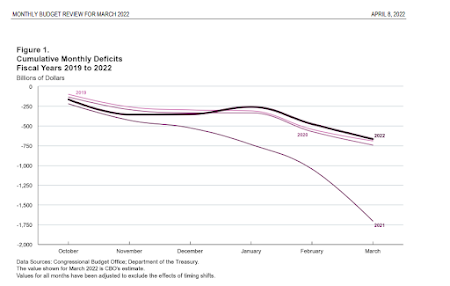
The end of March marks the halfway point of the federal fiscal year, and on Friday the Congressional Budget Office gave its update on the US budget up to that halfway mark. And what it shows is that the US budget deficit is plummeting.

The monthly deficits and cumulative shortfall so far in fiscal year 2022 are similar to those in 2019 and 2020. For the first six months of those two years, the cumulative deficits were $691 billion and $743 billion, respectively.

The deficit was much larger at this point last year because of spending for the federal response to the coronavirus pandemic. The higher outlays last year were driven largely by the recovery rebates (also known as economic impact payments) authorized by the Consolidated Appropriations Act, 2021 (CAA), and the American Rescue Plan Act of 2021 (ARPA). Spending also rose for unemployment compensation and for pandemic relief through the Small Business Administration (SBA).

Much of the drop in spending is due to the fact that COVID stimulus and relief programs have been wound down over the last year, as vaccinations have picked up, restrictions have been lifted, and jobs have come back.
Outlays for certain refundable tax credits totaled $203 billion—a decrease of $366 billion, or 64 percent. That reduction occurred largely because most of the second and third rounds of recovery rebates were paid in January and March 2021. Partially offsetting that decrease, several changes to the child tax credit increased outlays early in this fiscal year. Eligibility for and the size of the child tax credit were expanded, and advance payments of the credit were made between July and December 2021.

Outlays for unemployment compensation decreased by $186 billion, from $209 billion in the first six months of fiscal year 2021 to $23 billion in the first six months of 2022. That spending declined both because the enhanced benefits that were enacted earlier in the pandemic expired in September 2021 and because unemployment declined. In comparison, during the first six months of fiscal year 2020, just before the start of the pandemic, outlays for unemployment compensation totaled $18 billion.

Spending by the Small Business Administration decreased by $165 billion. In the first six months of fiscal year 2021, the SBA recorded a total of $184 billion in outlays, primarily from a second round of loans and loan guarantees made to small businesses under the Paycheck Protection Program.
The added spending and concern that is brought up with large levels of debt is the interest that has to be paid on that debt. Previously, this hasn’t been that big of a deal because the interest rates have been so low in recent years. But with prices and rates now on the rise, we may see this expense pick up.
Net outlays for interest on the public debt increased by $43 billion (or 25 percent), primarily because higher inflation this year has resulted in large adjustments to the principal of inflation protected securities.
The coming interest rate hikes would be a big problem if there was a big increase in new debt being issued. But because the deficit has fallen so fast, it may not be as much of a fiscal burden as one might have feared a few months ago.

It's also remarkable that some of these COVID aids have continued at high levels in FY 2022, and the concern is that this assistance may be slated to decline in the near future.

1. Medicaid +$38 billion – reflects the fact that recipients cannot be disenrolled under the COVID health emergency provisions, and that the Feds are temporarily covering a higher % of certain Medicaid services (I talked about that from Wisconsin's perspective in this post). When that ends, the number of recipients and costs from the federal side will likely go down.

2. Social Security +$33 billion – more beneficiaries of Social Security as Baby Boomers hit retirement age, but also an increase in benefits driven by higher inflation.

3. Food and Nutrition Service from USDA +$32 billion - increased SNAP and EBT benefits (especially for children) due to the COVID emergency.

4. Public Health and Social Services Emergency Fund +$21 billion - largely due to higher reimbursements to health care providers, and increased funds to pay for COVID testing, vaccination and therapy.

The question going forward is what happens for the next Fiscal Year for agencies who will have to grapple with higher prices. As of now, they are operating under a 2022 budget that assumed a lower level of cost increases than we are seeing today, which helps the fiscal picture today (since wages and revenues rise above that lower spending level), but will that mean spending has to increase to “catch up” to inflation and maintain the same level of services.

But what can’t be said is that the US budget deficit should be considered a major constraint on an increase in spending, because our deficit is in better shape now than it was 2-3 years ago, and Republicans had no problem with exploding supports and relief programs when Donald Trump was president at that time.

Plus, if they’re so concerned about the deficit, they can always reverse the GOP Tax Scam’s giveaways to the rich and corporate, and they can choose to designate more funds for the increased cost of Social Security and Medicare. But where would the campaign donations be in that?

Saturday, April 9, 2022

Journal-Sentinel column spells out the obvious -Foxxconn will never pay back what they owe

After finding out recently that Foxconn wouldn't allow Oshkosh Truck to build on its thousands of acres of land in Racine County, it leads many to ask "What's happening down there?" 5 years after the scheme was announced.

Kathleen Gallagher is a former Journal-Sentinel columnist and is currently the exec director of the 5 Lakes Institute, and she took a look into the Foxconn situation. It resulted in this piece to her former employer which included a stunning bottom line.

It looks to me Foxconn is in breach of its development agreement with Racine County and the village of Mount Pleasant; it isn’t building the large screen LCD factory and has told the state it expects to create 89% fewer jobs and spend 97% less on facilities than promised.

Several experts I’ve talked with believe the locals could sue for fraud; Foxconn never initiated the right kind of buildings, equipment, glassmaking partner, or people and related housing for such a factory.....

Foxconn committed in its (still in force) development agreement with Racine Co. and Mount Pleasant to complete construction of a big LCD screen factory by Dec. 31, 2025. In Wisconsin, you have three years from the discovery of a fraud to sue.
So for now, Foxconn can still claim "the factory is going to be built, just you wait", and not be in violation of the contract. And Gallagher theorizes that if some other business was using the site to do something else, then they couldn't hold up that charade, and the suit could proceed. So they don't allow anything to happen there.

Between now and the end of 2025, Foxconn has a big tax payment due, and with little on the site to show from it, Gallagher asks why we should expect the company to pay that bill.
Seriously, where would Foxconn get the money? The presumption was that by now the park would be generating revenue to pay the taxes. Not even close. And Foxconn’s U.S. subsidiaries don’t appear to have that kind of money.

The consequences of a default are severe: The locals need those $30 million annual property tax payments to service their combined $300 million of Foxconn-related debt. Mount Pleasant, in particular, is in the soup given that its Foxconn-related debt is more than 500% of its operating revenue. State taxpayers aren’t immune either; they’ve guaranteed 40% of $140 million of Mount Pleasant’s debt.

We’ve seen this movie before — the New York financiers take control of the real estate at 30% to 40% of its value and sell it to long-term investors, sometimes local ones, AFTER cleansing it. And the taxpayers take the hit.
And that's not even counting the hundreds of millions of dollars of infrastructure that taxpayers have spent that could have been better used in places that actually needed better roads and upgrades.

In a rare discussion that took place last month, the local officials in Racine County that signed off on this scheme are still going along with the company line that all of this "investment" will ultimately lead to something.
"We've put in a lot of infrastructure folks," said Claude Lois, Foxconn's project manager hired by Mount Pleasant. "We've sized this at the time for Foxconn Generation 10, but today, actually because of all the work we did we are sitting pretty good for all the work we did for the future."

Lois spoke during a special meeting of the Racine County Board and the Mount Pleasant Village Board Tuesday — the first time a public update on Foxconn has been given since 2019. Foxconn representatives were invited to participate but declined.

Residents were not allowed to speak during the meeting but were given a chance to submit questions in advance. Those questions were not answered during the meeting.
In other words, this is what Lois and other Foxconn grifters are trying to sell.

"When pigs fly", indeed.

But these events aren't preventing Foxconn slime from continuing to take advantage of Wisconsin's public institutions to grab funds and PR.

An announcement posted Thursday by UW-Madison’s College of Engineering announcing Yeung’s hire lists him as an author, college alum and technology executive — it has no mention of Foxconn.

Yeung was hired as a “professor of practice for entrepreneurship” who will bolster efforts to connect campus research with industry, according to the announcement. He began the new job Friday.

“Alan brings invaluable experience in new business venture and technology commercialization,” Ian Robertson, dean of the College of Engineering, said in the announcement. “Taking more of our world-class research to market more quickly is a top priority, and Alan’s leadership and expertise in addressing opportunities and achieving alignments make him the right person to begin this effort.”
Well, if you think "new business ventures" in the 21st Century involve getting a ton of handouts and gifts from government and other investors by promising big things, and then cashing out before the reality sets in and the venture collapses, I suppose a rep of Foxconn could tell students a lot about it.

Hey, grifting isn't easy, but someone's gotta do it.

It's pretty clear that the goal of Foxconn execs and the crooked locals in Mount Pleasant is to get out before that $30 million balloon payment hits, and dare them to find you and make you pay them and the state back. Any lawsuit that happens takes years to figure out, and may end up costing more than you'll ever get back.

As Kathleen Gallagher alluded to, after Foxconn gives up the facade and leaves, some other business will swoop in and use this taxpayer-funded infrastructure for pennies on the dollar. Which is "good business sense," you know. Why take risks to invest in areas when you can get crooked politicians to give you resources for less than nothing?

Friday, April 8, 2022

More data keeps showing our early 2022 inflation isn't a supply shock

I was looking at this Census Bureau report on wholesale sales and inventories, and it shows no evidence of tight supplies as February ended. In fact, inventories have continued to grow along with sales, so the ratios are no different than they were in early 2021.

Change in wholesale sales, inventories, Feb 2022 vs Feb 2021
Automotive
Sales +9.9%
Inventories +10.9%
Inventory/sales ratio 1.56 Feb 2022 vs 1.54 Feb 2021

Lumber
Sales +40.6%
Inventories +46.6%
Inventory/sales ratio 1.58 Feb 2022 vs 1.52 Feb 2021

Groceries
Sales +22.4%
Inventories +25.9%
Inventory/sales ratio 0.73 Feb 2022 vs 0.71 Feb 2021

Farm Products
Sales +26.1%
Inventories +24.0%
Inventory/sales ratio 1.43 Feb 2022 vs 1.45 Feb 2021

The only place where the sales-to-inventory ratio got tighter was in petroleum (0.29 in Feb 2022 vs 0.38 in Feb 2021). But Feb 2021 was a pre-vaccination time when travel was still depressed, and gas if you look at the amount of gasoline available as March ended, it was higher than what was available in the last half of the 2010s, and even higher than it was at that time last year.

Yes, I know some of this data came in before Russia invaded Ukraine and the last week of March can be a bit jumpy due to Spring Break stuff. But it's also clear that gasoline supplies weren't any tighter than we'd seen in other years when we weren't on lockdown. And while I understand that many products have a world price that overrides some of the supply-and-demand situation here in America, that doesn’t mean prices should be the same everywhere on the planet.

Given that there was sufficient supply of a lot of things before the breakout of war in Eastern Europe, and because the States haven’t yet seen much of a change in what’s available in the 6 weeks since then, there is no reason for the massive jump in prices that we’re seeing today and the gas price gouging of March. Well, beyond speculation and rent-taking from businesses and producers, neither of which helps the average American.

So yes, I remain suspicious of what is causing our “inflation”, because much of the data that I’ve seen in the recent months doesn’t indicate that the US is seeing large-scale shortages that warrant such a high increase in prices.

Thursday, April 7, 2022

2 years after COVID, Wisconsin traffic is still lower, with a lot less people on the bus

Interesting report today from the Wisconsin Policy Forum looking at driving and commuting patterns in Wisconsin during the COVID era. And the Policy Forum tells us that Wisconsin vehicle traffic continues to be lower today than it was before COVID was a thing we had to deal with, which indicates that commuting patterns and everyday life may be permanently disrupted.

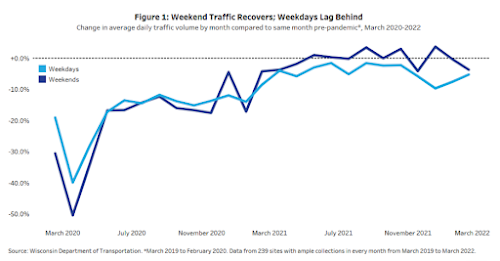
Comparing average daily traffic over the last year (April 2021 to March 2022) to traffic in the year preceding the pandemic, weekend traffic is down just 0.2%, while weekday traffic is down by 4.4% (see Figure 1). In fact, DOT data indicate that weekend traffic volumes have shown stronger recoveries than weekday volumes in each of the last 13 months, starting in March 2021. Traffic levels in Wisconsin’s most populous urban counties, as well as ridership on the state’s largest transit systems, show the likely cause is a reduction in the number of people commuting to work. Though weekday traffic may still further recover, the potential for a long-term shift should be considered when it comes to future road construction and transit route decisions.

The Policy Forum digs down into the traffic numbers, which reveals that after vaccinations became widespread last Spring, the decline in traffic lessened. But it’s still there, especially during what used to be peak commuting hours.
By March 2021 – when many Wisconsinites began to receive their first or second dose of COVID-19 vaccines – average daily volumes recovered to just 6.4% below March 2019 numbers. This was the first month in which average traffic volumes had not been down by at least 10% relative to the same month in the year preceding the pandemic (as our baseline, we use the 12 months running from March 2019 to February 2020). Since then, traffic volumes have remained below prepandemic levels in every month except September 2021.

However, the totals obscure a more complicated story. Over the last year (April 2021 to March 2022) and excluding holidays, weekend traffic exceeded prepandemic levels in six out of 12 months, including volumes that were 3.7% higher on weekends in January 2022 compared to January 2020. Meanwhile, there has not yet been a single month in which weekday traffic topped pre-pandemic levels.
Which shows that going out for weekend errands and leisure has returned near pre-COVID patterns (although where we're going might be a bit different), and that in-state travel isn't all that much different.

But there is a significant change in what types of vehicles are driving down the road. Because more people are spending more time and business at home, it takes those cars off of Wisconsin roads. At the same time, there is a greater need for big rigs to bring certain types of products to stores and homes.
In recent decades in the United States, car volume and vehicle miles travelled (VMT) can fluctuate but tend to increase over time. However, today, volume in Wisconsin appears to be only back to what it was at in 2015 or 2016, according to DOT data. That said, DOT notes that truck traffic is up notably (7% from March 2019 to March 2022). The increase may reflect an underlying shift in consumer spending away from services and towards goods during the pandemic: truck volumes have been above pre-pandemic levels in every month since December 2020.
Sure seems like trucks might be needing to pay more toward road repairs, since they're making up even more of the stress, eh?

While car traffic is lower, its decline is dwarfed by the plummeting in transit ridership that continues to this day.
In 2019, Wisconsinites rode on these nine transit systems a total of 48.5 million times – a number that represented a stark but gradual decrease from the 72 million rides they took in 2007. In 2020, that number plummeted to 26.4 million, a decline of 45.6% that is unrivaled by any other year of data. In 2021, bus ridership declined once again to 22.6 million, a decrease of 14.6% that was larger than any previous year-over-year decline other than the year prior.

Since the earliest months of the pandemic, Wisconsin saw its fewest reported COVID cases in June and July 2021; by this time, Pfizer and Moderna vaccines had also been made widely available to the general public. Still, in those two months, ridership on these nine bus systems was down 49.5% and 50.4%, respectively, compared to June and July 2019 (see Figure 3).

That collapse in demand (and related revenues) for a service that is still needed means that transit systems have had to be bailed out with added funding from the Feds. Three different rounds of COVID-era relief programs helped out in 2020 and 2021, and Wisconsin transit systems are also getting help from the infrastructure package that went through Congress a few months ago.
Wisconsin will receive more than $115 million in federal funding for transit projects this fiscal year, U.S. Department of Transportation Secretary Pete Buttigieg announced Tuesday….

The $115 million earmarked for Wisconsin will be split between the state government and local municipalities, according to FTA data. The exact breakdown of how funds will be spent has not yet been determined.

Several urban areas in the state will receive a portion of the federal funds to support their local transit agencies:
· Milwaukee will receive $32 million;
· $12.5 million is on its way to Madison;
· Kenosha will receive $123,725;
· Green Bay will bring in $3.4 million;
· and Appleton will receive just shy of $4 million.
For the record, I'm betting that $123,725 might just be for Kenosha's streetcar line, with their bus system getting a lot more than that (WisDOT likely needs to split that part up for the smaller bus systems).

As the Wisconsin Policy Forum alludes to, our transportation needs and usage is still quite different to how Wisconsinites traveled and (especially) commuted compared to the times before COVID. The one-time boost in funding from the infrastructure bill will help, but after 2022, we will likely need to adjust our spending and transportation planning to match how people may work and live in the post-COVID world. And recognize that our highways and transit systems probably won't be getting the help from DC that we've had in the beginning of the 2020s.

Wednesday, April 6, 2022

COVID still at lower levels in Wisconsin, but the decline has stopped for now

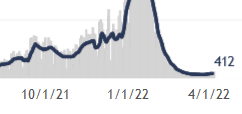
As Spring Breaks end and dreary, flu-season like weather lingers over Wisconsin, it seems like it's worth checking back to see what Wisconsin's COVID situation looks like in early April. And while new cases still well below where we were for most of the last 8 months, the decline has stopped and we've bumped back above 400 cases a day for the first time in a week.

Along with the slight increase in cases statrewide the Wisconsin Department of Health Services mentioned today that cases were growing in more counties this week vs shrinking.

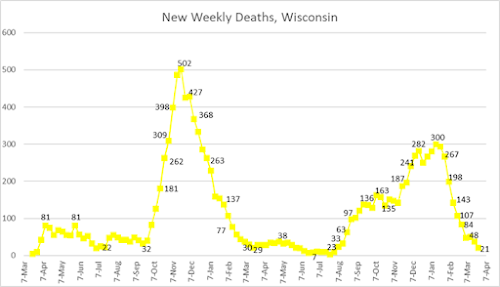
The good sign is that COVID deaths in Wisconsin continue to fall, down more than 90% since mid-January, and are at their lowest levels in 8 months.

And the lower death rate seems to be replicating around the nation, which is a good sign. And if things ever warm up here and allow for more outside activities, and travel slows down over the next 8 weeks, we hopefully can see the virus fade a bit more and stop any semblance of the recently increased caseload that we might be seeing today.

Monday, April 4, 2022

We've already saved big bucks with the "other Medicaid expansion". Why not do the "normal" one?

We found out from the Department Health Services last week that the State of Wisconsin is forecast to have another $221 million available in GPR (basically state tax dollars) to spend over the next 15 months, on top of the $3.8 billion we were already are projected to have.
The Department projects a surplus in the Medicaid program of $406.1 million GPR for the 2021-23 biennium……[reflecting] current estimates for Medicaid expenditures through FY 23, based on trends in enrollment, costs per enrollee, federal Medicaid participation, and third party revenues.
That’s up a significant amount from the projection of a $184.9 million surplus 3 months ago so why is that? Because Omicron’s breakout meant that the Feds will continue to pay a larger share of the state’s Medicaid bill.
The primary reason for the significant increase in the projected surplus since last quarter’s update is a further extension of the federal COVID-19 public health emergency declaration. Effective January 16, 2022, US Health and Human Services Secretary Xavier Becerra extended the emergency for 90 days until April 16, 2022. The Families First Coronavirus Response Act (FFCRA) adds 6.2 percentage points to the federal Medicaid match rate for expenditures during calendar quarters in which the public health emergency is in place. With the extension issued this past January, the enhanced match rate will be in place through June 2022. Act 58, the 2021-23 biennial budget, assumed the enhanced matched rate would end in December 2021. The Medicaid program must also continue to comply with FFCRA continuous coverage requirements during the public health emergency. The net impact of additional federal revenue, offset by higher enrollment due to the continuous coverage requirements, is $95 million GPR.
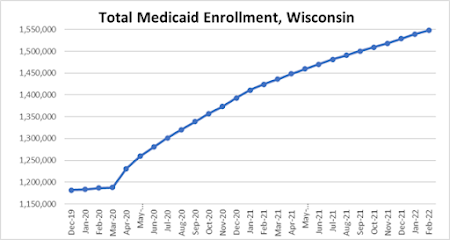
The “continuous enrollment” requirement basically keeps people from being kicked off of Medicaid for as long as the COVID emergency continues. This explains why Medicaid enrollments have continued to grow every month and is now 30% above pre-pandemic levels, even as the state’s economy has recovered to a record-low unemployment rate.

DHS anticipates that the emergency provisions will end, and that the number of people on the Medicaid rolls would drop quickly by May 2023 “to a level slightly above actual enrollment as of March 2020.” That rapid decline in enrollment accounts for $70 million of the additional Medicaid surplus, but it also would mean around 300,000 to 350,000 people wouldn’t be getting their health insurance through BadgerCare and other Medicaid programs.

Seems like something we need to keep an eye on, especially if the COVID health emergency ends in 2 weeks, which would allow Wisconsinites and many other Americans to be disenrolled off of Medicaid starting in July. And if I were in the Biden Administration, I’d say this would be a big reason not to end the health emergency this year, because who needs that disruption before the 2022 elections, especially with it being unknown what will happen in the Fall/Winter flu/COVID season?

It seems certain that the emergency declaration would be in place through at least the end of September, under guidance from last year that said there would be 60 days notice given to states if the emergency declaration was going to end, and that hasn’t happened with less than 2 weeks left in the current declaration.

Until last week, the Wisconsin DHS also benefitted from another source of Federal help in paying for parts of Medicaid, and that’s in Home and Community Based Services (HCBS) that deals with long-term care needs and other services in settings outside of nursing homes and medical facilities. The money came from President Biden’s ARPA stimulus package and gives an extra boost from Uncle Sam in paying for these services.
….The federal ARPA legislation enables state Medicaid programs to claim an extra 10 percentage points of federal Medicaid match on eligible HCBS expenditures from April 1, 2021 through March 31, 2022. As a condition of receiving these funds, the state must reinvest an equivalent amount in a place to enhance, expand, and strengthen Medicaid HCBS. The state has until March 31, 2025 to spend the reinvestment funds, and it can draw additional federal funding for reinvestments in Medicaid-eligible activities. Because of the reinvestment requirement, the enhanced HCBS match does not result in GPR savings in the current biennium.
While there’s no GPR savings, it also means that state tax dollars aren’t being used for initiatives such as a 5% increase in rates paid to providers of HCBS services, and a 16% rate increase to ambulance providers that took effect in February. This can help staff up those services, and increase the chances of providers of all sorts to stay in the business.

The GOP-run Joint Finance Committee has had no problem with approving all of this additional Federal help to pay for Medicaid services over the last 2 years. Which begs an obvious question - why don’t they want to have the Feds cover even more of Medicaid’s expenses by taking the expansion of services that is offered in Obamacare?

Seriously, what reason could you have after the last 2 years and the success of stability for those in need of health insurance? But the real reasons for WisGOP's continued foolishness on this issue seem to be:

1. Having the name of the Black Man in the White House associated with it, and
2, Being bought by the insurance industry and corporate oligarchs (because how dare the working poor be given insurance choices – they might look for better jobs!),

Other than that, I have no idea. But given that these COVID-related Medicaid provisions are going to end some time soon, it might be worth it for Governor Evers and other Dems to point out that we've already had expanded Medicaid funding in this state for the whole COVID era, and it's worked pretty well. So why not take the last step and save hundreds of millions of state tax dollars by permanently expanding Medicaid?