The economy added 315,000 jobs for the month, just below the Dow Jones estimate for 318,000 and well off the 526,000 in July and the lowest monthly gain since April 2021. The unemployment rate rose to 3.7%, two-tenths of a percentage point higher than expectations, largely due to a gain in the labor force participation rate to 62.4%, tied for the highest level of the year. A broader measure of unemployment that includes discouraged workers and those holding part-time jobs for economic reasons climbed to 7% from 6.7%. Wages continued to rise, though slightly less than expectations. Average hourly earnings increased 0.3% for the month and 5.2% from a year ago, both 0.1 percentage point below estimates.315,000 new jobs seems pretty good to me. And even the increase in unemployment was due to the "good reason", where 786,000 more people entered the work force, but "only" 442,000 of them found jobs. Given that there were still over 11 million job openings in July, I'd think quite a few of those new entrants will be able to find work in the near future. We now have it confirmed that there are more jobs now than before the pandemic broke out in early 2020, and 5.7 million jobs in the last 12 months. That's despite government employment being down 645,000 jobs in that time, which explains the gap that you see in this chart. But what made some hope that the Fed might back off was the lower amount of wage growth, at 0.3%, although I'll add that average hourly wages for non-supervisors was up a bit more at 0.4%, and 6.1% year-over-year. This seems pretty healthy to me, especially if those wage gains continue as gas prices go down, but corporate oligarchs likely don't want to see it. But just because we have more jobs than February 2020, it doesn't mean we are looking at pre-2020 conditions. Warehousing/storage jobs are 464,000 above their pre-COVID levels, but jobs in hotels and bars and restaurants are still well below what they were, and growth is slowing down. Now the question going forward is whether this lack of growth reflects an inability to find enough people to work these jobs, even if the demand is there (a factor cited in a few recent restaurant closings in Madison), or if it's a structural change where hotel business travel won't ever get back to what it was, and/or the market is saturated at this time. I still don't see why the Fed should want to crush already-calming inflation at the expense of what is still a very good job market with wage growth - especially wage growth and advancement in the lower ends of the economy. But the stock markets sure seem to think that will happen, which is why the DOW has dropped nearly 2,000 points since Fed Chairman Powell opened up his mouth in Jackson Hole 9 days ago. This tells me that the stock market and the jobs market might be two things that are at odds for each other in coming months, and it better be actual workers that win out in that equation. 300,000+ jobs and 3.7% unemployment is a pretty good spot to be in, and wrecking that to shave a couple of points off of CPI and gain a few more dollars in profit seems a bad trade-off to me.
Ventings from a guy with an unhealthy interest in budgets, policy, the dismal science, life in the Upper Midwest, and brilliant beverages.
Sunday, September 4, 2022
US jobs still rolling along in August. Why does Fed want to stop this?
Saturday, September 3, 2022
Sorry RoJo, Social Security is not in trouble, and it's easy to keep it fully funded
“Now, the point I want to make in this discussion is the only thing that threatens veteran’s benefits; the only thing that threatens the mandatory spending programs; Social Security, Medicare, others, is our massive deficit spending and our growing level of debt,” [Johnson] said…. “Let me say unequivocally: I have never said I wanted to put Social Security, Medicare, veteran’s benefits on the chopping block or cut them,” he said. “I want to save these programs. I want to stop mortgaging our children’s future.”Social Security is 100% funded for the next 13 years, and currently has more than $2.85 trillion in its bank account, earning (higher) interest. The only thing that threatens Social Security along with other current guarantees like veterans benefits and Medicare is the willingness of politicians to pay for them. And if you are turning those earned benefits into discretionary funding, you have made a choice to do so, and are also saying that you can cut these programs. Later in the week, RoJo floated his latest scheme on how to "help" Social Security's finances. And to boost our labor participation rate.
Because how dare we have people be able to leave the work force on their own terms and retire comfortably! Your service is to this guy first! Except the scheme to coax those older workers back is to KEEP THEM FROM PAYING INTO SOCIAL SECURITY with those (likely menial) jobs. Which would mean that there would be more people working, but less money to be made available for Socail Security, making it all the easier to try to wreck and kill. Side note - I don’t want to hear a GD word friom RoJo about our deficit and debt whenDuring his tele-town hall last night, Sen. Ron Johnson (R-WI) endorsed an "innovative" idea to address labor shortages: "coax" seniors to leave retirement and reenter the workforce so they can "earn a few extra bucks." pic.twitter.com/d5rTWG8FDO
— Heartland Signal (@HeartlandSignal) September 1, 2022
1. Our deficit is at its lowest level in 5 years. 2. Ron Johnson voted for the $1.9 trillion GOP Tax Scam that exploded the deficit well past the lower levels that we had before then. Especially when this crook personally added to that number with a major kickback to himself and his contributors.
Back to Social Security - I got a better idea about how to keep it fully funded without having to literally work old people until death, or make cuts in current or future benefits (which RoJo also wants to do). Why don’t we simply raise the cap on how many payroll earnings are taxed? This cap is currently at $147,000, and is on track to be close to $155,000 in 2023 due to inflation. Workers and employers each pay 6.2% in Social Security wages on those first $147,000 in wages, but not one cent after that. The recent Social Security 2100 bill from Rep. John Larson (D-Conn.) would put in a “donut hole” that re-starts the payroll taxes at all wages above $400,000. That bill also expands some Social Security benefits, but still could allow for full payments for another 5 years (to 2038). But why not go a step further? Instead of giving a payroll tax break to old workers, why not cut the payroll taxes by 1% for both worker and employer (to 5.2% for each) in 2023, and then drop the donut hole to $370,000. No one making under $400,000 would pay more taxes, it’s a sizable tax break for most workers and small businesses, and I bet we still get more revenue into Social Security. Compare that to the situation in our currently regressive payroll tax, where big businesses pay lower Social Security taxes on giving 5 well-paid executives $400,000 bonuses than they do in hiring 50 line workers at $40,000. That incentive needs to go away. We also should note that demographic changes are going to move the “exhaust dates” for full benefits into later years, even without changes. Some of this is for bad reasons. as evidenced by this headline from earlier this week.GOP megadonors Diane Hendricks and Dick and Liz Uihlein were able to claim a combined $215 million in deductions in 2018 because of provisions @SenRonJohnson put into the tax cut Trump signed, according to @propublica. https://t.co/mniK4o6R0I
— Patrick Marley (@patrickdmarley) August 11, 2021
And it's not just due to the pandemic that Ron Johnson misinformed about.US life expectancy fell from 79 to 76 just from 2019 to 2021
— Matt Grossmann (@MattGrossmann) August 31, 2022
https://t.co/rxuU5RF0M6
In 2019, someone born in the U.S. had a life expectancy of nearly 80 years. In 2020, because of the pandemic, that dropped to 77 years. In 2021 life-span dropped again — to 76.1 years. And for some Americans, life expectancy is even lower, according to a provisional analysis from the Centers for Disease Control and Prevention…. Injuries, heart disease, chronic liver disease and cirrhosis and suicide also contributed to the life expectancy decline. Increases in unintentional injuries in 2021 were largely driven by drug overdose deaths which increased during the pandemic. "The COVID-19 pandemic has in effect wiped out the health gains that the U.S. has made in the 20th century," says John Haaga, a member of Maryland's Commission on Aging. "To have this second year of crash basically wiping out the meager gains made during the century is really pretty shocking," he says.Sucks for the country, but it also translates into fewer Social Security recipients, and for lower amounts of time. The lower life expectancy already added a year to the “full benefit” date in June’s Social Security Trustees’ report, and that seems likely to be moved to a later year when it gets its next update. So no, Social Security does not have any funding issues today or for the near future. And any future concerns can be easily cleared up by making the payroll tax fairer or by paying it out of regular taxes and/or debt like any other program. What Ron Johnson (well, the puppetmasters of Ron Johnson) wants to do is find any excuse to wreck this successful program, cut taxes for rich people like himself and his donors, and make working people more desperate with fewer options. RoJo tends to be wrong on economic issues in general, but it's the US's Social Security/debt situation that he is most illiterate about.
Thursday, September 1, 2022
As inflation rose in the Spring, corporate profits also went up in the US
Profits from current production (corporate profits with inventory valuation and capital consumption adjustments) increased $175.2 billion in the second quarter, in contrast to a decrease of $63.8 billion in the first quarter (table 10). Profits of domestic financial corporations decreased $24.2 billion in the second quarter, compared with a decrease of $51.1 billion in the first quarter. Profits of domestic nonfinancial corporations increased $173.9 billion, in contrast to a decrease of $4.8 billion. Rest-of-the-world profits increased $25.5 billion, in contrast to a decrease of $7.9 billion. In the second quarter, receipts increased $51.1 billion, and payments increased $25.5 billion.A $175 billion (annual rate) increase in profits? And an 8.1% increase in profit between Q2 2021 and Q2 2022? But I thought all that inflation was holding back companies and cutting into their profits! Are you saying that wasn’t so? Not at all, which another stat in that report shows. Per-unit corporate profits jumped by 8.9% in Q2, and resumed a climb in profit margins that has happened since the COVID recession of early 2020. That’s profit above and beyond increases in costs such as labor and materials. The increase in per-unit prices that corporations charged in Q2 was nearly twice as much as the combined cost increase over that same time period. Which goes back to a theory I have had for quite a while about US inflation. A sizable amount of the increases in prices that consumers have had to pay is due to little more than corporate greed trying to take advantage of higher demand and in taking advantage of the changed circumstances of the post-COVID world we live in. We need to make sure that some of those changed circumstances aren’t due to a lack of competition and mergers in certain industries. And it also indicates that workers can and should continue to demand more pay. Not just because labor conditions are tight, but because the companies have the higher profit margins that should go back to the workers that help to create those profits. Keep this one in mind as Labor Day weekend looms.
Monday, August 29, 2022
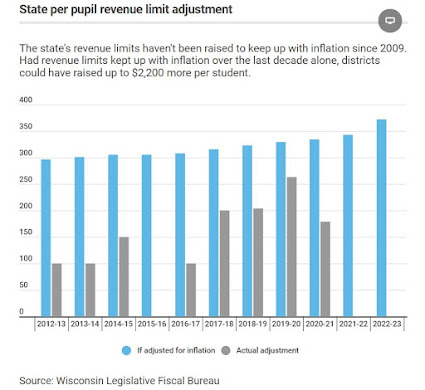
Revenue limits still hurting Wisconsin public schools, preventing use of billions, causing referenda
In a new Wisconsin Rural Schools Alliance survey of 80 rural school districts, 74 percent said they’re still struggling to fill at least one support staff position, and 69 percent are still looking for at least one teacher. More than 16 percent are still short three or more teachers…. Over two-thirds of these schools have made changes to deal with staffing shortages, with at least 20 percent increasing class sizes, sometimes by 50 percent. Many said they’ve cut electives and extracurricular activities. Some have upped teachers’ workloads or combined positions. Others have moved teachers around or hired long-term substitutes, sometimes putting them in charge of classes they have no experience teaching…. Whitehall School District is among many districts struggling to fill crucial positions, according to Superintendent Mike Beighley. The district is short five support staff and one special education teacher. "We're just seeing a dramatic reduction in the number of applicants for positions," he said. "Where we used to get 20 or 30, or perhaps even 100, now we get very few, if any."So it’s not just big-city schools facing the crunch, and it’s something that likely needs to be addressed in the next state budget. Which leads to this story from Wisconsin Public Radio from today.
Wisconsin school districts are asking voters to approve a record $1.9 billion in spending authority through 70 referendum questions that will be on ballots Nov. 8. https://t.co/ULwiTy73Cf
— WPR (@WPR) August 29, 2022
At least 50 Wisconsin school districts will ask voters to approve tax hikes this fall, with districts seeking a record $1.9 billion in borrowing and spending authority in referendum questions on ballots around the state Nov. 8. Districts still have time to finalize additional ballot questions, but as of Friday there were 70 separate referendum questions from 50 school districts across the state going to voters. Around half of the questions seek borrowing authority for new buildings or maintenance projects. The rest ask for approval to exceed state revenue limits on temporary or ongoing basis to pay for education, operations or staffing. All told, the referendum questions seek $1.93 billion. Wisconsin Policy Forum Ari Brown told Wisconsin Public Radio the next highest total requested by schools was $1.77 billion in the April 7, 2020 election cycle, which included a $1.3 billion, 30-year referendum pitched by the Racine Unified School District that passed by five votes.This is where we need to remember that Wisconsin has $5 billion sitting in the bank right now, if the gerrymandered GOP Legislature chose to do something about this situation. Even if the tax cuts that Gov Evers wants were to go through, there still should be a few billion (only a few) to fill in the gaps on schools through the 2024 cliff as part of the next state budget. Another option could be for Governor Evers to announce a program that gives bonuses to schools to help them hire staff, and could conceivably use COVID funds to do so, as part of the new post-COVID reality. This can be done by having school districts document their new hires, as well as associated bumps in pay to retain staff, and pay them extra funds in return for doing so. It also could be based on the average teacher salary in an area, and give schools funds for teachers that are paid more than what is typical for their years of service (I’m sure there’s some kind of formula that can be figured). It also could be time for serious reform on how we fund schools in Wisconsin, and I don’t mean the scam of “vouchers for all” (which Tim Michels would want). I mean the big change of taking schools off of the property tax, and having state funds take up more of the costs. I think that moving schools off of the property tax would be a bigger impact than any income tax cut, to be honest. And I think we need to require revenue caps for districts to rise to meet reality, or at least a sizable fraction of inflation. I can’t see WisGOPs in the Legislature going for that (because how could they get all those Dirty DeVos dollars?), but I bet a lot of Wisconsin voters would. If this state wants to remain economically competitive, it’s got to stop starving its community schools and improve the chances that workers want to stay and raise their families here. And we have a rare chance to make the big changes that we need to reverse some of the damage that has been inflicted on our schools and communities in the 2000s. If we choose to.
QCEW shows great job news is even better in US, Wisconsin
Each year, the Current Employment Statistics (CES) survey employment estimates are benchmarked to comprehensive counts of employment for the month of March. These counts are derived from state unemployment insurance (UI) tax records that nearly all employers are required to file. For National CES employment series, the annual benchmark revisions over the last 10 years have averaged plus or minus one-tenth of one percent of total nonfarm employment. The preliminary estimate of the benchmark revision indicates an upward adjustment to March 2022 total nonfarm employment of 462,000 (0.3 percent).Further, private sector job growth is slated to be revised higher by 571,000, led by professional/business services (+270,000), transportation and warehousing (+151,600), and leisure/hospitality (+140,000). It wasn't a completely great report, as a couple of sectors had much lower benchmarks compared to previous reports – retail (-323,300) and government (-109,000). That wipes away nearly 3/4 of the reported job gains in retail between March 2021 and March 2022, and leaves it below the pre-COVID levels of February 2020. So we may need to do a bit of a re-set as to where that sector is and what might happen for the future, especially since the monthly jobs report says retail hasn't gained any jobs since March. Wisconsin also had its QCEW figures for Q1 2022 in that report. And we are also set to have some positive revisions. Wisconsin, QCEW vs monthly jobs report
March 2021 - March 2022
Monthly jobs report +2.12%
QCEW +2.93% That translates into an additional 23,000 jobs. Which is all the more remarkable given that Wisconsin’s unemployment rate was already down to 4.3% in March 2021, and we still kept gaining jobs at nearly twice the rate we did in the mid-2010s, when we also had unemployment rates around 4%. What's also interesting is that despite job growth of nearly 3% over that 12-month period, it only places Wisconsin 39th in the country, which underscores how dramatic the job growth was for that first full year of the Biden Boom. "But Jake, look at that big 12-month drop in 2020 and early 2021. Why are you talking up the recovery from that?" Valid point, but I'll add that if you go back to March 2020 (when the COVID lockdowns began), Wisconsin fared 2nd best in the Midwest, a credit to limiting the losses in 2020-2021, and in gaining back quite a bit of those losses in 2022. Another good sign for Wisconsin is a sizable increase in wages, which helps explain how the state’s collections of individual income taxes could exceed already-high projections by more than $1 billion for the 2022 Fiscal Year. Wisconsin had a big jump in average weekly wages of 8.7%, which places Wisconsin at 15th in the country over the March 2021 - March 2022 time period. That not only can reflect higher wages in current jobs, but also some Wisconsini>tes moving over into higher-paying positions. The dollar amount in Wisconsin’s weekly wages matched the strong increase in wages for the US as a whole, but Wisconsin ended up in the top 15 nationwide due to our generally lower wages. Change in average weekly wage, March 2022 vs March 2021
Wis. +8.7% (+$86)
US +6.7% (+$86) Pretty good situation to be in, even though the additional jobs and wages also show how inflation could kick in and speed up (beyond regular corporate greed). To me, that’s the “good inflation”, which is based on high demand from consumers, and it beats recession and stagnant job growth. But given Fed Chair Powell's market-killing words the other day, it seems like the Masters of the Universe don't like seeing everyday people benefitting from the Biden Boom of jobs.
Saturday, August 27, 2022
Powell chooses inflation > growth. But inflation is already slowing down in Real America.
We also saw signs on Friday that the calmer inflation figures were getting the attention of policy-makers, although with caution that we need to see more of it before entirely backing off on tightening money.Now core PCE inflation. One reason that while this month was great no one should (or hopefully will) get overexcited is that it follows an unusually bad month in June. As usual averaging over something like three months is a good way to think--and that is a 4% annual average. pic.twitter.com/iB3hzIYiDA
— Jason Furman (@jasonfurman) August 26, 2022
ICYMI Atlanta Fed president @RaphaelBostic spoke with @CNBC senior economics reporter @steveliesman on @SquawkCNBC this morning in #JacksonHole. See the interview: https://t.co/5KiRdc3Vjz
— Atlanta Fed (@AtlantaFed) August 26, 2022
Atlanta Federal Reserve President Raphael Bostic said Friday he's leaning toward a half a percentage point interest rate hike in September following the better-than-expected inflation data released earlier in the morning. "I'm leaning a little more towards 50 [basis points]," Bostic said, during an interview on CNBC. Bostic said the July personal consumption expenditure index data, which came in better than the market expected, made him "happy.".. The Atlanta Fed president said there was "still a long way to go" on rate hikes. Bostic said he would like to see the Fed raise its benchmark rate to a range of 3.5%-3.75% by the end of the year and then sit still.A 50-point hike would be lower than the 75-point hikes we've seen in the last 2 Fed meetings. But Bostic’s 3.5%-3.75% range would also be 1.25% above where we are today, which indicates another 50 points in September, and then likely 50 more points in November and 25 in December. But it also puts the end of tightening in sight, which is good to hear. And the University of Michigan’s consumer sentiment also reflected a more upbeat mood from the lower inflation.
U.S. consumer sentiment improved further in August and households' near-term inflation expectations fell to an eight-month low amid declining gasoline prices, a survey released on Friday showed. The University of Michigan's final August reading on the overall index on consumer sentiment came in at 58.2, up from 55.1 earlier this month and 51.5 in July. The survey's one-year inflation expectations fell to an eight-month low of 4.8% from 5.2% in July, while the survey's five-year inflation outlook was unchanged at 2.9%, holding within the range that has prevailed for the past year.Everything was going in a good direction. And then Federal Reserve Chair Jerome Powell decided to open up his mouth in front of a bunch of bankers and oligarchs later on Friday.
In his speech at the Fed Symposium in #JacksonHole, Federal Reserve Chair Jerome Powell indicated the likelihood of further action to bring down #inflation, saying that "historical record cautions strongly against prematurely loosening policy." pic.twitter.com/Whb9hH3ai4
— Yahoo Finance (@YahooFinance) August 26, 2022
Speaking at the annual policy speech at Jackson Hole, Wyoming, Powell said in a very short speech, that “restoring price stability will take some time and requires using our tools forcefully to bring demand and supply into better balance,” according to a transcript of his remarks. “Reducing inflation is likely to require a sustained period of below-trend growth,” he said. “Moreover, there will very likely be some softening of labor market conditions. While higher interest rates, slower growth, and softer labor market conditions will bring down inflation, they will also bring some pain to households and businesses. These are the unfortunate costs of reducing inflation. But a failure to restore price stability would mean far greater pain.” “In a speech of just 1,300 words, Powell says “price stability” nine times and he builds the case that a strong labor market is predicated on price stability,” Jeffrey Roach, Chief Economist, LPL Financial, told GOBankingRates. “In essence, Powell is clearly stating that right now, fighting inflation is more important than supporting growth. One glimmer of hope from the Chair’s comments is his view that inflation expectations appear well-anchored.”And here's Friday's result of Powell's statements, which came about an hour after the market opened. I understand the idea of trying to crush out the chances of a wage-price spiral, but this seems to be overdoing it. We don’t need to be trip-wired into a recession by the Fed jacking rates to high levels when it looks like a lot of these issues are sorting themselves out. We have a labor imbalance because of high demand and because we have had over 1 million people DEAD and many others that have left the work force in the last couple of years. But that has already been reflected in higher wages and prices, and price pressures are less extreme as consumers adjust and supply disruptions clear. That’s not just true domestically, but also with imports.
It's possible that Powell telling the oligarchs what they want to hear (they have this thing for “sound money” and "confidence in the Fed" in allowing profits to beat wages). And maybe we only see a couple of ½ point moves between now and the end of the year, with the Fed then standing back and seeing where prices and the overall economy goes from there. That would be my preference, as it lessens the chances that our already deflating housing market doesn’t become a full-fledged crash that causes damage to most other sectors of the economy. Unike the Fed, I believe that 5% inflation is MUCH better than 5% unemployment. And if we see unemployment go from our current 3.5% to 5% because the Fed is still operating in a 1970s mentality instead of dealing with the reality of the 2020s, and it screws up our politics in 2022 or (more likely) 2024, I will be quite angry.Supply chains normalizing. pic.twitter.com/E2mfEwe6px
— David Andolfatto (@dandolfa) August 25, 2022
Wednesday, August 24, 2022
Even if I'm not getting student loan relief, it's still a very good thing
The $20K write-off for Pell Grant recipients was not in the details that were leaked out to the press last night. Pell Grants go to lower-income students, and as this Education Policy Professor at Southern Methodist brought up, targeting Pell Grant recipients give an extra boost to one traditionally underrepresented group in particular.In keeping with my campaign promise, my Administration is announcing a plan to give working and middle class families breathing room as they prepare to resume federal student loan payments in January 2023.
— President Biden (@POTUS) August 24, 2022
I'll have more details this afternoon. pic.twitter.com/kuZNqoMe4I
WEALTH is the key word to me here. Because what getting rid of student loan debt will do for many people is free up the hundreds of dollars that have been used to pay off that debt. The One Wisconsin Institute did a survey a few years back on the economic effects of student loan debt, and noted that those with student loans were much less likely to buy a new car or home. That extra demand maintains and adds jobs (including a lot of blue-collar jobs), and go into investments that grow and lead to real social mobility. But I refinanced my student loans into a lower rate in March 2020, right before the COVID-19 pandemic broke wide and the Fed drastically cut interest rates (which cut my interest rate further). That paid strong dividends for me, and likely saved me around $800 a year. However, it also led to this note when I logged into my student loan account today, to see what this might do for me.I cried today on a very official phone call when I heard that the simulation #s showed that around 500k Black people would be moved from negative to positive net wealth https://t.co/1ryXVRvESQ
— Dominique Baker (@bakerdphd) August 24, 2022
The recent announcement regarding student loan forgiveness is only applicable for Federal student loans. Any loans serviced by Firstmark Services are private loans which are not included in the Federal government's forgiveness package. You can refer to the studentaid.gov website for additional information.Well that sucks. But I kind of expected it, because I wasn't eligible for any of the student loan pauses that have been in place for the last 2 1/2 years either (I'd have kept paying anyway. I have the money and don't need that principal hanging over me). I also wasn't locked into the 6-8% interest rates that many student loan debtors had, which is an absolute killer for many and is why some are complaining that $10K isn't enough - because they might owe more today than when they originally took out the loans. That's one reason I'm not complaining about being left out of Biden's student loan relief (even if it would have helped me a lot). The other reason? I'M NOT A WHINY A-HOLE! I don't resent people that are getting a break on this - I know that paying student loans is something that holds back a lot of people from a better life in this country, and it's been an increasing amount since many parts of this country chose tax cuts over educational opportunity over the last few decades. And before you say "what about people who didn't go to 4-year schools. HUH, JAKE? HUHHHH?" 1. A whole lot of blue-collar workers had to go into student loan debt to get their 2-year degree and/or certification for their jobs. They'll be helped, too. 2. The improved economy due to student loan relief pays off in many sectors, including many service jobs and in demand for homes, landscaping, and everyday purchased items that are produced in this country by a lot of workers and American companies. Is this student loan relief package a cure-all for the increasingly higher cost of college and what can be a lack of payoff for what some people put in to a 4-year degree? Especially for some marginalized groups that were taken in to try to get a leg up from the bad circumstances they were in? Absoltuely not. And we need re-evaluation that goes far beyond this one-time bit that will help a lot of people, but not everyone that could use it. But I'll go back to something else that SMU professor said today.
I'll be explicit, there's more to be done for college affordability, to redress past harms with loans, and with our larger social safety net. The joy of being human is holding these tensions, celebrating the wins while recommitting to the work ahead.
— Dominique Baker (@bakerdphd) August 24, 2022