Wednesday, July 5, 2023

Evers vetoes most of the tax cuts. But that doesn't mean tax-cutting is over for 2023-25

This afternoon, we got the info we'd been waiting for since the Legislature sent the state budget up the chain last week.

I figured that the cut to the top tax rate would be vetoed, but I didn't know what Evers would do (or not do) about the second tax bracket, which would have cut the rate from 5.31% down to 4.4%, and would have had a big price tag, given that a majority of Wisconsin tax filers have a lot of their tax dollars fall into this bracket of taxabe income.

That being said, let's remember that ALL Wisconsin taxpayers will benefit from the tax cut in the bottom two rates, with the 3.54% rate dropping to 3.5% and the 4.65% bracket dropping to 4.4%. And that the taxpayers currently in the 5.31% bracket (along with the richest ones in the 7.65% bracket) got all of the benefits from the income tax cut that Evers signed in the 2021-23 state budget.

Evers also vetoed a WisGOP plan to update withholding tables next January 1, which would have been a one-time drop in revenues of $603 million if all the tax cuts had become law. But that's likely to be turf-claiming, where Evers wants his Administration to be the ones to decide when the tables get changed and more money goes into take-home pay vs refunds. He did the same veto in 2021, and then ordered the Wisconsin Department of Revenue to change the tables that following January.

And let's go back to JR Ross's original post, because deleting more than $3 billion in tax-related moves means that money will be added to the state's bottom line as the budget gets published. Which now means there should be $3.6 billion or more that can be played with between now and the 2024 elections, and Evers hinted that the budget adjustments shouldn't end with today's signing of the bill.

There's nothing stopping Evers from resurrecting his call to expand the Homestead and Earned Income Tax Credits, which would give relief to lower-income Wisconsinites. And perhaps think about adjusting a number of write-offs to catch up to inflation over the last several years (I've got a list, Governor).

Evers could also apply more heat on WisGOPs to restore $340 million in COVID-era assistance for child care providers that WisGOPs refused to fund, and keep the issue fresh in people's minds before the 2024 elections. And perhaps he could be willing to trade a smaller income tax cut for the 5.31% bracket or even cut the top rate to 7.5% as an olive branch. But there are plenty of options after Evers' vetoes today, and with 3 years left in his term and solid approval ratings, now is the time to press the advantage.

Of course, Evers' biggest and most creative veto was on the spending side, and I'll talk about that one in the next post.

Tuesday, July 4, 2023

No matter whose budget you choose, surplus goes away, and more will be needed in 2025

After the GOP-run State Legislature sent the state budget to Governor Evers' desk late last week, the Legislative Fiscal Bureau put out the numbers for both the 2023-25 budget, and the "structural budget" for 2025-27. The structural budget looks at what would happen if the same laws existed for the next budget, without accounting for any changes in costs, program usage, or revenue growth, and the LFB did the same exercise for Governor Evers' budgetwhen it first came out.

What you'll find is that neither the WisGOP Legislature nor Governor Evers would have anything close to a "balanced" structural budget, and both blow virtually all of the billions that are in our state's bank account today over the next 2 years.

But the key differences between the two budgets are in how the budget surplus goes away. Both have sizable one-time increases in spending for Fiscal Year 2024 and 2025, but Evers would have spent more funds overall (particularly on child care, medical care, education, and general government staffing), while Republicans on Joint Finance are cutting billions more in taxes and investing less.

One of the bigger ongoing expenses in Evers' budget would have been taking on more state funds to pay for Medicaid expansion as the $590 million a year in bonus payments from the Feds would go away - a bonus that was on top of the $1 billion+ a year that the state would save if it just took Medicaid expansion. Conversely, the one-time expense of $300 million in the shared revenue "Innovation Fund" would also not have to be spent under the GOP's budget after 2025. But is the lower-tax, lower-spending GOP budget perferable to a higher-service, small-tax cut Evers plan?

I don't think so, and the ongoing funding issues for schools and our state universities are going to continue in 2025. Working Wisconsinites are much more vulnerable with fewer options under the GOP's budget than in Evers', and there were inflation-related cleanups to our tax code that neither side wanted to take on. While it's certainly a step up from Walker-era austerity, no matter what Evers signs this week (and yes, he will sign it - too many things would be held up and tanked if he didn't), our challenges are not going to disappear with this 2023-25 budget.

I will say that Evers should use his veto pen to get the 2025-27 structural balance under $1 billion, and possibly near zero. This can be done by getting rid of WisGOP's tax cuts for the richest Wisconsinitwes along with a $60 million giveaway to banks that WisGOPs put in for the Finance Committee. This also will reduce the cost of adjusting the withholding tables for the state next January 1, and combined with removing some porky earmarks that Republicans put in for road projects and other local services, we should be able to have a couple billion to work with for the next 2 years.

And just because the budget would be signed, it doesn't mean work on improving policies should end for the 2023-25 biennium. Evers can always come back and ask for more and better closer to the 2024 election if the economy stays strong and more money is available, and with new maps looming, GOPs might feel that they have to listen.

Monday, July 3, 2023

In Wisconsin, it's not just if Evers vetoes tax cuts - it's HOW he vetoes them

Now that the GOP-controlled State Legislature has passed the state budget, the question now goes to what parts Governor Evers will veto, and what lengths he will go to in order to modify the budget more to his liking. And in particular, I want to look at the billions in income tax cuts that WisGOP put in during June.

Let’s go to the budget bill as it stands after the Legislature's changes to it, and I’ll especially note that Republicans put in changes to the wording of the tax cuts last week in an attempt to try to insulate them more from potential Evers vetoes. An example of how the GOP changed the wording was that instead of listing the tax rate as a %, they described the tax cut in terms of how much the rate would go down.
…“for taxable years beginning after December 31, 2013, 4.0 percent, less fifty hundredths for taxable years beginning after December 2022.”
Are the WisGOPs trying to protect against Evers giving a larger tax cut for the lower incomes, by knocking off a digit and/or writing in a new rate (like 3.0% instead of 3.50)? Or likewise, does this prevent Evers from lowering the amount of WisGOP’s tax cut by striking out digits and writing in another number (4.4% becomes 4.9%, for example?), and make it an “all or nothing” scenario?

According to the Legislative Reference Bureau, here are the guidelines for the line-item veto for a Wisconsin governor.
1. A veto of stricken text restores current law.
2. A veto of plain text or scored text [that the Legislature wanted to add to current law] wipes out the text.
3. The governor may not veto current law.
4. The governor may veto individual digits but may not create new words by rejecting individual letters.
5. The governor may not create a new sentence by combining parts of two or more sentences.
6. The governor may reduce the amount of an appropriation by writing in a smaller amount, but may not reduce other numbers, such as bonding authorizations, by a write-down veto.
7. A partial veto must leave a “complete, entire, and workable law.”
8. The law that remains after vetoed provisions are removed must be germane to the topic of the vetoed provisions. After Bartlett this germaneness rule is stronger and more likely to restrict the governor’s partial veto power. A partial veto may not alter the topic or subject of the enrolled bill.
As State Rep Evan Goyke pointed out as the budget bill was being voted on last week, the wording for the tax cut on the richest Wisconsinites was noy amended, and only says “…the rate is 6.50 percent for taxable years beginning after December 2022.” Which makes it easy for Evers to veto in full, and restore the current 7.65% top tax rate.

You’ll notice few mentions of tax changes in that list, just spending questions. But a 2020 Wisconsin Supreme Court decision on vetoes Governor Evers made in his first budget gives a clue on what might be OK for that question. In Bartlett v. Evers, 3 of Evers’ vetoes were shot down overall - two were decided on a 5-2 vote, and another was overridden on a 4-3 vote. Then-“Justice” Dan KeLLy and current nutjob Rebecca Bradley said Evers couldn’t do any of these vetoes, but their opinions are irrelevant to what might happen in 2023 and the near future.

Retiring Chief Justice Patience Roggensack, and current GOP Justices Brian Hagedorn and Annette Ziegler said that Evers was allowed to veto the WisGOP Legislature's attempts to cut vehicle registration fees for heavy trucks (which restored the current fees), and Roggensack was also OK with Evers deleting words that expanded the definition of “vapor product” beyond what the Legislature approved. Current liberal Justices Rebecca Dallet and Ann Walsh Bradley said all four of Evers’ vetoes were acceptable.

With liberal Justices Jill Karofsky and Janet Protasiewicz replacing KeLLy and Roggensack since Bartlett v. Evers, could Evers roll the dice by doing some type of line-item veto that has yet to be decided on? Like writing in a word to replace a word that the WisGOPs put in, especially if the word is a number? Or try to change the income thresholds where a tax rate is in effect (giving more or less people access to the reduced tax rate), because the WisGOPs are changing that tax rate’s statute as it is?

It could be worth trying, if Evers wants to have a more progressive tax code put in with this budget. Removing the giveaway to the rich seems like an easy veto, won’t be litigated, and won’t be too controversial. But perhaps making “adjustments” to the other tax cuts could limit the cost and make for a more sustainable budget in the future, and/or give a larger tax cut to lower-income Wisconsinites vs the peanuts that the WisGOPs are giving out.

The vetoes Evers makes will be revealed by the end of this week, and we will see just how much Tony wants to push on this.

Thursday, June 29, 2023

Solid growth, low unemployment, inflation dropping. So more rate hikes? WHY?

Usually the 3rd reporting on GDP levels is anti-climactic and somewhat irrelevant. Most data has already been reported in at this point, and you’re talking about economic events that happened 3-5 months ago. But today was an exception.

Gross domestic product increased at a 2% annualized pace for the January-through-March period, up from the previous estimate of 1.3% and ahead of the 1.4% Dow Jones consensus forecast. This was the third and final estimate for Q1 GDP. The growth rate was 2.6% in the fourth quarter.

The upward revision helps undercut widespread expectations that the U.S. is heading toward a recession. A separate economic report released Thursday showed layoffs running well below expectations, indicating that labor market strength has held up even in the face of the Federal Reserve’s 10 interest rate hikes totaling 5 percentage points.

According to a summary from the department’s Bureau of Economic Analysis, the change came in large part because both consumer expenditures and exports were stronger than previously thought.

Consumer spending, as gauged by personal consumption expenditures, rose 4.2%, the highest quarterly pace since the second quarter of 2021. At the same time, exports rose 7.8% after falling 3.7% in the fourth quarter of 2022.
Sounds pretty good to me. But not for Federal Reserve Chairman Jerome Powell, who now is saying more rate hikes are likely to come in the near future.
"We did take one meeting where we didn’t move," Powell said during an event held by the Spanish central bank in Madrid. "We expect the moderate pace of interest rate decisions to continue."

The labor market, with unemployment at 3.7%, is very tight, Powell noted. Underlying inflation, while down from its peak last year, is still running at more than twice the Fed's 2% target.

"Inflation pressures continue to run high, and the process of getting inflation back down to 2 percent has a long way to go," Powell said.

I’ve asked this before, and I will ask it here. What is so magical about a 2% inflation rate? I know it was the general pre-COVID baseline after George W Bush took over in 2001, taxes were cut for the rich, and real wages stagnated between then and 2019. But was that such a great economy in Real America?

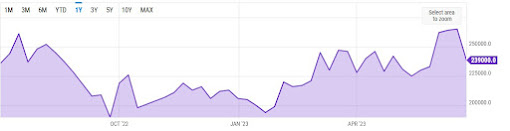
That’s what this is really about, isn’t it? Instead of having a wide mass of desperate workers willing to take any garbage wages that they can, the labor market is tight, and workers can actually grab more money for themselves. Job openings and job quits may be down from where they were 12 months ago, but are still high. New jobless claims are higher than they were in late 2022, but are still only between 235,000 and 265,000 a week – basically the same as they were a year ago.

In addition, real hourly wages have been gaining since inflation peaked in June 2022 - up by 5% in the last 12 months, while CPI is only up 4.1%.

Side note - when unemployment claims were that low in 2018 and the Fed was raising rates from 0%, then-President Trump threw a fit because it was increasing interest on his massive debts it threatened the continuance of (pre-COVID) economic growth.

Powell’s reaction to Trump’s whining? The Fed stopped hiking at the start of 2019, when Fed Funds rates weren’t even half as high as they are today. But now Jerome Powell keeps saying that 5% wage growth, 4% inflation, 4% unemployment, and 2% growth is a bad thing, and requires more rate hikes to try to change?

I’m not seeing the downside in where we stand today, and given June’s big rise in consumer confidence after the debt ceiling BS subsided, most honest Americans seem cool with it as well.

The only people not cool with it are rich Republicans that want to see Joe Biden and other Dems lose in 2024, increasing the chances for you and your fellow oligarchs to get away with even more larceny and even lower taxes.

But wanting a GOP win wouldn’t be Jerome Powell’s motivation for saying we should keep tightening. Would it?

via GIPHY

Tuesday, June 27, 2023

On the eve of the budget vote, what do the numbers tell us?

As the full Legislature plans to take up the state budget over the next 2 days, the Legislative Fiscal Bureau released their summaries explaining where we stand after the actions by the GOP-run Joint Finance Committee.

I just wanted to give a couple of quick illustrations about what's happened to a situation where we had projections of $10 billion to play with in the state's General Fund, and still had $9.5 billion after slightly lower revenue estimates in May. I also wanted to compare that baseline to what Governor Evers' budget planned to do, and where the GOPs on Joint Finance have left us at.

In both cases, Evers and JFC have gotten rid of pretty much all of those billions, although JFC did leave a cushion of just under $600 million.

But how they spend down that balance is quite different. Evers would have continued revenue growth by offsetting tax breaks for lower and middle-income Wisconsinites with higher taxes on the rich, while Republicans on Joint Finance signed off on over $3 billion in tax cuts, with most of the benefits coming to the rich.

Conversely, Republicans don't plan to spend as much General Fund money as Evers did. Although both have sizable increases in spending in the next fiscal year, mostly through one-time measures like transfers to the Transportation Fund, and in paying cash for Capital projects instead of borrowing for them.

But I'll also note that both the Evers and GOP budgets end up spending between $1.5 billion and $1.7 billion more than is taken in for revenue as the budget ends. And that means that we might have to cut back and fix quite a bit in 2025 if the GOP budget is allowed to stand as-is. Which means Governor Evers should be using the line-item veto on those tax cuts for the rich and other GOP stunts, which would allow for more funds to be available for the rest of this budget.

And if circumstances warrant, maybe use that cushion as a chance to have a mini-budget proposal in early 2024, particularly to restore the UW System's budget cuts, child care assistance, and in giving some tax relief for lower-income/working Wisconsinites, as Evers wanted to do with his budgets. With new maps being a strong possibility, maybe that'll get the WisGOPs to focus in and have a chance of doing things that help more than a handful of donors. Or deal with facing a voting constituency that can finally get rid of them.

Monday, June 26, 2023

Wisconsin rural broadband upgraded due to Dems in DC, with no help from GOP reps at the State.

Here's some good news if you're in one of the far-too-many Wisconsin communities where the Internet isn't up to snuff.

Wisconsin will receive more than $1 billion in federal funds to expand broadband as part of a sweeping infrastructure bill signed into law in 2021, Democratic President Joe Biden's administration announced Monday.

The announcement comes less than a month after the Legislature's GOP-controlled budget committee rejected Democratic Gov. Tony Evers' request to spend $750 million in state funds to expand broadband, citing the incoming federal dollars....

Wisconsin is receiving $1.055 billion for broadband — an amount greater than all but 15 states and territories. All Wisconsin Democrats in Congress voted for the bill and all Wisconsin Republicans voted against it.
Keep that last sentence in mind when you read this tweet from a longtime WisGOP strategist.

McCoshen is saying it's a good thing that WisGOPs in the Legislature didn't use any state dollars....because Democrats in DC stepped up to do something that Republicans in DC never would. Apparently it's only Democrats that can and do things that benefit the average Wisconsinite, and that McCoshen thinks Scott Walker should have taken the $23 million in rural broadband funds that Scotty turned down from the Obama Administration a dozen years ago. Noted!

If you look at the Legislative Fiscal Bureau's report on the state's broadband programs and needs, the $1.055 billion is on the high end of what was expected to be coming on our way.
Additional funding in the 2023-25 biennium is expected from the federal Infrastructure Investment and Jobs Act (IIJA), which created the Broadband, Equity, Access and Deployment (BEAD) Program. Nationwide, $42.5 billion is provided for broadband deployment under BEAD, consisting of a minimum of $100 million for each state, with the remainder allocated based on the state's proportion of unserved locations, determined by maps created by the FCC, and 10% set aside for certain high-cost unserved locations. The National Telecommunications and Information Administration (NTIA), the administrator for BEAD, has indicated BEAD's first allocations to states will be made by June 30, 2023. PSC is anticipating a total allocation of approximately $700 million to $1.1 billion for Wisconsin.

IIJA also funds the Digital Equity program, which was created to target broadband adoption efforts towards specific communities. Targeted communities include households with low income or low literacy, the elderly, residents of rural areas, people of color, individuals with disabilities, English-language learners, veterans, and incarcerated individuals. The populations covered under DEA account for 79% of Wisconsin's total population. Funding for DEA will be distributed through three programs over five years: (a) planning grants for states to create digital equity plans that promote broadband availability and access by targeted groups, as well as digital literacy and privacy awareness; (b) capacity grants for states to implement digital equity plans; and (c) competitive grants to units of government and nonprofit or community institutions to increase broadband access and availability among targeted populations. PSC anticipates an allocation of approximately $24 to $30 million over five years. Award amounts will be determined following PSC's submittal of its digital equity plan in September, 2023.
The LFB adds that most of these federal grants for "broadband" Internet require a 100 Mpbs download/20 Mpbs upload speed, which is above the 25/3 levels that most state grants require. That was one reason given to supplement the federal infrastructure funds, but another is that Wisconsin's unique topography can make the extension of broadband a costly venture.
Due to the scale and complexity of such a goal, it is difficult to estimate the cost of providing service at speeds of 100/20 to all residents of Wisconsin. However, PSC staff estimate that the total cost could be perhaps $1.8 billion, the state share of which could be perhaps $800 million after assuming an allocation of $1 billion from BEAD. It should be noted this estimate reflects only the capital costs of broadband expansion, and does not include ongoing operational or maintenance costs. The wide range of the estimate reflects uncertainty and assumptions regarding a number of issues, including: (a) reliability of mapping data and estimates of access to broadband service; (b) increasing costs of expanding broadband service as overall access increases; and (c) availability and timing of federal funding provided for broadband expansion. Additionally, as stated above, BEAD criteria regarding 25/3 may assign lower priority to some areas that PSC determines as in need.

PSC also states that state funding would be helpful to supplement federal funding in Wisconsin's high-cost broadband deployment areas, including forests, granite bluffs and other undulating terrain. In areas where it may be particularly challenging to build necessary infrastructure, federal funding may not be sufficient, and a state contribution could leverage or match federal funding to complete difficult projects. Given the estimated capital costs needed to reach universal broadband access statewide, other state funding sources may not be sufficient to meet the policy goals of broadband expansion.....
But that isn't set to happen under the state budget that is scheduled to be taken up by the Legislature this week. But like several other items in the budget, there is always the possibility to demand more later. Or a new Legislature that will do at the state level what DC Dems have helped Wisconsin do with federal funds - bringing rural Wisconsin's communications into the 2020s (or at least the 2010s).

Sunday, June 25, 2023

Also in the Wisconsin budget - other tax write-offs, but nothing for films/TV?

If you're one of the 5 followers of this blog, you know that I like looking at mundane things in state government that seem small and slip by most media in their reporting of bigger issues. And the Legislative Fiscal Bureau ran down some of these as part of the Wisconsin GOP's larger tax motion in last week's wrap-up of work for the Joint Finance Committee.
Deduction for Interest on Commercial Loans. Create an income and franchise tax deduction, beginning in tax year 2023, for the income of a financial institution derived from a commercial loan of $5 million or less provided to a person residing or located in this state and used primarily for a business or agricultural purpose. Estimate reduced income and franchise tax collections of $35,900,000 in 2023-24 and $29,300,000 in 2024-25. Estimate surcharge revenues paid by banks into the economic development fund to decrease by $130,000 annually, beginning in 2024-25. As a result, estimate that amounts appropriated from the economic development fund to the Wisconsin Economic Development Corporation (WEDC) are reduced by $130,000 in 2024-25.
"For the income of a financial institution"? Is this a bailout to banks and credit unions for impending foreclosures and businesses that might go belly-up? And the write-off is $65 million in this budget? Seems like an easy veto target and worthy of exposure about who lobbied to put that in. If it's legit, they can do a separate bill.

This item also came as news to me, but in a good way.
Sales Tax Retailer's Discount. Increase the sales tax retailer's discount rate from 0.5% to 0.75%, and increase the maximum discount a retailer may claim per reporting period from $1,000 to $8,000. Specify that these changes would first apply to sales and use taxes payable on the first day of the third month beginning after publication of the bill. Estimate a reduction in sales tax collections of $15,500,000 in 2023-24 and $21,100,000 in 2024-25.
This is a payment for retailers to deal with the time and money required to file sales tax reports with the state. Especially given how wages have gone up in recent years, taking the same amount of time will cost more, and I don't see a problem with this level of extra assistance. There is a related increase in admin discounts for businesses that sell cigarettes from 0.8% to 1.25%, which will be another increase in state payments of $3.2 million.

Increase Refundable Portion of the Research Tax Credit. Expand the partially refundable research tax credit (including the engine and energy efficiency credits), as computed under current law, to increase the refundable portion from 15% of the credit amount to 25% of the credit amount for taxable years beginninafter December 31, 2023. Increase estimated expenditures for refundable research credit claims by $3,500,000 GPR in 2024-25, with annual expenditures increasing to $13,800,000 GPR beginning in 2025-26.
This is a version of what Evers wanted in his budget, except that Evers wanted that write-off to be 50% instead of 25%. But it's something and should help some industries in the state. And seems a lot better than that bank bailout provision I mentioned earlier.

One business incentive that wasn't part of Governor Evers' budget or added in by the Legislature were any incentives to have films or TV shows shoot in Wisconsin. This was something that state had in place from 2007-2013, allowing media companies to write off as much as 25% of wages, salaries and production costs. But the amount of the credit was limited as early as 2009 under Governor Jim Doyle and a Dem Legislature, and it was discontinued under Scott Walker and a Wisconsin GOP Legislature in 2013.

Now Wisconsin-raised John Ridley, Oscar-winning writer of "12 Years a Slave" and director of television shows such as American Crime, wants to see that state writeoff for film and TV come back, and says Wisconsin would be a strong place to encourage more of this type of work.

"It really isn't even about the Legislature," Ridley said. "It's going to come down to that, but it's about going to people who are part of the hotel industry and saying here's how this benefits you. It's about going to farmers, who unfortunately they're struggling right now, to say to them look there's an opportunity. And there really is an opportunity, because as you build these incentives, you can build pluses."

"Let's just say - I'm going to pick a number - let's say it's a five percent tax incentive, maybe up to 15 percent. But you can say "Hey, if you film in Rhinelander, we're going to bump that up to 17 percent." If you film in some of the most distressed parts of Wisconsin, whether it's rural parts, that are distressed and population is leaving, or there are urban parts where you need investment, you can increase that incentive so people are going to want to come and spend money there.
And yes, Ridley mentions Foxconn in the interview, and notes that for a fraction of the infrastructure and tax breaks that paid for that debacle development, Wisconsin could start up a "dream factory" for filmed entertainment and related industries.

I'm not a big fan of tax breaks for business as a principle, but I'd much rather them be broader-based for an industry that can grow over targeting one business with shifting, unknown plans. Seems like a film incentive proposal could be something worth reviving and at least having hearings on over the next year. And it would likely get quite a bit of attention, especially if someone like Ridley or UW-Madison grad Michael Mann (who filmed Public Enemies in Wisconsin under the prior incentives) were to talk to a Legislative committee about how these incentives work in their industry.

There are other things to pick out as the budget gets to the Assembly and Senate floors this week (well, we think it'll be this week). But these are some of the smaller items to farm out that can make for an intriguing side-conversation as part of a bigger document that is sure to end up being hundreds of pages.