Saturday, June 10, 2023

We got deals on shared revenue and K-12! They're not the best deals, but hey!

One day after Republicans in the Legislature threatened to hold up action on reforming the state's outdated shared revenue system, and on the state budget as a whole, we apparently have ourselves a deal on both?

So what's the big change to the shared revenue plan?
*Milwaukee County and the city would be allowed to increase sales taxes through two-thirds votes by the County Board and Common Council rather than going to referendum. That would allow the county to add 0.4 percent to its current sales tax of 0.5 percent while creating a new city sales tax of 2 percent.

*the deal would set a new floor of a 20 percent boost in shared revenue payments for municipalities. That floor wouldn’t apply to Madison or Milwaukee. Madison is in line for a boost above the proposed floor anyway, while Republicans have previously said it wouldn’t apply to Milwaukee because it can raise additional revenue through the sales tax. The additional aid would come through dedicating one penny of the state’s 5-cent sales tax to shared revenue.
The big change is that the only votes for the sales tax in Milwaukee would be by the County Board and Common Council (respectively).

But I also wanted to see what conditions were still tied in to Milwaukee's sales tax, and the City in general. And according to Urban Milwaukee's summary of the bill, most of the strings are still attached.
A release from Republican legislative leaders says the city may not use the new money on “frivolous things such as street cars and woke diversity and equity initiatives.” Any new spending would require a two-thirds vote of the Common Council or County Board.

The Milwaukee Police Department would be required to maintain a sworn strength of 1,725, with 175 of those being detectives. The current average sworn strength in the 2023 budget is 1,640. The Milwaukee Fire Department would need to be staffed with a minimum number of firefighters.

The Milwaukee Fire & Police Commission’s authority would be gutted as part of the proposal. “Even the city admitted they had the most powerful police and fire commission in the country,” said Kurtz. Policy-making power will now be handed to the police and fire chiefs instead of the appointed board. The commission, which would retain the authority to hire and fire the chiefs, would also need to add two members, one each from lists provided the rank-and-file police and fire unions. The mayor currently has the authority to appoint up to nine members.

The bill blocks the city from using “moneys raised by levying taxes” for developing, operating or maintaining the streetcar system. The city has used tax incremental financing districts as a local match for a federal grant to build the system. It relies on parking revenue and sponsorships to operate the system. The bill would not impact the lakefront line extension.

Twenty-five MPD officers would need to be placed at Milwaukee Public Schools as part of the bill. The school board had voted to remove officers in 2020 at advocates’ request but continues to employ security personnel and officers routinely visit schools.
"The GOP is the party of local control"? MY A$$. Just tie the sales tax to police, fire, and maybe roads/EMS, and call it a day.

But beggars can't be choosers and I don't think the conditions should be a reason for Evers to veto the bill. And I like the reform where future City and County employees end up in the statewide Wisconsin Retirement System instead of having Milwaukee be the only community with its own standalone pension system. I don't see the change as a threat to my future benefits from the fully-funded WRS, and even if it causes a minor change in what I get, I'm adult enough to see that it is a good trade vs having our state's largest city and tourist destination get wrecked.

As for the K-12 part, it looks like we'll see the state cost for vouchers continue the rise that we've seen throughout the 12-year Age of Fitzwalkerstan.

According to WisPolitics, the tradeoff Evers made with Legislative GOPs allows for more funds into K-12 public schools.
*more than $1 billion in new money for schools between state aid and property taxes. The package would increase the revenue limit by $325 per pupil in the first year of the budget and another $325 in the second year.

*the low revenue ceiling would increase $1,000 to $11,000 per student. That cap affects districts that were locked into a lower spending limit compared to other districts in the mid-1990s when those restrictions were first put in place.
The increase in money per student for vouchers is likely related to those higher revenue limits (which is how it usually works out). But it would be quite a jump.
*for those in kindergarten through eighth grade in the choice program, the voucher would increase to $9,500 per student, up from $8,399. For high school students, it would go to $12,000 from $9,045.
That seems like a much larger per-student increase than public schools are going get, which seems like quite the subsidy to the voucher schools to me. And I also want to see if the funding flaw for vouchers continues, where the local public school gets state aid taken away from it if a local student takes a voucher, even if the kid never attended a day of public school.

But I'll have to wait until next week's Joint Finance Committee meeting to see how this all works together, and to see how much of the $1 billion in extra public school funding is split between state aid + property taxes. But it's also what you get when you have a split Legislature, and especially a gerrymandered one like ours where a lot of GOPs care more about making sure they Vos sends the Dirty DeVos dollars their way than they do in improving their community's schools.

For both these bills, I'll look to see if there is more digging into the numbers and details to get a better idea of how this shakes out. And while it leaves things better than they were, which likely makes it acceptable enough, there's also a lot of things that can be improved. Shrug and take it for now, and then wait for new maps and new opportunities to improve the situation for the future.

Wednesday, June 7, 2023

Sure enough, WisGOPs now can't get it together on either shared revenue OR the budget

2 weeks ago, I threw in this casual observation about where we were on both the shared revenue bill, and the state budget.
However, the Republicans in the Legislature still need to figure a bill that works for both the Assembly and the Senate, and they sure aren't on the same page about this bill as it is. And if those two houses can't figure out a bill that works, do we see that bleed over into a long-term budget stalemate, like we did with Robbin' Vos and Scott Fitzgerald in 2017, which kept the state budget from being passed until mid-September?

Given that 2023 Republicans are outright terrible at anything resembling governance, I'm getting skeptical that they can get anything done in the next month, and that this devolves into a intra-GOP waiting game on something that we all agree needs to be fixed. Or if there is a bill, it'll be so inequitable and filled with poison pills that Gov Evers should rip it up and come back with something legitimate.
And here's what we found out today.

Like clockwork. Robbin' Vos shoots his mouth off, and WisGOPs in the gerrymandered Legislature can't figure out how to do something worthwhile, so they try to screw over the state's largest city and metro area to distract from their incompetence.

This is completely backwards. What they should be doing with Milwaukee is giving them a sales tax at the city and county levels, and then you don't need a significant increase in shared revenue for them. And if GOPs want to tie the sales tax to police and fire services, fine, as long as you drop all of the stupid conditions imposed on Milwaukee. The property tax and other sources can go to other services, vs tying it up on the two main professions that were exempted from Act 10.

We got more proof that Milwaukee would be an especially good fit for a sales tax with the news this week that Wisconsin tourism spending reached a new record high in 2022, and look who led the way.
Milwaukee County led the state in direct tourism spending in 2022 at $2.2 billion, an increase of 23.6%, while Sauk County, home to many of the attractions of the Wisconsin Dells, was second with $1.6 billion in direct spending, a 7.9% increase. Dane County was third, followed by Waukesha County ($852 million, 15.1%) and Brown County ($764 million, 20.9%).
1% of $2.2 billion is $22 million, and I'd rather tourists be paying toward the services that their visiting requires than dumping it onto the locals.

The Legislature knows that tourism-heavy areas need sales taxes because of the extra services that heavy tourism imposes onto local communities, as there are already several low-population Wisconsin communities that have a "Premier Resort Tax" to help them pay the bills.

Heck, the two newly-elected GOP legislators that represent the Superior area in the Legislature just introduced a bill to add an Expo District and 2% room tax for that community. Someone should ask Sen. Quinn and Rep. Sapik "Why would an extra tax for tourism work for a city in one end of the state and not the other?"

As for the second part of my prediction from two weeks ago?

Not only is JFC slamming to a halt after Thursday, they're ditching their original plans to talk about the WisDOT budget tomorrow. Because if you don't know what the shared revenue situation is, other items like road aids to local communities become harder to piece together. So it might be a waiting game this Summer in a time when we have unprecedented resources, because Republicans still would rather play political games instead of solving problems and improving this state's ability to compete.

It's going to be pretty hard for this state to compete when you're defunding the state's largest city and tourism draw. But an honest debate and problem-solving won't fill up hours of AM radio topics, and distract the rubes from demanding more of themselves and their government, so how would that help Republicans?

By the way WisGOP, you might want to throw away that playbook that has already led you to lose almost every statewide, state-level race in the last 7 years, and got you hammered by double digits this April. It's your communities that are suffering under this system, too. And the new maps are coming. Might be wise for you to get real for once.

Tuesday, June 6, 2023

New estimates, WisGOP actions mean WisDOT budget is back in a hole

Later this week, the Joint Finance Committee is going to take up the Wisconsin DOT's budget, and all of its related parts. And the Legislative Fiscal Bureau gave some bad news about how many state funds might be available to fix the roads and pay for the many services that WisDOT is a part of.
Based on the Committee's action to date, as well as this reestimate of current law revenues and transportation revenue bond debt service, net transportation fund SEG revenues after revenue bond debt service would be lower by $126,613,900 in 2023-24 and $258,193,300 in 2024-25. Compared to AB 43/SB 70 [the state budget bill], transportation fund SEG appropriations, including reserves and lapses, under the Committee's actions to date would be: (a) lower by $144,262,800 in 2023-24 and by $213,011,100 in 2024-25 for DOT; and (b) lower by $154,700 in 2023-24 and higher by $228,000 in 2024-25 for other state agencies with appropriations funded from the transportation fund.
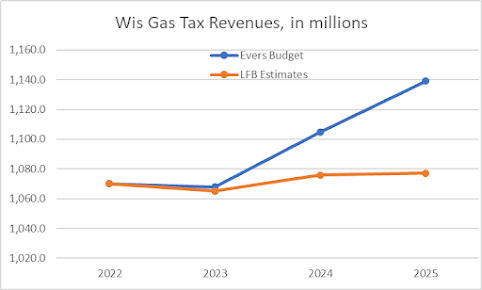
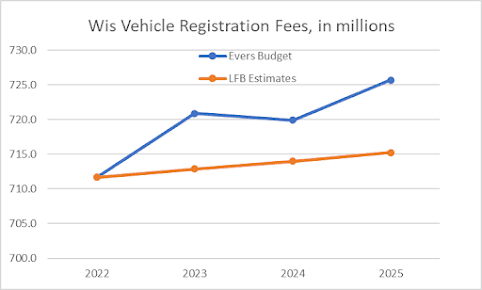
Here's a visual version of those numbers.

Two of the reasons behind this sizable shortfall is because LFB says less gas is expected to be consumed in Wisconsin than the Evers Administration projected, and that there will be less money coming in from vehicle registrations.

But the other big reason is that the GOP-run Finance Committee removed an Evers initiative that would have paid down nearly $380 million of the Transportation Fund's debt, and now it means there are less funds to spend on other DOT needs and services.
Transportation revenue bond debt service is an offset to revenues from vehicle registration and titles fees. Annual revenue bond debt service amounts are estimated to be lower by $5.1 million in 2023-24 and higher by $68.4 million in 2024-25, compared to the amounts included in AB 43/SB 70, which results in an increase in net revenues to the fund in 2023-24 by the same amount and a decrease in net revenues in 2024-25 by that same amount. Of these amounts debt service reductions of $5.1 million in 2023-24 and $7.8 million in 2024-25 are associated with the estimate of current law of transportation revenue bond debt service. The remaining difference in 2024-25 is associated with the Committee's earlier action to delete the proposed general fund transfer related to the defeasement of transportation revenue bond debt service, which would have reduced debt service on these bonds by $76.3 million in 2024-25. These estimated debt service amounts do not include debt service on any additional transportation revenue bonds for the major highway development program and for DOT administrative facilities, which would be authorized at $149.2 million and $18.5 million respectively under AB 43/SB 70. The Committee has yet to address those items.
So because we are still paying off the debt that Evers wanted to use the Gen Fund surplus to pay down, that's more than $76 million in DOT revenues that we have to use up to pay that debt during this budget (as well as more down the road).

The last item that is leading to the shortfall is another offshoot of the WisGOPs on Finance removing Evers' initaitives last monmth. Evers planned to increase the amount of General Fund dollars that is sent over to WisDOT, by diverting some of the sales taxes from auto-related products.
As a result, the recommended revenue increases under AB 43/SB 70 associated with the proposed transfers from the general fund to the transportation fund would not yet be included in the 2023-25 budget bill. These transfers equaled: (a) $43,625,700 in 2023-24 and $52,895,500 in 2024-25 associated with the estimated annual sales tax revenue from the sale of automotive parts, accessories, repair and maintenance services, and tires (APART); (b) $39,300,000 in 2023-24 and $55,100,000 in 2024-25 associated with estimated annual sales tax revenue from the sale of electric vehicles; and (c) $9,000,000 in 2024-25 to offset the loss in railroad property tax revenues to the fund associated with the repeal of personal property tax under AB 43/SB 70.
The upshot of this is that LFB says there is only $28 million available in the state's Transportation Fund to pay for any increased state funding for any DOT services - just more than 1.3% of projected expenses. And the costs of road construction and other needs are likely to go up a lot more than 1.3% over the next 2 years.

That being said, the infrastructure bills should give some more cushion over the next couple of years, and the Finance Committee could/should use some of those extra Federal funds to pay for projects and save state funds in the process. But those funds will go away in the next budget, and the flat gas tax and vehicle registration revenues for the next 3 years indicates that we will need to find new and better ways to pay for our many DOT needs for the rest of the 2020s.

Even in a time of major General Fund surpluses, these updated figures in the Transportation Fund shows that things are still very tight in this key area of the budget. And if WisGOPs choose tax cuts over using the surplus to add more General funds to fix the roads in this budget, they're making a big mistake.

Monday, June 5, 2023

More rail travel coming to Wisconsin. But how much more, and how much better will the rails be?

With the NFL Draft coming to Green Bay in 2025, there are questions as to how the league’s smallest market is going to be able to handle a potential influx of hundreds of thousands of people and media over several days. And one of the pieces of those logistical questions involves transportation, given that Austin Straubel Airport in Green Bay doesn’t offer a lot of direct flights, and that the nearest major market for lodging and air travel is 100 miles away in Milwaukee.

There is one solution now being floated that might allow for increased options to get to Titletown, and possibly lay the ground work for a future, more permanent transportation project in our state.
Green Bay Packers President and CEO Mark Murphy on May 24 mentioned the team had contacted Amtrak about passenger service to help bring some of the expected crowd of 240,000 people to Green Bay.

In a May 31 interview, Marc Magliari, an Amtrak spokesperson, said discussions have been informal so far, but there are precedents for that type of charter train service and the company is interested, but that there are questions to be answered before Amtrak could say "yes."…

In the case of Milwaukee to Green Bay for the draft, the Packers — or another business or organization — could contract with Amtrak for the rail trip or trips. Amtrak would provide the trains, cars and staff, and the contracting organization would then be tasked with selling seats.

In past years, Amtrak ran a charter train to the Kentucky Derby, for example. And, Magliari said, a one-off charter trip between Denver and the Winter Park Ski Resort a few years ago has led to a six-year contract to run the Winter Park Express route every Friday, Saturday and Sunday in January, February and March.
US DOT Secretary Pete Buttigieg mentioned the “huge potential” of Amtrak expansion in the Upper Midwest when ex-Mayor Pete was in Green Bay a couple of weeks ago to promote a sizable grant that the Port of Green Bay received.

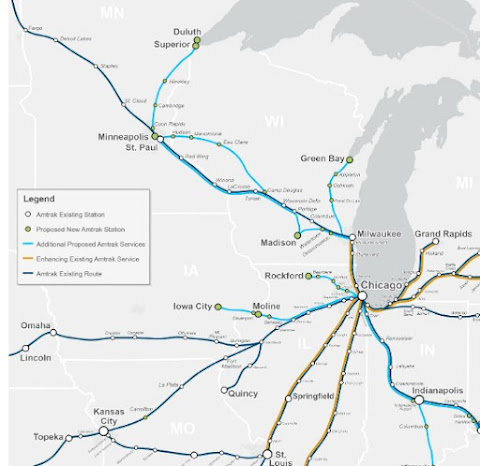
We already know Milwaukee-to-Green Bay service has been mapped in Amtrak’s future possibilities, along with bringing service to Madison 12 years after Scott Walker put the kibosh on the idea, as part of a significant expansion in funding that was part of the most recent infrastructure bill.

Passenger rail will also be part of this week’s JFC discussions on the Transportation budget, and the Legislative Fiscal Bureau discussed some of the increased options that are now available for Amtrak and other rail travel.

And one of the more immediate items to deal with involves increasing rail service in another part of our state in the next few months.
Wisconsin's share of operating costs for the new Twin Cities-Milwaukee-Chicago (TCMC) service are estimated by DOT to be $303,100 in 2023-24, and $518,100 in 2024-25. The TCMC project will eventually provide one additional daily round-trip between Chicago and the Twin Cities to augment Amtrak's current Empire Builder service, with stops in St. Paul, Red Wing, Winona, La Crosse, Tomah, Wisconsin Dells, Portage, Columbus, Milwaukee, General Mitchell International Airport, Sturtevant, Glenview, and Chicago's Union Station. Through an agreement with partnering states (Illinois and Minnesota) and Amtrak, Wisconsin will share in the costs of operating the service.

TCMC service is currently scheduled to begin in September, 2023. TCMC-related design improvements and construction projects will begin in early 2024, and conclude mid to late-2025. Since the TCMC service will use existing routes, and the planned construction projects are only intended to improve train movements and flow, TCMC service can begin prior to construction. The service is estimated to have $14.4 million in annual operating costs and is projected to generate annual revenue of $6.1 million, resulting in $8.3 million remaining in net operating costs that would need to be covered. TCMC operating costs for the first three years of service will be partially offset by the receipt of a $12.6 million federal grant received by partnering entities, which will pay for 90% of operating costs in 2024, 80% of costs in 2025, and 70% of costs in 2026. The remainder of net operating expenses will be paid for by the three participating states, with Wisconsin and Minnesota each paying a 35% cost-share, and Illinois paying the remaining 30% share. In 2026, it is estimated that Wisconsin's share of cost will equal $0.8 million. According to the Department, the agreement between Wisconsin, Minnesota, Illinois, and Amtrak is still under development, so some aspects of these costs will likely change once the agreement is finalized. Also, similar to the Hiawatha agreement, DOT will have an annual payment to Amtrak that will depend on the route's farebox revenues and actual costs incurred.
That annual payment on the Chicago-Milwaukee-Twin Cities train is estimated to be $303,100 in the 2023-24 Fiscal Year, and $518,100 for 2024-25, which doesn’t seem like a bad deal for more frequent service (and likely at a more convenient time).


Coming our way?

There are also $7 million in state funds budgeted for “nuts and bolts” capital work on rail lines that would be scheduled for next year, and another $2.5 million in Fiscal Year 2025. This includes contributions to upgrade WisDOT rail fleet and locomotive upgrades, but also includes some specific projects.
• Muskego Yard freight bypass of Milwaukee Intermodal Station (MIS) (which allows freight trains to avoid using the same tracks as Amtrak, helping ease congestion for both types of rail)
• [Milwaukee Intermodal Station] signal and centralized train control (CTC) upgrades
• Milwaukee Airport Railroad Station (MARS) second platform
• Hiawatha next generation equipment acquisition and implementation
JFC could turn down any or all of these projected upgrades, but given the additional usage of the rail lines with the new Midwest regional service, it makes sense that there would be an additional need to do work on the rail lines and install improvements.

The other wild card would be whether the state could have more announcements from Secretary Buttigieg, this time for federal grants to help the state and local communities build up its rail infrastructure. While the infrastructure bill seems to have given automatic increases for highway funds and other types of aids, it looks like most of the increased FED rail aids are case-by-case. Some immediate upgrade funds from DC would change the calculus quickly in terms of what we can and can't do for passenger rail in this state, but either way, it certainly looks like there will be more opportunities for Wisconsinites to ride the rails soon enough.

Sunday, June 4, 2023

Sunday reading - Elon, Zaslav, and other whiny rich a-holes

Wanted to give your attention to a great column by labor writer Hamilton Nolan, where he discusses why the uber-rich get so freaked out by the non-issue of "cancel culture" and other reactions to their general douchebaggery.

Nolan starts with the recent heckling that Warner Brothers CEO David Zaslav received when he was addressing the graduating class of 2023 from Boston University. Nolan points out that CEOs and mega-donors decide to take part because it's a way of promoting themselves, and getting the attention of a group of people who otherwise could not care less about what they have to say.
Boston University invited Zaslav to be its commencement speaker this year. If you were under the impression that college graduations are about the students, you are mistaken. The dreary ritual of commencement speeches and honorary degrees, bestowed as an empty honor upon some guy who the students do not give a damn about but who somehow lends wealth or prestige to the school itself, goes to show that the primary role of students at these events is to be a prop for future fundraising efforts. It’s not too different from the way that companies build lavish offices in which the employees are, above all, a backdrop for the CEO to look at in a self-satisfied manner as he ushers business partners into important meetings. Our open plan office makes it hard for you to do phone calls? I’m sorry, but it’s more photogenic.
Then when the students rightfully call out Zaslav for trying to screw over the writers at Warner Brothers and other generally scummy CEO behavior, he whines about how college campuses are "out of control" and disconnected from "the real world". But Nolan points out that Zaslav and other elites are the real ones that live inside of a Bubble, and can't get the respect from the Real America that they so badly want.
The only reasonable way to discuss cancel culture is not “Why are kids these days canceling people?”— it is “Why is this objectively unimportant niche phenomenon suddenly such a large part of mainstream discourse?” The most basic answer is “Because so much of mainstream discourse is produced by a narrow demographic of upper middle class middle aged uncool people who have never worked outside of media or politics or academia or nonprofits and whose nightmare is getting made fun of by college kids.” But on a more fundamental level, it’s that deep yearning for the things that cannot be purchased. Why do Ken Griffin and David Geffen and David Koch spend “charity” money not on feeding the poor, but to plaster their names on public buildings? Because they are thirsty for—above all—that public love. It is a sort of prestige, but not, ironically, the cheap sort of prestige that can be bought; what they desire deep down is the genuine love and respect of humanity. Their performative efforts to earn it are pitiful. But their desire never ebbs. That respect would amount to immortality for them.

You ain’t gonna get it, fuckers. Though it would seem, rationally, that a bunch of not-rich college kids heckling a guy who makes $100 mil a year would mean nothing to him, that is not the case. The idea of being mocked and shouted down by the unwashed masses strikes fear in the heart of the powerful because it is emblematic of their inability to buy that respect that cannot be bought. This goes not just for moguls and billionaires, but for those who have achieved cultural success—the prestigious newspaper columnists who cannot stop writing dumbass columns about this spectacularly asinine topic because it represents their worst fears. Namely, that a lifetime spent worshiping at the altar of careerism and credentialism was all for nothing. When you have long cultivated a resume that demands respect only to be disrespected by a bunch of nobodies, it can shake you to your core. What was the point of it all, if the cool kids think you suck?
And "being cool and entertaining" is the one area that our modern oligarchs can't break into it. And Nolan says that drives them nuts, because these oligarchs thought that their money and power would give them that.
The common thread is nothing more than a pulsing desire by the already powerful to sew up the last few places in the world that they are forced to deal with regular people on an equal playing field. Elon Musk is rich and powerful, but he looked like an idiot when he tried standup comedy. Thomas Friedman is distressingly influential and comfortable cheerleading a war, but he looked pretty normal when he got a pie in the face on stage. And David Zaslav can force thousands of writers to risk their livelihoods in order to go on strike, but he can’t help looking like a pathetic greed-drunk uncool dad when all the kids start booing him at his commencement speech.

If we lived in a more equal society in which everyone had a fair and democratic chance to exercise their own power and influence, we could have a reasonable discussion about toning down “incivility.” Until then, fuck it. You gotta use what you got. Keep booing these fuckers when you are forced to listen to their speeches. Yell at Stephen Miller when you see him in a restaurant. Make fun of billionaires. They can have everything else, but they’re not entitled to our love. They didn’t earn it.
This explains the entire existence of Elon Musk these days, and his pathetic neediness. The Defector's David Roth commented on a similarly odd comment from former Twitter CEO Jack Dorsey last week, and reminded us of a great column he wrote that pegged Musk and other Tech Bros perfectly, when you see them whining all over social media about some (non-)issue.

Online reactionary politics is a fan community before it is anything else; as with Donald Trump, the way to tell that Musk is an active participant is how obviously starstruck he is by the corny dingbats that make up its firmament. Where Trump lived for the approval of Fox News's glitching poreless on-air goblins, Musk has been queasily quick with an "exactly" in the mentions of various reactionary influencers: the anti-trans activist that solicits bomb threats to children's hospitals, or the one fellow from the Koch-backed Turning Point USA organization whose face seems to be shrinking, or Cat Turd 2. If it is embarrassing to know who these people are—and it is extremely embarrassing to know who those people are—it is more embarrassing still to have mistaken these relentlessly self-serving grifters for friends.

What all of that decidedly is not, however, is mysterious. Musk's politics, however heterodox he himself might secretly be, appear very much to be those of an extremely wealthy 51-year-old man with an entirely commonplace conservative media diet. There are only so many interesting ways and even fewer interesting reasons to adopt these politics; the most common one, which again is the one that Musk seems to have chosen, is to simply let the combined inertia of your circumstances and incuriosity back you into them. That he is now someplace so strange—winking at QAnon shit, already—seems mostly to reflect how conservative politics have moved in that direction; Musk, typically, seems not to have given any of it much thought. The extremities of his wealth and strange upbringing, and his personal peculiarities and the limits of his capacities for empathy or insight all probably played some role, but this is true of every other butthead that ever aged into reactionary politics. In time, these people realize what they actually believed all along and embrace what has always mattered most to them. In this sense, too, Musk's little blurts of umbrage and upset are just like those of all the other reactionary pilgrims on their own lonely journeys. Separately but in unison, they slough off everything and everyone that is not them, either out of principle or pique or just because they find themselves losing interest; instead of talking to the people they used to talk to, they just shout at everyone. Twitter has always been a good place for that.
Roth adds that since these ultra-rich folks have no real risk of losing anything tangible, they now treat life and their statements as some kind of sporting event or game show, where they have to "battle and defeat"....something. And they don't dare to question why people like them have are allowed to acccumulate so much power and wealth. So they're no more than the everyday a-hole that normal people who never waste their time with if they weren't so rich and given such a forum to spot their BS.
Socialism and barbarism are now both back on the menu, and each on the ascent. But for members of a generation who saw their politics as inseparable from themselves without ever thinking nearly as hard about the former as they did about the latter, this is all still a matter of performance. Such politics are easy to change because they were never really anchored to any actual system of belief. An obliterating narcissism and sawed-off selfishness is latent in American culture like lead in contaminated water; in the absence of countervailing principles, it will naturally make its presence felt over time. If your politics is just about Opposing Authority, for instance, with no regard for or sense of the structural and material realities of actual power, then remaining true to those politics is just a matter of propping up new authority figures to rage against....

Everyone knows what free speech means to people like this, because they have met these people and noticed how much more they care about talking than listening. There is a tendency, because of how much American culture reveres wealth, to assume that rich and powerful people got theirs on merit. That demonstrably incorrect faith predated and presaged Trump's presidency and survived its idiotic apotheosis; it fueled Elon Musk's ascent, and will almost certainly emerge unscathed from whatever reckoning is or isn't coming.

Which is astonishing because it is all just right there, the wild philistinism and the bullying and the offhand cruelty, the compulsive self-aggrandizement and the giddy vengeful sadism toward everyone he believes he can get away with treating that way—all of it so oafishly performed that it could not possibly be mistaken for anything but what it is. There's no principle to find here beyond spite and distaste; the speech is just noise cast out into the chaos by someone eager to mistake the echo for an answer. And then, even though the fact of it is so plain—and, again, so embarrassing and so implicating in its thudding overage—the mistake gets made anyway. "Maybe," the tech podcaster Kara Swisher mused on Monday, Musk is a few steps ahead of us all, and at work "building a new kind of media company." Leaving aside the characteristic mistake of assuming that "new" means "better," I suppose it's possible that what looks like flailing impulsivity and familiar old cruelties is in fact something finer and more reasoned. But it might just be what it looks like.
These people aren't special, and don't know much beyond maybe One Big Thing that they were lucky to hit on at the right time. They are exhibit A of why we need to go back to taxing the mega-rich at 70-90 (especially in capital gains) and why we need to beef up the IRS to make them think twice before trying some other type of tax scheme or give "donations" to fake charities, which prop up other grifters that pollute the discourse with RW misdirections.

These oligarchs think they can get away with every bit of bad behavior and jackassery, and don't have to deal with the consequences of anything. They need to have some real accountability and be brought back toward the Real America and real issues that the rest of us have to deal with in the wreckage of their self-entered foolishness.

Saturday, June 3, 2023

Another good jobs report for May. And with debt ceiling clearing, things look good

As the threat of a debt ceiling crisis faded on Friday, we also found out that the jobs market was trucking along in a time when default was still in play.

It wasn't all great news in the jobs report, as the rise in the unemployment rate from 3.4% to 3.65% with more Americans identifying as unemployed at the same time that more people entered the US work force. But it appears that a sizable amount of those losing jobs were in the "part time for economic reasons" category in April, which is why the U-6 unemployment rate only rose by 0.1%, staying near multi-decade lows.

While fewer Americans may have been self-employed in May, more were finding work at businesses they didn't own.

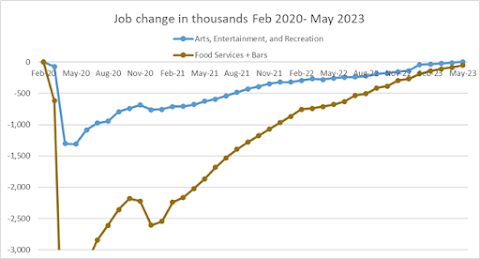
While Americans were claiming they lacked consumer confidence and were buying into the RECESSION FEAR being spread around the news (because "healthy economy with solid job/wage growth" is boring), we still see consumer-driven restaurants, bars and recreation services sectords hiring up. In fact, the arts/entertainment/rec sector has now gained back all of the losses it took on in the COVID era, and bars and restaurants will likely get back to pre-COVID levels by the end of the Summer.

The wage growth figures in the jobs report were good-but-not-great, matching a trend of the last several months that goes along with our declining levels of 12-month inflation.

Or maybe we're in a balanced economy that is continuing to need workers, which helps everyday Americans. That's what the Fed SHOULD recognize, and use their meeting later this month as the one to pause on their trend of rate hikes, as the Fed Funds target of 5-5.25% is now above the 12-month gains in both inflation and average hourly wages, and quite a bit more when you look over the last 9 months (where the annual rate is 3-4%).

Combine the strong jobs market with the threat of debt default going away, and the DOW Jones Industrial Average jumped by more 700 points on Friday. We've also seen US gas prices decline in the last month, and go down more than 25% compared to a year ago, as gouging prices were nearing their peaks. After a lot of questions before Memorial Day weekend on the economy, things feel pretty good now, and don't let the wishful BSing of Republicans and scummy hedge funders try to tell you otherwise.

Thursday, June 1, 2023

Debt ceiling bill not as bad as it could be. And we can make it better after 2024.

As the debt limit deal goes through Congress, getting through the House and being debated at the Senate sooner than later, let's go over the AP's summary of the agreement.
The agreement would keep nondefense spending roughly flat in the 2024 fiscal year and increase it by 1% the following year, as well as suspend the debt limit until January 2025 — past the next presidential election.

For the next fiscal year, the bill matches Biden’s proposed defense budget of $886 billion and allots $704 billion for nondefense spending.

The bill also requires Congress to approve 12 annual spending bills or face a snapback to spending limits from the previous year, which would mean a 1% cut.
So does that mean would-be saboteurs in the GOP House can’t shut down the government when the Fiscal Year ends on September 30? Because that’s what I figure would be their next move, because even though a budget would be in place, they could hold up releasing the funds, or some similar monkey business. I would guess that there will be performance artist MAGAts trying some stunts over the next 4 months to move money into one area and take it away from others, but it still seems like a helluva cave by McCarthy and the rest of the House GOPs.

Which hopefully means that Biden privately threatened to walk away and use the 14th Amendment to pay the bills and obliterate the debt ceiling (which is what I wanted him to do all along). And maybe McCarthy and other DC GOP insiders knew Republicans were going to be blamed for the economic damage from a debt ceiling meltdown.

I’m skeptical of that calculation - I think low-info voters would blame the president in charge when the economy takes a downturn, and hurting Biden and the Dems for 2024 was a central part of the GOP’s hostage-taking strategy on the debt ceiling. But because they couldn't get the big stuff, this deal has a lot of symbolic budget cuts related to “concerns” that only exist in the Faux News BubbleWorld.
Republicans targeted money that the IRS was allotted last year to crack down on tax fraud. The bill bites into some IRS funding, rescinding $1.4 billion. Budget scorekeepers said the change would increase deficits by $900 million because less enforcement means less revenue coming into the Treasury.

The White House has said that the deal also includes an agreement to take $20 billion from the IRS over the next two years and use that money for other nondefense programs.
But it also means that IRS funding will be increased by around $60 billion compared to what it was before Biden took office. The Treasury Department has already credited the added funding to improvements in service to everyday taxpayers and increased speed of refunds during this year’s tax season, and in the long run, it will still lower the deficit due to increased enforcement against tax cheats. I’ll take that.

We've also found out over the holiday weekend that our state might be giving a sizable contribution to the "savings."

Wisconsin officials are preparing to send back some of the federal pandemic funding that has not yet been spent under a deal between President Joe Biden and House Speaker Kevin McCarthy to raise the country's debt limit as a federal government default looms.

Gov. Tony Evers told reporters on Tuesday his administration is planning for the possibility, which could result in Wisconsin losing some of the $447 million in federal funds state officials have not yet spent out of the billions it was allocated as part of federal laws passed by Congress to help states navigate and recover from the coronavirus pandemic.

"We haven't heard anything because I don't think the written document exists so we are planning all across our agencies," Evers told reporters in Brown Deer, according to WISN-TV. "We're looking at what is known and seeing how much money we would have to send back but at this point in time we're not anywhere near because they aren't anywhere near soup yet."…

When the GOP-controlled House passed a bill in April to raise the debt limit in exchange for cutting various types of spending, the nonpartisan Congressional Budget Office estimated clawing back pandemic funding would save about $30 billion. Government accountants excluded $316 billion in remaining funds that the government is legally obligated to pay out. An additional $16 billion that CBO estimated would be committed before any deal was finalized was also excluded.
Like the Guv, I am unclear how “unused” was determined, and what time period is the cutoff point. The CBO analysis of the debt ceiling agreement gives us some specifics, saying "a majority of the reductions would come from the Public Health and Social Service Emergency Fund and from certain infrastructure and disaster relief programs," and basically takes back some of the money that was budgeted for those duties. So Tony, make an announcement and get that money obligated before Biden signs the bill! (I'm mostly kidding)

If you widen out to CBO's analysis of the full bill, you'll see a similar pattern.

Most of the budget cuts come from "updated projections from lower funding”, and here’s how CBO explains that category.
Caps on discretionary funding in fiscal years 2024 and 2025 would affect CBO’s projections of discretionary funding in 2026 and beyond because of the way that CBO is required to project such funding. In CBO’s projections for discretionary spending, funding in a future year generally is based on the projection (or amount provided) for the prior year. Because the caps would reduce CBO’s projections of funding for fiscal year 2025, the projections for the following year (and each year thereafter) also would be reduced.
Of course, if those numbers are adjusted to reality and future needs higher levels, those “savings” will never exist. But hey, it sounds big!

We’ll see if Coffee Boy is still around in those future years to see his dream of future budget cuts come to fruition.

We also know that this will not be the only cuts imposed onto services that Americans depend on. McCarthy says he and his fellow Republicans will be back for more, if voters keep them in office after 2024. No matter what they claimed what “off limits” in these recent discussions.

God forbid we ask the rich and corporate to give back any of the benefits the GOPs gave them in the GOP Tax Scam of 2017 to reduce the deficit, or other giveaways those privileged few have gotten in my 48-year-old lifetime.

There will certainly be people worse off from this, particularly due to the wasteful "work requirements" that are more likely to take away benefits from working people than it does in getting people to enter the work force.

And that's one of several items that need to be fixed the minute Dems regain total control in DC. This includes the removal of the debt ceiling as a THING, because markets decide if US Treasuries are able to be bought, and budgets decide how much we can spend.

But it's also a deal worth signing onto for the next 2 years, as it will keep us from an economic meltdown caused by failing to pay our bills due to an artificial debt ceiling. Which means it becomes less likely for Americans to lose their jobs and go through more economic troubles through no fault of their own, which is something we should have driving our economic strategy. Take it for now, and remind people just how Republicans endangered millions of people for stupid, symbolic and spiteful reasons.