Wednesday, April 22, 2015

Classless and secretive- how the Walker Admin rolls on Earth Day

Two stories that broke this afternoon show just how low-class the Scott Walker administration has become. The first you've probably heard of already, and involves 57 employees of the Department of Natural Resources getting layoff notices as a result of Gov Walker's budget provisions, with the dismissals being concentrated in a very convenient section of the DNR.
DNR spokesman Bill Cosh said that of that number, 27 employees are in the Bureau of Science Services, a unit of the DNR where Walker is proposing significant cuts.

The bureau performs significant research duties for the DNR, and the cuts have come under fire from wildlife and environmental groups who say research is the underpinning of many agency activities. Other positions that could be cut are education and communications personnel.

DNR officials have said in recent weeks that it's premature to say what cuts will actually occur, and how science and research will be handled at the DNR in future years. Cosh has said that science is carried out across the DNR, and not just in the Bureau of Science Services.

The DNR's scientific staff conducts research on matters ranging from estimating the size of the state's deer herd to to studying the effects of aquatic invasive species. Work is paid for with state and federal funds.
Catch that last part? Many of these positions are federally and grant-funded, and ending these positions won't do anything to reduce Wisconsin's budget deficit. But remember, Scott Walker has been recently named a favorite of the Koch Brothers in the 2016 GOP primary, and the Kochs are especially interested in reducing (if not outright ending) enforcement of pollution laws, and measures to reduce climate change, since both items might cut into their profits. Having DNR staff that might use actual science to show that bad things are happening to the natural beauty and resources of Wisconsin might turn people against big-money energy execs that Walker wants to grab money off of. So why not take that possibility out of the equation by cutting that staff, and especially strike that pose on Earth Day, to show your Koch bosses how "serious" you are about helping them out? Yes, the Walker Administration's act is just that transparently political and absurd when it comes to its DNR policies.

It's been similarly transparent and absurd that Walker has made Wisconsin taxpayers shell out for his campaign trips trade missions around the globe, as well as the staff from WEDC that accompany him on these junkets. In addition, Walker makes the taxpayers pay for his security detail when he makes his many trips out of state to court donors and GOP voters. This issue came up again in today's Joint Finance Committee meeting, as the State Patrol's funding was discussed, and what they have to spend to accompany Walker on these trips was part of the discussion.
The committee voted along party lines 12-4 to reject a Dem motion to require the Walker administration to detail how much the state is spending on providing protection for the guv.

The motion sought a quarterly report on the expenses for the dignitary protection unit, which protects the guv, lt. guv, their families and visiting officials.

Sen. Jon Erpenbach, D-Middleton, said Gov. Scott Walker's travel outside Wisconsin and the country as he mounts a bid for the presidency has been "staggering," but the committee has no idea how much is being spent.
That's right, the GOP legislators said it was none of the taxpayer's business how much Walker was spending on his personal vanity run for president, and they weren't willing to even get a report how much was being spent. Remember when conservatives allegedly were the ones that were the "tightfisted overseers of the taxpayers' dollars." Not so much in the Age of Fitzwalkerstan, where the accumulation of money and power is always more important than anything that would resemble ethical governance or caring for the public good.

Gee, you wonder why Walker's approval ratings are in the low 40's and falling, and why the Wisconsin public has turned against these budget provisions in massive numbers? Because they know Scotty and the gutless GOP lackeys in the Legislature could not care less about what happens to the everyday person in Wisconsin, or what kind of state they leave behind after the leave their current job and cash in for big bucks as a lobbyist or other type of wingnut welfare case. You just wish a lot of these people could have figured this out 6 1/2 months ago (it's not like the signs weren't there), and then we wouldn't have the disgusting embarrassment of a state government that we're stuck with today.

Tuesday, April 21, 2015

More Transportation funding won't solve the problems

Tomorrow features the Legislative Fiscal Bureau resuming its budget meetings, and the biggest-ticket item will involve several parts of the budget for the Wisconsin Department of Transportation. This included a re-estimate of the state's Transportation Fund, which is separate from the General Fund that has been the source of many Scott Walker budget cuts. And it's generally good news, as there is a little more money to play with in the Transportation Fund for the next budget.
The Governor's budget was based on revenue and debt service estimates made prior to the time of the bill's introduction. Since that time, the Department of Transportation (DOT) has reestimated revenues and debt service payments and this office has reviewed, and, in some cases, modified, those estimates. The resulting estimates are reflected in the fund condition statement shown below. At the time of introduction, the biennium-ending fund balance was estimated at $11.2 million. However, due primarily to projections of higher motor fuel tax revenues and lower debt service costs, the transportation fund is now projected to have a biennium-ending balance of $84.7 million.
Some of that is related to an increased carryover amount of $32.2 million, which is related to more fuel consumption and vehicle registration revenue than anticipated, and lower interest rates have also helped, leading to debt service costs being $37.0 million less between now and mid-2017. It's a nice benefit to have, but as you'll see, it isn't going to go very far in minimizing the many issues that are prevalent in the Transportation budget.

For example, while the debt service is projected to be lower than it was in the budget bill, it's still slated to go way up over the course of the budget, and will crowd out the ability to spend funds in other Transportation areas as a result.

Projected revenue bond debt service, Wisconsin Transportation Fund
2014-15 $234.96 million
2015-16 $242.1 million
2016-17 $276.3 million

And that figure is slated to go up in future years, because Walker's budget plans to borrow $1.0 billion from the Transportation Fund, and $300 million more from the General Fund. This was the trade-off Walker chose instead of raising taxes or fees to pay for all of the $4.5 billion in DOT-related costs, and while the extra $72 million could go toward reducing that borrowing amount, it also is barely more than 5.5% of the total borrowing that's in the Governor's budget, leaving $1.228 billion that would still have to be paid back later, plus interest.

In addition, there are other needs that might be a better spot to spend the extra money on. For example, aids to local governments to help fix their roads is slated to stay at 2015's levels for 2016 and 2017, so that won't even keep up with any inflation that may come along. Same goes for mass transit aids, which are a huge necessity for local governments with bus systems, since the GOP Legislature removed all Regional Transit Authorities from the state in 2011, which means it comes down to state and federal aids, property taxes and fares to fund the systems. A small increase in these funds would go a long way toward removing burdens for cash-strapped local governments.

There are also a couple of General Fund notes that are intriguing with the DOT fund. First of all, the scheduled transfer from the General Fund to the Transportation Fund is notably less from what it gets now. This reflects the self-inflicted wounds that were part of Gov Walker's deficit-ridden budget, because there simply isn't the money available to send more funds into the DOT.

Transfer from General Fund to Transportation Fund
2014-15 $169.6 million
2015-16 $38.0 million
2016-17 $46.1 million

It's interesting to note that $46.1 million is a bit larger than the $39.1 million that was listed in the Governor's Budget in Brief (page 33), which indicates that there is $7 million more that has to be made up in the budget deliberations (unless I'm missing something, feel free to say if I am). That's money that isn't available for filling in the cuts at the UW System or K-12 schools or Senior Care or any number of other unfunded needs.

But maybe the $72 million can fill in some of those holes, and stop the daily announcements of UW layoffs. Oh wait, the Road Builder amendment from last November makes that illegal. So much for schools being helped with the increased tax revenue from driving.

So with that extra money in the Transportation Fund having to stay there, let's see what options the Joint Finance Committee takes tomorrow. Do they try to reduce borrowing, help local governments, pay for something else, or bank it for later. Regardless of which path is chosen, there are still major unfunded needs for Transportation in this budget, and the Walker Administration's "borrow and spend" policies aren't going to allow business as usual to continue much longer.

Monday, April 20, 2015

Bucks arena in major jeopardy? Seems so

Two intriguing articles on the Bucks arena have hit in recent days that seem to indicate that the new facility is far from a sure thing. As a result, NBA basketball is looking less likely to be around in Wisconsin in 2 years, barring major changes in heart at the State Capitol, or in the hearts and minds of state voters.

What really set off the alarm bells for me was when I read this article today from ESPN's Brian Windhorst on how the NBA won't accept much foot-dragging on the arena, and wants a decision to be made sooner than later. Windhorst goes into detail on how the always-contentious issue of public funding for a pro sports facility has an extra level of emotion in Milwaukee, with memories of the battles that led to Miller Park being built in the late '90s (culminating in a recall of a state senator who supported the Miller Park tax), and the present-day conflict between the GOP-led state government and the Dem-run City and County of Milwaukee. Windhorst says that the NBA would have no problem with allowing the Bucks to move if a new building isn't going up.
This is the essential conundrum of being a local politician bargaining with a national sports league. The options are all difficult. And in this case, the answers have to come almost immediately. When a New York-based group led by Wesley Edens and Marc Lasry bought the Bucks from former U.S. Sen. Herb Kohl in April 2014, the deal included both a carrot and a stick to encourage local politicians to put the Bucks at the top of the political priority list.

The carrot was hundreds of millions of dollars toward the stadium. A nice benefit, but not enough to get the building completed. The stick was a clause stating that if an arena is not in place in Milwaukee by the start of the 2017-18 season -- an ambitious schedule -- the NBA has the right to buy the team. League insiders suggest a sale and relocation is the next logical step. The team would be worth more, by most analyses, in another city. NBA commissioner Adam Silver visited Milwaukee last November and made it clear at the time he wasn't carrying a big stick, saying "I didn't come here to announce deadlines." But, according to league sources, the NBA office -- having learned through the years that pledges and promises have little value until ground is broken -- has made it clear to all parties it will enforce the out clause if shovels are not digging quickly. The NBA has communicated it could give on the schedule a bit, but only in the case of true progress. The league isn't threatening consequences; it's guaranteeing them.
Windhorst says that the Bucks would likely move to Seattle in 2 years if a deal cannot be struck, as the Seattle Metropolitan Statistical Area is twice the size of Milwaukee's, and has lacked NBA basketball since the SuperSonics left for Oklahoma City in 2008. Other possibilities include two markets close to Milwaukee's size- Las Vegas and Louisville - who lack any teams in the major 4 pro team sports as of this time.

Windhorst also goes over the financing numbers, and where a gap has appeared in recent weeks after Senate Majority Leader Scott Fitzgerald and other state legislators said they were looking to reduce the amount of money the state would chip in toward the project compared to what was in Gov Walker's budget proposal.
It is projected the new Bucks arena will cost $500 million. With a combined $250 million from Kohl and the Bucks' new ownership, the proposal is a 50/50 split between public and private money. It is similar to the arena being built in Sacramento, California, where the city avoided the Kings moving to Seattle when a partnership was struck that saw the city invest $255 million and the Kings pledge $222 million. Gov. Walker has proposed $220 million through bonds issued by the state. The legislature, however, is fighting him on it and is proposing a deal for much less: $150 million. The city has offered $25 million in the form of infrastructure and land but no cash. The county hasn't offered a formal plan as yet but is expected to offer a package in the range of $25 million, as well.

That leaves a major shortfall -- between $50 million to $100 million -- and no one is offering to fill it, including the Bucks' ownership, who lawmakers have more than hinted should fund the solution. It is in this hole where the Bucks' future probably is going to be decided.
It sure doesn't look likely to be the City of Milwaukee that'll be the ones to cough up more funds than they are already offering. Milwaukee Alderman Bob Bauman gave a revealing interview in Milwaukee Magazine last week regarding the City's side of financing the Bucks arena, and the general political state of play on the issue. Bauman may be quite a prickly guy if you're on the wrong side of him, but he's also extremely knowledgeable on the ins and outs of policy, and few will shoot straighter on what's really going on. This interview is no exception.
[Bauman]: Everybody’s acting undercover here, not just the city. The Walker plan on paper is just fine. The understanding was that the City would come up with $25 million and the County would come up with $25 million, and we basically said, that we can handle. Now, the state’s going to change the deal, where it’s not $200 million, it’s $150 million. That creates a $100 million dollar gap. The City can’t handle that. It just can’t. And I think that’s exactly what (Assembly Speaker) Robin Vos and (Senate Majority Leader Scott) Fitzgerald intend to have happen.

As soon as we heard the legislature changing the deal, we don’t know what they’re willing to offer at this point. Do we have the capacity to make (a $25 million) contribution? Yes. Do we have the political will? That remains to be seen. Do we have the capacity to make a $50 million contribution? No, we don’t. We just plain don’t...

I have a perfect solution to all this, but the state will never go along because it involves raising taxes.

Allow Milwaukee County to levy a dedicated one percent sales tax that funds transit, parks and recreation, cultural institutions and the construction of a new arena. And there’s no state subsidy. And that would remove $74 million from the Milwaukee Country property tax levy to boot. It takes the park system off the county property tax levy, it takes all the cultural institutions off the county property tax levy, it takes public transit of the county property tax levy and it funds the arena with no state subsidy. All the state has to do is say, “OK, Milwaukee County, raise your sales tax one penny.”
And remember, County voters approved of such a 1% tax in an advisory referendum in 2008, but a County Exec named Walker urged the Legislature not to allow it, and it never happened.

Bauman adds that he thinks the GOP-run Assembly won't pass a bill to allow Milwaukee to raise non-property tax revenues toward a Bucks arena, and as a result "this all goes south and the Bucks move," which Bauman says will give the GOP and talk radio the excuse to blame Mayor Tom Barrett. Of course, it's past policy from the GOP-run state government that has led to many of these financing problems, not only in dumping more of the burden of the arena onto them, but in disallowing the tools that would allow the city and the county to get the revenue to comfortably generate funds and spend more toward the project. Instead, the State Legislature has consistently tied the City and the County's hands with limitations on sales taxes and shared revenue payments from the state, then complains when those levels of government decide to pay for police, fire, and streets over neglecting those services and jacking up the tax rates of locals to help pay for a basketball arena.

And last week's Marquette Law School Poll doesn't seem to indicate there's much of an appetite for shelling out state funds to the arena (doubly interesting since Marquette basketball may well play in the new arena). The MU Poll asked about the reduced-cost plan floated by the State Legislature of $150 million to be borrowed (they didn't even ask about $220 million Walker wants to borrow), and the answer was an overwhelming "HELL NO!"
Seventy-nine percent oppose borrowing about $150 million to support a new arena for the Milwaukee Bucks, with 17 percent supporting the proposal. In the Milwaukee media market, 67 percent oppose funding for an arena and 29 percent support it. Those views vary by less than 2 percentage points among the City of Milwaukee, the surrounding suburban counties of Waukesha, Ozaukee and Washington counties, and the seven other southeastern Wisconsin counties included in the media market.

In the rest of the state only 9 percent support borrowing for an arena, with 88 percent opposed.
Oddly, the funding question for the Bucks arena will not likely be affected by new revenue estimates that come out in a couple of weeks, because there is very little debt payoff that is to be made over the next two years on the arena (the Legislative Fiscal Bureau estimates this number at $2.8 million). But given what Windhorst and Bauman have hinted at, the big decisions regarding the Bucks arena and the team's future are likely to be decided in the next few months, and if the developments of recent weeks are an indication, this arena may be moving further away from being reality as the deadline get closer.

Some foks say it better- Rep. Gordon Hintz on "unnecessary crisis budget"

Articles like this is why I was damned happy to see Gordon Hintz join Chris Taylor as the Assembly Dems' 2 reps on the Joint Finance Committee. The man knows his stuff, and knows how to state it to others.

The first thing Rep. Hintz does is take the Walker Administration and GOP legislators to task for the Bush-like move of blowing a projected budget surplus on tax cuts for the rich and corporate, leading to a budget deficit today that was entirely avoidable.
Governor Walker's budget is a "crisis budget" at a time when other states are investing in opportunity and growing their economies. We are told by Governor Walker and his Republican Legislature that we have to make "tough cuts" and this budget "invests in priorities." Yet, just last spring, the state was projected to have a budget surplus. Governor Walker and the Republican legislators were up for election, so they passed a permanent $541 million tax cut. While it may have made for good politics at the time, it was poor fiscal management. The Walker Administration recently had to delay a debt payment of $103 million, which taxpayers will pay additional interest on, just to keep our current budget in the black.

Another misplaced priority has been the increased use of the manufacturing and agriculture tax credit, a measure slipped into Governor Walker's first budget that eliminates most state income taxes on owners of factories and farms once it is fully phased in. When the credit was passed in 2011, it was estimated that it would cost $128 million annually by 2016-17. However, it is now estimated that it will cost more than twice the amount expected. Delaying the final phase in of this credit by two years could restore nearly $78 million to the budget and help avoid further cuts.
What I like about Hintz's column is summarized in that last sentence. Not only does he give why the Walker budget sucks, but he has a solution to help solve the problems that Walker/WisGOP have caused (in this case, by leveling off the M&A tax cut). It's not like Dems don't have solutions to these issues, but far too often, they are unwilling to say what they are, causing the average dope to think the GOP is the party of "action", even if that action is detrimental.

Rep. Hintz finishes off the column with another budget solution, and a reminder that these Walker/WisGOP tax cuts and cost-shifting have not led to good results, but certainly have led to the mess we are currently in.
Maybe the biggest casualty of Governor Walker's presidential ambitions is his stubborn political decision to reject the federal Medicaid expansion funding. We are the only state in the upper Midwest which has not accepted this funding. Taking the expansion money would provide 81,000 additional Wisconsinites access to health care, save state taxpayers $345 million, and add an estimated 10,000 health care jobs.

If Wisconsin had some positive economic results to show for the recent borrow-and-cut policies, you could make a case for continuing this direction. But we don't. Wisconsin remains dead last in the Midwest in job growth over the past four years and 40th in the U.S. overall. The "crisis budget" we are dealing with has been self-inflicted and intentional. Cut revenue enough that government has no choice but to reduce its programs and expenses. We didn't have to be in this position and we don't have to make these cuts now. Instead of slashing and borrowing, we need a state budget that invests in opportunities for the people of Wisconsin.
If more Wisconsin Dems talked truth like this, they wouldn't lose a statewide election for the next 20 years. So why the hell don't they?

Sunday, April 19, 2015

A few notes from Walker's awful Marquette Poll

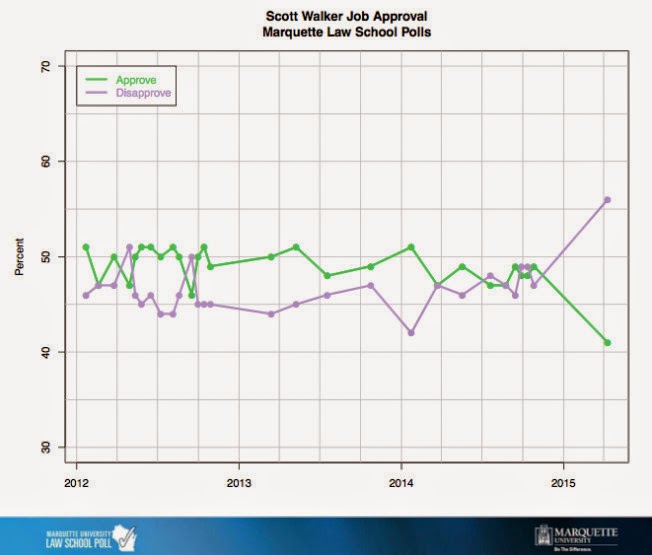
You may have heard something about the Marquette Law School poll that was released last week, and while the headline number is the tanking approval ratings of Gov Scott Walker, whose approval is down to 41%, and disapproval up to 56%. These results match similar declines for Walker that PPP reported last month, and is even more remarkable because the Marquette Poll and Professor Charles Franklin have ties to the pro-Walker oligarch groups such as WPRI and the Bradley Foundation, so they have little reason to knock down Scotty.

Let's start by enjoying Walker's tanking approval ratings, because it shows a notable change in the relatively consistent trend we had seen over the last 3 years of the Marquette Poll, where just under half of Wisconsinites would approve and half disapprove. This graphic from the Marquette Law School illustrates how different this week's poll was.


In the stock market, that would be known as a "breakout." It bears to mind the polling history of another Dubya, who slipped into negative approval for good in April of his second term, as that Dubya was trying to privatize Social Security, and his number never recovered. And just like with Bush, Walker slipped by in the election in November, and immediately started trying to push through policies that he never ran on.

As I've mentioned before, it's obvious that many Wisconsinites hate the thought of presidential candidate Walker. Just like with the PPP Poll, Walker does worse than most other GOP candidates when matched against Hillary Clinton in Wisconsin.

Hillary Clinton vs. GOP candidates, Wisconsin
Clinton 49, Paul 41
Clinton 49, Bush 38
Clinton 50, Rubio 38
Clinton 52, Walker 40
Clinton 52, Cruz 36

Not only is Clinton destroying Walker, she's above 50% against him, with the fewest amount of undecided out of any of those five candidates. It shows those who know Walker best don't want him as president, just like how Milwaukee County voted against Walker by 20-25% in all 3 of his Governor's elections after putting up with his tenure as County Exec. You've been warned America.

And it's not just Walker that's in trouble in this poll- it's his policies and the Wisconsin GOP in general. Take a look at these responses on certain issues that are part of Walker's budget.

Approve-disapprove, certain Wisconsin budget initiatives

Support cutting $127 million from K-12 schools?
Support 18%
Oppose 78%

Support $300 million cut to UW System?
Support 26%
Oppose 70%

Borrowing $150 million for Milwaukee Bucks arena?
Support 17%
Oppose 79%
Walker actually wants to borrow $220 million in the budget, so you'd imagine that's hated even more.

Requiring Senior Care recipients to enroll in Medicare Part D?
Support 30%
Oppose 44%

Eiminate cap on voucher schools?
Support 37%
Oppose 54%

What's more important to you?
Higher spending on schools 54%
Lower property taxes 40%

Scott Walker's budget is on the losing side of every one of these issues. And yet Walker's excuse for his declining poll ratings was that people didn't know enough about the budget and that they'd ultimately like what they see. Those poll responses indicate the exact opposite- that people hate the budget provisions even more. Walker's either lying, or completely out of touch, and a whole lot of GOP legislators seem to be realizing they will pay a huge price in 2016 if they stand behind this loser of a budget.

I admit that I haven't found a way to dig inside the crosstabs, due to formatting issues with the Zip folder (any help would be appreciated), and I'd like to see which groups in particular Walker are losing compared to 6 months ago. But it is clear that Scott Walker's act as a presidential candidate and the pose-ridden budget that he sent out as a result has angered many people across the state, and may have put his disapproval and lack of favorability past a point of no return. And the Marquette Poll results indicates to me that if Walker wants to do a little game theory, and find his best bet to carrying the state in November 2016, it involves a clear option. RESIGN AS GOVERNOR.

Saturday, April 18, 2015

Economy slowing down, or just taking a breather?

Lots of odd cross-currents going on when you look at the U.S. economy in recent weeks. On the positive side is the fact that unemployment claims remain very low, consistently staying below 300,000 in new claims over the last 7 months, and staying 15-20% below what we saw this time last year. Housing seems to be picking up, with both total sales and prices increasing over last year's totals, and both trends accelerating in recent months.

Even real wages, whose slow growth have long been a drag on the Obama Recovery, have seen a bit of a boost, with real hourly and weekly wages up 2.2% over the last 12 months. All three stats have some interaction, as a tighter labor market should lead to higher wages, and more funds available to buy homes. But the flip side to that real wages increase hints at some of the concerns with the economy, as the nominal change is actually down compared to last year, and it's only a drop in inflation that has led to the "real" increase.

12-mo change, March 2015 vs. March 2014
Nominal hourly wages, March 2014 +2.2%
Nominal hourly wages, March 2015 +2.1%

Consumer Price Index, March 2014 +1.5%
Consumer Price Index, March 2015 -0.0%

Real hourly wages, March 2014 +0.6%
Real hourly wages, March 2015 +2.2%

And a lot of that flat inflation is due to lower oil and gasoline prices, which led to energy prices being down more than 18% for the last 12 months. This is nice for those of us who spend a sizable amount of money driving, but it's also been a big reason why the Mining industry lost more than 22,000 jobs in February and March combined. This was a factor behind the disappointing March U.S. jobs numbers, with only 126,000 gained. That's less than half the average monthly gain of 268,000 jobs over the 12 months before that, and that was in a time when unemployment claims were similarly low to what we've seen recently, so we'll see in a few weeks if March's drawback was a blip, or the start of a jobs slowdown.

A stronger dollar has also played into this trend, not only in lowering gas prices due to cheaper overseas oil, but also in hampering U.S. exporters, whose products become more expensive to foreigners. U.S. manufacturers have only added 1,000 jobs in the two months measured since January, after adding 858,000 jobs in the 5 years prior to that (or more than 14,000 a month). Again, it could be a short-term blip, or an ominous sign of something more.

We'll see how all these contrasting factors play into the GDP report that comes out at the end of this month, and as you can see from this graphic from the Atlanta Federal Reserve Bank, the predictions for 1st Quarter growth have been falling throughout the last 2 months.


Of course, last year GDP actually shrank by 2.1% in the 1st Quarter of 2014 because of the polar vortex winter, then snapped back with increases of 4.6% and 5.0% in the next 2 quarters on the way to 2.5% growth for the year, and the highest single-year U.S. job growth in the 21st Century.

Certainly a continued combination of near-zero short-term interest and high economic growth isn't compatible (even with the higher dollar and lower gas prices), and at least one Fed Governor hinting this week at "boom times ahead" with higher interest rates coming with it. Does that combination then pop the mini-bubbles it seems like we're feeling in tech and housing, to go along with the recent end of the oil and drilling boom, and then set other forces in motion that would cause real damage to the economy.

With these different signals of data, you can see why it's worthy to keep your eyes on these figures over the next couple of months. We're also nearly 6 full years into the Obama Recovery, and at some point in the relatively near future history indicates that there will some kind of sustained decline in growth, if not an outright recession. I just wonder how long from now that'll be, and if we're at or near full employment when it happens.

Friday, April 17, 2015

The hits keep coming to the UW System

Add two more schools to the list of UW System institutions that are taking steps to cut staff because of Gov Walker's proposed budget cut of $300 million to the System. This includes the flagship institution at Madison, where Chancellor Rebecca Blank announced that up to 400 positions would be eliminated to close the gap. The announcement comes a week after the UW Board of Regents allowed for higher out-of-state to help defray some of that deficit, but Chancellor Blank notes that it is nowhere near enough, and with the next school year coming up with the state budget still up in the air, UW-Madison officials had to act.
Even while we continue to advocate for a smaller cut, we must now put our initial plans into action for Fiscal Year 2015-16, which begins on July 1. Our $36 million plan includes $21 million in budget cuts and redirects an additional $15 million from other campus units to our overall educational mission. This plan includes the elimination of approximately 400 positions.

It begins to bridge, but does not fill, a structural deficit that may be as much as $96 million as a result of state budget cuts in the upcoming fiscal year. The nonresident undergraduate tuition increases approved by the Board of Regents on April 10 will provide another $17.5 million in new revenue. There will remain, however, a significant deficit.

The reductions have been planned and will be carried out by our deans and directors, who know best which programs can be cut while minimizing the impact on the student experience and our core educational mission. Starting today, campus leaders are sharing information about their plans for budget cuts in their units.
Blank mentioned that UW-Madison might also merge or restructure some programs, since it will lack the staff to offer a sufficient curriculum in some areas.

Later in the afternoon, another UW campus joined a list of 5 others offering buyouts to its older employees. This time it's UW-Platteville having to make the move, offering early retirement for as many as 226 of its employees to deal with a $5 million cut in this budget, and another $5 million cut resulting from previous cuts and underfunding. In order to qualify, a Platteville employee must
be, as of June 30, 2015, currently appointed as faculty, academic staff, permanent classified staff, project staff, or limited term employee staff;
• be age 55 years or older as of June 30, 2015;
• be vested with the Wisconsin Retirement System and eligible to receive an annuity under WRS;
• have a start date at UW-Platteville on or before June 30, 2010
And what is even more infuriating about this situation is that it was entirely caused by dumb policies from Gov Walker and the Wisconsin GOP-run Legislature. Previous tax cuts have led to shortfalls in revenue, lessening the money available, and this Governor and his TeaBagging minions in the Legislature have chosen not to make up the difference by reversing or even stopping the expansion of any of these tax cuts. Instead, Walker chose to cut the UW System and K-12 schools as a means to make up the difference in this budget over other areas to reduce, such as the slush fund known as WEDC, or coming up with innovative ways to reduce the spending in Corrections.

Instead of all of the "Go Bucky" tweets the last month, why didn't these "Open for Business" legislators fund the great resource that is one of the few separators this state has over others, and remove all of the uncertainty that have led to these job and class cuts. As a result of their foolish choices, Wisconsin is now losing jobs and reducing our competitiveness in developing human capital. So tell me again how that mentality is supposed to attract business and make Wisconsin a better place to live in?