Tuesday, November 17, 2020

Evers puts out a plan to deal with COVID World. WisGOP responds with...nothing

You keep waiting for things to stop getting worse in regards to COVID-19 in Wisconsin, and it just doesn't happen. Today set another notorious record. In light of this, Governor Evers unveiled his package of legislative changes to deal with the pandemic. Many of Evers' provisions simply extend rule changes that were put in place as COVID broke out and hundreds of thousands of Wisconsinites lost their jobs.
The governor's plan would let the Department of Health Services issue an order prohibiting eviction or foreclosure actions for any period of time before Jan. 1, 2022.

It would fund community testing, contact tracing, vaccinations and public awareness related to COVID-19, although the exact amount of state funding would vary greatly depending on whether the federal government extends its funding.

Evers' plan would prevent insurers from capping coverage on prescription drugs that expired earlier this year.

Schools would no longer have to complete state assessments and report cards for the current school year under the governor's plan.
You can look at Evers’ plans by clicking here. There are also several other health measures in Evers' bill, including:

1. Requiring health plans that cover certain services in-person, to also cover those services if they are offered via telehealth.

2. Requiring that individuals pay zero out of pocket for “…every health insurance policy and every self-insured governmental health plan that generally covers testing for and treatment of infectious disease to provide coverage of testing for, diagnosis and treatment of, and administration of any vaccination developed to prevent COVID-19.”

3. Prevent individuals from being charged higher prices if they have to use an out-of-network provider to get diagnosis or treatment related to COVID, and their in-network provider is shut down. The state will help to pay the difference to providers.

There also are several unemployment-related provisions that re-establish laws from the Spring. This includes removing the work search requirements for people that are laid off, eliminating the 1-week waiting period for people to get unemployment benefits, continuing the expansion and easing of requirements for employers to put in work-share programs. Evers' bill will also allow Wisconsinites to receive both Federal disability benefits, and to receive unemployment benefits.

In addition, many of the costs in Evers' proposal has a subtext of “we need federal help because it costs us a lot of money to do what needs to be done."
Which makes some kind of extension/renewal of the CARES Act all the more necessary in the next 6 weeks. Because if that money runs out (as it is slated to do at the end of 2020), it will be near impossible for the states and local governments to continue doing what they’re doing without having to make cuts in other areas that are in need during the COVID World.

There is one additional item that Evers wants to use taxpayer dollars for, and that’s an additional $75 million in (unspecified) grants to small business. This would likely be something similar to what the Evers Administration has already been doing in the We’re All In program, and other bailout funds like today’s announcement of who is getting the $10 million in CARES money that is designated for Wisconsin movie theatres. Naturally, the gerrymandered GOP Legislature planned their own public event to respond, and discuss their ideas on how to attack COVID in the coming months. Well, at least that's what they were SUPPOSED to do. Then a certain Senator Dumbass from Delafield decided Robbin' Vos couldn't get the award for dumbest and most callous GOP of the day. Really, Kap? You think leaving Wisconsinites to make their own decisions on how to handle COVID is working out for us? On a day when 92 Wisconsinites die, over 1,400 are dead since October 1, and nearly 100,000 new COVID cases have been diagnosed in November so far?

And yet, voters kept 61 of 63 Assembly seats in the GOP’s hands, and actually gave them 2 MORE seats in the State Senate. I know gerrymandering is a big hurdle, but COME ON, at some point don’t you just fire people for sucking at their jobs and not caring about what's happening to their constituents? Or setting fire to torches, grab a pitchfork, and head to their houses?

The lack of accountability for WisGOPs' laziness and arrogance goes a long way toward explaining why COVID-19 continues to get worse as typical November weather keeps more Wisconsinites inside. And me and a whole lot of others in the "thinking and decency" parts of the state are out of patience with the way these mediocrities drag the rest of us down.

Monday, November 16, 2020

All close Dem wins are not the same - how Wis has changed in the 21st Century

Neat articled from Craig Gilbert in the Journal-Sentinel where he points out that Wisconsin isn't the same 50-50 state that we had in 2004.

To begin with, rural Wisconsin used to be relatively even between Democrat and Republican, especially in Western Wisconsin. That's not the case today, as outstate Wisconsin has almost entirely become Trump Country, as you can see in this chart.
These smaller counties outside the state’s metros voted for Republican George W. Bush by a combined 5 points in 2004. They voted for Republican Trump by a combined 20 points in 2020.

The size of the swing is staggering in places: 21 mostly rural counties have shifted more than 20 points in their presidential margins since 2004. Six have shifted more than 30 points: Pepin, Rusk, Trempealeau, Buffalo, Clark and Adams. Kerry won Trempealeau in western Wisconsin by 16 points. Biden lost it by 17. Kerry won neighboring Buffalo by 7. Biden lost it by 25.
But at the same time, Democrats have made significant gains in the state's two largest media markets. And not just in the big cities of Madison and Milwaukee, but also in the suburbs and outlying counties.
Back in 2004, Bush won the Milwaukee media market (the state’s largest) by almost 4 points. In 2020, Trump lost it by almost 3 points... Something similar has happened in the Madison media market. Kerry won it by 21 points and roughly 107,000 votes. Biden won it by 30 points and more than 180,000 votes.

When you compare 2004 to 2020, it's almost as if the two parties engaged in a massive vote swap. That swap cost Democrats more than 140,000 votes outside of metropolitan southern Wisconsin. But in the broad Milwaukee to Madison corridor, Democrats gained that many and a few more.
This shift has notable significance in how this state's politics is going to look for the 2020s. It will be very hard for Dems to win control of the State Senate or Assembly if they continue to lose so badly outstate, and they will have to decide if they want to change strategies and emphases in issues if they want to win back some of those votes. At the same time, Republicans have lost voters in more educated and urbanized parts of the state due to their emphasis on "divide and conquer" cultural issues over constructively and honestly trying to solve problems.

The other variable playing in here are the shifts in population that'll be reflected in new maps for the House of Representatives and the State Legislature. According to the US Census Bureau, over 40% of Wisconsin's 135,448-person increase in population has come in Dane County, a jump that is more than 42,000 above any other county in the state. Also, if you take out the 8 counties with the largest growth in population, and even include the loss of 2,000+ people in Milwaukee County, the rest of the state has barely grown at all.
Now let's go back to this tweet from Marquette Law School professor Charles Franklin. Every one of those counties with the largest growth in population had Biden gain at least 4 points on Donald Trump vs Hillary Clinton's performance in 2016. And while I don't buy into the "demographics is destiny" argument, and note that a lot of damage has happened to all people in this state in the decade that Dems have been shut out of power in the Legislature, it does mean that GOPs are going to struggle to win anything statewide if their Trumpist "culture/resentment" strategy continues, as Dems are gaining ground in the places where more people are choosing to come to.

Both parties in Wisconsin likely need to change strategy and talking points if they want to gain back some of the voters they have lost in the last 16 years. But a lot of constituents that make up the base of both parties is going to be a significant headwind to those efforts, and often the electoral incentives of trying to get one group of voters comes at the expense of more reliable voters. So barring some big event that makes many people rethink their priorities and status in life (which apparently has NOT happened with COVID), our politics seem likely to remain in the same kind of trench warfare that we've seen in Wisconsin for most of the last decade.

Sunday, November 15, 2020

Another week of COVID making things worse throughout Wisconsin

In a week where the country continued to set records for new COVID-19 cases and is back at 1,100 deaths a day, Wisconsin is doing even worse than most places in America. There were 8 times as many new COVID cases in Wisconisin last week than there was in the week before Labor Day, and over 1 in 3 people that were tested in the state last week ended up being positive for the virus.
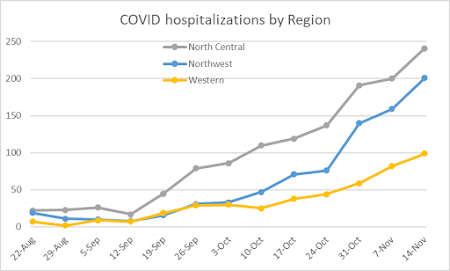
Worse than those increases in infections is what has come with a 3-4 week lag after the infections start - jumps in hospitalizations, which are straining the capacities of our health systems. This was already the case in outstate Wisconsin by October, but it has gotten worse in November and now COVID is filling hospitals in the most-populated reigons of the state.
And given the trajectory of new cases, there's no reason to think that the strains on the state's hospitals will end any time soon. Likewise, deaths also continue to rise in Wisconsin, where 2,625 fatalities have been attributed to COVID so far, with nearly half of those coming October and November.
There's not much good to find these days on the COVID front, which is a big reason why most schools in the UW System are going all-virtual for classes after Thanksgiving, and saying if students go home in 2 weeks for that holiday, they should stay home. And it certainly seems wise for Wisconsinites to limit their chances of exposure, both at work and in their personal lives.

Which makes it all the more urgent for there to be action taken at the state level to try to help us through the increased perils to health and the economy that are happening (since the Feds aren't doing anything). Which makes it all the critical to look at what Governor Evers may reveal this week to deal with the worsening pandemic, and to put the heat on a WisGOP Leguislature that has been far too satisfied to do nothing as more people continue to be afflicted by this disease.

Saturday, November 14, 2020

Drop in unemployment could lead to problems in Wisconsin when winter comes, and claims rise again

In recent months, unemployment claims in America have shown a consistent trend. The number of new and ongoing claims continues to decline, but they still are at higher levels than we saw during the Great Recession of the late 2000s. And there are troubling headwinds ahead on both the jobs market, and in bringing the demand necessary to prevent further layoffs.

First off, the number of new claims continued to go down in the week of the 2020 Election.
The number of people applying for unemployment benefits fell last week to 709,000, a sign that the labor market is continuing its slow recovery from the pandemic even as coronavirus cases surge.

The figure, released Thursday by the Department of Labor, is a decrease of 49,000 from the previous week and marks the lowest level since the start of the pandemic in March.
Buuuuut......
Filings, however, remain historically high. The pre-pandemic record for weekly unemployment claims sat just shy of 700,000.

Another 298,000 people applied for jobless benefits through the Pandemic Unemployment Assistance program, which was set up by Congress to help workers who would not otherwise qualify for regular state benefits.
Seems like a worthy context to keep in mind.

If you dig into the actual report from the Department of Labor, the story was the same on the continuing claims side. Lower than before, but still really high.
The advance seasonally adjusted insured unemployment rate was 4.6 percent for the week ending October 31, a decrease of 0.3 percentage point from the previous week's revised rate. The previous week's rate was revised down by 0.1 from 5.0 to 4.9 percent. The advance number for seasonally adjusted insured unemployment during the week ending October 31 was 6,786,000, a decrease of 436,000 from the previous week's revised level. The previous week's level was revised down by 63,000 from 7,285,000 to 7,222,000. The 4-week moving average was 7,575,750, a decrease of 653,000 from the previous week's revised average. The previous week's average was revised down by 15,750 from 8,244,500 to 8,228,750.
And that's just the regular unemployment insurance, which doesn't count PUA, or the increasing number of people who have already gone through their regular 26 weeks of unemployment and are now on extended claims.
In Wisconsin, the trend is similar, as October ended with continuing claims falling below 100,000 for the first time since the COVID shutdowns hit full force 7 months prior to that. But Wisconsin Public Radio reported that decline is now going to cause some Sconnies to be cut off from further benefits, despite the fact that 5 times the number of people are on unemployment in Wisconsin vs this time last year.
The U.S. Department of Labor has notified the Wisconsin Department of Workforce Development (DWD) that an unemployment insurance extension program known as Extended Benefits has been "turned off" in Wisconsin, according to a recent press release from DWD. The federal program grants an additional 13 weeks of unemployment insurance to eligible individuals who have exhausted benefits under both regular unemployment insurance and Pandemic Emergency Unemployment Compensation (PEUC).... he program was triggered to "turn on" in May after dramatic rises in the state's unemployment rate. In April, Wisconsin's unemployment rate skyrocketed to 13.6 percent, the highest ever recorded. The unemployment rate in May dropped to 12.1 percent, the second-highest ever recorded in the state. But as of early October, the share of people on unemployment in Wisconsin relative to the number of people covered by the unemployment insurance system fell to [a multi-week average of] 4.87 percent, just under the 5 percent minimum needed to continue the program.
That rate had slipped to 3.44% as of the end of October, so it seems likely that those Extended Benefits aren't going to be available for a while here.

Not many Wisconsin had been on the 39+ week Extended Benefits program (37 in the week of Oct 24, the last week measured). But more than 57,000 were on the PEUC program for people that have been getting benefits for more than 26 weeks. And this is an ominous time of year for the EB program to end, as 9 months after COVID shutdowns began takes us to mid-December. So Merry Christmas to those folks!

Wisconsin already has seen an increase in new claims in October as the weather turned colder. Now add in what is likely to be a brutal COVID winter for bars, restaurants, and retail with fewer people willing to dine, drink, and shop inside due to the pandemic, and the number of layoffs are likely to go up yet again.

Also, the week after Thanksgiving is usually one of the highest claim weeks in the state (deer hunting and related Holiday stuff, ya knoow), so there's another concern that's going to crop up in the near future. And oh yeah, the $300-a-week boost in unemployment benefits that Wisconsinites are getting as a result of Trump's desperate raid on FEMA funds is having its 6 weeks run out at the end of this month.

So in the next month, we will be seeing:

1. A rise in the number of Wisconsinites filing for unemployment.
2. Tens of thousands of Wisconsinites possibly being cut off from benefits as their 39 weeks runs out.
3. Those that are on unemployment will lose their extra $300 a week.
4. Little to no seasonal hiring for retail stores, since people aren't going to crowd inside during a pandemic.

This makes it critical for policymakers at the state and federal levels to take action to help people get through this unhealthy and economically stressful time. The end of CARES funding on December 31 makes things especially concerning at the state level, since there isn't going to be many resources available to make up the difference. If nothing is done (looking at you, Republicans) this combination of factors will likely push pandemic-ravaged Wisconsin into a second recession to end 2020.

PS- Speaking of Republican interests, guess who also wants action to help businesses and workers get by in these tougher times? The same jackwagons who sued to end Wisconsin's restrictions that were intended Stop the Spread of COVID, and has many of its members operate in a manner that has likely played a major role in having COVID get out of control in many Wisconsin communities I can hear your "F*** YOUUUUU!"s from my living room.

More Wisconsin election reflections

I wanted to forward your attention to Dan Shafer's excellent rundown of details in Wisconsin's votes in his Recombobulation Area blog, and some of the links/tweets he has embedded.

First off, let's start with the statewide picture, where Shafer uses Marquette Law pollster Charles Frnaklin's charts, where you can see that few counties had drastic changes But given that Trump won by less than 1% in 2016 and Biden won by less than 1% in 2020, even a small shift meant a lot. Shafer also puts more numbers behind an assessment I and many others have made regarding Biden's 20,500 vote win - that the Milwaukee suburbs played a major role in putting Joe over the top.
Biden improved upon Clinton’s 2016 margin in Waukesha County by 5.5%, and in Ozaukee County by nearly 7%. Trump still won those counties — +21 in Waukesha, +12 in Ozaukee — but cities like Mequon, Elm Grove, Port Washington, Waukesha and Brookfield came within single-digit margins between Biden and Trump — and Biden won outright in Cedarburg. Milwaukee County suburbs that were once evenly split or had a slight Republican advantage have almost all gone blue since 2012, sometimes in huge margins, and Greendale and Greenfield flipped for the Democrat from 2016 to 2020.
Shafer also includes two tweets that contain data illustrating just how big and thorough this shift was, including a contrast with another close statewide Dem win over an incumbent - Tony Evers' defeat of Scott Walker in 2018. And this Tosa East graduate is especially heartened by one particular result from last week.
No Milwaukee County suburb shifted more toward Biden than Wauwatosa -- a 12-point swing from the last election. From 2016 to 2020, the city increased its vote total in the presidential election by about 4,500 -- nearly all of which went for Joe Biden. Nearly a quarter of the statewide margin of just over 20,000 votes came from Wauwatosa alone. Its impact on this election was huge.....

‘Tosa not only swung hard for Biden, but it is now responsible for electing two Democratic representatives to the State Assembly.
Downticket, the shifts in the suburbs might lead to Republicans changing their redistricting strategies. They already can get their maps blocked by Governor Evers, but the blue shifts in the burbs might mean that WisGOP will stop trying to have Waukesha County GOPs "represent" sizable areas of Milwaukee County. Heck, they can just copy what I did in the Dave's Redistricting app a few months ago.
The other place that won it for Biden? The place I call home today - Dane County, where the population and Dem margins continue to grow with each election.
Joe Biden’s margin of victory in Dane was more than 181,000 votes — about even to the roughly 182,000-vote margin in much more populous Milwaukee County, and up by about 35,000 votes from Clinton’s margin in 2016. The Biden-Harris ticket was able to fuel this Democratic powerhouse, winning more than 75% of votes in the county.
You're welcome, America.

But as a Dem, there are also trends in the election that make me worry. Note all of the counties in Northern, Central and Western Wisconsin that went stronger for Trump than they did for Walker, or even for Trump in 2016. Outstate Wisconsin allowed Trump to expand his already-large margins in 2016, not only because of higher percentages, but because those areas turned out to vote in significantly higher numbers than they did 4 years ago. If you take out Milwaukee County, the WOW Counties, the BOW Counties in the 920, Dane County, and Racine/Kenosha Counties, and look at the other 62 counties in the state, turnout went up by more than 150,000 votes from 2016. It was also significantly higher than any of the previous 3 presidential elections.
This strong GOP outstate performance also led to the flip of 2 state senate seats, along with GOPs holding every Assembly seat that didn't include parts of Milwaukee County. The higher turnout is especially "interesting" given that many of these counties have stagnant or even declining populations, but let's give it the benefit of the doubt.

Maybe Trump/GOP has found a way to target and activate previously indifferent citizens in rural areas and small towns, and if so, Dems better catch up. My unscientific theory is that GOPs use Facebook, AM radio and other media to personally target those populations, and use cultural/social messages to stir them up. For some reason, Dems don't do nearly enough to try to break through that Bubble of BS and maintain a presence and counter-narrative to the constant barrage of right-wing memes and messaging outstate.

This is something that needs to be changed going forward, and quickly. If Dems can't make gains outstate, they can't win either house of the State Legislature (even with fairer maps), which means if Dems don't stay in the Governor's Chair, we return to unblocked GOP rule. In addition, Ron Johnson's Senate seat comes up in 2022, and while it offers a major opportunity for Dems in both Wisconsin and DC, there also is the possible backlash that happens in the first midterm of a new president (especially if Biden doesn't spark major change in 2 years).

So Dems need to be out in the sticks NOW, getting their messages out NOW, and not just showing up every 2 years right before elections, when voters are already exhausted and tuning out because of the firehose of (mis)information. And those messages need to be appearing in places beyond TV ads.

That being said, Wisconsin played a major role in getting the Biden/Harris team in the White House, despite the struggles outstate, and that's something to be happy about. But let's not celebrate and relax for long, because there is a lot to fix in both DC and in our state, and you know the bad guys are going to be doing their part to block any kind of repair so they can shove the blame for any stagnation onto Dems that are allegedly "in charge". So get ready to gear up, even as everything else shuts down in our Winter of COVID.

Thursday, November 12, 2020

Ignore the "business" groups - shutdowns and subsidies may be needed in a COVID winter

In mid-November 2020, COVID-19 continues to rage at their worst levels yet, both in America and in Wisconsin. Now that the election is over, maybe we can actually get some kind of agreement that having 7,400 cases in a day and hundreds of deaths each week deserves more attention and formal government action. And it seems noteworthy that on Tuesday, several organizations said that they are stepping up their efforts to encourage Wisconsinites to do their part to stem the fast-expanding breakout of COVID in our state.
The statewide coalition effort to combat the spread of COVID-19 has doubled down on the urgency of its messaging as Wisconsin’s public health crisis threatens to overwhelm the state. Today, the “Stop the COVID Spread!” coalition released its fourth public education announcement on broadcast TV and digital platforms statewide, with a stern and serious new message in the coalition’s efforts urging Wisconsin residents to do their part to help reverse the public health crisis that is threatening to cause great harm to the state. The new ad comes as Wisconsin again hit new daily COVID-19 records, surpassing 7,000 new cases in a single day, and after a White House task force report again warned that Wisconsin’s ongoing health emergency will continue to lead to increasing hospitalizations and deaths unless more serious action is taken.

The latest ad features headlines from major publications around the state, documenting Wisconsin’s ever-growing public health crisis. “Positive cases are skyrocketing. Hospitals are filling up. Businesses are closing. Death counts are rising. Wisconsin – is losing,” says the narrator. “Our frontline workers are doing all they can, but they can’t do it alone. More people are getting sick and dying. Unless we make changes, there will be more deaths we could have prevented. You can change this.”

“COVID has a vice grip on Wisconsin that’s getting tighter every day and the consequences for our citizens, our businesses, and our health care systems are becoming worse,” said Eric Borgerding, President and CEO of the Wisconsin Hospital Association. “Last week, the White House Coronavirus Taskforce warned that Wisconsin will face more COVID deaths without a more robust state response to this virus. We need everyone to understand, accept, and act on these urgent warnings about Wisconsin that we continue to see from the White House Task Force and other experts. We need a unified message and response.”
Nice talk about having a unified message and response. Which makes it completely infuriating to go to the bottom of the press release and see who is chairing this “coalition”.
Wisconsin Hospital Association – Myranda Tanck, mt@platform-communications.com

Wisconsin Grocers Association – Brandon Scholz, brandon@wisconsingrocers.com

Wisconsin Manufacturers and Commerce – Nick Novak, nnovak@wmc.org

Wisconsin Restaurant Association – Tracy Kosbau, tkosbau@wirestaurant.org

Wisconsin Counties Association – Mark D. O’Connell, oconnell@wicounties.org
That includes a whole lot of right-wing organizations that have railed against any public health measure that might help to stop the spread of COVID (the Counties Association is somewhat of an exception), and any recourse that workers may have if an employer pushes them into a more dangerous situation.

These groups have spent a lot of money getting Republicans elected to the State Legislature that have constantly sued Governor Tony Evers whenever Evers has tried to require behaviors that would lower the chances that Wisconsinites might get COVID. WMC’s inclusion in that coalition is especially garbage, because guess who is demanding that St. Croix County not pass laws this week that might help them Stop the Spread?
Wisconsin Manufacturers & Commerce (WMC) – the combined state chamber of commerce, manufacturers’ association and safety council – sent a letter to the St. Croix County Interim Administrator and Board of Supervisors on Tuesday outlining the questionable legal authority it has to issue a “Chapter 41 COVID-19 Communicable Disease Ordinance” that would inflict significant economic harm on residents and businesses.

The proposed ordinance – which is set to be voted on by the St. Croix County Health and Human Services Board on Wednesday – would allow the public health officer to require most people to wear facemasks indoors and limit gatherings to 25 percent of occupancy limits. Individuals who fail to comply with such an order would face a $100 forfeiture per incident.

WMC’s letter explains that the ordinance is, “legally suspect and bad public policy that will simply create confusion, uncertainty, and fear, which will negatively impact local employers, workers, and customers.”
What’s “uncertain” about requiring everyone to wear facemasks and limit the number of people who can be in one indoor setting? That’s pretty cut and dried, don’t you think?

This song definitely comes to mind when discussing these clueless and selfish "business leaders."

By the way, it’s not like things are going great guns for business in our Wild West state as it is. Take a look at this chart, which shows how sales continue to be depressed in restaurants in America. Wisconsin’s year-over-year losses were between 34 and 40% for each of the three 3 weeks before Election Day, and you can bet that number gets worse now that our warm stretch is over and outdoor dining season is mostly over.

Newly elected State Rep. Francesca Hong (D-Madison) owns and operates a restaurant steps from the Capitol, and unlike the right-wingers, she thinks a shutdown would be the best thing for both public health and restaurants. Governor Evers has rolled out a version of the bailout Rep-Elect Hong references, in the form of over $100 million in aid to small businesses, live music venues, lodging establishments, and other sectors that are still in need of help in the COVID World. But that money comes from the federal CARES program, which ends with the end of 2020 – only 7 weeks away. And COVID doesn’t look like it’ll be anything close to gone when 2021 begins. Which means more federal help is going to be needed if we want to keep many of these service businesses alive while keeping people at home to Stop the Spread of COVID.

Right now, there is little happening with stimulus talks, which not only could give aid to these COVID-affected businesses, but also can help states pay for the large-scale testing and treatment that is going to have to continue in the early part of 2021 (at least). And now that the election is over and Donald Trump is going into a shell and deciding to settle scores on the way out the door, he and the rest of the White House are not as keen to make a deal to help Americans survive these dire circumstances.

But there is a government shutdown looming on December 11, and it sure seems to me that this deadline should be used in tandem with a new stimulus bill to allow people to survive what is fast-becoming a winter where many will either be sick or out of work. Or both. And if Nancy Pelosi wants Joe Biden not to walk into an economy and nation in even worse shape than we have today, she'd better use that leverage, instead of opting for a "stability" that isn't so stable today.

Tuesday, November 10, 2020

COVID rages to new highs after the election. Will that make the Legislature finally get off its duff?

I was wondering if Governor Evers was going to lay down new rules and restrictions in his address tonight, and generally the answer is no. The key word is "advising", as in a very strong recommendation, although Evers indicated that he would call another special session with suggested bills to deal further with the pandemic. So we'll see what that entails, and if the GOPs decide to take their first actions since April on this pandemic that don't involve using tax dollars to sue Evers.

It is unquestionable that Wisconsin's COVID outbreak has reached unprecedented levels, and it's happening in every corner of the state, with the hardest hits coming in Northeastern Wisconsin.
And now the unseasonably warm stretch that may have given a brief reprieve to many restaurants is ending. It's pretty evident that the more people are packed inside with others, the more likely they will catch COVID, and more needs to be done to prevent those situations from happening. But given how WisGOP has been unwilling to do anything for the last 7 months, do you feel at all confident that they'll change course and do the right thing now that the election is over?

We can hope so. Any sort of Legislature that cared about its citizenry would do so. But with these guys? I'm not betting on it.