Wednesday, August 18, 2021

Defund the police? Thank the WisGOPs for that

Earlier this month, Governor Evers rightfully vetoed a GOP poser bill that would have cut shared revenue from Wisconsin communities if they reduced the staffs of their police departments, fire departments, and first responder units. Evers said this bill would have micromanaged local governments, and made already-difficult budgeting even harder.

And it’s pathetic to see GOPs try to stir up rubes with this garbage in 2021, because the Wisconsin Policy Forum noted on Wednesday that many Wisconsin communities were defunding the police before any of the uprisings of 2020, under budgets and laws passed by Scott Walker and a GOP Legislature. I had a lot of ideas ready to roll on this, and then Bruce Murphy of Urban Milwaukee beat me to the punch by also discussing the Policy Forum's paper.

I'll add to Murphy's ideas by going into more detail on a couple of angles. Let me give you some of the Policy Forum's numbers that go into how much is spent on law enforcement, and just how many cut spending at the end of the 2010s.
Starting with law enforcement, we find that total spending on that function across all municipalities increased from $1.21 billion in 2018 to $1.23 billion in 2019 (1.3%). However, the data show 253 municipalities decreased the dollar amount spent on all law enforcement activities (see Figure 1). This includes large cities (Milwaukee, Green Bay), suburbs (Bayside, Grafton, Stoughton, Verona), and a number of very small communities, including 144 municipalities with fewer than 2,000 residents.

In fact, all but 10 of Wisconsin’s 72 counties had at least one municipality that decreased its police budget in 2019. Milwaukee was the only municipality among this group with a spending decrease larger than $1 million ($7.4 million). Given that the spending data does not match the exact definition in the proposal, we did not look to see which of these municipalities met the 30-employee threshold.

Over that same two-year span, 461 municipalities increased their spending on police, including three that increased spending by more than $1 million: Madison ($2.2 million), West Allis ($1.7 million), and Racine ($1.5 million). It should be noted that 1,118 municipalities – more than three out of every five – spent nothing on police in either year; however, most of these are town governments with a population of under 1,000. As we noted in a recent report on local government spending, those small communities tend to be served by county sheriff departments.
I’m betting that increase of $2.2 million in added police spending in Madison won’t get mentioned on AM Hate Radio in Wisconsin.

Not surprisingly, the Policy Forum finds that bigger cities had more of their budgets tied up in police and fire protection in 2019. And that’s a big problem given the past decade of state Republicans limiting expenses for all municipalities in the name of “property tax relief.”
Wisconsin municipalities have been operating under strict property tax limits for more than a decade and intergovernmental revenue – primarily aid from the state – has also declined as a share of overall municipal revenue over that period. These constraints on the growth of property taxes and state aid likely have contributed to the difficulties faced by municipalities in maintaining police and fire department budgets and staffing…

In 2019, police, fire, and emergency medical services together made up 39.3% of all municipal operating spending in Wisconsin, down only modestly from the 40.5% mark in 2009. In big cities, like Milwaukee (52.1%), Madison (44.2%), and Kenosha (56.7%), that number is even higher (see Figure 3); 39 of Wisconsin’s 50 most populous municipalities spent at least 40% of their operating budget on these three services in 2019.

Then throw in Scott Walker’s side deal with the police and firefighter unions, where he paid back their support in 2010 by not allowing their unions to be busted by 2011’s Act 10. So cities have more of their expenses tied up in police and fire services, can’t raise property taxes to pay for these services, and aren’t allowed to use the “tools” of Act 10 to limit costs (by offloading them onto employees and away from tax dollars).

But at the same time, WisGOPs want to prevent (further) defunding of police. Well, seems like the answer to that one is easy. Allow cities and other municipalities to put in a sales tax that pays for police and fire services. More of the money that is generated by these places stays in the community to improve public safety, and property taxes don’t have to go up in the process.

And yet WisGOPs chose not to allow that happen, when they refused to allow Governor Evers proposal to free up more municipalities in Wisconsin to put in sales taxes to pay for services. I think communities should be able to use their own money as they see fit, but can’t there at least be some kind of compromise where the sales tax funds are targeted for public safety and/or roads?

If WisGOPs don’t allow a sales tax, then they can’t complain when communities choose to defund police. Because it’s the fiscal handcuffs that WisGOPs have imposed on local governments that have led to the defundings that have already happened!

Wisconsin curve flattening on COVID, but what happens next defines our Fall

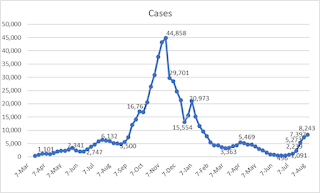
Like much of America, Wisconsin's COVIDS cases and complications continued to rise last week. Although I will note that the curve is starting to get flattened out, with new cases increasing by less than 850 compared to the prior week.

But that's little comfort to those who have already been afflicted, and we are now starting to see alarming increases in hospitalizations.

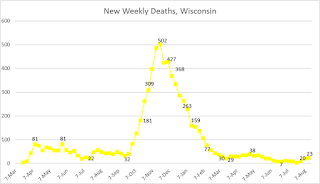
And deaths are starting to follow, with more than 20 COVID deaths in each of the last two weeks, and possibly worse for this week.

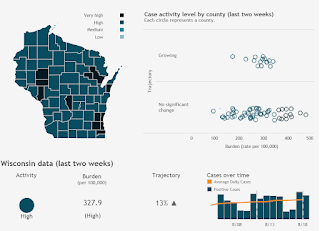
Drilling down to regions of the state, the Milwaukee area continues to have the worst of it, with Milwaukee, Ozaukee and Waukesha Counties each having a rate of more than 400 cases per 100,000 people over the last 2 weeks. But now they're being joined by outstate areas, with the Wisconsin Department of Health Services saying today that 7 counties outside of Southeast Wisconsin are seeing "very high" activity above the statewide rate.

But you also see that flattening of new cases in recent days, and perhaps people are taking the virus more seriously in these parts again. It's certainly possible that enough people smarten up, vax up and limit the damage, and we see a livable Fall and set the tone for a clear 2022.

However, vaccination rates still need to get better in most places, with barely 3/5 of adults statewide fully vaccinated at this late date, and the start of school looms in 2 weeks. There is also a real danger of this going the wrong way in the next few weeks as the bells ring and the weather cools, and I fear August will have the most deaths out of the last 3. This is why it's likely a wise decision for Dane County to mandate masks indoors, at least for the next month, even if our infection rates are lower than the rest of the state.

Because we don't want the Fall of 2020 to look like Florida or Texas or Louisiana do today....or Wisconsin in the Fall of 2020.

Tuesday, August 17, 2021

Retail sales slump in July. COVID effect? Or just shifts in spending?

Remember me saying that July’s retail sales report grew in importance after a drop in consumer sentiment last week? Yeah, about that….
Retail sales dropped 1.1% last month. Data for June was revised up to show retail sales increasing 0.7% instead of rising 0.6% as previously reported. Retail sales are 17.2% above their pre-pandemic level.

Economists polled by Reuters had forecast retail sales slipping 0.3%. Sales increased 15.8% compared to July last year.

Receipts at auto dealerships fell 3.9% after declining 2.2% in June. Motor vehicle production has been hampered by a global shortage of semiconductors.
Ugh in general, and in particular, those July figures continue a big cutback in auto sales in recent months.

That being said, the Federal Reserve reported manufacturers of autos and other goods cranked back up in July, so perhaps some of the bottleneck will be alleviated in the near future.
In July, manufacturing output increased 1.4 percent; excluding the large gain in motor vehicles and parts, manufacturing output moved up 0.7 percent. The index for overall manufacturing in July was 0.8 percent above its pre-pandemic level. Production of durable goods rose 2.4 percent in July. In addition to the increase for motor vehicles and parts, gains of 1.5 percent or more were recorded by machinery; electrical equipment, appliances, and components; aerospace and miscellaneous transportation equipment; and miscellaneous manufacturing. The output of nondurable goods rose 0.3 percent; the largest increases were recorded by textile and product mills and by plastics and rubber products. The output of other manufacturing (publishing and logging) increased 0.2 percent. The index for mining advanced 1.2 percent, about the same pace it has averaged over the past 12 months. The index for utilities fell 2.1 percent in July, as an unusually hot June gave way to a July with temperatures somewhat below normal.
But do consumers still need or want those goods? The retail sales report indicates that they were still cycling away from industries that did well in the COVID World, and spent more money on entertainment and other “going out” places, before this next wave of infections started to hit full force.
Sales at building material stores decreased 1.2%. Receipts at sporting goods, hobby, musical instrument and book stores declined 1.9%.

But consumers increased spending at restaurants and bars, leading to a 1.7% rise in receipts. Sales at restaurants and bars increased 38.4% compared to July 2020. Restaurants and bars are the only services category in the retail sales report.
And that continues the unwinding of disruptions that we saw when COVID first broke out in early 2020. The types of businesses that boomed through April have given back some of their gains, while spending at bars and restaurants keeps climbing.

I said I wasn’t going to worry about COVID breakouts and GOP-planted inflation concerns leading to any type of economic slowdown until we saw evidence of slowing consumer behavior. Now this bad retail sales report comes along, so we need to keep our guard up to see if other bad signs start appearing, especially with August’s COVID numbers being much worse across the country.

And I think we need to recognize that just because we had a Biden Boom in the first half of 2021, its sustainability isn’t quite guaranteed – especially as long as some COVID-iots refuse to join the Silent Majority of us who did our parts to fight this scourge. So we need to keep building and giving stability to the many who have yet to fully recover from the economic damage that they took on in 2020.

GOPs may want to cry crocodile tears about inflation and the US budget deficit in an attempt to stop those supports from coming with the infrastructure and social services bills in Congress. But that’s because GOPs want austerity to be imposed to help their chances of winning in 2022, and this slip in retail sales should remind us that just because our economy has grown for most of the last 16 months, it doesn’t mean that we are fully recovered.

And as we’ve seen in the last month, what hit the economy in 2020 is still a threat in 2021. Individuals and policymakers need to keep attacking until that viral threat is beaten down again.

Monday, August 16, 2021

With jobs and wages booming, GOPs are scaring consumers by talking up inflation

Jobs are bouncing back in big numbers, and demand is so strong that many service industries can’t find enough people to replace those who were laid off in 2020. So the result is that consumer sentiment in America…. is tanking in August?

The University of Michigan’s gauge of consumer sentiment plunged to a preliminary August reading of 70.2 from a final July reading of 81.2. Economists polled by the Wall Street Journal had expected an August reading of 81.3.

It is the lowest sentiment reading since December 2011, below any level in the beginning of the pandemic last year…..

The decline was due to consumers sensing that the delta variant of the coronavirus means that the pandemic will not end soon. This caused an emotional reaction and generated negative assessments about the economy’s likely performance.

The economy had been humming along and the Fed was preparing to exit its ultra-easy policy stance. If consumers stop spending and avoid crowds, the outlook could darken quickly. Price gains seen this year are unlikely to unwind quickly, and this could result in stagflation – higher prices and a slumping economy.
I don’t think stagflation is happening in a time when we’re adding 2.5 million jobs in 3 months. That’s just a boom that causing everything to go up (including pay). While you may be concerned that
the increase in average hourly wages hasn’t been keeping up with the overall increase in prices, I’d encourage you to take a step back and realize that real wages are up a solid amount compared to where we were 2 years ago.

And much of this rise and fall is related to the fact that lower-wage jobs were the ones most likely to be terminated as COVID first broke out in 2020, and wages fell as those jobs have come back (in fits and starts) since May 2020 and prices rose back to reflect the post-2020 normal. I think June or July 2021 marks a good baseline to see where things go from here, as much of the (prior) COVID overhang had mostly cleared by then.

To me, the real reason for the decline in consumer confidence seems to be two-fold:
1. Real concerns about whether the resurgence of COVID leads to more shutdowns and disruptions in the economy (and I think that would be more likely to happen through choices made by consumers on their own vs formal government lockdowns/restrictions).

2. Republicans are dishonest Pom-Pom wavers on pretty much anything (so the same situation results in positives for GOPs and negatives for Dems), while Dems are more likely to analyze the situation straight-up. That sounds like a partisan slap, but it’s backed by pretty much any poll on a variety of issues.

I’m not overly worried, other than the concern about whether COVID’s continued growth slams the brakes on consumers’ desires to go places and spend money. But the person doing that will be more likely to be a Dem that’ll take precautions than some MAGAt screeching about “FREEDUM” and not wanting to take measures to stem the tide of this virus.

Living in heavily-vaxxed Madison, I don’t see a lot of a slowdown or change in spending habits yet, but we haven’t been hammered like the South has, so maybe the cutbacks have already started (hard to go to restaurants from a hospital bed…or the grave). Which makes this week’s retail sales report a lot more important than we thought it would have been a week ago.

The consumer confidence report also tells us that we can’t afford to use a shortage-based jump in inflation as a reason for policymakers to stop helping the economy. In fact, targeted help for industries that are especially susceptible to a COVID cutback might return to the agenda, along with a long-overdue remaking of priorities in an economy that relies too much on trading paper over taking care of human needs.

Just tax the rich, and that takes care of a lot of this asset inflation that is part of the concerns that many have, which is likely leading to the shakiness that some are feeling about the economy. But don’t count on Republicans to do anything to help, and not only because they are allergic to anything that would make their oligarch puppetmasters pay another dime in taxes.

GOPs know that if the economy stalls out between now and Fall 2022, it helps their chances in the elections. Until it started killing their voters and making their pro-COVID governors in Texas and Florida look bad, they had no problem with COVID coming back and causing more economic problems. And you can bet they will blame any COVID-caused slowdown on “failed Dem policies”, even though Biden and Dems are the only ones trying to stamp down COVID flare-ups.

Thursday, August 12, 2021

No surprise, but Census shows Dane County bigger, MKE smaller, and lots of map-drawing to come

Today was the big release of Census data that'll be used to go into redistricting and allocations of resources and a lot of other stuff. I'm going to wait till I see an easier way to download the data to do more with it, but I can make some high-level observations.

First of all, Dane County reiterated itself as the leading source of growth in a state that didn't add a lot of people in the 2010s.
More than one-third of Wisconsin's population growth over the last decade occurred in Dane County, in and around Madison. The county grew by 15% to add more than 73,000 people — the highest county-level increase in the state — with the city of Verona experiencing some of the fastest growth at 32%.
In fact, Dane County was 1 of only 2 Wisconsin counties that had population growth of more than 10% between 2010 and 2020. The other was St. Croix County, which was one of several high-growth counties around the Twin Cities.

But while population boomed in Dane County, Wisconsin's largest city had a large loss of people.
Meanwhile, the state's largest city has hit its lowest population since 1930. Milwaukee's population fell to 577,222 — a drop of about 17,000 people since 2010. Milwaukee County also saw a tiny population decrease of less than a percentage point.
Conversely, those numbers mean that the Milwaukee County suburbs grew by around 9,000, and the WOW Counties also had decent growth (between 3.7% and 5.9%). The Green Bay/Appleton areas had decent growth, and as you can see above, a lot of rural counties lost out.

With Dane County accounting for more than 36% of the whole state's population growth, that means in any kind of a legitimate Legislative map, Dane should get at least one entire new Assembly district located within its borders. But this also means that City of Milwaukee's representation in the Legislature will be even smaller, and if you look at this guy's map, the biggest losses were in minority-centered districts.

I was not surprised to see Assembly Speaker Robbin' Vos and the rest of the legislative Republicans to be excited about the release of the data (gerrymandering is that guy's life work, along with money-shuffling scams). But I was surprised to see him and the rest of the Assembly GOP make a public gesture to bring the public into being part of the discussion.

Polling must be terrible for WisGOP on gerrymandering (and other things) if Vos is trying to avoid looking like the power-obsessed lowlife we all know him to be. But hey, I'll take the added interest. The Legislature's website looks like a copy of what Governor Evers' People's Maps Commission did, but hey, click on there and fill it out. They don't have the 2020 data up yet, but that'll come soon.

On the Congressional side, the biggest wildcard in Wisconsin's redistricting will come with the swingy 3rd District. Current Rep. Ron Kind isn't even going to find out what that district looks like, as he announced yesterday that he will not run for re-election in 2022, but there are serious choices to be made in what places make up WI-3.

As you can see, GOPs pitchforked the Dem-voting city of Stevens Point into Kind's district in 2011, with the idea that they'd trade a safer Dem seat for guaranteed wins in the surrounding 6th and 7th districts. Little did GOPs know that Western and Central Wisconsin would shift toward the GOP, especially in the Trump era.

Oddly, the 3rd District could stay basically the same for the 2020s, because its population is right in line with how many people should be in a district. But Mark Pocan's Madison-based District 2 has to shrink by a lot (which borders 3) and Gwen Moore's Milwaukee-based District 4 will need to take on much more area, so that'll obviously affect everyone else.

Dave's Redistricting and other sites will have the full precinct data up in the next week, and I'll draw up my modifications right after that. We need to do this on our own, because it'll help us identify just how BS any gerrymander might be, and what choices they could have made, but chose not to.

Wednesday, August 11, 2021

Pt. 1 of infrastructure is out of the Senate. Get it finalized, and go onto the bigger work

Well, we've finally got the first part of the infrastructure package out of the Senate.
A key part of President Joe Biden’s economic agenda, the agreement calls for $550 billion in new federal spending on top of about $450 billion in previously approved funds. The bill is an ambitious plan to upgrade and modernize the nation’s roads, bridges, water systems, broadband access, and electric grid, starting in 2022.

The bill calls for investing $110 billion for roads and bridges, $66 billion for rail, $55 billion for water and wastewater infrastructure, and $39 billion for public transit, in addition to billions for airports, ports, and the nation’s first network of electric vehicle charging stations.
It looks like part of the new investments will be paid for by raising fees on some types of transactions, as well as reallocating some funds in previous COVID relief programs that won’t be used up.
Lawmakers spent weeks negotiating how to pay for the bill after Biden opposed raising the gas tax or imposing electric vehicle fees and Republicans ruled out raising taxes on corporations or increasing the Internal Revenue Service’s enforcement capacity. In addition to the $28 billion expected to be raised by the new crypto reporting requirements, the bill will be paid for with about $210 billion in unspent Covid-19 aid and $53 billion in federal pandemic unemployment assistance that some states returned.
It’s a start, and according to a White House “fact sheet” that came out last week, it would give a sizable amount of extra money to help Wisconsin pay for their projects. (for the record, I think these numbers are the total amount sent to Wisconsin, not the added amount that comes from this bill).

All of that sounds pretty good to me. But it apparently wasn’t so good for Wisconsin’s senior US Senator.

That tweet really hasn't aged well, given that we were reminded today that RoJo personally put a massive giveaway put into the 2017 tax bill that gave $215 million in deductions to some of Johnson's biggest donors. Without any regard for what that was going to do to the deficit.

And in general, it's amazing to me that Republicans like Ron Johnson have justified the Tax Scam and other tax cuts by claiming they will boost the economy by so much that they will “pay for themselves” (they almost never do). Yet when actual government spending and jobs are asked for, somehow there’s no added economic effect whatsoever, and we can’t add to the deficit.

I bring this up because the Congressional Budget Office didn’t account for these extra jobs and the related revenues when it scored the infrastructure bill, and claimed it would add to the already-large US budget deficit. I mean, someone’s gotta do work on these new projects, right? There are at least going to be some people getting more money from these added services and increased financial stability, won't they?

As long as the extra government spending doesn’t raise prices or interest rates by so much that it offsets those boosts in activity by hurting other places (it hasn’t so far), why should anyone care that much? Even if the deficit will go up, the effect that this bill will have on it will be tiny – barely $25 billion a year.
“Even though the impact on the deficit will be larger than we initially anticipated, the economic impact will still be modest because that spending will take a few years to ramp up and will in any case be spread over the rest of the decade,” Michael Pearce, senior U.S. economist at Capital Economics, wrote in a note to clients on Friday.

Asked about Republican opposition to the bill based on the CBO’s report, Sen. Bill Cassidy (R, La.), one of the bill’s negotiators, told CNN Sunday that most Republicans supported former President Donald Trump’s $1.5 trillion infrastructure bill, “and only 5% of it was paid for.”
And this one is well more than 5% paid for.

So now this bill goes over to the House, and I think they should pass it quickly. I understand when Speaker Pelosi and House progressives say there must be more than just this first bill when it comes to added investments. But that can be done with the regular budget debate next month. The threat of the debt and a government shutdown is going to focus a lot of people on completing the job at that time.

The key is getting this first step of “hard” infrastructure into law, and keep our foot on the gas when it comes to the economic recovery. After that, we can get going on the hard work of deciding how to right-size our economy and reorder our priorities for the 2020s.

Circle of WisGOP scum - RoJo helps oligarchs, oligarchs help RoJo, and both spread Big Lies.

I want to thank Pro Publica for their expose on a massive giveaway to the rich that was shoved at the last-minute into the GOP Tax Scam of 2017. And you’ll never guess who is at the center of the story.

The article begins with the Tax Scam being deliberated in 2017, and reminds us how Johnson threatened to derail the whole thing, unless this one item was included.
Making the rounds on cable TV, the Wisconsin Republican became the first GOP senator to declare his opposition, spooking Senate leaders who were pushing to quickly pass the tax bill with their thin majority. “If they can pass it without me, let them,” Johnson declared.

Johnson’s demand was simple: In exchange for his vote, the bill must sweeten the tax break for a class of companies that are known as pass-throughs, since profits pass through to their owners. Johnson praised such companies as “engines of innovation.” Behind the scenes, the senator pressed top Treasury Department officials on the issue, emails and the officials’ calendars show.

Within two weeks, Johnson’s ultimatum produced results. Trump personally called the senator to beg for his support, and the bill’s authors fattened the tax cut for these businesses. Johnson flipped to a “yes” and claimed credit for the change. The bill passed.
And you’ll never guess who got some of the biggest breaks as a result of Johnson’s demands.

Dick and Liz Uihlein of packaging giant Uline, along with roofing magnate Diane Hendricks, together had contributed around $20 million to groups backing Johnson’s 2016 reelection campaign.

The expanded tax break Johnson muscled through netted them $215 million in deductions in 2018 alone, drastically reducing the income they owed taxes on. At that rate, the cut could deliver more than half a billion in tax savings for Hendricks and the Uihleins over its eight-year life.
Hold those names in your mind, and let me remind you about this bombshell report from the New Yorker’s Jane Mayer, which showed that a lot of the funding for the Big Lie is coming from right here in Wisconsin.
These disparate nonprofits have one thing in common: they have all received funding from the Lynde and Harry Bradley Foundation. Based in Milwaukee, the private, tax-exempt organization has become an extraordinary force in persuading mainstream Republicans to support radical challenges to election rules—a tactic once relegated to the far right. With an endowment of some eight hundred and fifty million dollars, the foundation funds a network of groups that have been stoking fear about election fraud, in some cases for years. Public records show that, since 2012, the foundation has spent some eighteen million dollars supporting eleven conservative groups involved in election issues.

It might seem improbable that a low-profile family foundation in Wisconsin has assumed a central role in current struggles over American democracy. But the modern conservative movement has depended on leveraging the fortunes of wealthy reactionaries. In 1903, Lynde Bradley, a high-school dropout in Milwaukee, founded what would become the Allen-Bradley company. He was soon joined by his brother Harry, and they got rich by selling electronic instruments such as rheostats. Harry, a John Birch Society founding member, started a small family foundation that initially devoted much of its giving to needy employees and to civic causes in Milwaukee. In 1985, after the brothers’ death, their heirs sold the company to the defense contractor Rockwell International, for $1.65 billion, generating an enormous windfall for the foundation. The Bradley Foundation remains small in comparison with such liberal behemoths as the Ford Foundation, but it has become singularly preoccupied with wielding national political influence. It has funded conservative projects ranging from school-choice initiatives to the controversial scholarship of Charles Murray, the co-author of the 1994 book “The Bell Curve,” which argues that Blacks are less likely than whites to join the “cognitive elite.” And, at least as far back as 2012, it has funded groups challenging voting rights in the name of fighting fraud.

Since the 2020 election, this movement has evolved into a broader and more aggressive assault on democracy. According to some surveys, a third of Americans now believe that Biden was illegitimately elected, and nearly half of Trump supporters agree that Republican legislators should overturn the results in some states that Biden won. Jonathan Rauch, of the Brookings Institution, recently told The Economist, “We need to regard what’s happening now as epistemic warfare by some Americans on other Americans.” Pillars of the conservative establishment, faced with a changing U.S. voter population that threatens their agenda, are exploiting Trump’s contempt for norms to devise ways to hold on to power. Senator Whitehouse said of the campaign, “It’s a massive covert operation run by a small group of billionaire élites. These are powerful interests with practically unlimited resources who have moved on to manipulating that most precious of American gifts—the vote.”
And over the weekend, the Intercept’s Murtaza Hussain was able to follow the money.

AN ORGANIZATION LINKED to a major hub of efforts to undermine the credibility of the 2020 U.S. presidential election was funded to the tune of millions of dollars by several right-wing donors, according to a tax document obtained by The Intercept. The group, the Bradley Impact Fund, is linked to a larger foundation that was identified in a recent report as a central player in distributing money to organizations pushing conspiracy theories about election fraud, denying the results of the 2020 election, and undertaking legal efforts to overturn the presidential vote…..

The tax document obtained by The Intercept, a publicly filed IRS form that included a list of donors, shows a handful of large corporate and individual donors to the Bradley Impact Fund. The contributions listed in the fiscal year 2018 filing range from roughly $782,000 to $1.5 million. The Bradley Impact Fund operates as a donor-advised fund, a vehicle frequently used to allow anonymous contributions by letting donors give to a fund and then directing their contributions to particular recipients.

Among the corporate donors to Bradley Impact, according to the tax document, were ABC Supply Co., whose website describes it as “the largest wholesale distributor of roofing in the United States”; the Boelter Companies, described online as “a provider of supplies, equipment, and design solutions for commercial foodservice, hospitality, and beverage industries”; and Bandon Golf Courses, which operates a number of golf courses in Oregon. Other donors include a former music industry CEO in Wisconsin, the CEO of a company that provides equipment to pipeline companies, and a number of small family foundations. (Neither Bradley Impact nor the donors listed in the tax filing responded to requests for comment from The Intercept.)
And guess who runs ABC Supply?

It's the lady on the right

As for RoJo's other Wisconsin-connected oligarch friends, we have found out that the Uihleins gave $4.3 million to one of the central groups that put on the January 6 pro-Trump event which culminated with a violent insurrection at the US Capitol.

Put it together, and realize that Ron Johnson was helping the Bradleys by spreading Big Lies after the 2020 election instead of looking into the moves that preceded the MAGATs' coup attempt, after changing a Tax Scam to give his billionaire, tax-dodging benefactors what they wanted. Nice little circle of back-scratching, isn't it?

It’s well past time that these lowlifes pay for what they have been stealing from us, both figuratively and literally.