Friday, October 16, 2020

For 2020, US has record deficit while Wisconsin ends up $1.2 trillion in the black.

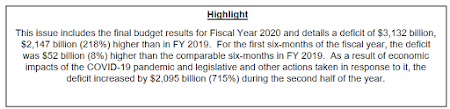
We knew 2020 was going to break the record for federal budget deficit, and today the Treasury Department gave us the final numbers.
$3.13 trillion it is. As alluded to by the Treasury, most of that came from extra spending due to CARES, although revenues did drop a bit as well.

US budget, 2020 vs 2019

Revenues
2019 $3.462 trillion
2020 $3.420 trillion (-$0.024 trillion)

Expenditures
2019 $4.445 trillion
2020 $6.552 trillion (+$2.107 trillion)

And half of that $2.1 trillion expenditure jump comes from aid that went out through the Treasury (including the $1,200/$2,400 stimulus checks and bailouts to various businesses), and from the expanded unemployment benefits that went out to tens of millions of Americans. The temporary increase in relief to student loans also was sizable, outpacing the increase in Social Security payments.
Also notice that decline in interest on the debt. That's despite a major increase of $4.2 trillion in outstanding Treasury debt, which illustrates the effect of the Federal Reserve cutting rates to near-zero.

A lot of those extra Federal expenses were funneled down to states through CARES and other programs, to help them pay for the extra services caused by the unprecedented loss of jobs and economic activity that came with the original breakout of COVID-19. And Wisconsin ended up getting by their 2020 Fiscal Year just fine as a result.

Ironically, the state's year-end budget numbers also came out this week, (in the form of the Annual Fiscal Report), and the numbers were far better than many of us imagined 6 months ago.
The General Fund has an undesignated balance of $1.172 billion as of the end of the fiscal year. General purpose revenue taxeswere $17.532 billion compared to $17.341 billion in the prior year, an increase of $191 million or 1.1 percent. General purpose revenue expenditures, excluding fund transfers, were $17.327 billion. This is $502 million less than the budgeted expenditure allocation of $17.829 billion.
We knew about the revenue numbers before, and those barely below-estimate numbers reflect the fact that unemployment benefits are taxed in Wisconisn (as well as at the federal level), so the loss in revenue on the income tax side wasn't nearly as bad as first feared.

In addition, even though many more Wisconsinites were in need of assistance, expenditures didn't spike because the Feds were taking up more of the costs of services such as Medicaid (which I explained in this post earlier in the week).

So for now, Wisconsin's General Fund budget is in decent shape, as that $1.172 billion is only $89 mil below what was projected by the Legislative Fiscal Bureau 3 weeks ago. And that projection had over $779 million left over at the end of the 2021 Fiscal Year, so even with the decline in 2020, there's still $690 million of cushion.

But 2021 still has danger looming. If the Feds stop paying for those extra expenses and jobs remain far below where they were at the start of 2020, you could see that cushion go away quickly. But for now, there's no reason for Gov Evers to pre-emptively put in additional budget cuts, and we may as well see what develops in DC and the overall economy in the next few months before we take any additional steps in regards to the Wisconsin state budget.

Thursday, October 15, 2020

Unemployment claims stay high, and high COVID and lower temps will keep them up

Today's new report on unemployment claims in America was alarming, both in the main headline and in the deeper stats below them. We are clearly hitting a wall as the weather turns colder and COVID-19 continues to be an anchor on everyday life.

First, the topline numbers.
The number of people filing for unemployment benefits increased last week to 898,000, a worrying sign that the job market's recovery from the pandemic-induced recession is slowing. The figure, released Thursday by the Labor Department, is an increase of 53,000 from the previous week, and is the highest level since mid-August. Claims have stagnated between 800,000 and 900,000 for the past seven weeks after falling from a peak of nearly 7 million in March. The levels are historically high – the pre-pandemic record for weekly claims sat just shy of 700,000. An additional 373,000 people applied for jobless aid through the Pandemic Unemployment Assistance program, which was created by Congress earlier this year to help workers who would not otherwise qualify for unemployment.
So 1.25 million new claims a week continue to be filed, but the news report does say there is some good news with unemployment claims.
There are encouraging signs that employers are hiring and rehiring workers, however. The number of people receiving unemployment benefits on a continuous basis fell notably during the week ending Oct. 3, down to roughly 10 million from nearly 11.2 million the week prior.
But even that positive number is misleading. If you dig down into the numbers in the actual DOL report, you'll see that the drop in continuing unemployment claims is actually a transfer of what unemployment program these people are in.

Because when people have their 26 weeks on the regular unemployment program run out, they move to the extended claims program. In the last week of September (the last week where both programs have reported numbers), regular claims went down by 800,000, but extended claims went up by that same 800,000. This type of offset has become the pattern since the start of September, which (not coincidentally) was 6 months after COVID lockdowns started to hit throughout America.
Also noteworthy with continuing unemployment claims is that the previous week of September 26 was revised up by 207,000, so it makes me wonder if there are claims getting backlogged again, which masks just how bad things are.

Even with the information we currently are going on, there are a lot of people out of work in America. As September ended, we were going on 23 straight weeks of at least 25 million continuing claims.

And now that the weather is getting colder at the same time that Wisconsin has become the COVID Capital of the Country, we’re seeing a still-depressed restaurant industry get into an even worse situation. Isthmus had a saddening piece which described the looming demise of one Madison brewpub, along with other places in town.
Nate Warnke of Madison’s Rockhound Brewing Company announced this morning that he will be closing “his little dream.”

Warnke, a former business analyst, says in a composed but emotional Facebook message that if he were one of his own former clients, he would have to advise that it was time for this project to end. “I can see no logical path forward.”

Rockhound joins other Madison businesses that have decided it was impossible to continue in the face of COVID-19, among them The Tin Fox, Hungry Badger, Common Ground, Vientiane Palace, Captain Bill’s, Manna Cafe and Bakery, Doolittle’s Woodfire Grill, Graft, and the Good Food Low-Carb Cafe.

“[The] COVID downturn is the main reason. The numbers just don’t make sense and it would be too difficult to reconcile long-term,” says Warnke in an email to Isthmus.
WisGOPs can try to blame recent restrictions on capacity that Gov Evers put on, but the real culprit is the virus itself, which has made a lot of people unwilling to eat in an enclosed building around strangers. And a whole lot of others that might risk it are already sick, and in no condition to go out.

Wisconsin saw its number of new claims jump by more than 2,900 in the most recent unemployment report, and had extended claims jump by 10,000. And if these restaurant stories from Madison are any indication of what's coming statewide, it won't take long before those closings ripple over into more parts of the state's larger economy. Which would put another headwind onto a jobs market that already seemed to be plateauing in September both in Wisconsin, and in America.
Wednesday, October 14, 2020

Even with more on the rolls, Fed help means Wisconsin will be ahead on Medicaid for 2020

One of the items to track in Wisconsin’s COVID World is how many more people have been added to the state’s Medicaid rolls as jobs have been lost and wages cut. And since COVID started breaking out in March, the number of people receiving Medicaid has grown by at least 18,000 in every month.
You’d think that this would lead to a significant dent in the state’s available dollars, given that we weren’t planning on an increase of 150,000 Medicaid enrollees for 2020 when the Wisconsin budget became law in July 2019. But in fact, the Wisconsin Department of Health Services recently said we are on track to have a surplus in Medicaid of $289 million for this budget.
This projected surplus is higher than what was reported in our June letter primarily due to two factors. First, this projection assumes that enhanced federal Medicaid funding will be available for four calendar quarters from January through December 2020; the June projection assumed only three quarters of enhanced funding. In March, Congress enacted the federal Families First Coronavirus Response Act (FFCRA), which increased the Federal Medical Assistance Percentage (FMAP) by 6.2 percentage points for Medicaid benefits in the calendar quarters in which the federal COVID-19 public health emergency is in effect. Since our last report, U.S. Department of Health and Human Services Secretary Alex Azar extended the COVID-19 public health emergency for an additional 90 days, until October 23, 2020 (and extended again into January 2021 since this report). The extension is expected to generate an additional $120 million in GPR savings for the biennium compared to the June projection.

Second, this projection reflects additional months of Medicaid enrollment data and updated enrollment estimates for the remainder of the fiscal year. Medicaid enrollment has increased due to the economic downturn brought on by COVID-19 and the continuous enrollment requirements under FFCRA. As a condition of receiving enhanced FMAP funds, FFCRA bars states from disenrolling individuals or imposing stricter eligibility or premium requirements during the public health emergency. Full benefit Medicaid enrollment has increased by approximately 128,000 individuals from January to August 2020. While substantial, this increase is smaller than assumed in our June letter. We project that enrollment will continue to grow by an additional 53,500 full benefit enrollees by June 2021. These enrollment projections are consistent with assumptions used for the Department’s 2021-23 biennial budget request submitted on September 15, 2020.
But what has given the state this sizable surplus in Medicaid is because of added funding from DC taking up more of the bill. If that is allowed to go away, and if there is no stimulus bill that makes up the difference starting in January 2021, then state taxpayers will be on the hook for a lot more. Especially if COVID World continues, and the economy drops back into a second wave of recession.

If you go into the Department of Health Services’ budget request (as noted in pages 323 to 326 of the PDF), they estimate that state tax dollars for Medicaid will increase by $1.145 billion over the next 2-year budget if there is no extra help coming from DC, and if the State Legislature won’t sign onto the ACA’s Medicaid expansion (which DHS says would save more than $588 million in state tax dollars). Combined with the possibility that revenues will be limited if the economy stays slow, and you can see where 2021-23’s Medicaid budget can be a very troubling situation for Wisconsin if Congress refuses to step up to help states.

But the good budgetary news for Wisconsin is that because a pre-election DC has been willing to shell out additional help in 2020, it does seem like we’ll be OK between now and late June, even with the large increase in people on Medicaid. Therefore, we may not need to make any more adjustments to the state budget and services over the next 8 1/2 months, which is something I would not have counted on a couple of months ago.

Tuesday, October 13, 2020

This week in Wisconsin COVID - still getting worse. And dumber

As we reach the middle of October, with temps set to drop into the 30s (and 20s up North), there is a whole lot of bad in the most recent week of COVID-19 numbers in Wisconsin. These charts show the statewide picture through Saturday, which showed that the number of new cases, deaths and rates of positive tests were still near record highs.
And hospitalizations around the state continued to jump last week.
Then today's news was even worse. Meanwhile, note the (indoor) scene as one of Donald Trump's kids visited Waukesha County yesterday. And what is a major GOP ally choosing to do today? I'd say boycott Tavern League members, but I'm not going inside to any bars these days anyway. Because of COVID-19 concerns. And I'm not going in there until things get a lot better in this state.

You wonder why things continue to get worse here? You wonder why????

Senate GOP gets it backward - chooses SCOTUS over stimulus

Despite it being only 3 weeks before the November election, and despite over 25 million Americans receiving unemployment benefits as job growth continues to slow down, it still seems likely that there will be another week with no stimulus coming from DC.
House Majority Leader Steny Hoyer, a Maryland Democrat, sent out a notice to lawmakers Monday saying “that due to the Trump Administration’s failure to reach an agreement on coronavirus relief, no votes are expected in the House this week.” The House is not in session this week and most members are away from Washington. But they remain on 24-hour standby, though, should an agreement be reached.

Trump’s changes in direction last week -- first calling off talks in a tweet, then saying he wanted a bigger package than even Democrats have proposed -- may have hardened Pelosi’s resolve to hold firm. On Sunday she called the White House offer a “miserable and deadly failure."
And even if Trump and Pelosi reach an agreement, and the House of Representatives passes that deal, the GOP-run Senate seems likely to keep it from going through.
One of the people said Mnuchin’s offer to Pelosi wouldn’t have enough Republican votes to pass the Senate without major changes.

Some senators said that the spending levels being discussed were unacceptable and that ballooning the deficit will damage their standing with voters. Others said that a deal of that size would hand Pelosi and the Democrats a major victory right before the election, said the person, who spoke on condition of anonymity.

There also were objections to some of the policies, including expanding eligibility for the Affordable Care Act, which Republicans have been trying to dismantle, and aid to state governments.
C'mon guys, can't we crank out more of these things?

The stupidity of the Senate GOP amazes me, as not only is shoving through a Supreme Court justice before the election unpopular and making them more likely to lose, but NOT acting on stimulus also increases voter anger against the Senate GOP.

Apparently the Senate GOP has seen the polls move even more against them for these screwed-up priorities. Because on the same day that their Supreme Court Justice dodged, evaded and generally annoyed 2/3 of the country iin the Judiciary Committee, Moscow Mitch says the Senate GOP will now try another "mini-stimulus" vote.
Senate Majority Leader Mitch McConnell said Tuesday that he's scheduling a procedural vote on a GOP COVID-19 relief bill next week, pushing aid to hard-hit businesses in a smaller-bore approach to virus relief that Democrats say they won't go for. The Kentucky Republican says the first item of Senate business when the chamber returns next Monday will be a procedural vote on a scaled-back aid bill. Democrats filibustered a GOP-drafted aid bill last month and recent talks on a larger deal between Treasury Secretary Steven Mnuchin and House Speaker Nancy Pelosi, D-Calif., fell apart this past weekend, probably for good.
Basically this is a re-vote on a bill that failed to receive 60 votes and got shot down a month ago. Then Ruth Bader Ginsburg died a week later, and Mitch and the rest of the Senate GOP forgot about stimulus until this week.

To review, here's what was in that smaller Senate GOP bill.
The bill carried a price tag of roughly $500 billion and would have provided an additional $300 per week in expanded unemployment insurance benefits for out-of-work Americans. Congress established a benefit providing an additional $600 per week as part of the CARES Act which passed in March, but that provision expired at the end of July. McConnell's bill also included an additional $257 billion for the Paycheck Protection Program, which has provided hundreds of billions of dollars in loans to small businesses, liability protections and $105 billion for schools. Liability protection in particular has been a priority for McConnell.
Yes, because what this COVID-wrecked economy needs is liability protection for companies that rush people back to the job (slams head on desk).

But honestly, if I was Chuck Schumer, I'd allow enough Dems to let that mini-stimulus get to the full Senate (which is where you need 60 votes under stupid Senate rules) and then it can pass on a majority vote after that. In fact, why not use the stimulus vote to add amendment upon amendment to improve the package, which delays any votes for SCOTUS by doing so (while making the GOP look all the lamer and power-hungry).

Pelosi doesn't have to pass it anyway, especially when President Trump is desperately tweeting that Congress should "GO BIG OR GO HOME" on stimulus. This would make the Senate GOP would actually be opposing the President whose deplorable voters are needed for the many GOP Senators that are in serious electoral trouble. Pelosi could just change the bill to what just passed, and send it right back to Moscow Mitch and the rest of the Senate. Except it would be even closer to the election.

Hey, if GOPs still want to care more about rigging justice and going light on stimulus in a time when so many people need and demand more, please proceed guys. It'll help Dems win bigger on November 3, and be able to pass whatever level of stimulus they want, which hopefully will be at a level sufficient enough to keep us from falling back into a deep recession during what is shaping up to be a long COVID Winter.

Monday, October 12, 2020

Foxconn officially fails. And we can't let it be forgotten

You figured this might have been coming, but it was still a surprise to see the headlines today about the absurd boondoggle in the SE Corner of Wisconsin.
In a letter sent Monday to the Taiwan-based company's Vice Chairman Jay Lee, Wisconsin Economic Development Corp. Secretary Melissa Hughes said "Foxconn’s activities and investments in Wisconsin to date are not eligible for credit" under the more than $3 billion contract first signed back in 2017. The letter also underscores that negotiation attempts between the state and company this summer failed to result in a new contract.

"As we have discussed numerous times, markets, opportunities and business plans can and often need to change," Hughes said in the letter to Lee, which was obtained by the Wisconsin State Journal through a records request. "I have expressed to you my commitment to help negotiate fair terms to support Foxconn’s new and substantially changed vision for the project."

In other words, Scott Walker's 2017 scheme to give a foreign company unprecedented incentives isn't going to be anything close to what Foxconn, Scotty and President Trump claimed would happen.
Now that a non-grifting administration is in charge of WEDC, they are holding Foxconn accountable for not delivering on the jobs or products they claimed they would. And I have little doubt that if Walker were governor today, he'd be covering up this fact and still trying to sell to rubes that "Foxconn will be a great investment."

Josh Dzieza of The Verge has been all over the Fox-con for several years, and here is his excellent summary about how Foxconn fell far short of what was promised, and why the state isn’t going to pay them for the handful of jobs they did add in Racine County.
Though the state has spent money on infrastructure and other expenses related to the project, this would have been the first installment of the nearly $3 billion in refundable tax credits that made up the bulk of former Gov. Scott Walker’s record-breaking subsidy package. The credits, likely to be made in the form of direct payments to Foxconn, were to be released each year after Foxconn met certain employment targets. In 2018, Foxconn needed to hire at least 260 eligible employees, and Foxconn fell so far short of that goal it didn’t apply for subsidies.

In 2019, Foxconn needed to hire at least 520 people, and the company’s submission to WEDC showed 550 employees at the end of the year. But WEDC estimates that only 281 of these employees would likely be eligible under the terms of the contract. WEDC’s response notes that this is an initial estimate and that a full verification was unnecessary given the project itself was not eligible under the contract. It did not say why the other employees Foxconn submitted were ineligible, however, a large number of them were hired in the final weeks of the year, and Foxconn would have had to pay them in 2019 for them to be eligible. Employees could also be ruled ineligible if they made less than $30,000 per year or were not based in Wisconsin.
Do you think a Scott Walker-run WEDC would have checked up on Foxconn's claims? HELL NO! They would have handed out tens of millions of taxpayer dollars just so they could continue to say "See, Foxconn is working out!"

Dzieza also mentions that not only is Foxconn's Wisconsin plant not making the large screens that they claimed they would, it isn't making much of anything at all.
But the larger problem is that those employees weren’t working on the project described in the contract. The instructions WEDC included for Foxconn’s subsidy application repeatedly refer to the definition of the project in the original contract: a larger Gen 10.5 factory. Furthermore, as part of the third-party audit conducted by Deloitte for the subsidy process, WEDC included a survey of employees asking what projects they were working on. (Documents show Foxconn initially objected to this question but later acquiesced when the language was changed.) Answers included working on the globe Foxconn is building, developing office software, and making circuit boards, but none, unsurprisingly, mention a Gen 10.5 LCD factory.

“The Recipients are ineligible for tax credits because of their failure to carry out the Project,” WEDC wrote in its letter to Foxconn, quoting the passage defining the project as a Gen 10.5 in the original contract. “The fact that the Recipients have neither built, nor started to build or operate, the required Generation 10.5 TFT-LCD Fabrication Facility (the “10.5 Fab”) is not in dispute. The Recipients have acknowledged that they have no formal or informal business plans to build a 10.5 Fab within the Zone, and WEDC and the State of Wisconsin have corroborated that fact from observation, evaluations, and from industry experts hired to provide consulting services.”

The issue of factory type is more than a technicality. The state’s economic impact analysis was predicated on an enormous factory rapidly scaling up to employing 13,000 people and tapping into local supply chains. This hasn’t happened. In Foxconn’s original WEDC application, the company said it would invest $3.3 billion by the end of 2019. Its 2019 subsidy application shows it has invested only $280 million. (For unclear reasons, WEDC’s estimate in its response shows approximately $300 million, but either way, it is less than 10 percent of Foxconn’s target.)
A few hundred jobs and maybe $300 million in new buildings and equipment? Not really what these guys were selling 3 years ago, was it?
By the way, Hughes and WEDC are actually trying to give Foxconn a break - offering to redo the contract in a way that allows Foxconn to be treated as any other WEDC jobs incentive package. But even with the jobs and capital investment credits going away, don't forget that Foxconn still was given hundreds of millions of taxpayer dollars in road upgrades, electrical grids, water, and other infrastruture. All for a project that isn't going to yield a fraction of the jobs that a typical Amazon warehouse will.

What a pathetic waste. And even though most Wisconsinites have already accepted that Foxconn is at best a disappointment (if not outright higheway robbery), I would love to see Wisconsin politicians hammer on every Republican that signed off on this scam for the next 3 weeks. We can't forget that the GOPs were more than willing to flush billions of taxpayer dollars and change our environmental laws in exchange for Foxconn's photo ops and cheap headlines.

And while we're at it, maybe someone could ask the President about Foxconn's failure when he comes to Janesville next weekend for a COVID rally The dimwit probably doesn't even know how dead this thing is, and would anger a whole lot of Wisconsinites as he tries to sell something that most of the state stopped buying into a long time ago.

Sunday, October 11, 2020

Weekend reading : WisGOP's white supremacist strategy

Wanted to direct you to this excellent article in the New Republic from Wisconsin native Emma Roller. The title says it all: "How Wisconsin Became a Bastion of White Supremacy."

Roller goes through a list of items that illustrate the economic and social apartheid that is part of the way things have been run in this state, and how central that is to the messaging and political strategy of Wisconsin Republicans.
Milwaukee is the most segregated metro area in the country, according to a 2018 Brookings study. Wisconsin locks up Black men at a higher rate than any other state, according to a 2013 University of Wisconsin-Milwaukee study, which found that 13 percent of Black men of working age in Wisconsin are in jail or prison, compared to the 6.7 percent national average.

Evictions also fall disproportionately on Black tenants in Wisconsin. In his 2016 book Evicted: Poverty and Profit in the American City, Matthew Desmond found that more than one in eight Milwaukee renters were forced to move involuntarily, either through eviction, landlord foreclosure, or building condemnations, over the course of three years. And as in many American cities, race and class follow similar fault lines. Fully 79 percent of Black families in Milwaukee County are poor or low-income, compared to 39 percent of white families in the county, according to a 2018 UW-Madison report.

You cannot understand what Trump support looks like in Wisconsin without understanding how much white Republican grandpas here love AM talk radio. For the past 30 years, two names have dominated Wisconsin’s conservative talk radio market: Mark Belling and Charlie Sykes. Since 2016, Belling has doubled down on his role as the Badger State’s own Rush Limbaugh, taking to Trumpism like a muskie to lake water. Sykes is a more interesting case. He’s probably most famous for airing racist grievances about welfare queens living large off of whites’ hard-earned tax dollars. In 2013, Sykes published a book called A Nation of Moochers, arguing that “those who plan and behave sensibly are being asked to bail out the profligate.” Two years later, Sykes rebranded himself as a #NeverTrump Republican, and he has spent the past five years expressing shock and disgust at the GOP’s racism.
You built that, Chuckie. And we will never forget.
Roller notes that this mentality culminated in the election of a governor who promised his donors that he would "divide and conquer" the state, with his fellow Republicans also working to grab power by any means they could. This enables WisGOP to hold on to power long after the majority of the state has rejected their racist, regressive plans.
Walker has an unearned reputation for being placid and even boring, mostly because of his love of sad-looking ham sandwiches. But that characterization obscures the damage Walker inflicted during his time as governor. Wisconsin became a Koch-sponsored laboratory of the same regressive, anti-democratic policies that we’re seeing enacted all over the country during the Trump era. Walker shattered public employee unions, rolled back environmental protections, and gutted funding for public education. This agenda, wrapped in the language of white resentment, played well in the “WOW” counties—Washington, Ozaukee, and Waukesha—a trio of white-flight suburbs and exurbs that neighbor Milwaukee County and have historically acted as the engine of the state’s white grievance politics. But his most harmful work was passing the voter ID law and district maps meant to dilute the voting power of people of color....

2010 was the year that the Tea Party’s Ron Johnson ousted Feingold, a left reformist champion. As ill luck would have it, 2010 was also a census year, meaning that Walker and Republican lawmakers were able to draw one of the most absurdly gerrymandered [state legislative] maps in the country. “Wisconsin’s maps are so gerrymandered that Republicans can win close to a supermajority of House seats even with a minority of the vote,” the Brennan Center for Justice’s Michael Li wrote in April.

Ten years after the Tea Party wave, Wisconsin Republicans aren’t even trying to hide their agenda. After the 2018 midterm elections, state Assembly Leader Robin Vos all but lamented the fact that people who live in cities are allowed to vote. ​“If you took Madison and Milwaukee out of the state election formula, we would have a clear majority,” Vos said. The midterms saw the election of a Democratic U.S. senator and the end of Walker’s reign, but gerrymandering was key to the GOP’s ability to hold on to the state Assembly and its seats in the House.
And this gerrymandering and racist strategy goes a long way toward explaining the recent absurdity and (in)activity at the Capitol. While Wisconsin was becoming the COVID Capital of America, with 175 people dying in the last 2 weeks, take a look at what the WisGOPs thought was important . But of course, they're trying to block any moves that Evers might make that would deal with COVID, while not having any bills or ideas themselves beyond "complain about the Governor."

And WisGOPs definitely didn't want to talk about the plot that white gun nuts had to kidnap the Governor of Michigan, or how those guys trained in Wisconsin. But here is what they want to talk about. All 4 of those sponsors of the ALEC-written "riot law" are from the WOW counties, and that is not coincidental. These lowlifes feel that a racially-tinged non-issue is winning politics over actually discussing things that matter. It's mostly worked for them so far, and they won't stop trying to maintain Wisconsin's apartheid going until they pay such a price at the polls that not even their gerrymander can save them.

Why is why we have to MAKE IT SO in this Fall's elections. WisGOPs don't want this state to progress into a diverse, intelligent place with a high quality of life, because they feel it doesn't help them win elections. So if you want that, you have to do your part to give them the boot.