Saturday, July 10, 2021

A two-track Wisconsin continues to show up in COVID vaccinations

With news of certain parts of (unvaccinated) America seeing a resurgence of COVID-19 infections, I wanted to check back on Wisconsin's situation with the virus. And we now have new layers of data to dig into, as the Wisconsin Department of Health Services announced new data tools this week.
Today the Wisconsin Department of Health Services (DHS) released maps and corresponding downloadable data tables that break down COVID-19 vaccinations by new geographic boundaries. The new maps allow Wisconsinites to view existing COVID-19 vaccination data by municipalities (cities, towns, and villages), zip code tabulation areas, school district boundaries, and census tracts.

“Breaking down existing vaccination data by these additional geographies offers new ways for people to understand COVID-19 activity within their communities and will allow us to determine where we need to focus our ongoing vaccination outreach efforts,” said DHS Secretary-designee Karen Timberlake. “Providing timely, transparent COVID-19 information to local and tribal health officials and the public has been a top priority throughout the pandemic, and these updates continue that commitment.”

DHS also recently released an additional filter option for the COVID-19 Vaccines for Wisconsin Residents dashboard. Users can now select to view vaccination data for just the adult population ages 18 and older.
And the Census tract table of who has taken the shot tells a lot.

If you go further into the SE quadrant of Wisconsin, and if you know which groups live in which parts of town, you can see the divide in vaccination ragtes across racial and economic lines.

Sure tells you where vaccination outreach efforts might be needed, and in which communities you might feel safer in spending your money when visiting, eh?

I also wanted to check back on a few counties I looked at a couple of months ago, starting with the places that were the best 3 counties for getting its population vaccinated at that time. Since then, Dane County has established itself as the clear leader in getting its people vaccinated, Door County is doing well, and Bayfield County is starting to lag a bit.

And I also looked at 8 counties that have similar rates of people with at least 1 vaccination, but have very different rates of vaccinations among ages. First off, those 8 counties are still similar on the toplines.

Now go across the age range, and note how the 4 counties up North lag in vaccinations among kids under 18, and then how Ashland jumps up among adults (especially adults 35+). It's also worth noting how Ozaukee and to a lesser extent Waukesha act more like the blue-voting counties than the 3 red(neck) counties below that group. And that La Crosse's figures are even better than they seem, because the numbers are held down because of lagging rates among their large college-age population (well, they haven't gotten their shots in La Crosse County anyway).

I headed up to see family at a family place in Vilas County for a couple of days this week, but I mostly stayed at the cabin with my vaxxed folks. But I noticed the large amount of Help Wanted signs and drove through Minocqua on a rainy Wednesday as I headed back, and saw the large crowds that took advantage of a Holiday week to go to the Northwoods as a non-flying destination. Given the lack of vaccinations among the adult populace there, I think we should check back in a couple of weeks to see if our 7-day COVID infection rate remains under 100, or if we start to see some regional resurgence of our own after a long 4th of July weekend.

While we're well past the herd immunity levels here in Dane County, that isn't true for a lot of parts of Wisconsin. We don't have this thing entirely licked yet, so please play it smart, and if you know of non-vaxxed people, get them off that status as fast as you can. And keep it outside as much as you can.

Thursday, July 8, 2021

And the budget is official. But it isn't the end

To no surprise, Governor Evers signed the GOP-designed budget today.
Evers used his partial veto powers to eliminate or modify 50 provisions in the spending plan, but left intact $2 billion in income tax cuts proposed by Republicans, achieved by bringing the state's third income tax bracket — which applies to individuals making between $23,930 and $263,480 per year — down from 6.27% to 5.3%.

The budget — modified significantly from what the governor initially proposed in February — passed the Legislature with support from all Republican lawmakers and seven Democrats.
As I mentioned last week, Evers wasn’t going to veto the entire document, as that would have given the WisGOPs the excuse they needed to deny $2.3 billion in stimulus funds for K-12 schools. The real question was whether Evers would let the largely-regressive income tax cuts stand, and he decided it was OK to sign that and use vetoes to save other funds for later (which I’ll get to in a minute).

Even though the Wisconsin Supreme Court has said Evers couldn’t use his vetoes to rewrite the budget in a way that adds more money to schools, Evers said he would take steps to help out K-12 districts in another way – using even more federal stimulus funds.

I’m not sure if this $100 million will be sent out through some kind of formula distribution that everyone gets, or if it’ll be based on specific situations such as high levels of poverty or districts that didn’t get much from either the stimulus and in the GOP-designed budget.

Where Evers did use his veto pen was in knocking down certain GOP provisions that would have diverted a sizable amount of the available funds into the state’s Rainy Day Fund. He explained his reasoning as follows.
…I object to making these funds unavailable for supporting the needs of Wisconsinites that the Legislature failed to address. The balance of the budget stabilization fund is reserved for periods of below-normal economic activity when actual state revenues are lower than estimated revenues. This transfer removes $550,000,000 from dollars that can be immediately applied to investments in our kids, small businesses, and our state's continued economic recovery. Instead, this funding should remain in the general fund where it can be directly appropriated to address gaps and shortfalls in the Legislature's budget actions. I request the Legislature work with me to instead invest these funds to address the immediate needs of Wisconsinites.
Tamarine Cornelius of the Wisconsin Budget Project noted that the state's Rainy Day Fund is already over $1.6 billion, and that Evers' move allows for the chance for the funds to be used in the next two years.

If the state's revenues stay strong, this allows Evers to call the Legislature back into session in a few months to fund schools or pay for other needs with this extra money. And then hammer on WisGOPs if/when they fail to do so.

While Evers allowed for the income taxes to be cut, Wisconsinites will only see that reflected in the form of higher refunds in the Spring instead of seeing lower refunds and a higher amount being taken home in their 2022 paychecks.
I am vetoing this section because I object to requiring the Department of Revenue to make these withholding table adjustments at a cost of approximately $700 million while other critical priorities have not been sufficiently funded by the Legislature. This veto does not increase anyone's tax liability compared to what the Legislature passed. The reduction in the rate of the third individual income tax bracket from 6.27 percent to 5.30 percent starting in tax year 2021 will still occur, and taxpayers will receive approximately $2 billion in individual income tax relief from that reduction in this biennium. The secretary of the Department Revenue has the ability under current law to make these adjustments as appropriate and will assess whether and when these updates should be made within the full context of revenue collection trends and other state priorities.
Not only does this allow Evers’ Department of Revenue to decide if/when the withholding tables get changed (maybe closer to the election?), but it adds to the $550 million removed from the Rainy Day Fund to allow for a total of $1.25 billion to play with and/or cushion for additional needs.

Evers also vetoed an item that would have sent more money from general taxes and into the Transportation Fund long-term.
I am partially vetoing this provision to eliminate the increase in the transfer after fiscal year 2022-23 because I object to increasing the general fund's subsidy to the transportation fund on an ongoing basis. As a result of my veto, the transfer will revert to the current law amount of 0.25 percent of general fund taxes for fiscal year 2023-24 and beyond. I have made it a priority to ensure that we have a sustainable, dedicated source of transportation funding to ensure we can repair our roads and fund public transit while also investing in our schools and communities. While enhanced transfers to the transportation fund for the 2021-23 biennium are reasonable given the impact of the coronavirus pandemic on motor fuel tax collections, these increases should be temporary rather than permanent.
The current budget will still get $276.2 million in General Fund money on a one-time basis in this budget, but Evers’ move will bring it back down toward $50 million a year going forward.

In other budget-related news, Evers used today’s event to say that a separate item used for another GOP tax cut for businesses is going to be shot down.
In addition to the income tax cut, Evers kept a measure that will reduce property taxes by about $647 million — but he said he will veto separate legislation passed by Republicans that would eliminate the state's personal property tax, which applies to business equipment. Evers and other Democrats have said the legislation was too rushed.
Well, when WisGOPs farm out policy to WMC, sometimes details get missed. Let’s see if WisGOP tries to actually get this one right, or uses it as a reason to whine over the next 16 months that Evers isn’t giving everything away to their donors.

Given the nature of the gerrymandered Legislature, you knew that Evers could only get so much through for 2021-23, but today’s moves also give a lot of room for later maneuvering, or at least something to run on. Because it seems to be a pretty easy sell to say “we’re able to pay for all these things we want, and level the playing field in the process, if you vote for Democrats to run things in Wisconsin.” And with the extra state funds lying around, Evers could use the property tax cut as a springboard to reform that reduces the need for schools and local governments to levy as much in property taxes.

So I view the budget-signing as the prelude to more work and debate to be had for the rest of 2021 and likely most of 2022. And who Wisconsin's voters choose out of that debate likely will also be the ones who get to make the decisions with the next budget in 2023.

Sunday, July 4, 2021

Bucks in SIX! And watch WisGOPs love MKE for 2 weeks

It's a year late, but the eyes of the nation will get to turn to Milwaukee in the Summertime.

And there was much rejoicing.

This is going to be fun. Yes, it'll be unlikely to be a Bucks win if Giannis can't play. But getting to the Finals is pretty damn cool, and Summer in Milwaukee is the best time for the US to see what Wisconsin's largest city has to offer.

Now watch for the inevitable double-talk from Wisconsin politicians who spend all their time bashing the Cream City.

The sales tax item is especially galling, because these same WisGOPs complain about how the City can't afford basic services and to maintain its police force, yet won't allow the City to retain a DIME of the extra sales taxes that are generated from the Deer District and nearby businesses. Which would make it a whole lot easier for the City to keep the police and fire fighters that it has.

But many WisGOPs (and Dems for that matter) were more than glad to shell out funds to build the FiServ and the related development, and have food/beverages taxes go toward that, while leaving behind so many other needs in Milwaukee. And they're more than happy to have surburbanites work in Milwaukee and grab their income taxes for use in the rest of the state.

Keep that duplicity in the back of your mind as we enjoy the ride over the next 2 weeks. Maybe some people in this state will wake up and recognize what a lot of Americans are going to be made aware of - Milwaukee is the state's number 1 attractor of tourist dollars for a reason, and its largest economic engine for a reason, and it needs to be valued as such.

Saturday, July 3, 2021

As COVID fades, the economy changes back. And jobs are moving as a result

One thing that's stood out in recent economic reports is that as COVID fades as a factor in Americans' spending decisions, we are seeing jobs and spending patterns shift accordingly.

On the positive side, more money and jobs continue to come back to bars, restuarants, hotels and entertainment. The jobs may not be catching up to the increased spending (particularly at sit-down bars/restaurants), which explains some of the alleged shortages that we are seeing in those sectors. But both parts have certainly been on the rise.

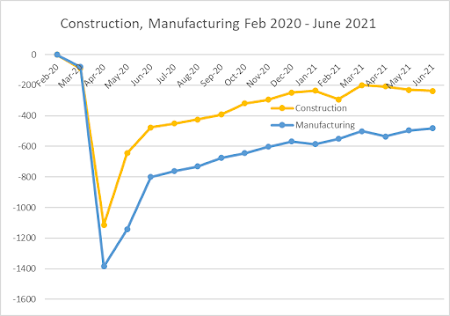
With Summer in full swing and any COVID restrictions going by the wayside, there's no reason to think this upward swing won't continue in these sectors. Now the problem is trying to get enough staff to catch up to the jump in demand. On the flip side, employment in manufacturing and construction has been flatlining, after getting a boost in the !st quarter of 2021 as more houses and goods were in demand, and weren't booming in price as much as they are today.

We also found out this week that overall spending on construction continues to be in a funk, even with the growth in home-building.
Construction spending during May 2021 was estimated at a seasonally adjusted annual rate of $1,545.3 billion, 0.3 percent (±1.0 percent)* below the revised April estimate of $1,549.5 billion. The May figure is 7.5 percent (±1.3 percent) above the May 2020 estimate of $1,437.7 billion. During the first five months of this year, construction spending amounted to $594.8 billion, 4.6 percent (±1.0 percent) above the $568.5 billion for the same period in 2020.
In fact, the seasonally-adjusted amount of construction was lower in May than it was in January. And it's worthy to note the divergence in the different categories of construction.

Change in construction, May 2021 vs Jan 2021 (annual basis)
Private Residential +$20.5 billion
Private Non-Residential -$11.8 billion
Public Construction -$13.2 billion
TOTAL -$4.5 billion

Sure seems like there could be a need for an infrastructure package to re-start construction and the related manufacturing sectors, eh?

In addition, now that the entertainment, dining and tourism sectors are opening up, there is less need for Americans to buy supplies at grocery stores and big box warehouses. As a result, the runup in jobs that we had in those sectors has now ended and is now reversing. This is likely in part due to the reduced demand, and likely in part due to other types of service jobs reopening, allowing people to change jobs.

The question now is "how long does this readjustment continue"? When does this adjustment end, and what changes in employment and spending are permanent in the post-COVID America?

I don't think those changes are done as of this time, and we need to be aware of the fallout and disruptions that are likely to continue in the 2nd half of 2021. The economy might grow enough so that the downsides aren't much, but I bet the growth will be uneven, depending on what type of sector we are talking about.

Friday, July 2, 2021

A big June for jobs. Even more than the typical June

You may have sensed that the economy was rolling as the weather warmed and COVID faded as a major restriction on growth. But we hadn’t seen job creation kick into the next gear until today.
Job growth leaped higher in June as businesses looked to keep up with a rapidly recovering U.S. economy, the Labor Department reported Friday.

Nonfarm payrolls increased 850,000 for the month, compared with the Dow Jones estimate of 706,000 and better than the upwardly revised 583,000 in May. The unemployment rate, however, rose to 5.9% against the 5.6% expectation….

As the data continues to point higher, economists are looking for GDP growth in the second quarter to approach 10%, a stunning continuation of a rebound helped by vaccines that have sharply reduced Covid-19 case rates along with hospitalizations and deaths.
There are some interesting sidelights to the report, when you dig into it. First of all, the seasonal adjustments were a big part of this report, and inflated some jobs numbers while deflating others.

One of the big “increases” in this jobs report came from government, which added 188,000 jobs on a sesonally adjusted basis, and 193,000 on the state and local side. But all the “growth” was in education, and it’s because fewer people left the sector than normal as the school year ended in June.

State + local govt education sector jobs, June 2021
State govt education
Seasonally-adjusted +74,500
Non seasonally-adjusted -203,900

Local govt education
Seasonally-adjusted +155,200
Non seasonally adjusted -208,700

Even with this public education job "growth", we are down more than 71,000 jobs on the state side and nearly 358,000 fewer on the local side vs June 2019. If we go back to the start of 2019 and use the non-seasonally adjusted numbers, you can see where the education layoffs of 2020 were not recovered during the regular 2020-21 school year, and the total number of education jobs didn't get back to the peaks of 2019 and 2020. As a result, there are less workers available to end up leaving/losing their jobs in June.

On the other hand, adjusting for typical Summer hiring knocked down some big numbers of new jobs in service sectors that are coming back as the overhang of COVID fades away.

Change in jobs June 2021
Bars and restuarants
Seasonally-adjusted +194,300
Non seasonally-adjusted +290,200

Accomodation
Seasonally-adjusted +155,200
Non-seasonally adjusted -208,700

Arts, entertainment and rec
Seasonally-adjusted +155,200
Non-seasonally adjusted -208,700

But even with the deflated numbers, the food services, accommodations, and entertainment industries continued to recover from their large-scale losses from 2020, and the leisure and hospitality sector overall accounted for 343,000 more jobs on a seasonally-adjusted basis in June.

The household survey wasn’t as good, as shown by the unemployment rate bouncing back to 5.9%. On a seasonally-adjusted basis, labor force grew by 151,000, but 18,000 fewer people identified as employed. But this also was skewed by seasonal adjustment.

Household survey June 2021
Labor Force
Seasonally-adjusted +151,000
Non seasonally-adjusted +1,560,000

Employed
Seasonally-adjusted -18,000
Non seasonally-adjusted +505,000

On a raw basis since February, as vaccinations ramped up and weather warmed, 2.15 million more people have joined the work force, and 2.76 million more have said they are employed. So even though the seasonally-adjusted unemployment rate has only dropped by 0.3% in that time, the household survey still is showing that more people are working and entering the work force, which are steps in the right direction. I concede that some of the non-seasonally adjusted additions in labor force and employment may be seasonally inflated, but given that we are now operating under much fewer restrictions and infections than we were in February, I wouldn’t be surprised to see many of those people stay on the job even as the temps cool off later this year. Let’s see if my instinct is correct.

But while this June jobs report shows a strong step up in our recovery, and while we have more than 3 million more jobs now compared to what there were in January, the 5.9% unemployment rate and still-sizable jobs deficit shows we still need a lot more months like it before we return to our pre-COVID levels.

Some of that deficit might be sorted out if businesses stay on at these levels of staffing in Fall, when layoffs usually happen (thereby causing strong job “gains” that result from retaining the same amount of jobs). But what we can’t do is shrug and step off of the gas pedal in the misguided belief that things are back to pre-COVID “normal”.

Things are not normal, and there are a lot of Americans who are going to have to ride out more adjustments to the post-COVID reality. We’re going to need to continue efforts to keep up demand and support for the 2nd half of 2021 if we want to avoid stalling out at a point that is well below this economy’s full potential.

Thursday, July 1, 2021

SPORTS BETTING IN WISCONSIN????!!!!

This came out of nowhere today, and jolted me this morning. In a great way.
Gov. Tony Evers and Oneida Chairman Tehassi Hill today signed a historic compact amendment that expands allowable gaming at Oneida Nation casinos and affiliate locations in the state of Wisconsin to include event wagering. This compact amendment will be the first to allow event wagering, including sports betting, to occur in Wisconsin. Following today’s signing, the compact amendment will be sent to the U.S. Department of Interior, Bureau of Indian Affairs for a 45-day review.

“I’m grateful to Chairman Hill and the Oneida General Tribal Council for their partnership on this historic compact amendment,” said Gov. Evers. “The Oneida Casino is a critical source of revenue and employment for Oneida Nation and this expansion will bring new opportunities for employment and revenue growth to the Tribe.”
) HELLLLL YESSSSSS!!!! What am I able/not able to bet on?
“Event wagering,” as defined by the compact amendment, can include sports and events betting such as wagering on nationally televised award shows, professional sports league drafts, and professional sporting events such as the National Football League, the National Basketball Association, and Major League Baseball. Event wagering has expanded in states throughout the Midwest in recent years, including Iowa, Indiana, Illinois, and Michigan. The current compact amendment does not allow for wagering on Wisconsin college athletics. Wagering is also prohibited on the outcomes of elections for public office and for events with participants under the age of 19.
That last sentence makes me wonder about college sports that do not involve Wisconsin teams (like most of March Madness and all non-UW college football), but I assume that will be cleaned up.

The direct impact on the state budget may not be all that much from the bets themselves, as the tribes pay the state a certain percentage of profits from gambling (I don’t know if sports bets would be put in a different category). But the real bump may come from increased traffic at the casinos in general, and more money spent at the other businesses on-site at Oneida, such as the new sportsbook and the other Oneida lands where people can bet.

According to the press release, the US Bureau of Indian Affairs has 45 days from yesterday to approve or disapprove of the change allowing sports betting. And 45 days from June 30 is in mid-August, before the start of the NFL and college football seasons, which is a big deal since football is the sport that has the most betting action in America, and you’d think that would be especially true at a casino that is 5 miles from Lambeau Field.

I’m amazed this story didn’t slip out yesterday, when the Oneida Nation’s Business Committee met in an emergency meeting to discuss amendments to their gaming compact with the state. And even more impressed that the Evers Administration and the Oneida kept such a tight lid on this over the months this change was being worked out.

Cagey stuff, Tony!

Now let’s see if Evers works to have the other tribes in the state follow suit by allowing sports betting at their casinos as well, and soon enough so that we can have the betting in place by the first kickoffs (I’m especially looking at you, Potowatomi and Ho-Chunk!). That better happen, both for my personal reasons, and because it'll be good politics to let others in on the fun that Oneida is now able to have.

Tuesday, June 29, 2021

In today's edition of "Bad idea budget theatre"

I'd seen Dem types such as Citizen Action and State Sen. Chris Larson say they wanted Governor Evers to veto the entire state budget if it got to his desk in its current WisGOP-modified form. We found out today why this would be a very bad idea.

Those packages — one signed by President Biden this spring, one by former President Trump in December — include a requirement that states maintain their current spending commitments to K-12 and higher education to qualify for the money.

The Cares Act, which Trump signed, requires that maintenance of effort extend into the 2021-22 fiscal year. Under the American Rescue Plan Act, which Biden signed, the commitment must be met in both 2021-22 and 2022-23.

If the budget is vetoed and no new one is approved, the state would continue with the appropriation levels in place for the 2020-21 fiscal year, which ends tomorrow.

In a memo requested by Sen. Jon Erpenbach, LFB estimated the state wouldn’t meet the maintenance of effort requirements under either package if that happened.
I know I said a month ago that Evers should consider tossing the whole budget out, but that was before the WisGOPs ended up adding enough state money to K-12 to guarantee the stimulus funds (yes, it's a gimmick to reduce property taxes vs investing in schools, but it still gets us the $2.3 billion from the Feds).

As it stands today, Evers can veto or rewrite bad parts out of the budget while accepting some other parts, and then if those big revenues do appear in the coming months, turn around and demand WisGOP to use those funds in 2022.

I also have no doubt that if Evers did veto the whole budget, WisGOP would laugh, do nothing (a skill they are very good at), and then cynically blame Evers for not allowing districts to get the stimulus funds. No sense playing that game.

Speaking of games, it looks like a giveaway WisGOP is planning on giving to certain business owners is hitting some snags.

That legislation, Assembly Bill 191, is focused on eliminating the personal property tax paid by businesses. It would save the businesses about $200 million a year.

But the legislation would also expand an income tax break for manufacturers and agricultural operations.

That tax break is now available on income generated by manufacturers, as well as warehouses and office structures "when located at the site of the (manufacturing) activity."...

The tax legislation coming up Tuesday would eliminate the phrase "when located at the site of the activity." According to the Department of Revenue, a manufacturer based in China, Mexico or anywhere else would now be able to claim the tax break for its warehouses and offices in Wisconsin....

The issue came to light just days after lawmakers learned that their plans to end the personal property tax would likely also lead to a tax break of $45 million a year for railroad companies.
See what happens when you allow WMC to write bills for you?

So the budget is being held up for a bit as WisGOP tries to remedy the hash that they've made of their tax cut giveaway, and it will likely cost taxpayers more money to fill in the holes caused by the extra giveaways that this language is causing. Or given that this is a standalone, Evers could veto this and tell WisGOP to put it back into the oven to get it right.

Wouldn't it be nice to stop the games and posing for interest groups, and actually do something that's smart and workable? Evers likely will, but I'm not so sure about a lot of others these days.