It wasn't done as an intentional Friday afternoon news dump, but the Wisconsin DOR came out with its February revenue figures yesterday, and much like Janaury's numbers, it wasn't very good.
For income taxes, they were down 57% from last February, but the DOR rightly points out that February and March income tax numbers can be misleading, because "70,705 more people [filed] their income tax returns electronically in February 2012 than they did in February 2011", and that meant there were a lot more refunds sent back (I was one of those). This would reduce the total income tax amounts given out, and may not reflect people working and wage amounts, although I'd argue that the large amount of refunds go directly to the bad job performance in Fitzwalkerstan and the hundreds of thousands of workers who had their take-home pay cut in the middle of the year. These people had income and taxes taken at a much higher level at the start of the year than their full-year earnings would indicate, and the refunds would make up that difference. Act 10 and other Fitzwalkerstani policies prove again to be the gift that keeps giving, doesn't it?
A better indication is the year-over-year trend, and that's going in the wrong direction, especially in the last 5 months. This means that we're heading toward a growing revenue shortfall, based on the state budget's projections.
Wisconsin income tax collections 2011 vs. 2012
Budget projection, FY 2012 vs. FY 2011 - +2.5%
FY 2011 thru Feb. vs. FY 2011 thru Feb. - +2.4%
Last 5 months 2012 vs. Last 5 months 2011- +0.7%
First 2 months 2012 vs. First 2 months 2011- DOWN 6.87%
And recall this time last year that income tax revenues were picking up, leading to the infamous Fiscal Bureau revenue upside surprise last May which proved Walker's "budget crisis" requiring Act 10 to save his "broke" state was a total lie.
By comparison, the LFB mentioned last month that low revenues are a big reason behind the $208 million deficit that will have to be made up in the next 16 months, probably in the form of another budget repair bill. We're actually below those 2011 tax levels for the first 2 months of last year, so while the income tax gap right now would only be about $5 million or so for this fiscal year, that could well grow these last 4 months.
The bigger indicator of trouble is sales tax revenues. February 2012 had 1 more day than February 2011 due to Leap Year, so you'd logically assume a 3.6% increase in sales taxes, all things being equal. Yeah, that didn't happen.
Wisconsin sales tax collections 2011 vs. 2012
Budget projection, FY 2012 vs. FY 2011 - +3.91%
FY 2012 thru Feb. vs. FY 2011 thru Feb. - +3.16%
Last 5 months 2012 vs. last 5 months 2011 - +2.88%
Feb. 2012 vs. Feb. 2011 - DOWN 1.95%
Now you can chalk this up to the Packers not winning the Super Bowl this time or there not being history-making protests in Madison for this February. But that alone shouldn't account for a drop of $571,000 in sales taxes A DAY, which is what we got for this February. A 0.75% gap in sales taxes vs. the budget would mean another shortfall of about $32 million, and I don't think we're going to see the fiscal boost from protest coverage like we did last year.
Another place we're coming up short is excise taxes, which go on items like cigarettes, alcohol and other types of sins. While I try to keep up on the beer side, looks like others were not doing the same in the first 2 months of the year (then again, given the crowds out last week, I wouldn't be shocked to see a slight uptick for March :P)
Wisconsin excise tax collections, 2012 vs. 2011
Budget projection, FY 2012 vs. FY 2011 - +1.99%
FY 2012 thru Feb. vs. FY 2011 thru Feb. - DOWN 3.48%
Last 5 months 2012 vs. last 5 months 2011 - DOWN 5.06%
Feb. 2012 vs. Feb. 2011 - DOWN 4.55%
If we stay 5.5% below budget projections on excise taxes, that's another $40 million that we come up short. So smoke and drink up, will ya!
Lastly, Walker's corporate tax cuts have barely started to take effect, and we're already seeing it cost the state money. Despite the U.S. corporations having record profits in late 2011 as they hoard money instead of paying wages, Wisconsin hasn't seen that translate into better corporate revenues.
Wisconsin corporate income taxes, 2011 vs. 2011
Budget projection, FY 2012 vs. FY 2011 - +3.28%
FY 2012 thru Feb. vs. FY 2011 thru Feb. - DOWN 0.49%
Last 5 months 2012 vs. last 5 months 2011 - DOWN 7.60%
First 2 months 2012 vs. First 2 months 2011- DOWN 21.52%
That's a fun thing to see if you're still doing your taxes, isn't it? Knowing that profits are at record levels and seeing Wisconsin corporations paying fewer taxes on those profits. Amazing how that works out when you have a corporate puppet occupying the key spots in the Capitol.
If we somehow reverse the corporate tax shortfalls of the last few months and only stay at that 3.77% shortfall that we're at for this fiscal year, that means another $33 million below estimates. So let's add up the Walker revenue deficit sheet so far:
Income tax - $5 million
Sales tax - $32 million
Excise tax - $40 million
Corporate tax- $33 million
TOTAL SHORTFALL $110 million
In other words, a little more than the $103 million loss the Fiscal Bureau anticipated for this year, and that's assuming the negative trend for 2012 reverses enough these last 4 months. If it doesn't, that $208 million 2-year deficit will only grow bigger, and there will be another budget repair bill by the start of 2013. But this time, there will be a lot of new faces in the Legislature required to fix it and maybe they won't waste time on castle doctrines and abortion like the last one did. I also hope at that time we have a new Governor that is willing to stop giving away the store to corporate contributors at the expense of state revenues, economic growth, and needed services, because the current one has been doing just that, and it has failed by any measure.
Saturday, March 24, 2012

The web grows on Walkergate
Good stuff from Capper putting together the new transcripts in Walkergate. This includes new players such as Walker's spokeswoman while he was County Executive and the Finance Director for Walker's campaign.
Please, go to Cog_Dis and check it out. That drip of information is going to become a flood pretty quick, and it's pretty obvious where the source is. The fun part is seeing which tributaries are flowing in, and it seems like there's quite a few.
Please, go to Cog_Dis and check it out. That drip of information is going to become a flood pretty quick, and it's pretty obvious where the source is. The fun part is seeing which tributaries are flowing in, and it seems like there's quite a few.
Friday, March 23, 2012
Another month, another update for the Walker jobs deficit
When I came back from some out-of-town work Thursday afternoon, I saw a headline for what appeared to be a pretty good February Wisconsin jobs report- 8,300 jobs added and unemployment staying at 6.9%. But the Walker Administration was strangely quiet over this one, and after reading the actual report, I could see why.
The biggest reasons behind the job "growth" were largely cosmetic. January's jobs figures were revised down by 7,300, and the Cap Times article says it's in no small part because of a tweak in the UW System's schedule for this year that had the schools starting their Spring semester one week later than usual.
But those weren't the only revisions, as private sector employment in January was also reduced by 1,900, which means the 4,000 increase over January is really only 2,100 when you subtract that downward revision (and due to the UW adjustment, total employment is only up 1,000 from the initial January figures). As a result of these downward revisions, the Walker jobs gap between Wisconsin and the growth rest of the nation continues to be unacceptably huge.
All jobs - Walker jobs gap = 58,650

Private sector - Walker jobs gap = 50,900

And even some of that private sector job growth is much like January's alleged "growth"- it reflects fewer layoffs than are typical for the month instead of more people actually working. More than half of the increase in private sector jobs came in Construction, but the non-seasonally adjusted numbers show that the number of people actually working construction went down by 300. Of course, the BLS adjusts these figures because typically February is too cold to have lots of construction in Wisconsin, so this is how that drop of 300 people can become a gain of 2,100. But this wasn't an ordinary February, as it was part of 3rd warmest winter in Wisconsin history, and as mentioned previously the good winter weather has probably accelerated home building and home sales, skewing the numbers higher.
I wouldn't doubt if we see a similar effect with this record March. For example, I'm already seeing large amounts of green grass on the lawns and orange barrels coming onto the roads over the last month, and this was happening in Madison 3 weeks ahead of schedule.

But even with the weather and boosts from other seasonal factors and the strengthening U.S. economy that Wisconsin has received over the last 2 months, Walker and WisGOP's jobs record is still awful. There are still fewer people working than when Walker took office at the start of 2010, and over 21,000 fewer jobs than there were when Act 10 was passed. No wonder Walker and Reggie Newson in DWD didn't say much when the jobs numbers came out yesterday, because the less attention given to their brutal record, the better.
The biggest reasons behind the job "growth" were largely cosmetic. January's jobs figures were revised down by 7,300, and the Cap Times article says it's in no small part because of a tweak in the UW System's schedule for this year that had the schools starting their Spring semester one week later than usual.
"That appears largely due to college students returning to campus after the semester break," says John Dipko, a spokesman for DWD. "Many of them may have started working in the latter part of January and are now being included in the February estimates."This helped revise state government jobs down by a seasonally-adjusted 5,500 for January, and led to a "rise" in the following month of February of 4,300 - more than half the job growth for the entire state.
But those weren't the only revisions, as private sector employment in January was also reduced by 1,900, which means the 4,000 increase over January is really only 2,100 when you subtract that downward revision (and due to the UW adjustment, total employment is only up 1,000 from the initial January figures). As a result of these downward revisions, the Walker jobs gap between Wisconsin and the growth rest of the nation continues to be unacceptably huge.
All jobs - Walker jobs gap = 58,650

Private sector - Walker jobs gap = 50,900

And even some of that private sector job growth is much like January's alleged "growth"- it reflects fewer layoffs than are typical for the month instead of more people actually working. More than half of the increase in private sector jobs came in Construction, but the non-seasonally adjusted numbers show that the number of people actually working construction went down by 300. Of course, the BLS adjusts these figures because typically February is too cold to have lots of construction in Wisconsin, so this is how that drop of 300 people can become a gain of 2,100. But this wasn't an ordinary February, as it was part of 3rd warmest winter in Wisconsin history, and as mentioned previously the good winter weather has probably accelerated home building and home sales, skewing the numbers higher.
I wouldn't doubt if we see a similar effect with this record March. For example, I'm already seeing large amounts of green grass on the lawns and orange barrels coming onto the roads over the last month, and this was happening in Madison 3 weeks ahead of schedule.

But even with the weather and boosts from other seasonal factors and the strengthening U.S. economy that Wisconsin has received over the last 2 months, Walker and WisGOP's jobs record is still awful. There are still fewer people working than when Walker took office at the start of 2010, and over 21,000 fewer jobs than there were when Act 10 was passed. No wonder Walker and Reggie Newson in DWD didn't say much when the jobs numbers came out yesterday, because the less attention given to their brutal record, the better.
Thursday, March 22, 2012
So close, but....
I'd comment more about things, but still feeling heartsick from the Badgers' 1-point loss to Syracuse. That botched last possession with Jared Berggren (Bucky's best player in this game) getting stuck at the scorer's table with 1 TO in Bo Ryan's pocket is going to haunt me for a while.
This'll sting a bit. You don't get many chances when things start clicking at the right time, and this seems like it was one of them, given how UW was nailing 3's for much of the second half. I guess that's why I'm taking this harder than I thought I would. I'll get by, but it won't mean I won't think about this one for a while.
This'll sting a bit. You don't get many chances when things start clicking at the right time, and this seems like it was one of them, given how UW was nailing 3's for much of the second half. I guess that's why I'm taking this harder than I thought I would. I'll get by, but it won't mean I won't think about this one for a while.
Wednesday, March 21, 2012
That econ. growth report isn't saying what Walker wants it to say
Sometimes it's frustrating to be working during the day when news breaks and someone blatantly deceives on what happened. Today was one of those days when I read Scott Walker trying to take credit for the Philly Fed report which showed that Wisconsin was projected to grow in the next 6 months. Check out this bilge.
 And Wisconsin's growth is nothing too special. It barely qualified for the dark green shade at 1.95%, and trails the rest of the nation, and is well behind most of the Midwest.
Forecast growth for the next 6 months- Philly Fed
Mich 3.21%
Ind. 3.20%
Ohio 2.96%
Ill. 2.52% (failures, right Scotty?)
U.S. 2.17%
Wis. 1.95%
Iowa 1.16%
Minn 0.88%
So credit Obama for the Wisconsin economy coming back, not Walker. This is especially true when you look at where we've been the last several months. Another big part of the Philly Fed survey is going over the last 3 months of economic performance. And as shown in prior months, Wisconsin remains a standout for the wrong reasons.

And that's far from all, as Wisconsin had its economy contract for all of 2011 (i.e. in RECESSION and worse off than when Walker took office) while every one of the other Midwestern states bounced back. Going back to the start of the U.S. recession at the beginning of 2008, you'll see that Wisconsin was beating both the U.S. and most of its neighbors in economic performance under Jim Doyle. Then Walker came along and Wisconsin got passed by the U.S. and Indiana in 2011, with Ohio poised to do the same in the first half of the year. Coming up quickly on the stagnant Wisconsin is...Illinois. (click on picture for bigger view)
Economic growth, 2008-2012, Philly Fed

But Walker is hoping that you'll be as shallow as the average Milwaukee talk show listener and not notice the context that the next 6 months' growth is from a much lower point than it should be, and that it would be merely an effect of the U.S. economy continuing to gain strength under President Obama. Certainly Walker's backers at the Journal-Sentinel are willing to play stupid, giving prominence to Walker's side of the story on the projected growth while burying the fact that the U.S. and most other states are slated to grow faster.
And because you know the corporate mouthpieces at Journal Communications and the Wisconsin State Journal won't tell that truth, it's up to people like me to break these stats down and write about it. It's up to readers like you to call out this bullshit and continue to expose the economic failure that is the Scott Walker Administration to your friends and the public. We'll win if the truth gets out, we just have to do it.
The Philadelphia Federal Reserve Bank released a new economic growth forecast for states yesterday. The report forecasts Wisconsin to grow 1.95 percent over the next six months. It is the best economic forecast for the state since 2003. Wisconsin also experienced the most improved forecast in the nation. Wisconsin’s three-month change was 2.36 percentage points, moving to a forecast of solid gains.Well, at least Walker got the numbers right. Too bad that's all he got right on that report. Sure, Wisconsin is projected to grow in the next 6 months, BUT SO IS EVERY OTHER STATE.
Governor Scott Walker today released the following statement on the Federal Reserve Bank of Philadelphia’s forecast of solid growth in Wisconsin over the next six months:
“Strong signals suggest we are turning things around for Wisconsin’s economy, and the Federal Reserve Bank of Philadelphia’s newest report of state leading economic indexes provides yet one more indication that our pro-jobs policies are moving us in the right direction. Although there is much work left to be done, the forecast along with additional economic indicators such as our state’s lowest unemployment rate since 2008 indicate we are heading in the right direction.”
 And Wisconsin's growth is nothing too special. It barely qualified for the dark green shade at 1.95%, and trails the rest of the nation, and is well behind most of the Midwest.
Forecast growth for the next 6 months- Philly Fed
Mich 3.21%
Ind. 3.20%
Ohio 2.96%
Ill. 2.52% (failures, right Scotty?)
U.S. 2.17%
Wis. 1.95%
Iowa 1.16%
Minn 0.88%
So credit Obama for the Wisconsin economy coming back, not Walker. This is especially true when you look at where we've been the last several months. Another big part of the Philly Fed survey is going over the last 3 months of economic performance. And as shown in prior months, Wisconsin remains a standout for the wrong reasons.
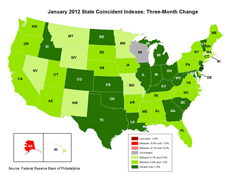
And that's far from all, as Wisconsin had its economy contract for all of 2011 (i.e. in RECESSION and worse off than when Walker took office) while every one of the other Midwestern states bounced back. Going back to the start of the U.S. recession at the beginning of 2008, you'll see that Wisconsin was beating both the U.S. and most of its neighbors in economic performance under Jim Doyle. Then Walker came along and Wisconsin got passed by the U.S. and Indiana in 2011, with Ohio poised to do the same in the first half of the year. Coming up quickly on the stagnant Wisconsin is...Illinois. (click on picture for bigger view)
Economic growth, 2008-2012, Philly Fed

But Walker is hoping that you'll be as shallow as the average Milwaukee talk show listener and not notice the context that the next 6 months' growth is from a much lower point than it should be, and that it would be merely an effect of the U.S. economy continuing to gain strength under President Obama. Certainly Walker's backers at the Journal-Sentinel are willing to play stupid, giving prominence to Walker's side of the story on the projected growth while burying the fact that the U.S. and most other states are slated to grow faster.
And because you know the corporate mouthpieces at Journal Communications and the Wisconsin State Journal won't tell that truth, it's up to people like me to break these stats down and write about it. It's up to readers like you to call out this bullshit and continue to expose the economic failure that is the Scott Walker Administration to your friends and the public. We'll win if the truth gets out, we just have to do it.
Tuesday, March 20, 2012
J-S blows it again, this time on home sales figures
I noticed that the Milwaukee Journal-Sentinel was trumpeting the Wisconsin Relaltors' Association report of an increase in home sales for February on its front page in Madison today. Seems like a good sign that maybe Wisconsin is catching onto the Obama recovery despite the best efforts of the Walker Administration...well at least until you actually read the report.
The Realtors' Association report shows that while sales are up and inventories are starting to drop, it also shows that a lot of sales were the result of bottom-feeding, and not actually a growing economy. The prices of those sales continue to fall, down to a median price of $115,000 vs. $117,000 last year (1.7%), down $5,000 year-to-date. Worse, in lots of parts of the state with large amounts of sales, it was a bigger drop than that.
Median home sales prices, Feb. 2011 vs. Feb. 2012
Milwaukee Co. $92,500 2011, $74,500 2012 (-19.5%)
Racine County $122,500 2011, $89,500 2012 (-26.9%)
Waukesha Co. $228,000 2011, $219,250 2012(-3.8%)
Dane County $197,250 2011, $188,875 2012 (-4.2%)
Rock County $73,500 2011, $83,249 2012 (+13.3%)
Brown County $131,000 2011, $126,000 2012(-3.8%)
Outagamie Co. $121,500 2011, $137,000 2012 (+12.8%)
Western Wisc. $115,000 2011, $116,500 2012(+1.3%)
Marathon Co. $98,950 2011, $80,500 2012 (-18.6%)
North of Hwy 29 $89,512 2011, $85,000 2012 (-5.0%)
Well, no wonder these people might be seeing lower property taxes- their home values are in decline. I imagine the handful of dollars in taxes they might be saving is small solace in comparison to the thousands of dollars in lost home value they might be seeing in the age of Fitzwalkerstan. And scarier, these home prices and sales figures were probably helped by the country's economic recovery and the abnormally warm weather we've been having. From the same Journal-Sentinel article that tries to promote the big pick-up in home sales is this passage.
So while the good weather and low prices may be skewing home sales higher in Wisconsin, it also means that we could well be seeing a bigger cutback (or smaller-than-usual increase) once we get to the Spring, because the underlying lack of demand hasn't changed- it's just people taking advantage of the prices and record temperatures. We'll need to see what happens in April and May (assuming the record heat ends) for both in sales numbers and in sales prices to see if there is some kind of actual strength in the Wisconsin economy. It can't be taken as a sign of improvement to see dropping home values despite the tailwinds of low interest rates and 2nd Quarter sales getting pushed into the Q1, and it sets up the real possibility of that Journal-Sentinel touted "rebound" becoming another "drop" come Springtime.
The Realtors' Association report shows that while sales are up and inventories are starting to drop, it also shows that a lot of sales were the result of bottom-feeding, and not actually a growing economy. The prices of those sales continue to fall, down to a median price of $115,000 vs. $117,000 last year (1.7%), down $5,000 year-to-date. Worse, in lots of parts of the state with large amounts of sales, it was a bigger drop than that.
Median home sales prices, Feb. 2011 vs. Feb. 2012
Milwaukee Co. $92,500 2011, $74,500 2012 (-19.5%)
Racine County $122,500 2011, $89,500 2012 (-26.9%)
Waukesha Co. $228,000 2011, $219,250 2012(-3.8%)
Dane County $197,250 2011, $188,875 2012 (-4.2%)
Rock County $73,500 2011, $83,249 2012 (+13.3%)
Brown County $131,000 2011, $126,000 2012(-3.8%)
Outagamie Co. $121,500 2011, $137,000 2012 (+12.8%)
Western Wisc. $115,000 2011, $116,500 2012(+1.3%)
Marathon Co. $98,950 2011, $80,500 2012 (-18.6%)
North of Hwy 29 $89,512 2011, $85,000 2012 (-5.0%)
Well, no wonder these people might be seeing lower property taxes- their home values are in decline. I imagine the handful of dollars in taxes they might be saving is small solace in comparison to the thousands of dollars in lost home value they might be seeing in the age of Fitzwalkerstan. And scarier, these home prices and sales figures were probably helped by the country's economic recovery and the abnormally warm weather we've been having. From the same Journal-Sentinel article that tries to promote the big pick-up in home sales is this passage.
Realtor Tammy Maddente said there has been enough positive news about the economy, especially an improving unemployment rate, that more people are feeling confident enough to take a serious look at buying a house.And indeed, others are pointing out that our amazing run of weather (83 again today in the Mad City, which I spent on the deck on the Malt House enjoying fine beverages) is its own mini-stimulus for the 1st Quarter of 2012. This CNBC report mirrors a number of others that indicate that sales which usually would be happening around April and May are happening now because people want to buy and get homes built when the weather's good. And that certainly matches the Realtors' history of the last 3 years in Wisconsin, where April through October are the peak months of home buying, and then there is a drop off from October through January as the weather cools.
"No matter how good interest rates were in the last year or two years, no matter how good the pricing was, people just didn't have the confidence," said Maddente, executive vice president of First Weber Group. "I think people are sick of having their lives on hold."
According to the Realtors report, existing home sales increased in every region in the state in February, with most increasing more than 10% from a year ago.
The mild winter has helped, Maddente said.
"You have good economic news coming out on the federal front and the state front and then you have 70-degree weather. What could be more perfect? It's really helped ignite the spring market," she said
So while the good weather and low prices may be skewing home sales higher in Wisconsin, it also means that we could well be seeing a bigger cutback (or smaller-than-usual increase) once we get to the Spring, because the underlying lack of demand hasn't changed- it's just people taking advantage of the prices and record temperatures. We'll need to see what happens in April and May (assuming the record heat ends) for both in sales numbers and in sales prices to see if there is some kind of actual strength in the Wisconsin economy. It can't be taken as a sign of improvement to see dropping home values despite the tailwinds of low interest rates and 2nd Quarter sales getting pushed into the Q1, and it sets up the real possibility of that Journal-Sentinel touted "rebound" becoming another "drop" come Springtime.
Sunday, March 18, 2012
"Job creators", Wisconsin less likely to give health insurance, workers squeezed
Paul Krugman wrote a strong article today showing how employers have become much less likely to be a source of an American's health insurance, and it included the following graph that was part a paper on employer coverage from the National Institute for Health Care reform.

What's remarkable in that graph is not only the decrease in number of Americans under 65 that get employer coverage (from nearly 70% in 2001 to 53.5% 9 years later), but also where that sixth of Americans did as a result.
1/2 of that group went on Medicaid
1/3 of that group ended up uninsured
About 1/10 got individual insurance
About 1/12 went on Medicare
Another key part of the study shows that the real speed-up in people not getting employer coverage happened with the start of the recession in 2007. The report notes that 10% more families weren't working at all (understandably), and some of those that did keep a job had their hours reduced from full-time to part-time, which made it less likely to get health care benefits. There were also a couple of particular groups of workers who weren't as likely to get their coverage through work:
It's also interesting to note that over 1/4 of workers with a high school degree don't take employer-sponsored health plans even if offered them, probably because the plans are too expensive for them (which means they are uninsured or on public assistance), or they are covered through another family member (spouse, parent, etc.).
So with fewer people getting their insurance through their job, it now falls to the government and the individuals to pay for health insurance, and this is where you get the squeeze. Wisconsin is a good example of how an individual worker can get hit from a lack of support in health insurance from both the employer and the government. If you take a look at the $91 million in approved Medicaid cuts that went through Joint Finance last week you'll see that over 40% of these savings come from large increases in BadgerCare Plus premiums for families that make between 133% and 200% of poverty. For example, a 3-person family making just over $30,000 would go from paying $27 amonth in premiums to $115 a month. That's a serious bite for a single-parent with 2 kids working full-time making $14.00 an hour, and DHS officials figure 7,500 Wisconsinites will simply drop out instead of making the payments. What happens to them? They might end up uninsured (and go to the emergency room for treatment), or the end up on the individual insurance market, where they'll be hard-pressed to get the affordable, comprehensive care they might need.
Related to that, another $20.8 million in DHS savings is from raising premiums in "transitional" Medical Assistance. The original DHS plan was to entirely cut off the single-parent, 2 kid families at $38,000 in income, but after the Obama Administration threatened to pull their side of the funding . (much like how they did to Rick Perry and Texas last week) , Dennis Smith and company backed off of that. So instead, they'll raise premiums for parents by as much as $200 a month (if you make $38K) and $450 a month (if you make $57K). Children seem to be exempted, but realistically some parents might choose a different family coverage if they have pay $200-$450 a month for health coverage, and DHS figures another 2,643 Wisconsinites will go off the Medicaid rolls as a result.
Now you put it together from the report on employer coverage mentioned above, and you see that both governments and employers are finding a logical place for savings is putting the stress onto the individual as a way to cut costs of operations. So my question is simple - why don't we admit that health insurance is a serious burden for individuals and businesses, and the increases in cost for insurance continue to go up, so why not have Medicare for all to cover these costs, take the burden off of the individual and business to pay these expenses? Any resulting tax increase would probably be less than the widely varying and increasing costs we have now, (in fact, Krugman offers another good takedown of GOP lies about health care policy, as he points out the estimated costs of Obamacare keep coming down) and there'd be a much wider base to spread the expense around. Seems simple and logical to me, and it would stop the crunch that millions of workers are getting caught in with less jobs, stagnant wages, and less employer health coverage.
Oh wait, that would cut into the profits for insurance corporations and drug companies, and they contribute too much to have their interests take a back seat to having government contribute to the general welfare and economic stability. Silly me.

What's remarkable in that graph is not only the decrease in number of Americans under 65 that get employer coverage (from nearly 70% in 2001 to 53.5% 9 years later), but also where that sixth of Americans did as a result.
1/2 of that group went on Medicaid
1/3 of that group ended up uninsured
About 1/10 got individual insurance
About 1/12 went on Medicare
Another key part of the study shows that the real speed-up in people not getting employer coverage happened with the start of the recession in 2007. The report notes that 10% more families weren't working at all (understandably), and some of those that did keep a job had their hours reduced from full-time to part-time, which made it less likely to get health care benefits. There were also a couple of particular groups of workers who weren't as likely to get their coverage through work:
Among young adults aged 18 to 27, the share [being a member] in a working family dropped from 70 percent in 2007 to slightly more than 50 percent in 2010, and the share enrolled in employer-sponsored insurance dropped from 43 percent to 31 percent. For people in families headed by someone with a high school education or less, the share in working families dropped by 16 percentage points to just more than half, and the share with employer coverage declined from 47 percent to 36 percent between 2007 and 2010. Families headed by people with a college degree experienced smaller declines in both employment and employer-sponsored insurance. Families at the edge of the labor force were most susceptible to losing health insurance because of long-term cost trends and were most likely to lose jobs during the recession.
Among working families, only those employed by small firms - fewer than 100 workers - experience a statistically significant decline between 2007 and 2010 in employer health coverage, from 51 percent to 45 percent. Decline in both the [employer] offer rate and the [employee] take-up rate contributed to the overall decline in coverage for workers in small firms.
It's also interesting to note that over 1/4 of workers with a high school degree don't take employer-sponsored health plans even if offered them, probably because the plans are too expensive for them (which means they are uninsured or on public assistance), or they are covered through another family member (spouse, parent, etc.).
So with fewer people getting their insurance through their job, it now falls to the government and the individuals to pay for health insurance, and this is where you get the squeeze. Wisconsin is a good example of how an individual worker can get hit from a lack of support in health insurance from both the employer and the government. If you take a look at the $91 million in approved Medicaid cuts that went through Joint Finance last week you'll see that over 40% of these savings come from large increases in BadgerCare Plus premiums for families that make between 133% and 200% of poverty. For example, a 3-person family making just over $30,000 would go from paying $27 amonth in premiums to $115 a month. That's a serious bite for a single-parent with 2 kids working full-time making $14.00 an hour, and DHS officials figure 7,500 Wisconsinites will simply drop out instead of making the payments. What happens to them? They might end up uninsured (and go to the emergency room for treatment), or the end up on the individual insurance market, where they'll be hard-pressed to get the affordable, comprehensive care they might need.
Related to that, another $20.8 million in DHS savings is from raising premiums in "transitional" Medical Assistance. The original DHS plan was to entirely cut off the single-parent, 2 kid families at $38,000 in income, but after the Obama Administration threatened to pull their side of the funding . (much like how they did to Rick Perry and Texas last week) , Dennis Smith and company backed off of that. So instead, they'll raise premiums for parents by as much as $200 a month (if you make $38K) and $450 a month (if you make $57K). Children seem to be exempted, but realistically some parents might choose a different family coverage if they have pay $200-$450 a month for health coverage, and DHS figures another 2,643 Wisconsinites will go off the Medicaid rolls as a result.
Now you put it together from the report on employer coverage mentioned above, and you see that both governments and employers are finding a logical place for savings is putting the stress onto the individual as a way to cut costs of operations. So my question is simple - why don't we admit that health insurance is a serious burden for individuals and businesses, and the increases in cost for insurance continue to go up, so why not have Medicare for all to cover these costs, take the burden off of the individual and business to pay these expenses? Any resulting tax increase would probably be less than the widely varying and increasing costs we have now, (in fact, Krugman offers another good takedown of GOP lies about health care policy, as he points out the estimated costs of Obamacare keep coming down) and there'd be a much wider base to spread the expense around. Seems simple and logical to me, and it would stop the crunch that millions of workers are getting caught in with less jobs, stagnant wages, and less employer health coverage.
Oh wait, that would cut into the profits for insurance corporations and drug companies, and they contribute too much to have their interests take a back seat to having government contribute to the general welfare and economic stability. Silly me.
Subscribe to:
Posts (Atom)