Wednesday, October 19, 2022

2022's inflation might mean lots of relief in 2023

Inflation may be a pain for a lot of people, but in a backdoor way, a lot of Americans are going to get tax relief in 2023 due to the rise in prices in 2022.
Taxpayers will get fatter standard deductions for 2023 and all seven federal income tax bracket levels will be revised upward as the government allows people to shield more of their money from taxation because of persistently high inflation.

For couples who file jointly for tax year 2023, the standard deduction increases to $27,700 up $1,800 from tax year 2022, the IRS announced. Single taxpayers and married people filing separately will see their the standard deduction rise to $13,850, up $900, and for heads of households, the standard deduction will be $20,800, up $1,400.

The adjustments come as inflation accelerated in September, with the Consumer Price Index rising 0.4% last month after just 0.1% in August. Inflation is up 8.2% for the past 12 months.

Some items that were indexed for inflation in the past will remain unchanged, such as the personal exemption, which remains at zero. And the limitation on itemized deductions was eliminated under President Donald Trump.
That's an inflation adjustment on the tax brackets of about 7% at the federal level, and Axios gives a good breakdown of the changes in this article.

So if you don't get a 7% raise next year, at least you'll pay a lower % in income tax. And from what I can tell on state statute, Wisconsin's brackets may be up as much as 8% for 2023.

Older Americans are also going to see a boost in a different type of income due to this year's high inflation.

It's also worth mentioning that those same seniors aren't going to pay more than $35 for insulin next year, due to the Dem-supported Inflation Reduction Act. And they are also going to pay lower premiums for Medicare Part B next year, because some medical costs didn't go up as much as prices overall.
Medicare’s Part B standard monthly premium will fall to $164.90 in 2023, a $5.20 decrease from 2022, the Centers for Medicare & Medicaid Services (CMS) announced on Sept. 27. The open enrollment period to make any changes to next year’s Medicare coverage begins on Oct. 15 and goes through Dec. 7.

The premium drop comes in the wake of the big 2022 increase, the largest dollar increase in the history of the program. Part B covers doctor visits, diagnostic tests and other outpatient services. Most Medicare beneficiaries have Part B premiums deducted directly from their monthly Social Security payments.

Next year’s premium decrease makes good on statements this year by Health and Human Services Secretary Xavier Becerra that the money Medicare was saving because spending on Aduhelm, a new Alzheimer’s drug, was not going to be as high as expected would be passed on to beneficiaries in 2023. Spending on other Part B services is also projected to be less than anticipated.
We've already seen overall inflation moderate since June, and now a large number of Americans are going to be taking home more money in 2 1/2 months. This could go a long way toward giving the "soft landing" that the Fed and most Americans are hoping for as rates are raised and prices cool off.

Monday, October 17, 2022

High inventory, flat sales, and lower import prices should further slow inflation. Key word: SHOULD

In the later part of last week, we got several bits of information that indicated that INFLATION PANIC seems overblown.

The first item I want to notice is a follow-up from last week, where I expressed concern over a tightening of gasoline supplies and a higher amount of gasoline usage as September ended. I wanted to see what the reports from the Energy Information Administration said for the first week of October, to see if there was finally a supply-and-demand reason to raise gasoline prices.

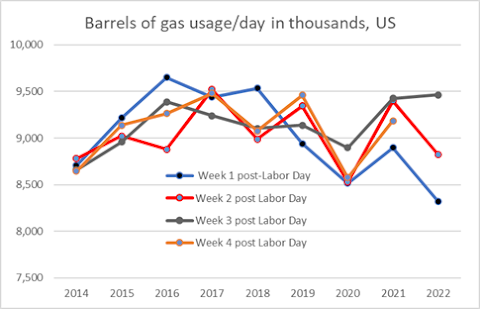
Well that concern isn't as strong with me this week, as gasoline availability rose, and gas usage fell significantly, to the lowest post-Labor Day levels in years.

Likewise, prices at the pump have fallen back in many parts of America in the 10 days since that last week of usage was recorded - below $3.60 here in Madison, which makes the short-term spike that was passed out due to refinery outages a few weeks ago all the more BS to me.

We also saw multiple reports last Friday that indicated inflation at numerous types of shopping places should be leveling if not flat-out declining. The first of those reports showed the value of business inventories rising by 0.8%, and up by over 18% in the last 12 months.

And that report came a week after one that showed the value of inventories in retail businesses went up by 1.3% in August.

Then last Friday, retail sales in America continued to show softening of demand in September after a strong first 6 months of 2022. That's not a great thing for the overall economy, but also gives little legitimate reason to jack up prices.

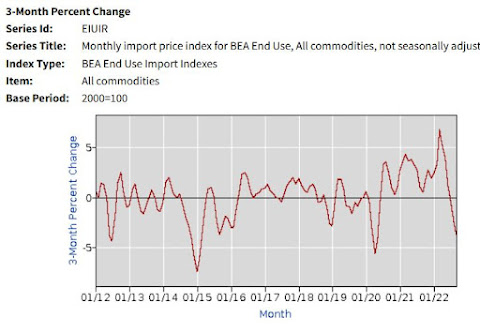
The other report that gave good news on the inflation front on Friday was from the Bureau of Labor Statisitics, which showed the prices of imported goods continued to fall in September. Part of this is a reflection of the absurdly strong dollar, but it also continued a 3-month trend of declines of more than 1 percent, and a marked reversal from the increase in import prices that we saw earlier this year.

If you look at the 3-month trend, we are seeing import prices fall in a way that we haven't seen since the COVID pandemic had much of the world in lockdown.

And while you frequently hear about the 12-month Consumer Price Index increase of more than 8%, it's worth noting that the price of non-fuel imports has only gone up by 3.4% in the last year, and has declined in each of the last 4 months.

The high inventories, strong dollar and softening demand for retail and gasoline all are items that should cause inflation to drop. Which reiterates to me that much of our "inflation" has been profiteering, and that Wall Street fear-mongering over inflation and profitability should be taken with a whole lot of salt. If prices stay high for Q4, it is more likely a cash-in than a pass-through.

Sunday, October 16, 2022

$4.3 bil in the bank now, $5.3 bil by next June. Opens door to real changes, if we want.

This news wasn't too much of a surprise on Friday, but I still think it needs to be pointed out.

How did this happen? About 2/3 was due to the $2.8 billion we already had in the bank. Most of the rest of it was due to much-stronger than expected tax revenues (which were already hundreds of millions of dollars above what was in the 2021-23 budget), and we also spent less state tax dollars than expected (mostly due to the Feds covering a higher % of Medicaid expenses due to COVID emergency measures).

Also interesting is that the surplus would have been even bigger, except a sizable chunk of money is set aside to be used in year 2 of the biennium.

All 3 of the state's main tax revenue sources beat the numbers that were assumed in the original 2021-23 budget, and the already-higher estimates that the Legislative Fiscal Bureau gave in January. This includes individual income taxes nearly matching FY 2021's totals despite significant income tax cuts being put in place, and corporate income taxes continuing their unprecedented increases.

So let's go off of the revenue picture that we have today, and then make the following assumptions.

1. Income tax revenues increase by the same 5% assumed in the 2021-23 budget.

2. Sales tax revenues increase by the same 3.1% assumed in the 2021-23 budget.

3. Corporate taxes shrink back to the $2.585 billion that the LFB assumed in the 2021-23 budget.

If you go with that (and those are very conservative assumptions), and assume all other tax revenues meet budgeted levels, revenues will be $1.334 billion above budgeted levels. We'd also exceed expenses in FY 2023 by almost exactly $1 billion, pushing the balance at the end of the 2021-23 budget to $5.3 billion.

That would open the door to a significant restructuring of taxes in Wisconsin. Either by removing all of the cuts to shared revenues over the last 14 years, and/or removing the property tax as the main method of funding schools and local governments. We also could consistently increase the use of General Funds for roads, highways and transit, instead of relying on gas taxes and registration fees.

What we shouldn't do, is this.

Giving away our surplus to the rich and corporate wouldn't just be regressive garbage that would hurt our state's economy, it would be a gigantic waste of a once-in-a-lifetime opportunity to update the way we fund our services in this state, fixing a system that has long been outdated, constrictive and inequitable.

Thursday, October 13, 2022

INFLATION PANIC! But why? The numbers leveled off for Q3

The last two days, I've looked at the Producer and Consumer Price Index reports, and am really confused why I keep seeing articles from Wall Streeters and pundits that sound like this.

Both indexes rose 0.4% for September, which is around a 5% annual rate. Not great, but not something that would cause great changes in the economy either. And on the producer side, prices went down at some stages of production, continuing a trend of the last 2 months.

On the consumer side, a big cuplrit for the rise was shelter, which takes up about 1/3 of the total CPI index,and a higher proportion of the "core" CPI.
The index for all items less food and energy rose 0.6 percent in September, following an identical increase in August. The shelter index continued to increase, rising 0.7 percent in September, also the same as in August. The rent index rose 0.8 percent in September. The owners’ equivalent rent index also increased 0.8 percent over the month, the largest monthly increase in that index since June 1990.
And that sucks if you're a renter looking for places, no doubt. But the CPI ignores how tens of millions of America with locked-in low-interest mortgafges aren't paying anything extra for their houses these days. Sure, that may be a statement coming from a point of privilege, but let's also acknowledge that these inflationary effects are widely varied depending on what situation you are in.

And while lower-income people are more likely to rent and feel the effects of inflation that way, let's also not forget that eveyrday line workers have been the ones seeing higher wage increases in 2022. And for the third straight month, regular line workers saw their wage increases outpace inflation.
Real average hourly earnings for production and nonsupervisory employees increased 0.1 percent from August to September, seasonally adjusted. This result stems from a 0.4-percent increase in average hourly earnings combined with an increase of 0.3 percent in the Consumer Price Index for Urban Wage Earners and Clerical Workers (CPI-W).

Real average weekly earnings increased 0.4 percent over the month due to the change in real average hourly earnings being combined with an increase of 0.3 percent in average weekly hours.

I then saw this article from CBS Marketwatch's Rex Nutting that stated what I've been thinking throughout the last couple of months.

If we looked just at the year-on-year increase in the CPI, we might agree with the Federal Reserve’s assessment that there hasn’t been an “appreciable decline” in bringing inflation down to the 2% target.

The year-on-year perspective is good for seeing how far we’ve come, but it’s not so good at predicting where inflation is going, because it’s essentially a backward-looking measure. It gives equal weight to inflation in September 2021 and inflation in September 2022. Yet the inflation rate from a year ago has little bearing on what the inflation rate will be going forward....

The monthly data seem awfully noisy. So let’s find the underlying trend by taking a three-month average to smooth out the bumps. In this case, the data say that the CPI rose at a 2% annual rate from July through through September, down from 11% in June and 11.3% in March, which was a 41-year high.

This perspective answers the question: What’s happening with inflation yesterday, today and tomorrow?

If we look at the three-month smoothed annual rate, we might disagree with the Fed about how much progress they’ve made. Going from 11.3% in March when the Fed started raising interest rates to 2% now isn’t nothing. It looks like — dare we say it? — progress.
I'll go along with Nutting's point and add this one. Yes, it's a pain to a lot of us that prices went up as they did starting in Summer 2021 and lasting through June of this year. But why does the Fed care more about that, and not what is happening now in America. And why are they fighting the last war instead of looking at what their recent and future moves will do to everyday Americans in Q4 2022 and all of 2023?

And maybe Wall Street traders also realized that this INFLATION PANIC wasn't being based on the reality in October 2022. Because take a look at the ride the DOW Jones has been on today.

These guys don't know what's going on, probably because none of them have lived through a pro-worker time where inflation might stay at 4-6% for a while (THE HORROR!). And they really don't like that everyday people are finally getting an upper handm which is why they're hoping for GOPs to win in November and smack down workers into compliance with a bad economy and austerity.

Let's not have that happen, shall we?

Wednesday, October 12, 2022

Who's voting in November? In MU Law School Poll, it's old racist white folks.

My general thoughts about the Marquette Law School Poll?

What angers me is that our media will NOT say that obvious reality, and instead go with the pro-GOP "likely voter" numbers (which ignores respondents who say they are "very likely" or "50-50" to vote). And that's what some low-info voters will use as their cue to decide who they should support, since they want to be associated with winning.

And it's especially infuriating when you see posts like this from former Feingold press secretary Jud Lounsbury.

Dig into the crosstabs on the Registered Voter sample, and it's a lot more like Real Wisconsin.

Registered Voters, MU Law Poll
Black voters 4.8% of electorate
Hispanic Voters 5.7% of electorate
Voters 18-29
Evers 53-34
Barnes 54-35

Still a bit overly white, but generally in line with what we would expect. So I'm assuming this is the state of play until something different comes along.

The media coverage would be quite different if those were the poll numbers being discussed today. And I bet Bradley Foundation-funded Chucky Franklin knows it too.

Tuesday, October 11, 2022

Why do we think more MAGAs will vote in Wis, when COVID killed a lot more of them?

If you've been following the trends in COVID cases and severity since vaccines became widely available in early 2021, this stat doesn't surprise you. But it sure tells a lot.

And the reason why shouldn't surprise you either.

The same pattern holds in Wisconsin.You may remember that Milwaukee County had well over 200 COVID deaths in the first 2 months of the pandemic, which more than half of the state's total deaths at the time. Since that time, a little more than 2,100 Milwaukee County residents have died due to COVID-19, but nearly 15,000 more Wisconsinites have died (or probably died) due to COVID overall.

And if you look at the overall death rates in the state, you can see it is heavily skewed toward rural areas in northern Wisconsin that have older populations, lower vaccination rates, and high levels of MAGA.

Every one of those 24 counties listed voted for Donald Trump in 2020. And a disproportionate amount of those voters are now gone in 2022.

This reality becomes especially important when you remember that rural, Trumpy parts of the state had a higher part of the 2020 Wisconsin electorate than they have in recent years, and Milwaukee County (and especially the City of Milwaukee) had a lower amount share.

Now you may think a 1% difference in electorate share isn't a big deal, either in the outstate counties gaining or in Milwaukee County declining. But if you assume the same turnout share as 2018 and the same Dem vs GOP results as 2020, here's the change.

When you add 0.5% to the Dems and take away 0.5% from GOPs, that would turn Biden's 20,000 vote margin and take it over 50,000. And it's not unreasonable to think that the COVD death factor alone makes the 2018 electorate the base reality for 2022, if not even more pro-Dem.

But you don't see that modeled in polls, which somehow think this electorate will be even more GOP-leaning than the one that voted in 2020. Maybe this is a bit of hopium speaking, but I don't see anything in the demographics, COVID numbers, or 2022's election results that indicate that. And does anyone think that the WOW Counties are going to vote 2-to-1 for Trump-humpers like Ron Johnson and Tim Michels, like they voted 2-to-1 for Scott Walker in 2018? Me neither.

I'm not saying that the races won't be close in Wisconsin in 4 weeks. But I am saying that incorrectly modeled polls can influence those results (I'm looking at you, Charles Franklin), and I do think the polling is not accounting for the extraordinary times and changing state/country that we are in, with COVID mortality being a central part of that.

Monday, October 10, 2022

Despite OPEC moves and refinery outages, oil keeps pumping in US.But big reports later this week

With gas prices at or above $4 a gallon in Wisconsin these days, I wanted to take another look at this country's supply-and-demand situation for the product, and oil in general.

First off, while there has been (conveniently timed) disruptions with refinery outages in both the Midwest and the West Coast in recent weeks, the amount of oil being produced in America still remains at or above 12 million barrels a day. That's basically what we were doing in early 2019 when prices weren't nearly this high, and well above the 11 million that was being pumped out when President Biden took office in January 2021.

And let's add that the Biden Administration is still releasing oil from the Strategic Petroleum Reserve and delivering it to refiners through the end of next week, so put that 600,000 or so a day on top of what you see in that graph.

On the demand side, I wanted to look at the full weeks after Labor Day in recent years, as that removes the distortions of the holiday and gives us a good reference for what consumption looks like in a normal school/work period. Consumption had trended down for the first two weeks after Labor Day this year, but there was a sizable amount of usage in Week 3, the last week reported so far.

This meant that availability of gasoline dropped to their lowest post-Labor Day levels in 5 years, after being quite a bit more plentiful earlier in September.

It makes Thursday's report on gasoline consumption and availability an important one, because let's see if the increased demand and restrained supply is a one-week blip, or a sign that things have actually gotten tighter, which would give prices a legitimate reason to be higher vs the speculation/greed BS we've had to deal with in a lot of this year.

That being said, it'll also be intriguing to see the reaction when the Consumer Price Index shows another drop in gas prices for September, which likely will lead to another lower overall number. Because it's been interesting to me how the Federal Reserve and speculators have pointed to CPI increases in earlier 2022 as an example of "high inflation" for Q3 (not true), but that they're now avoiding the recent history and looking ahead to OPEC supply cuts and higher future prices as a reason to keep tightening money.

But what's not mentioned is that the gasoline supply picture should loosen up in the next couple of weeks as the refineries come back online now that Q3 profits have been locked in, and that along with the traditional lower driving levels of October should counteract any limits on oil supply that start hitting the system in the coming weeks.