Saturday, December 11, 2021

WMC says they want more talent, but have no clue how to get it

Oh, look it’s Wisconsin’s “business leaders” with another plan to boost this state’s economy. Let’s see what these mediocrities big thinkers are up to.
The report, titled “Wisconsin 2035” was prepared by WMC Foundation, an affiliate of Wisconsin Manufacturers and Commerce, the state’s largest business lobbying group that has primarily supported Republicans, and will be presented during WMC Foundation’s Future Wisconsin Summit in Madison on Thursday. As part of the report, officials interviewed more than 80 leaders in industries such as manufacturing, construction, retail and hospitality as well as officials in government, health care and education.

“Everything comes back to workforce,” WMC president and CEO Kurt Bauer said in a statement. “Wisconsin must attract, retain and expand our talent pool. The state can no longer afford to be the best kept secret in the Midwest. We must tell our story and, at the same time, make Wisconsin an even more attractive place to live, work and play.”
Not a bad idea at all to try to get people to come here. Especially given our cold weather and unfavorable demographics.

So what does WMC have in mind?
To address the need for more workers, WMC suggests increased efforts in talent attraction through foreign immigration, such as eliminating the 65,000 cap on temporary employment visas, and boosted efforts to draw more people from other states. One measure that could help on that front is an item in the state’s 2021-23 budget that directs the Wisconsin Economic Development Corp. to spend $3 million on talent attraction and retention initiatives.
It’s a good start, although is advertising “more immigrants” something you want to bring up, given that you overwhelming support Republicans who want to stir up rubes with thinly-veiled racism/xenophobia?

Eh, maybe they’ll look past it. Republicans are good at that kind of two-stepping. What else does WMC think will solve these demographic issues?
WMC also points to tax cuts as another way to draw more talent to the state. One suggestion includes potentially reducing, flattening or even eliminating the state’s top individual income tax bracket, which is at 7.65% for incomes higher than about $263,000….

WMC also suggests targeting alumni from the University of Wisconsin System, members of the military nearing the end of their service and young employees looking to leave high-cost, high-tax states like neighboring Illinois. For those in Wisconsin schools, WMC notes that working to better connect K-12 systems with local employers could help recent graduates find work and stay in the state.

Oh, so attracting rich FIBs to go across the border is your magic pill? How are you going to do that when the WMC crowd wants to pay as little as possible to basically everyone that’s not an oligarch, while Wisconsin continues to have the lowest manufacturing wages in the Midwest ($5/hour below both Illinois and Minnesota).

It’s especially cute that WMC talks about trying to attract “young employees” and UW alums, when they support Republicans who continue to pass backwards/racist legislation as a strategy. Stuff that makes people from outside Wisconsin say “That state’s screwed up, why would I want to live there?”

In fact, it's telling that the only place in the state that gets large amounts of talent to move here is liberal, high-services Madison – a city that the WisGOP/WMC crowd constantly complains about.

Since WMC is concerned over a lack of population compare Wisconsin's population growth with a couple of other mid-sized cold-weather states who took a different path in the 2010s - electing Dems as Governor, protecting natural resources, maintaining public education, paying higher wages to workers, and encouraging a higher quality of life. How did they do?

Maybe WMC could learn something from that, before Colorado and Minnesota pass us for population in this decade.

Naaah, they'd rather sit on their backsides and pay politicians vs improving things for anyone other than themselves. These oligarchs/mediocre businessmen got pretty much everything they wanted in the 2010s – complete Republican control with massive giveaways to corporations and wage-suppression measures like Act 10 and right-to-work (for less). And now they complain about how Wisconsin lags behind in growth?

Take a seat, WMC. Let those of us who know what actually works in the 21st Century take care of this state for a while. And I bet you’ll do better than you are today (well, except for the crooks who got WEDC handouts in the Walker years). Win-win!

Thursday, December 9, 2021

All that COVID aid likely explains higher US inflation. And it beats the alternative

Found an article from CBS Marketwatch today that went over a new study from an international organization compared the COVID economic responses across nations, and it feels important to know ahead of tomorrow consumer inflation report in America.

This report said a big reason that the US has inflation (6.2% year-over-year) than the euro zone (4.2%) and especially Japan (0.1%) is because of CARES and other COVID relief packages, which took on a different type of support in the US.
One reason U.S. inflation might be hotter than the rest of the world is how countries decided to help their workers in the early days of the pandemic.

The U.S. mostly relied on generous unemployment benefits and direct stimulus checks, while Europe and Japan, by contrast, mostly relied on furlough programs.

Hyun Song Shin, economic adviser and head of research at the Bank for International Settlements, finds that in some respects, the differing strategies got the jobs market back to similar places. Since the fourth quarter of 2019, the change in hours worked followed similar paths.

But the composition was far different. In the U.S., the rise in average hours worked was mostly due to lower unemployment, as well as a pickup in participation in the jobs market. In other developed markets, Shin found, the rise in average hours worked reflects workers taking on more hours at the same companies where they were previously employed……

The U.K., he concedes, is one place that did rely on furlough programs but also has seen a rise in job vacancies. But in most advanced economies, average wage growth is more or less in line with pre-pandemic trends, or a little below. “It is notable, however, that in the United States, where labor market changes are most apparent, wage growth has picked up despite labor market conditions that appear weaker than before the pandemic,” he said.
Oh no! Stronger wage growth from not having to settle for garbage pay! Not that! God forbid! NOOOOOO!!!!

The article also includes these charts which show that the US has the smallest decline in total hours worked vs the start of the pandemic, while also being the only one that has seen a rise in average hours worked, indicating that a lot of crappy low-pay, part-time jobs have now been phased into better paying work for fewer employees.

I’ll take slightly higher prices with less poverty and better-paying work vs the alternative. Wouldn’t you? Maybe “profit by any means necessary” needs to take a back seat to “we all do better when we all do better” for a while.

Keep this in mind as you see Wall Streeters and GOPs cry crocodile tears about "higher prices" when the CPI numbers hit tomorrow.

Evers sends stimulus aid to Wisconsin movie theatres, and the cinemas need the help

As 2021 closes up, it’s worth noting that Wisconsin still has plenty of COVID relief funds left to be used, and that there is still COVID-related economic damage in some sectors. That was borne out with Governor Evers’ announcement of a new round of aid in an industry that is still well below their pre-COVID levels of business.
Gov. Tony Evers today announced more than $14 million in grants were awarded to movie theaters, summer camps, and minor league sports teams throughout the state. Today’s grant awards are a part of the governor’s more than $140 million investment to support the recovery of Wisconsin’s tourism and entertainment industries from the ongoing coronavirus pandemic. ….

The Movie Theater Assistance Grant Program is a more than $10 million program that provides approximately $15,000 per screen to 49 theater companies. This is the second pandemic relief program to assist the movie theater industry in Wisconsin, bringing the total investment in Wisconsin’s movie theaters to $20 million.
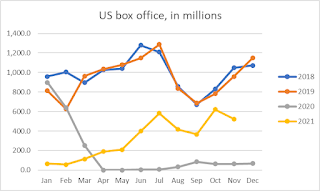
Movie theaters throughout the state were closed for much of 2020, and even after vaccinations and mask policies have been put in place in 2021, many have yet to watch films in any place other than homes.

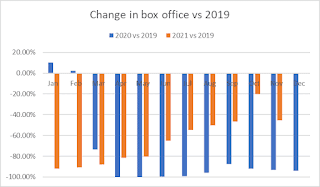
You take a look at national box office figures for movies (courtesy of the Box Office Mojo website) and you can see that despite good growth since all ages were able to be vaccinated in May 2021, we are still well below the ticket revenues that existed before the pandemic.

Those numbers certainly warrant additional help, even though we’re 21 months into COVID being a thing in America. We don’t want to see more of these businesses and buildings be shuttered again, and have the property values fall off of the tax rolls. Hopefully by this time next Summer, the pandemic has largely faded away with all ages able to be vaccinated, and a lot of the barriers to going out to the movies have disappeared.

However, you have to wonder about whether the concept of “going out to the movies” is going to be less in a post-COVID world. Some of this will be due to the availability of streaming, improved televisions and other platforms to enjoy movies, but it may also be because some may decide they don’t need to see movies in theatres in general (some might figure “we got through 2 years without it, and it wasn’t so bad”).

Which makes me wonder what box office figures will look like in 2022, and whether some of the theatres getting help throughout the state won’t be heading out of business even with the subsidies in 2021. If COVID has gone away but fewer people are still coming in, would those businesses even be worth bailing out at that point?

It’s a topic for another time, because the $10 million+ to theatre operators keeps a lot of these business afloat in the near term, and gives us time to see how the post-COVID movie business might operate. But do we reach a point where we risk losing access to a vital form of entertainment in many communities across Wisconsin? Films as art and having community outlets like theatres to show that art matters, and is having that possibly be less available for Wisconsinites something we should allow to happen?

Monday, December 6, 2021

People in DC must stop saying "you can't" when it comes to action. Or in making GOPs pay.

Look, I understand that it is difficult to have Democrats in Congress pass bills on their own, given the extremely tighty margins they have in both houses, and that Republicans would rather talk down how things are going and avoid doing anything to improve things in the hopes that voters will put them back in power after 2022. But that doesn't mean Dems should throw up their hands and say "Well, that's all we can do for now."

Brian Beutler of Crooked Media says that DC Democrats aren't taking enough action to confront the major challenges that are hitting the country. Especially when voters elected them to pull us out of the numerous messes that existed after Donald Trump left office, and the other messes to come due to a rigged SCOTUS in 2022.

When Roe [v. Wade] falls, people are going to turn to their elected leaders for relief, and Democrats are going to need a better answer than “elect [more] Democrats.” Not because the answer is wrong, exactly, but that it awkwardly and conspicuously ignores the obvious: Democrats turned out harder than voters have ever turned out in an election in 2020, enough to give Democrats undivided control of government, but now they say there’s literally nothing they can do other than hope the midterms go even better.

It’s true in an almost trivial way that the solution to the problems Republicans create is to elect more Democrats. If the country had elected more Democrats in the past, we wouldn’t be facing the demise of Roe, and faced with the demise of Roe the only thing that will restore the right to an abortion is more Democrats. But if after the singular effort to unseat Donald Trump, the number of Democrats currently in power isn’t enough to do more than fundraise and campaign off of Republican minority rule, people are going to notice and some are going to assume the situation is hopeless. Lecturing them about the past would be a terrible idea, but treating their frustrations over the party’s paralysis as unfounded wouldn't be much better....

The problem is almost too daunting to contemplate, and almost certainly insoluble unless Democrats accept that they must solve it now. Unlikely as that is, it’s definitely not going to happen if the party’s leaders don’t come to terms with how bad things are and plead with the rank and file not to stand idly by while the minority party seizes power and wrecks the country beyond fixing.
And in order to make things better, you need to be honest about how bad things are. In addition, isn't the point of winning elections and getting power is to use that power to right the wrongs of the past, and improve things for the future? Or it should be.

Far too many DC Dems want to push the responsibility of getting things done and influencing public opinion back down to the voters or the GOP, instead of leading it themselves. Beutler notes how President Biden and other DC Dems continue to talk about how disappointed they are that GOPs won't lift a finger to clean up problems that Republicans caused, and that after news surfaced last week that Donald Trump likely knew he was COVID-positive when he debated now-President Biden in Fall 2020, Biden blew off a chance to rip The Former Guy.

DC Dems aren't taking the gloves off and attacking a reckless, anti-democracy GOP, in a deluded belief that "going high" and valuing tranquility will be rewarded by voters. Beutler rightly says that deciding to ignore the scumminess of Trump and other GOPs is a stupid strategy.
There are any number of reasons Biden should be thinking about what Trump’s up to, including his, um, ongoing efforts to overthrow the Constitution. But [Trump hiidng his positive COVID test] is an absolute gimme! It would not require him to take any personal umbrage; he could say “I’m less concerned about Trump's willingness to kill me than to kill others who wouldn’t have had access to the best care,” and leave his surrogates to express outrage at the incredible fact that Trump knew he was COVID-positive at that debate. The whole party could support an inquiry into the chain of infections that stemmed from Trump’s behavior to better understand the toll of his conduct. They might find out he killed someone! They might find out government doctors gave him palliatives to mask his symptoms. And there’s already a House committee constituted to investigate it. But by saying, in essence, “NBD!” Biden gave the national press and House Dems the high sign that it’s fine to move on, and presumably they will.

Whatever psychological pleasure Democrats derive from floating above the fray like this, or whatever polls tell them about its political wisdom, it just doesn’t work, and it doesn’t work because it’s incongruent to the realities staring them in the face. It’s how you wind up responding to a coup attempt with an infrastructure bill while the fascists convince more voters that you’re the real threat to democracy. It’s how, faced with the completely predictable demise of Roe v. Wade, you constitute a court-reform commission to put the kibosh on court-expansion efforts, only to realize at the last possible moment that court expansion has been our only hope all along. More than anything in the world, Democrats want it to be one way. But it’s the other way.
And DC media is equally failing in dealing with the horrible actions of Republicans. The Washington Post's Dana Milbank ruffled the feathers of many Beltway types over the weekend...by telling the truth about the not-so-liberal media.

I suspect my peers across the media have fallen victim to our asymmetric politics. Biden governs under traditional norms, while Republicans run a shocking campaign to delegitimize him with one fabricated charge after another. This week, Republicans threatened a government shutdown to block Biden’s vaccine mandates, after a year of efforts to discourage vaccination. Yet, incredibly, they’re simultaneously blaming Biden for coronavirus deaths — deaths occurring almost entirely among the unvaccinated. “More people have died of covid under President Biden than did in all of 2020,” proclaimed Sen. John Barrasso (Wyo.), GOP conference chairman.
In fact, Milbank ran the numbers, and showed that the media is tougher on Biden in 2021 than it was for Trump during a disastrous 2020 in America.
Artificial intelligence can now measure the negativity with precision. At my request, Forge.ai, a data analytics unit of the information company FiscalNote, combed through more than 200,000 articles — tens of millions of words — from 65 news websites (newspapers, network and cable news, political publications, news wires and more) to do a “sentiment analysis” of coverage. Using algorithms that give weight to certain adjectives based on their placement in the story, it rated the coverage Biden received in the first 11 months of 2021 and the coverage President Donald Trump got in the first 11 months of 2020.....

After a honeymoon of slightly positive coverage in the first three months of the year, Biden’s press for the past four months has been as bad as — and for a time worse than — the coverage Trump received for the same four months of 2020.

Think about that. In 2020, Trump presided over a worst-in-world pandemic response that caused hundreds of thousands of unnecessary deaths; held a superspreader event at the White House and got covid-19 himself; praised QAnon adherents; embraced violent white supremacists; waged a racist campaign against Black Lives Matter demonstrators; attempted to discredit mail-in voting; and refused to accept his defeat in a free and fair election, leading eventually to the violence of Jan. 6 and causing tens of millions to accept the “big lie,” the worst of more than 30,000 he told in office.
Far too many in DC are consulting a bygone playbook that has gone out the window, and is likely to lose in a time of rampant misinformation and a GZOP that refuses to operate within the bounds of reality or legality. Proper debate and shaming will not work, so it's time to use the power that you have been given to pound these fu**os with words and actions. Not just Democrats, but the media as well.

Don't tell us you can't step up, get things done and hold the scumbags accountable. You can, if you choose to.

Sunday, December 5, 2021

Maybe we need to stop calling it COVID-19, and call it the MAGA-virus

As COVID cases continue to rise in our state and our country after Thanksgiving, it's pretty obvious that some places are getting it a lot worse than others. And frankly, a lot of that damage is self-inflicted by self-centered, stubborn fools.

National Public Radio went in-depth on the numbers over the weekend, and noted that it's Trump Country that has been hammered by COVID in these recent surges. Not coincidentally, it's Republicans are the ones who aren't doing their part to control the virus.
NPR looked at deaths per 100,000 people in roughly 3,000 counties across the U.S. from May 2021, the point at which vaccinations widely became available. People living in counties that went 60% or higher for Trump in November 2020 had 2.7 times the death rates of those that went for Biden. Counties with an even higher share of the vote for Trump saw higher COVID-19 mortality rates.

The trend was robust, even when controlling for age, which is the primary demographic risk of COVID-19 mortality. The data also reveal a major contributing factor to the death rate difference: The higher the vote share for Trump, the lower the vaccination rate....

Recent polling data that show Republicans are now the largest group of unvaccinated individuals in the United States, more than any other single demographic group. Polling also shows that mistrust in official sources of information and exposure to misinformation, about both COVID-19 and the vaccines, run high among Republicans.

"An unvaccinated person is three times as likely to lean Republican as they are to lean Democrat," says Liz Hamel, vice president of public opinion and survey research at the Kaiser Family Foundation, a nonpartisan health policy think tank that tracks attitudes toward vaccination. Political affiliation is now the strongest indicator of whether someone is vaccinated, she says: "If I wanted to guess if somebody was vaccinated or not and I could only know one thing about them, I would probably ask what their party affiliation is.

And we see a similar pattern in Wisconsin, where 21 of the 26 counties that the Wisconsin Department of Health Services listed as having "critically high" case rates at the end of November voted for Trump in 2020, including every one of the 13 counties with the highest rates.

Trump counties also account for 19 of the 20 counties with the highest death rates from COVID in the state over the course of the pandemic, and 8 of those 9 counties are north of Highway 29.

Another pattern emerges among children under 18. Wisconsinites under 12 years of age weren't able to be vaccinated until November, and you can see that gap open up in the number of new cases over last few months.

And the cases in this school year also explains why the total number of cases among kids under 18 (shown in blue on this chart) went from being the lowest in number by age group in Wisconsin through mid-August, to the highest today.

Lastly, Dane County Public Health has given us a glimpse into what things look like in a highly vaccinated area. Even with more than 3/4 of Dane County residents vaccinated, Dane County says that over half of the cases in the last 2 weeks of November came from people who have not had their COVID shot.

In addition, over 1/3 of those people that were fully vaccinated in Dane County have had their booster (shown in light green in this chart), and while the sample size and time frame is small, those people have been extremely unlikely to get COVID so far.

Vax up folks. And damned straight that me and most of my family/friends in Madison have already gotten boosted.

At the risk of sounding mean, I think it is time to reframe the COVID situation from a political standpoint. For serious illness, it is no longer the Coronavirus, and instead it is the MAGAvirus. Let's ID it as such, and show who is the real problem here.

Saturday, December 4, 2021

November jobs "meh", until you realize that over 1 million more Americans were working

Yesterday was another jobs Friday, and if you looked at the numbers a certain way, you'd say that it wasn't that great.

Quick digression - given how far off the jobs report numbers are vs "expectations", maybe the problem is the people doing the forecasts? Anyway, back to the data.

The initial payrolls number is "meh" compared to the large growth that we'd seen in recent months, but just like with previous reports in 2021, the prior months had their job growth revised up.
The change in total nonfarm payroll employment for September was revised up by 67,000, from +312,000 to +379,000, and the change for October was revised up by 15,000, from +531,000 to +546,000. With these revisions, employment in September and October combined is 82,000 higher than previously reported.
So let's see if 210,000 is all we get for November job growth when more data is known in the coming months. Somehow I doubt it.

And besides, the real story to me is what happened in the household survey. Unemployment fell for the 5th straight month, well below the "expert predictions" of 4.5%, and nearly 1/3 lower than June's levels of 5.9%.
The unemployment rate fell by 0.4 percentage point to 4.2 percent in November. The number of unemployed persons fell by 542,000 to 6.9 million. Both measures are down considerably from their highs at the end of the February-April 2020 recession. However, they remain above their levels prior to the coronavirus (COVID-19) pandemic (3.5 percent and 5.7 million, respectively, in February 2020).....

The labor force participation rate edged up to 61.8 percent in November. The participation rate is 1.5 percentage points lower than in February 2020. The employment-population ratio increased by 0.4 percentage point to 59.2 percent in November. This measure is up from its low of 51.3 percent in April 2020 but remains below the figure of 61.1 percent in February 2020.
Put the reduction in unemployed people of 542,000 and the increase in labor force of 592,000 and you get an increase in employed Americans of 1,134,000 for November. An insane number. Over 1 million more people identified as “employed” vs Oct. is likely an overestimate of reality, but as UW’s Menzie Chinn notes, the household survey had trailed the jobs gains over the last year, so perhaps this is simply having that survey catch up to the payrolls figures.

I will also point out that the “disappointing” payrolls number of 210,000 had a lot to do with seasonally-adjusted losses in the retail sector. But those “losses” are really a lack of hiring ahead of the Holiday shopping season.

Job change, Nov 2021
Clothing/accessory stores
Seasonally adjusted -17,700
Non-seasonally adjusted +54,900

Big box stores/Supercenters
Seasonally adjusted -12,900
Non-seasonally adjusted +71,900

Department Stores
Seasonally adjusted -7,500
Non-seasonally adjusted +94,500

This is understandable given that consumers don’t need to be on-site as much for these places any more, and because of the shortage in candidates willing to work in lower-wage, high-contact jobs like retail. Especially second jobs in such places.

Besides, who needs a second job when you can make more money in these types of gigs than you could have last year?
In November, average hourly earnings for all employees on private nonfarm payrolls increased by 8 cents to $31.03. Over the past 12 months, average hourly earnings have increased by 4.8 percent. In November, average hourly earnings of private-sector production and nonsupervisory employees rose by 12 cents to $26.40.
And it is much higher than that at the lower end of the pay scale.

Year-over-year change, Average hourly wage, Nov 2020- Nov 2021
Leisure and Hospitality +13.4% (+$1.97 per hour)
Education and Health Services +7.4% (+$1.92 per hour)
Retail Trade +5.25% (+$0.94 per hour)

All things considered, this seems like a pretty good jobs report to me. And I am far from noticing how different the numbers are being spun vs the last time we had unemployment in the low 4%'s.

Thursday, December 2, 2021

Most of Wisconsin was still in COVID job deficits this June. And some places have a long way back

This week, the Bureau of Labor Statistics released the full data set on the "gold standard" Quarterly Census of Employment and Wages, which gave a more complete picture on where we stood at the end of June.

This adds to the statewide and large-county numbers that were released before Thanksgiving, which I discussed here, and noted that these numbers need to be recognized with the context that the end of Q2 2020 was when much of America was still locked down and unemployment was high. So we really should compare it to where we stood after Q2 2019 - before COVID-19 was known as a thing.

Under those standards, Wisconsin didn't lose as much as the US did in the first year, but didn't gain back as much in the following year, and ended up at a similar severity of jobs deficit by June 2021 that we had in the country as a whole.

That overall deficit is -3.43% for Wisconsin, and when you dig down into the individual counties, we see that there were actually 7 Wisconsin counties that actually had more jobs at the end of June 2021 vs June 2019. This was led by Calumet County, who suffered the smallest damage as COVID broke out (only losing 2.4% of jobs for the June 2020 report), and ended up with a 3.8% growth rate that is a good number for a normal 2-year period, let alone COVID World.

It's also worth noting that most of the counties that did best didn't lose the 8.6% of jobs that the state did as a whole between Q2 2019 and Q2 2020. And there does seem to be a hangover effect where the places that got hit worst in Q2 2020 (whether due to shutdowns or other reasons) were often the ones in worst shape.

And some counties were still cratered in June 2021, with 10 counties still down more than 6%. This was led by Jackson County, who had lost more than 1 out of 8 jobs that existed there in June 2019.

So how many of the jobs should we have expected to return? Statewide, 60.3% of the jobs that had been lost between June 2019 and June 2020 had come back by June 2021. But this varies widely depending on where you are, even among the largest counties in the state. More than 3/4 of Dane County's jobs came back, but only 3 out 8 of Milwaukee County's had.

% of lost jobs recovered, June 2020-June 2021
Statewide 60.3%
Milwaukee Co 37.1%
Waukesha Co 54.5%
Dane County 75.9%
Brown County 53.6%
Outagamie Co 43.8%
Winnebago Co 56.7%
Rest of state 64.5%

But the counties with the lowest number of lost jobs recovered were overwhelmingly in rural Wisconsin.

It is not surprising that we were still behind in June 2019, given the economic damage of the pandemic and the increasing number of people out of the work force and/or DEAD (over 9,000 due to COVID as of this week). And given that unemployment in Wisconsin is down to a low 3.2%, there is a legitimate question if we can get the rest of those jobs back any time soon.

It's a good situation if you're looking for work and/or coming back to it. But it also means we need to recalibrate what a good level of growth and number of jobs may be as we get into 2022.