Monday, October 10, 2022

A great Sept jobs market was something the Fed and Wall Street didn't want

So we got the September jobs report, and the topline numbers seemed to be the right combination of slower growth, but not heading towards recession.

The Biden jobs recovery continues, where the job losses of the COVID era recovered and then some, both overall and in the key industries of manufacturing and construction.

And naturally Wall Street hated it.

Why? Yahoo's Rick Newman says that it's because the Federal Reserve will translate this data into an economy that is still "overheating", because we're still adding jobs at faster rate than Donald Trump's "greatest economy in history". And the Fed is demanding "fewer jobs, please."
The jobs report for September was solid, but in the current fun-house economy, that’s bad news. Employers created 263,000 new jobs in September, which is slower than the pace of hiring for the prior three months, which averaged 372,000 new jobs. But 263,000 new jobs is still a bigger jump in employment than would be normal in a healthy economy. In 2018 and 2019, for instance, job gains averaged 189,000 per month, which was not too hot and not too cold.

The September numbers are too hot, even with the slowing pace of growth. That’s because of inflation, currently running at 8.3% (over the last 12 months, not the current monthly rate). The Federal Reserve is aggressively raising interest rates in order to slow economic activity. As lending costs rise, consumers and businesses borrow less and spend less. That depresses demand, which is supposed to bring prices down and solve the inflation problem.

The Fed won’t come out and say it, but part of the inflation-fighting plan is to cool the hot labor market and push up the unemployment rate. Fewer workers earning a paycheck is one sure way to bring down aggregate spending. The September job numbers show the Fed’s strategy isn’t working, yet. The unemployment rate actually dropped from 3.7% to 3.5%, which would be great if inflation weren't a problem.

As it is, however, the September numbers make clear that the Fed has a lot more work to do. “Job growth and wage gains cooled, a bit,” Oxford Economics reported on Oct. 7. “However, the drop in the unemployment rate back to a cycle low underscores that the labor market remains extremely tight. The Fed will view the jobs report as a reason to continue its aggressive pace of tightening.”
But the gains in the last 2 quarters have been notably lower than the amount of gains in the first year after Biden's stimulus package was passed in March 2021.

Total job growth, US
Q2 2021 +1.267 million
Q3 2021 +1.630 million
Q4 2021 +1.912 million
Q1 2022 +1.616 million
Q2 2022 +1.047 million
Q3 2022 +1.115 million

And job growth should naturally slow further at 3.5% for the rest of 2022 regardless of what happens. But the Fed doesn't like it when workers have more job options and more money, because then they can demand more things, which allows for companies to keep "inflation" going by passing on cost increases to consumers.

But I'm still not seeing what the problem is here. And I don't understand why the Fed wants to raise borrowing costs sky-high when our inflation issues involve supply-fixing by overseas petro-states and bubbly commodity prices bid up by traders?

Plus, prices were already leveling off in Q3, and inventories have continued to grow in many sectors. So why does the Fed think they need to do much more to crush inflation and take the economy with it?

It feels like a dumb and backwards-looking strategy from a group of people who are supposed to be "the smartest folks in the room." But that's where we need to remember that they're not working with and hanging around everyday people with real jobs and bills to pay.

Thursday, October 6, 2022

More proof that inflation is already moderating and economy slowing. But Fed not yet adjusting to reality.

As data from August and September starts to come in, it's becoming evident that the Fed's rate hikes are succeding in slowing down activity in housing and construction. And it's looking like manufacturing is also starting to slide.

I will note the decline in "prices paid", which indicates to me that inflation is leveling off, if not outright deflating in some areas. And even some things that will improve GDP numbers for Q3 2022 comes with indications that inflation pressures should wane.

But yet central bankers keep insisting that inflation is the main economic concern, and think that rates need to go even higher.

Easy for them to say from their board rooms, but out here in the real world, I think these guys are fighting the last war and at this point they are unneccesarily putting a lot of working people at risk. And how is a rate hike going to do anything about inflation caused by supply chain tightness or market manipulation through oligarchs like OPEC?

We're now at a point that many are likely wishing for a less-than-great jobs report with lower wage growth tomorrow, in the hopes that the Fed will start to back off on its plans to derail the economy and the strong employment market in the name of "price stability". And all of that seems very stupid.

Tuesday, October 4, 2022

Michels flat tax scheme would make most of us pay more. But he and his rich buddies would love it!

In addition to the vomit-inducing thought of the Tavern League holding a Tim Michels photo op today (mediocre "big fish, small ponders" with 20th Century mentalities unite!), there was this bit of news at the event.

I'll leave the BS about inflation and the personal property tax out of this one (other than the statement being absurdly out of touch with the reality of most Wisconsinites), and take a look at that income tax talk. And it's a specific type of GOP scheme that also seems lost back in the 20th Century.
“I’m going to sit down with all the smart tax people. We’re going to figure out how low we can get the income tax," Michels said when asked if he'd support a flat income tax. "Right now it looks like we can get it to somewhere around 5%.”....

A December report from the conservative Center for Research on the Wisconsin Economy, which was praised by Republicans including former Gov. Scott Walker and several business groups, broached the idea of increasing the state's general sales tax from 5% to 8% to cover the reduction in tax revenue caused by striking the income tax.

Democrats and groups such as the Wisconsin Budget Project said eliminating the state's progressive income tax while increasing the sales tax would shift the tax burden away from the rich and onto those with low and moderate incomes.
To be fair, Dems and the Budget Project only said that because it is true. And the Koched-up CROWE group never mentioned what spending would have to be cut to make up for the billions that still would have to be made up to account for the gap caused by the 0% income tax and only a 3% raise in the sales tax.

But let's look at Michels' reference of a 5% flat tax. And let's also remember what our current tax brackets are in Wisconsin.

Note that this is taxable income, which doesn't count about $12,000 for single filers and a little over $21,400 for joint filers. But I'll assume that under Michels' scheme, those same exemptions will stay, and we'll start from the taxable income of $0. We will also assume that the brackets will be indexed by 5% inflation next year (I'm being conservative).

What you'll find is that a 5% flat tax would not only raise taxes for lower-income Wisconsinites, but also single filers that make $50,000 a year (or $62,000 overall), and for married couples that make $100,0000 in taxable income (or slightly over $120,000). The crossover points of taxable income are around $100,000 for singles and $150,000 for married couples.

That's the overwhelming majority of Wisconsinites losing out under this scheme. And even if you're making well into 6 figures, there is little difference for you under a flat tax. But if you're in an elite income level, you get a big return.

And THAT'S why Tim Michels and GOP oligarch donors his "smart tax people" like this idea. I bet it's even "revenue neutral", because the majority of us end up paying more under this 5% scam.

I would bet Michels doesn't even know this, just like how I'm sure he has zero clue about what shared revenues are and how they fund most local governments in the state. Michels just knows how this falt tax scheme would help rich failsons like him, and that's all guys like him need to care about.

Sunday, October 2, 2022

Hey Mandela. You want this job? You want change to happen? Fight for it.

You've probably seen this ad a few times on TV or youTube in recent weeks.

I find myself rolling my eyes at this ad, and Cap Times Opinion editor Steve Elbow said his "head nearly exploded" when it came on. Elbow is seeing the Mandela Barnes campaign using a dumb strategy that hurt his chances (and the chances for other Dems) in September.
We're 39 days from the election, and Barnes is still introducing us to his family and doing everything he can to reassure white voters that he isn't a dangerous Black man.

Meanwhile Ron Johnson and his allies are running a series of blistering and blatantly racist ads that depict Barnes as someone who, among other things, puts murders and rapists on the street. And they're working.

We should have learned this by now: If you're a Democrat running for office, don't let Republicans define you. Especially if that Republican is Ron Johnson, who won his Senate seat by beating one of the most competent, dedicated and intelligent senators on Capitol Hill — to the everlasting shame of Wisconsin. And he did it twice, ending Russ Feingold's political career.
I completely agree with this. The positive, introductory stuff should have used to insulate Barnes from the racist garbage that we all knew would be coming from Ron Johnson and other GOPs after the primary, because RoJo can't win this race on his horrible record and out-of-touch positions. It doesn't do anything now. But that phase of messaging should have ended around Labor Day.

If low-info voters haven't cemented a positive image of Barnes by early September, there is little in the last 8 weeks of campaigning that will do that. What can be done is to make those voters say "HELL NO" when it comes to giving Ron Johnson a third term, and Elbow doesn't understand why the Barnes campaign isn't making this election a referendum on the 12-year incumbent who can't stop saying and doing stupid/crooked things.

...[Barnes] just takes it on the chin and goes on the defensive.

Isn't it time for Barnes to take the fight to Johnson? With all the idiotic, self-serving and cruel things Johnson's said and done, Barnes should have plenty to work with.
For example, here's a layup message that I don't see the Barnes folks blasting out, where Ron Johnson was one of 25 GOP Senators that voted against the continuing resolution to avoid funding the government past Friday.

Does the Barnes campaign understand that media won't amplify a message you want if you don't run ads on it, or hammer it in every message and appearance? They need to, and NOW. Also, why isn't Mandela running as a vessel of change and improvement? Among general voters, Barnes needs to stop putting his face and personality in the center of his campaign.

PoliSci professor and strategist Rachel Bitecofer's central thesis has been that most elections in this era are decided by "negative partisanship", where voters make their decision based on the outcome they cannot accept. Republicans understand this concept, especially with a candidate as unliked and unpopular as Johnson, so they attack, lie and spin about Dem candidates to make them unacceptable. With that in mind, Barnes' ads and messages should emphasize that the Senate cannot get better as long as Ron Johnson is in it. Make voters understand that Ron Johnson will waste time on stupid garbage like Hunter Biden's laptop (the "Benghazi!" of the early 2020s for Republicans), and won't do anything to stop gun violence or to end the slanted economy that pays off big for Ron Johnson's donors, at the expense of everyone else.

What's odd is that Barnes seems to understand this concept, which explains this recent social media ad with fellow Lieutenant Governor/Senate candidate John Fetterman of Pennsylania.

Why not have this idea be central to the last month of the campaign? (along with the point that Ron Johnson is a crooked, clueless POS who doesn't give a f**k about you or 99% of other Wisconsinites). "If you elect me, I'll make the Senate work where 50 votes gets things done, we'll stop gerrymandering and take money out of politics, and we will reign in an out-of-control Supreme Court and restore Roe v. Wade as law of the land."

Stop running a primary campaign geared toward high-info voters who made up their minds long ago. Run the campaign that'll make voters demand change and progress, and make them know the only way that happens is by booting out Russian Ron Johnson and the GOP scum that are holding us back in both Wisconsin, and in America.

And if that isn't enough for the Barnes folks to understand, then he needs to know that if he fails to remove Ron Johnson and stop the embarrassment so many of us feel from having that lowlife "represent" Wisconsin in the Senate, then Mandela Barnes is done as a statewide candidate. He and the rest of his campaign will not be forgiven if they blow this.

So my message to Team Mandela is - don't blow it. Fight like your career is on the line, and that you will not allow yourselves to lose in November, or be able to endure the aftermath. Because many of us will not be invested in the future of Wisconsin if things go the wrong way.

August incomes, spending not great, not bad. Unlike regular Americans, Fed not adjusting to reality

A quick rundown of the income and spending report for August that came out on Friday.

First off, it seems that consumer spending is starting to plateau in the US, especially when adjusted for inflation. But the savings rate remains low.
Personal outlays increased $67.8 billion in August (table 3). Personal saving was $652.8 billion in August and the personal saving rate—personal saving as a percentage of disposable personal income—was 3.5 percent (table 1).....

The 0.1 percent increase in real PCE in August reflected an increase of 0.2 percent in spending on services and a decrease of 0.2 percent in spending on goods (table 7). Within services, health care and transportation services were the leading contributors to the increase. Within goods, "other" nondurable goods (including personal care products, and newspapers, printed materials, and other nondurable recreation items), and recreational goods and vehicles were the leading contributors to the decrease.
But a lot of that August plateau is due to the decline in gas prices that continued that month. Take out gasoline/energy, and spending was up by nearly $110 billion.

And you can see the adjustments Americans have made in 2022, using services more and not spending as much (omn an inflation-adjusted basis) on goods. Especially non-durable goods that had significant price rises in the first half of 2022, such as groceries and gasoline.

On the income side, we also saw indications of leveling off, particularly among wages and salaries. The $71.6 billion increase in personal income and $39.1 billion increase in wages and salaries were the lowest in 7 months.

That being said, those income numbers also show that wages and salaries in America were continuing on the consistent climb that it's been on since the Biden stimulus was signed in March 2021, and unemployment payments are lower than they were before the pandemic began.

Again, if incomes and consumer spending are decent but not torrid, why is the Federal Reserve hell-bent on continuing to jack up interest rates and crush the economy, along with many people's 401k's?

Especially when many of these "inflation" issues come down to supply chain constraints, a disrupted level of available workers due to the pandemic and demographic reasons...and flat out GREED that has lifted corporate profits past $3 TRILLION on an annual rate?

Thursday, September 29, 2022

GDP down, inflation up, and profits up. A 2nd look at the first half of 2022

A few reactions to today's updated GDP reports for Q2 2022, as well as the couple of years before it.

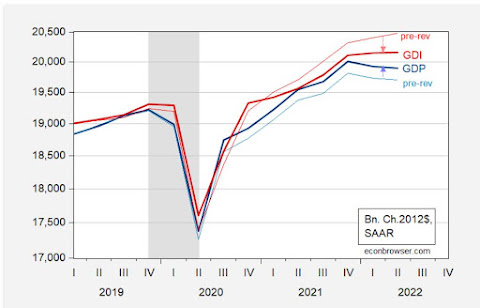
Unlike what some predicted, real GDP still went down by the same amounts that were previously reported for the 1st Half of 2022 (-1.6% in Q1 and -0.6% in Q2). But the growth at the end of 2020 and for all of 2021 was revised higher, so the recovery from the COVID-19 cutbacks was even stronger than we knew. On the flip side, Gross Domestic Incomes (GDI) was revised down, indicating that wage growth wasn't as huge as previously reported.

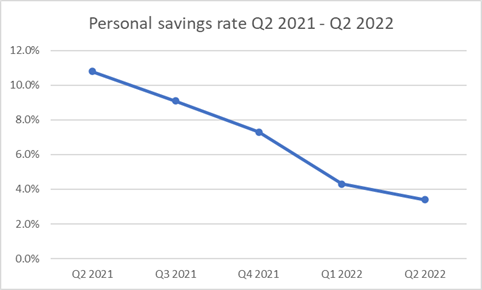
The lower incomes did not translate into less consumer spending, which means that Americans were saving 1/3 of the disposable income that they were saving in mid-2021.

It also looks like the Fed's favored inflation gauge rose by larger amounts in the first 2 quarters than previously known.

PCE price index, Q1-Q2 2022
Q1 2022 +7.5% (+0.4% vs 7.1% original)
Q2 2022 +7.3% (+0.2% vs 7.1% original)

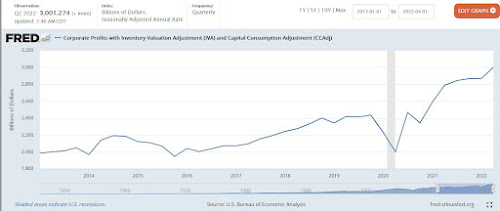
Another effect of the lower incomes and wage growth? Profits were even higher than we knew. Unlike what was previous reported, pre-tax profits were higher in Q1 2022 than they were in Q4 2021.

And then Q2 profits jumped by another 4.6% from that higher Q1 level, reaching $3 trillion on an annual basis.

I got your f***ing inflation right there! Maybe that's what we should try deflating and dampening, instead of having Jerome Powell try to inflict some economic pain on working people.

These figures also make me wonder if the Fed is spending too much time looking at what happened in the past instead of looking at the present situation, and figuring out what their rate hikes will do to the future economy. Which makes me seethe at the end of Q3 2022, as I wonder what's so bad about an economy that is still seeing unemployment claims at 50-year lows.

Wednesday, September 28, 2022

Property values way up in Wisconsin, but property taxes barely budge.

With local budget season underway, the Wisconsin Policy Forum had a timely report this week which showed that property values in the state 2022 blew upward at rates that they'd never seen.
Total property values in Wisconsin grew by a record 13.8% in 2022, marking the largest increase in decades of data, according to a newly released interactive tool from the Wisconsin Policy Forum...

In the seven-county southeast Wisconsin region, overall equalized property values increased by 12.9%, the most for the region in the available data going back to 1985. Every county in the region experienced a double-digit increase in total property values, led by Walworth County at 15.8%.

Dane County overtook Milwaukee County to become the largest in the state in terms of property values. However, the city of Madison still trails the city of Milwaukee in this measure. Total values in the city of Milwaukee grew 11.6% as of Jan. 1, 2022, slightly less than the previous year's growth of 12.3%. Total values in the City of Madison grew by even more at 17.2%, the most since at least 1985.

Residential property values statewide were up 14.9%, the largest increase since at least 1985. Residential values in southeast Wisconsin increased at a slightly lower rate of 13.5%, but also achieved the highest growth rate since at least 1985. In Dane County, residential property grew 14.5%, also slightly below the state average but still the most on record.
But that doesn't mean that people's property taxes are going to blow up by double digits this Winter. That's because Wisconsin limits how much in additional taxes a community can get, and only allows for the rate of growth of NEW CONSTRUCTION, not the houses and office buildings that alreaady exist.

The result of these levy limits was a property tax increase in 2021 of less than 2%, and 2022 probable will repeat that, regardless of the higher prices and home values.

Meanwhile, gross property tax levies approved in late 2021 (for 2022 local government budgets) increased by 1.6% statewide. That was far less than the rate of inflation and the smallest increase since 2014.
The Policy Forum notes that property tax rates fell by nearly 5% last year, the largest drop in 16 years. But it's funny how we don't view that as a tax cut, even though we certainly would call it one if it dealt with income tax or sales tax rates.

Among other things, the Policy Forum's tools allows you to look at your community's and your district's tax levies and how much property values went up in your town for 2022.

The Policy Forum's figures are based on gross tax levies, but doesn't take into account the several ways that number is reduced further before people pay their property taxes. One of those answers came today, as we found how much this Winter's property taxes would be reduced due to ticket sales for the Wisconsin Lottery.

The projected total of the lottery tax credit for this year is $320.7 million, which is down nearly $20 million from 2021's record reduction, but still double what it was 7 years ago.

So while inflation may be blowing up the equity and home values for Wisconsin property owners, it doesn't look like their property tax bills will go up nearly as much. Which is a nice bit of relief for those people, but it also means that schools and communities aren't going to get to reap much of the benefits of their higher property values, and those local governments aren't allowed to add many more resources, even though their costs go up due to inflation and the need to raise wages to keep employees.

That seems like a quandry that needs to be fixed in the next state budget, especially given the $5 billion that is sitting in the state's bank account.